Most advice about walking dogs in summer stops at “avoid the hottest part of the day.” That is true, and it is not nearly specific enough — because the thing that injures your dog is not the air temperature you checked on your phone. It is the ground, and the ground is dramatically hotter.
Here is the gap in one line: at 25°C (77°F) air temperature, asphalt reaches around 52°C (125°F). Burn physiology research puts second-degree burns at roughly five seconds of contact at 60°C. Your dog is walking barefoot across that.
This guide gives you the actual numbers, the test that takes seven seconds, and an honest note about a statistic almost every article on this subject repeats incorrectly.
The gap between air and ground
Dark asphalt is close to an ideal solar absorber. It soaks up radiation all day and re-radiates heat long after the sun drops. The figures below come from Washington State University’s College of Veterinary Medicine:
| Air temperature | Asphalt temperature |
|---|---|
| 25°C / 77°F | 52°C / 125°F |
| 30°C / 86°F | 57°C / 135°F |
| 31°C / 87°F | 62°C / 143°F |
Note how steep that climb is. A 6°C rise in air temperature produces a 10°C rise in surface temperature. The relationship is not linear and it does not forgive.
Independent measurement backs this up. Researchers documenting contact burns recorded asphalt peaking at 59.5°C (138.5°F) and concrete at 53.3°C (129°F) when ambient temperature was around 38°C (100°F) at midday. An earlier study in the same line of research found asphalt and sand peaking near 68°C (154°F) with ambient temperatures of only 35–38°C.
Want the number for today? Our free pavement temperature tool estimates ground temperature from the day’s air temperature so you can check before you leave the house.
How fast a burn actually happens
This is where it stops being abstract. Burn physiology has well-established thresholds — the classic Moritz and Henriques work on how skin responds to heat — and the times are far shorter than people expect:
| Surface temperature | Time to a second-degree burn |
|---|---|
| 44°C / 111°F | 6 hours |
| 50°C / 122°F | 15 minutes |
| 60°C / 140°F | 5 seconds |
| 65°C / 149°F | 2 seconds |
Look at the shape of that curve. Between 50°C and 60°C, the time to injury collapses from a quarter of an hour to five seconds. And 60°C is a surface you reach on an ordinary summer afternoon.
For context, the American Burn Association notes that hot tap water causes third-degree burns in five seconds at 60°C and in one second at 68°C.
WSU’s guidance states plainly that second-degree burns can occur within 35 seconds of contact with hot pavement. A dog crossing a car park is on that surface for longer than that.
The seven-second test
You do not need a thermometer. Dr. Raelynn Farnsworth, who heads the Community Practice Service at WSU’s veterinary teaching hospital, recommends a test anyone can do:
Press the back of your hand flat against the pavement. If you cannot hold it there for a full seven seconds, it is too hot for your dog’s paws.
Use the back of your hand, not the palm — palm skin is thicker and less sensitive, and it will lie to you. Test the surface you will actually walk on, not the shaded patch by your front door.
The reason this test beats a weather app is that it accounts for everything at once: sun angle, cloud cover, surface colour, material, and how long the ground has been baking.
It is not only paws — the heat illness picture
Burned pads are the visible injury. The more dangerous one is systemic.
Dogs cannot sweat meaningfully. They shed heat mainly by panting, and that mechanism has limits that depend heavily on the individual dog. The largest study of the problem — 905,543 dogs under UK veterinary care, published in Scientific Reports — found a case fatality rate for heat-related illness of 14.18%. Roughly one in seven affected dogs died.
The same study identified who is most at risk. Relative to a Labrador Retriever:
- Bulldog — 13.95× the odds
- French Bulldog — 6.49×
- Pug — 3.24×
- English Springer Spaniel — 2.74×
- Golden Retriever — 2.65×
Beyond breed, three factors stood out:
- Flat-faced (brachycephalic) skull shape: 2.10× the odds of a normal-muzzled dog
- Bodyweight over 50 kg: 3.42× — the highest weight category
- Age: dogs 12 years and older carried elevated odds, as did dogs at or above their breed-sex average weight
For flat-faced breeds the picture is worse than the headline. Research on brachycephalic obstructive airway syndrome (BOAS) found around half of pugs, French bulldogs and bulldogs assessed were affected, and that brachycephalic dogs are more vulnerable to heat-related illness even at relatively low ambient temperatures and relatively low activity levels. You cannot make it safe simply by walking slowly.
If that describes your dog, our adventure breeds guide covers which breeds handle heat well and which need a completely different summer plan.
A myth worth correcting
You will see a specific claim repeated across almost every article on this topic: that the asphalt temperature figures come from Dr. Berens, published in JAMA in 1970.
We went to the research to verify it. The 1970 Berens paper is a case series of three patients injured in motor vehicle crashes — it contains no pavement temperature dataset at all. The attribution appears to have been copied from article to article until it acquired the appearance of a citation.
The good news: the numbers themselves hold up. They are supported by WSU’s veterinary guidance and by direct measurement in published contact-burn research. It is only the citation that is wrong. We mention it because a guide that tells you to trust it should be willing to show its own working.
What actually reduces the risk
In rough order of effectiveness:
1. Change when you walk. Early morning is the strongest single move — surfaces have had all night to shed heat. Evening is second best and less reliable, since asphalt holds warmth for hours after sunset.
2. Change where you walk. Grass, soil and shaded natural trail run far cooler than asphalt, concrete, brick or sand. WSU’s advice is simply to walk pets on grass or dirt instead of pavement wherever possible.
3. Carry water and offer it before your dog looks thirsty. Prevention, not rescue.
4. Protect the paws when you cannot avoid the surface. Boots are the direct answer for hot pavement, sharp rock and sand.
Check Ruffwear Grip Trex on Amazon →
One caveat worth knowing: research on dogs wearing boots found that sudden use without prior practice can cause gait changes or distress. Condition them at home first. Our dog boots guide covers sizing, which matters more than brand.
5. Help the dog shed heat. An evaporative cooling vest has actual evidence behind it. In a study of military working dogs exercising in 28–31°C heat, dogs wearing an evaporative cooling vest finished 0.62°C cooler than dogs wearing nothing, and were 0.77°C cooler fifteen minutes after exercise.
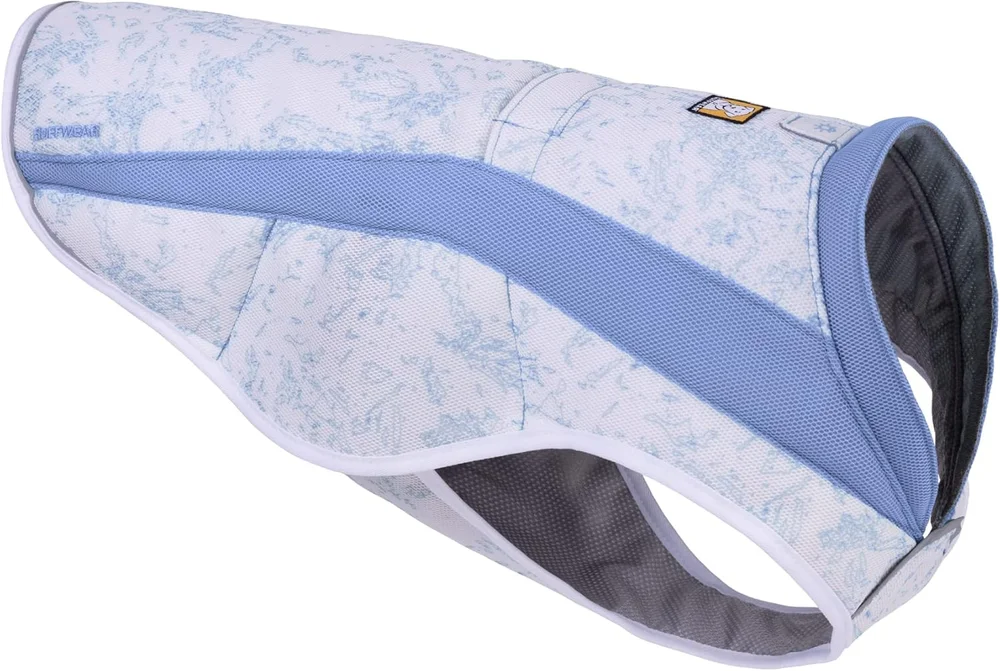
Check Ruffwear Swamp Cooler on Amazon →
Important limitation from that same research: cooling vests are for prevention during exercise, not treatment of heatstroke. A dog in trouble needs a vet, not a vest.
6. Never leave a dog tethered on hot pavement, in a truck bed, or in a parked car. WSU lists the first two explicitly; the third needs no explanation.
Warning signs to stop immediately
The Royal Veterinary College lists these as early signs of heatstroke in dogs:
- Panting, which can progress to distressed or noisy breathing as it worsens
- Restlessness or agitation — pacing, seeking shade or water
- Drooling
- Red gums or tongue
- Increased heart rate
- Vomiting or diarrhoea
And these as advanced stages:
- Lethargy
- Confusion
- Weakness or collapse
- Seizures
The RVC also notes who is most susceptible: overweight animals, flat-faced breeds, pets with thick coats, the very old and very young, and animals with pre-existing airway, lung or heart problems. Critically, they point out it does not have to be “hot” — excessive exercise in warm weather, or a poorly ventilated humid space, is enough.
For pads specifically, WSU advises that suspected burns be seen by a vet promptly — treatment may involve pain relief, wound care, and a collar to prevent the dog licking the injury.
If your dog overheats: cool first, transport second
This section could matter more than everything above it, because the standard advice most owners have absorbed is wrong, and the RVC has said so directly.
For years, first aid guidance told owners to cool a hot dog “slowly,” with “tepid but not cold water.” The RVC’s position is blunt: that advice persists across many websites despite no substantial evidence supporting it. The equivalent myth in human medicine has been dispelled by extensive research showing cold water immersion and evaporative cooling are the most effective treatments.
Their recommendation is a phrase worth memorising: “cool first, transport second.”
The evidence for why urgency matters is stark. A VetCompass study of 945,543 dogs across 886 UK practices found that of the dogs presenting with heat-related illness, only 21.7% had been actively cooled before being taken to the vet. Of those that were cooled, only about a quarter used a currently recommended method — while 51.3% were cooled with wet towels, which the RVC describes as better than nothing but nowhere near as effective as immersion or evaporative cooling.
The RVC’s first aid steps for an overheating dog:
- Move the dog somewhere cool — a well-ventilated area, or use a fan.
- Offer small sips of water. Do not force the dog to drink.
- Cold water immersion is an effective approach for young, healthy dogs.
- Or use the evaporation method: pour water — any temperature cooler than the dog — over them, combined with air movement.
- Seek veterinary advice as soon as possible.
Separate research at the University of Pennsylvania’s Working Dog Center reinforces the point about active cooling. Comparing partial water immersion in a 22°C pool against isopropyl alcohol on the paw pads against simply resting, water immersion cooled dogs fastest — and the dogs left to cool passively actually got hotter, averaging slightly above their starting temperature after a 20-minute rest. Doing nothing is not a neutral option.
Practical translation: get water on the dog immediately, get air moving over the wet dog, then call the vet on the way. Don’t spend the first critical minutes driving with a dry, overheating dog in the back.
None of this replaces veterinary care — it is what you do in the minutes before you get there, and those minutes are the ones that count.
The short version
- The ground runs 20–30°C hotter than the air, and the gap widens as the day heats up.
- Around 60°C causes second-degree burns in about five seconds. You reach 60°C on an ordinary summer day.
- Seven seconds, back of the hand. If you can’t, your dog can’t.
- Walk early, walk on grass, carry water. Boots and cooling vests help; timing and surface choice help more.
- Flat-faced, elderly, overweight and very large dogs need a materially more conservative plan than everyone else.
None of this means summer walks are off. It means the forecast is the wrong instrument. Put your hand down and let the ground tell you.
Sources
- Washington State University College of Veterinary Medicine — Protect your pet’s feet from heat, burns
- “Streets of Fire” revisited: contact burns — pavement temperature measurements and burn thresholds
- Hall EJ, Carter AJ, O’Neill DG. Incidence and risk factors for heat-related illness (heatstroke) in UK dogs under primary veterinary care in 2016. Scientific Reports (2020)
- Liu N-C, et al. Conformational risk factors of brachycephalic obstructive airway syndrome (BOAS) in pugs, French bulldogs, and bulldogs. PLOS One (2017)
- Benito M, Lozano D, Miró F. Clinical Evaluation of Exercise-Induced Physiological Changes in Military Working Dogs Resulting from the Use or Non-Use of Cooling Vests. Animals (2022)
- Changes in Ground Reaction Forces and Center of Pressure Parameters of Paws When Wearing Dog Boots in Dogs
- Royal Veterinary College — The RVC urges owners of hot dogs to “cool first, transport second”
- Royal Veterinary College — Heatstroke in dogs and cats: prevention, symptoms and first aid
- A Randomized Cross-Over Study Comparing Cooling Methods for Exercise-Induced Hyperthermia in Working Dogs in Training — Penn Vet Working Dog Center
- American Kennel Club — How to Protect Dog Paws From Hot Pavement
Frequently asked questions
At what temperature is it too hot to walk a dog?
There is no single air temperature, because the ground is what burns paws and it runs far hotter than the air. Washington State University's veterinary teaching hospital gives useful reference points: at 25°C (77°F) air, asphalt reaches roughly 52°C (125°F), and at 30°C (86°F) air it reaches about 57°C (135°F). Since burn research shows around 60°C causes second-degree burns in about five seconds, surfaces get dangerous well before the air feels extreme.
What is the seven-second rule for dog paws?
Press the back of your hand flat against the pavement and hold it there. Dr. Raelynn Farnsworth of WSU's veterinary teaching hospital puts it simply: if you cannot hold it there for a full seven seconds, it is too hot for your dog's paws. It costs nothing, takes seven seconds, and is more reliable than guessing from the forecast.
Can dogs get burned paws in mild weather?
Yes, and this is the part owners underestimate. WSU's guidance is explicit that burns to a pet's pads can result even in relatively mild temperatures, because dark asphalt absorbs solar radiation and climbs far above air temperature. A pleasant 25°C afternoon can still produce a surface hot enough to injure pads.
Which dogs are most at risk in the heat?
A study of 905,543 UK dogs found flat-faced breeds are especially vulnerable — Bulldogs showed nearly 14 times a Labrador's odds of heat-related illness and French Bulldogs about 6.5 times. Brachycephalic dogs overall had 2.10 times the odds, and dogs over 50 kg had 3.42 times. Older dogs and overweight dogs were also at higher risk. Heat-related illness in that study had a case fatality rate of 14.18%.
What time of day is safest to walk a dog in summer?
Early morning is the safest window, because surfaces have had all night to release heat. Evening is second best but less reliable — asphalt holds warmth for hours after sunset, so a path that feels fine to your shoes can still be too hot for bare pads. Whichever you choose, test the surface rather than trusting the clock.
What should I do if my dog burns its paws?
This is a vet visit, not a home remedy. WSU advises that pets with suspected pad burns should be seen promptly — treatment may involve pain relief, wound care, and a protective collar to stop the dog licking the injury. Get your dog off the hot surface and onto cool ground first, and call your veterinary practice for advice specific to your dog.
Comments
Got a question, a tip, or a correction? Leave a comment — no account, no sign-in. Just your name and your thoughts.
Loading comments…