
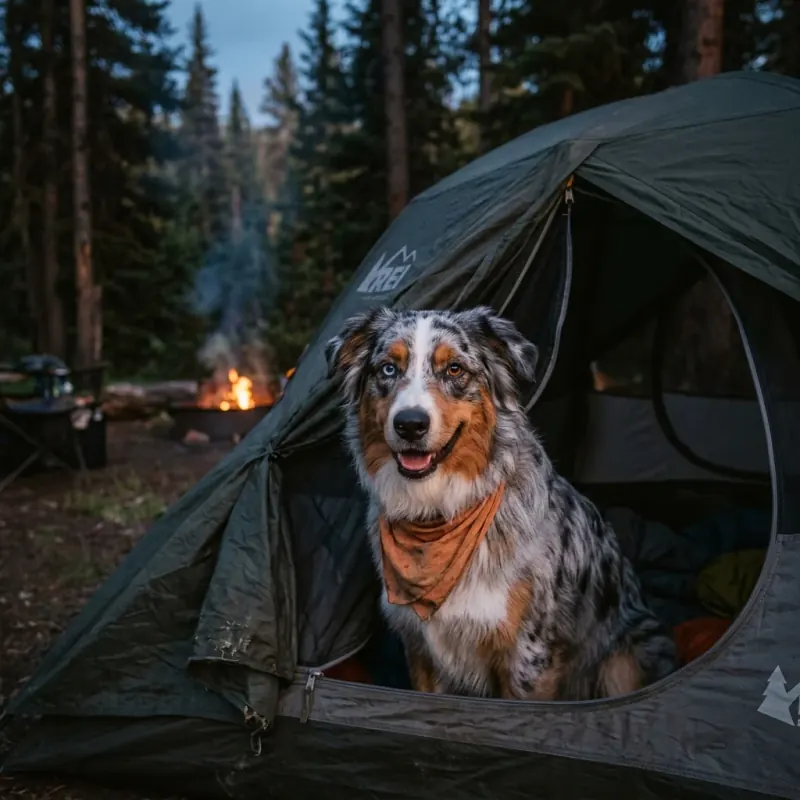
The secret to a smooth first camping trip is that it doesn’t start at the campsite. It starts on your living-room floor, weeks earlier. Camping success with a dog is built at home, not in the wild — and the couples and families whose dogs sleep soundly under canvas almost always ramped up to it in stages.
Here’s the five-step progression that turns “we’ll just wing it” into a dog that curls up and sleeps through the night. Each step lets your dog win before the difficulty goes up. Once you’ve done the ramp-up, our dog camping checklist makes sure you actually pack it all.
Step 1: Pitch the tent in the living room
Before the tent ever sees a trailhead, put it up indoors. Let your dog investigate it on their own terms — no pressure, treats for going near and inside. Feed a meal or two in there. Toss in their bed. You’re teaching one simple lesson: the tent is a safe, normal place, not a weird flapping monster.
Spend a few evenings on this. A dog that already loves the tent at home has nothing to fear when it appears in a strange forest.
Step 2: Sleep out in the backyard
Now move the whole thing outside — same tent, same bed, but with real night sounds, temperature and ground. Do a full dress rehearsal: pad or dog sleeping bag down, evening routine, lights out.
The backyard’s magic is that home is thirty feet away. If it goes sideways at 2 a.m., you walk inside — no harm done, and you’ve learned what to fix. Most dogs surprise their owners here and sleep fine. If yours doesn’t, you’ve just saved a real trip from disaster.
Step 3: Car-camp close to home
Pick an easy, drive-up campground within an hour of home for your first real night out. The short distance is deliberate: it’s your safety net if anything goes wrong.
This is where the day’s rhythm matters. A tired dog is a calm dog — hike, play, and let them explore so that by evening they’re ready to settle. Keep them on a long-line around the site, secure them to a tie-out while you cook, and run your evening routine exactly as you practised. Familiar smells and a predictable sequence do the heavy lifting.
Step 4: Try an easy established campground
Once close-to-home car-camping is boring (that’s the goal), stretch to a proper established campground a bit farther out — with amenities, other campers, and the normal chaos of a shared site. New distractions, same skills.
This is the step where your dog learns to be neighbourly: to settle despite other dogs, kids and campfire commotion, and not to bark the site awake at dawn. Reward calm, redirect the barking, and keep them leashed or tied per the rules.
Step 5: Head into the backcountry
Only now — with a dog that tents happily, settles at a busy site, and recalls reliably — do you take on remote, dispersed or backcountry camping. Out here there’s no ranger, no easy exit and no cell signal, so everything you drilled in steps 1–4 has to be automatic.
Before you go: nail down recall, carry more water than you expect, and think through the full checklist — plus a way to find your dog off-grid, which our GPS tracker guide covers honestly.
The mistakes that cause the 3am drama
- Skipping the ramp-up. A dog’s first-ever night outdoors shouldn’t also be its first night in a tent, in the woods, hours from home. That’s three new things at once.
- An under-tired dog. Energy you didn’t burn during the day comes out at night. Plan the exercise.
- No shade or warmth plan. Dogs overheat in a hot tent and chill on cold ground. Solve both before dark.
- Ignoring recall. The backcountry is the worst place to discover your dog doesn’t come when called. Build it at home first.
- No plan B. Especially on steps 3–4, know your exit. A rough night with an escape hatch is a story; without one it’s a crisis.
The bottom line
Don’t test your dog in the wild — rehearse them at home. Living room, backyard, close car-camp, busy campground, then backcountry. Each step is a small, winnable challenge, and by the time you’re deep in the woods your dog treats the tent like a bedroom. That’s how you skip the 3am drama and actually enjoy the fire.
Sources
Frequently asked questions
How do I get my dog used to camping?
Build up to it in stages instead of starting with a wild backcountry night. Pitch the tent in your living room, then sleep out in the backyard, then car-camp close to home, then try an easy established campground, and only then head somewhere remote. Each step lets your dog succeed before the difficulty rises.
Will my dog sleep in a tent?
Most dogs settle fine once the tent feels familiar — which is exactly why you practise at home first. Bring a bed or pad that smells like home, tire them out during the day, and keep the first nights close to your bail-out option. A dog that's slept in the tent in the backyard rarely panics in the woods.
Is my dog too old or too young to start camping?
Healthy dogs of almost any age can car-camp; the ramp-up matters more than the number. Go gentler with puppies (short outings, no heavy pack, watch temperature) and seniors (extra padding, shorter days). If your dog has a health condition, clear the plan with your vet first.
Comments
Got a question, a tip, or a correction? Leave a comment — no account, no sign-in. Just your name and your thoughts.
Loading comments…