
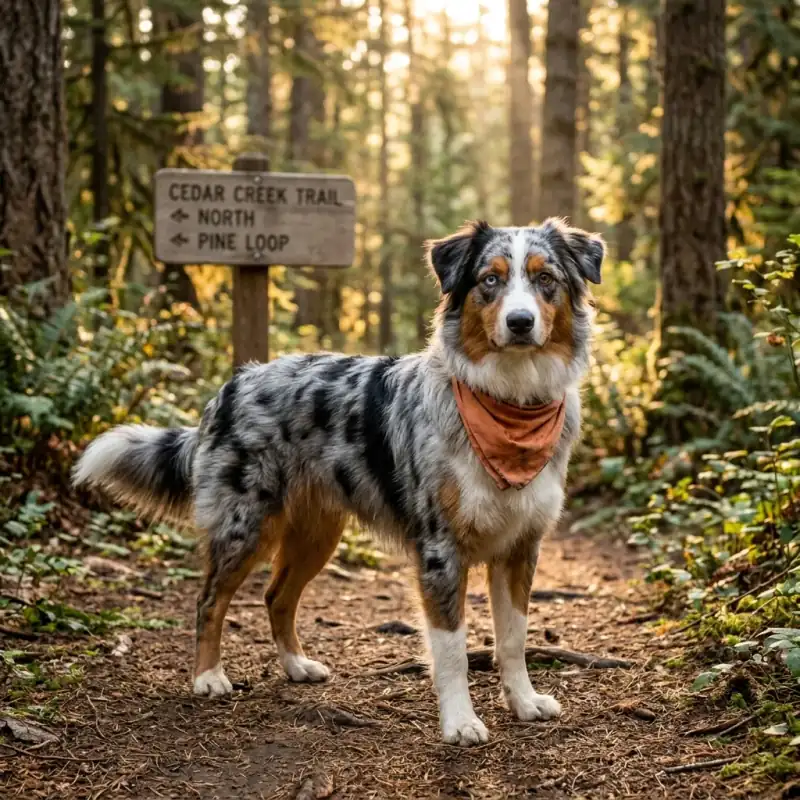
Every great trail-dog photo hides a lot of unglamorous groundwork: the weeks of building fitness, the recall drills in the backyard, the first short hikes that ended before anyone was tired. Hiking with a dog is one of the best things you’ll do together — but the difference between a dog that thrives on the trail and one that gets hurt or ruins everyone’s day is all in the preparation.
Here’s how to start the right way, honestly. It’s less about gear than you’d think and more about fitness, control and trail manners.
Start with a vet-honest fitness plan
Your dog can’t tell you their knee hurts, so you have to be conservative for them.
- Build up gradually. A couch dog doesn’t hike ten miles on day one any more than you would. Start with short, easy walks and add distance and elevation over weeks. Conditioning protects joints, pads and heart.
- Mind your dog’s age. Puppies’ growth plates are still open (roughly until 12–18 months, later in big breeds) — keep their outings short and low-impact. Seniors can hike but need gentler grades and more rest.
- Know your breed’s limits. Flat-faced (brachycephalic) breeds like Bulldogs and Pugs overheat and tire fast; thick-coated northern breeds struggle in heat; light sighthounds feel the cold. Match the hike to the dog you have.
- Watch for “enough.” Excessive panting, lagging behind, lying down, or limping all mean stop. End the hike with your dog wanting more, not wrecked.
Building up: there is no formula, so read the dog
Search for a dog conditioning plan and you will find confident week-by-week mileage tables. Be sceptical of them for the same reason we are sceptical of the famous five-minutes-per-month puppy rule — which, as our puppy exercise guide sets out, is the most repeated number in the English-speaking dog world and has no research behind it. We could not find a validated hiking progression for dogs anywhere either — which does not mean none exists, but it does mean the confident tables are not resting on one. What you can rely on is a sensible structure and a dog who will tell you things if you watch.
Change one variable at a time. Distance, elevation, terrain roughness and carried weight are four separate stresses. Add distance on one outing, add elevation on another. Stack all four at once and when something goes wrong you have no idea which one did it. Rough ground is the one worth watching most carefully, simply because it is the stress people tend not to count at all.
Judge the outing by the next morning, not by the trailhead. Dogs finish enthusiastic almost regardless of what it cost them. The honest readout is whether they get up stiff, sleep flat all of the following day, or are slow off the mark on the next walk. If any of that appears, the last hike was the ceiling — hold there for a couple of weeks rather than progressing.
End every early hike with the dog wanting more. This is the whole method, compressed. Turning round while your dog still has gas is not wasted effort; it is the effort. A dog that gets wrecked once learns that the trail is where they get wrecked.
Let the season pace you. Heat compresses everything. A dog that is comfortable at eight miles in October may be at their limit at three in July — and, as our running guide covers, exercise rather than parked cars is what triggers the overwhelming majority of canine heat illness. Build in the cool months and maintain through the warm ones.
Two hard stops, regardless of progress. Skeletal maturity, if your dog is young — real mileage, elevation and any carried weight wait until the growth plates close, which runs from around 6–8 months in toy breeds out to 14–16 months in large and giant ones. And your vet, if your dog is a senior, is flat-faced, or has any joint or heart history. Neither of those is a build-up you can rush.
Nail recall and trail manners before you go
The trail is the worst place to discover your dog ignores you. Two skills matter most:
- Recall. Practise “come” in low-distraction settings first, then harder ones, long before you rely on it near a cliff, a road or wildlife. If recall isn’t bombproof, your dog stays leashed — full stop. Our full guide to dog recall training covers how to build one properly, and the common mistakes that quietly destroy it.
- Yielding and calm passing. Your dog should be able to sit or step aside while other hikers, dogs, bikes and horses pass. A lunging, barking dog is why some trails ban dogs at all.
Understand the leash rules (they’re not optional)
Most public trails require dogs to be leashed, and the rules exist for good reasons: protecting ground-nesting birds and wildlife, respecting hikers who are nervous around dogs, and keeping your own dog safe from cliffs, porcupines and lost-dog nightmares. Check the specific trail’s rules before you go — national parks are often stricter (many ban dogs on trails entirely) than national forests or local open space.
Even where off-leash is legal, it’s a privilege that depends on recall. A long-line — 15 to 30 feet — is the honest compromise for most dogs: room to explore and sniff, with you still in control.
Disclosure: some links below are affiliate links. If you buy through them we may earn a small commission at no extra cost to you.
Check Long-Line Leashes on Amazon →
Right of way: you are at the bottom of it
This is the piece of trail knowledge that most separates a welcome dog owner from an unwelcome one, and almost nobody arrives knowing it.
The general hierarchy on a shared trail runs one way: bikers yield to hikers and to horses, hikers yield to horses, and when two hikers meet, the one going downhill yields to the one coming up — climbing costs more, so you give the climber their rhythm. Washington Trails Association sets it out that way.
Then there is the line that applies to you specifically: trail users with dogs should yield to all other trail users. Not “usually”. All of them. A dog is an unknown quantity to everyone you meet, and stepping aside is how you prove it is a managed one.
Horses need one extra detail, and it is the part people get backwards. When you yield to a horse, step to the downhill side of the trail if the ground allows, get your dog close and quiet, and talk to the rider. The talking is not politeness — a horse that hears a human voice can place you as a person rather than as something crouching in the brush with a wolf.
None of this costs you anything, and it protects the access you actually have some say over. Some dog bans are habitat decisions taken before any dog showed up and no behaviour reopens them — but the local trail that quietly stopped allowing dogs usually did so because of dogs, or more precisely because of the owners attached to them. Our Leave No Trace guide covers that from the other direction.
The water rule that matters more than giardia
Beginners are told not to let dogs drink from streams because of giardia. Giardia is real, and it is also survivable. The hazard worth actually changing your behaviour for is cyanobacteria — blue-green algae, and it deserves more than the passing mention it usually gets. Blooms are not a summer problem that ends with the heat, either — they can persist into the autumn hazard season.
Cornell’s Riney Canine Health Center describes these as overgrowths of bacteria that produce toxins, and dogs are poisoned by drinking the water or simply swimming in it — a dog that wades and then licks its coat has taken a dose. Cornell’s account of the timeline is that signs can develop rapidly or over several hours, and the list runs from vomiting, diarrhoea, drooling and weakness through to muscle tremors, rigidity, difficulty breathing, seizures and sudden death. Their assessment of the outlook is blunt: many affected dogs do not survive long enough to reach a veterinary hospital, and those that do can be left with chronic liver disease.
Here is the part that should decide how you behave at every lake for the rest of your dog’s life. Blooms can look like blue-green or red-brown scum, mats or foam, and the water may smell of rotting vegetation — but Cornell states there is no way to tell visually whether a particular bloom is toxic or not. You cannot inspect your way to safety.
So the rule is simple and absolute: carry your dog’s water, and treat any discoloured, scummy, foamy or foul-smelling water as off limits. Check local advisories before a lake day. If your dog does get into suspect water, rinse them before they groom themselves and get to a vet — this is not a wait-and-see.
The starter gear (less than you think)
You don’t need a pile of equipment to begin:
- A well-fitted harness. A harness spreads pressure better than a collar for pulling and scrambling. A no-pull design like the Ruffwear Front Range is a solid all-rounder.
- Water for both of you, and a bowl. Don’t rely on streams — giardia and blue-green algae are real. A collapsible bowl weighs nothing.
- Waste bags, packed in and out.
- Paw awareness. Hot rock and rough trail punish pads; a paw balm helps, and you should check paws at the end of each hike.
Once your dog is conditioned and grown, let them carry their own water in a pack — see our dog hiking backpack guide for how to fit one and what load is actually safe.
Respect the trail and the wildlife
Hiking with a dog comes with a responsibility to leave the trail as good as you found it:
- Pack out waste — every time, even in the backcountry. Dog waste isn’t “natural” fertiliser; it spreads disease and disrupts ecosystems.
- Keep your dog on the trail to protect fragile vegetation and nesting wildlife.
- Don’t let your dog chase wildlife. It’s dangerous for them and devastating for stressed animals. In bear country that last point stops being about etiquette: a loose dog can bring a bear back to you, and hiking with dogs in bear country covers the sequence and what the research says about it.
Our Leave No Trace with dogs guide goes deeper — it’s how we keep trails open to dogs at all.
Watch the heat
Heat is the danger beginners underestimate most. Dogs cool far less efficiently than people, and hot ground burns paws. Hike in the cooler hours, carry plenty of water, rest in shade, and learn the early signs of overheating. Our full guide on keeping your dog cool and safe on summer hikes covers this in detail — it’s worth reading before your first warm-weather outing.
Two more things worth checking before you plan a trip. If your dog is under about 18 months, read how much exercise a puppy needs first — the growth-plate question decides when real mileage is safe. And if the plan involves a national park, check whether dogs are actually allowed: most of the famous ones keep dogs within a hundred feet of the car park, while a handful open a hundred miles of trail.
The post-hike check (two minutes, and it is not just paws)
The hike is not over at the car. Dogs conceal discomfort well enough that the things worth catching are usually found by hand rather than reported.
- Paws. Between every toe, not just the pad. Cuts, grit, cracked pads, worn-down nails from rock.
- Grass awns — foxtails. These are the injury beginners have never heard of. The American Kennel Club describes a seed built with backward-facing barbs, so it cannot reverse out: once it catches in fur it only travels inward with every movement. They lodge between toes, in ears, eyes and nostrils, and can migrate far enough to cause serious internal infection. The tells are a swelling between the toes, or a dog that starts sneezing hard, shaking its head or rubbing its face after a walk in dry grass. Run your fingers through the coat, check the armpits and the ear folds, and brush or tweeze off the seeds you can see before they embed — that is the AKC’s advice. Anything already lodged in swollen or reddened skin is a vet job, not a tugging job.
- Ticks. Same sweep, and worth doing in good light rather than in the boot of the car.
- Gait. Watch them walk away from you the next morning. Stiffness that was not there yesterday means yesterday was too much — which is information, not failure.
Do this after every hike for the first few months and you will learn your dog’s normal, which is what makes the abnormal obvious later.
The bottom line
Start slow, build fitness, drill recall, learn the rules, and pack light. Do that and hiking becomes the thing your dog lives for — and you become the owner other hikers are glad to share the trail with. The summit photo will come. Earn it first with the boring, important groundwork.
Sources
- American Kennel Club — Hiking With Your Dog
- Leave No Trace — Enjoying the outdoors with pets
- Washington Trails Association — Right-of-Way on Trail — the yielding hierarchy, and where dog handlers sit in it
- Cornell Riney Canine Health Center — Blue-Green Algae Poisoning (Cyanobacteria Toxicosis) — onset, signs, prognosis, and why blooms can’t be judged by eye
- American Kennel Club — Foxtails: Why They’re Dangerous to Dogs — grass-awn migration and what to check after a walk
Frequently asked questions
How far can a dog hike?
It depends entirely on breed, age, fitness and heat — there's no single number. A conditioned adult dog can handle a long day hike, but you build up to that over weeks, just like you would. Puppies need much shorter outings to protect growing joints, and flat-faced or senior dogs have real limits. Start short, watch for tiredness, and add distance gradually.
Do I need to keep my dog on a leash while hiking?
On most public trails, yes — leash rules exist to protect wildlife, other hikers and your dog. Even where off-leash is legal, it's only appropriate with rock-solid recall. A long-line is a good middle ground: freedom to sniff and explore while you stay in control.
How do I train my dog for hiking?
Train three things before distance: recall, so your dog comes back the first time you call under distraction; loose-lead walking, because a dog that pulls for six miles ruins the day for both of you; and a reliable "leave it" for the wildlife, carrion and dropped food a trail is full of. Then build fitness gradually — a dog that walks 20 minutes a day is not ready for eight miles, however willing they look at the trailhead.
At what age can a puppy go hiking?
Short, flat, gentle walks are fine early, but save real hiking — distance, elevation, rough ground and any carried weight — until growth plates have closed. That is roughly 6–8 months in toy and miniature breeds and as late as 14–16 months in large and giant breeds, with the overall range running from about 6 to 24 months. Big breeds are the ones people push too early, because a nine-month-old Labrador already looks fully grown. Check the timing with your vet.
Who has right of way on a trail when you have a dog?
You do not. Washington Trails Association puts it plainly: trail users with dogs should yield to all other trail users. The wider hierarchy is that bikers yield to hikers and horses, hikers yield to horses, and among hikers the one going downhill yields to the one coming up. When you yield to horses, step to the downhill side of the trail if conditions allow, keep the dog close and quiet, and speak to the rider so the horse can place you as a person rather than a predator.
Can my dog drink from streams and lakes on a hike?
Carry water instead. Beyond giardia, the serious risk is a harmful algal bloom — cyanobacteria, commonly called blue-green algae. Cornell's Riney Canine Health Center notes dogs are poisoned by drinking or swimming in affected water, that signs can develop rapidly or over several hours, and that the outlook is poor enough that many affected dogs do not survive to reach a veterinary hospital. The part that decides your behaviour: there is no way to tell visually whether a given bloom is toxic. Treat any discoloured, scummy, foamy or foul-smelling water as off limits.
What should I bring hiking with my dog?
At minimum: water and a bowl for both of you, a well-fitted harness and leash (or long-line), waste bags, and paw awareness for hot or rough ground. On longer or remote hikes, add a small dog first-aid kit and a way to locate your dog if they bolt. Let a conditioned dog carry its own water in a pack.
Comments
Got a question, a tip, or a correction? Leave a comment — no account, no sign-in. Just your name and your thoughts.
Loading comments…