
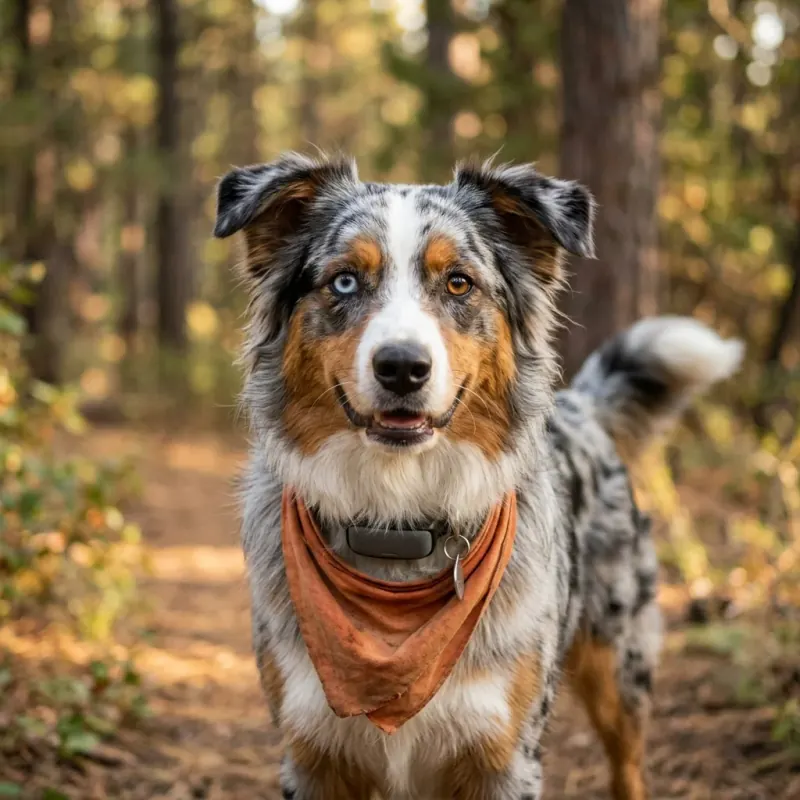
Here’s the honest verdict most roundups bury: for a dog that hikes and camps with you, the single most important spec isn’t range or battery life — it’s whether the tracker works when your phone shows no bars. Almost every “best GPS tracker” list quietly ignores this, because the trackers that top those lists (Fi, Tractive) stop working the moment you leave cell coverage — which, on a real trail, is most of the time.
So this guide is organized around one question: where do you actually take your dog? Get that right and the choice makes itself. Get it wrong and you’ll pay for a tracker that goes dark exactly when your dog disappears over a ridge.
Quick pick by where you hike
If you only read one section, read this:
- Neighbourhoods, dog parks, campgrounds with a bar or two of signal → a cellular tracker. Tractive for value, Fi for activity data.
- Real backcountry, no service, dog ranges far → a VHF Garmin Alpha system. The only thing here that keeps working with zero infrastructure.
- Fast updates for a far-ranging dog, but you still have coverage → Garmin Alpha LTE. No handheld, updates every 10 seconds.
- Cheap backup for the occasional around-town escape → an Apple AirTag, understood for exactly what it is.
The rest of this guide explains why — because the reasoning is what stops you buying the wrong one.
The three technologies (this is the whole game)
Every dog tracker on the market uses one of three ways to tell you where your dog is. The marketing rarely spells out which — but it decides everything.
| Technology | How it finds your dog | Works with no cell signal? | Real range | Ongoing cost |
|---|---|---|---|---|
| Cellular (LTE) | Collar has GPS, then uses the phone network to send the location to your app | ❌ No — no tower, no update | Unlimited (where there’s coverage) | $99–$189/yr |
| VHF radio | Collar transmits its GPS position straight to a handheld over radio | ✅ Yes — no network involved | ~1–9 miles line-of-sight | None |
| Bluetooth crowd-network (AirTag) | No GPS; borrows the location of nearby phones | ⚠️ Only if strangers’ phones are nearby | ~30 ft to nearest phone | None |
That’s the entire decision in one table. Cellular is brilliant in town and useless in a canyon. VHF is the opposite. AirTags are neither — they’re a city tool wearing a hiking costume.
Why cellular trackers fail off-grid (the part nobody explains)
A cellular tracker like Fi or Tractive has a real GPS chip, so it always knows where your dog is. The problem is telling you. It does that over the LTE network — the same towers your phone uses. Independent testers are blunt about the consequence: if you hike where cell service is unreliable, “no signal means no location update.” The collar sits on your dog’s neck knowing its exact coordinates and unable to send them anywhere.
This is why a tracker can advertise “unlimited range” and still be worthless in the backcountry. Unlimited range only means unlimited cellular range. Step outside coverage and the range is zero. Worse, the failure is invisible until the emergency: the app shows your dog’s last known position — a stale dot from the trailhead an hour ago — with no warning that it stopped updating.
For most dog owners this is a fine trade. If you walk neighbourhoods, visit dog parks, and camp at established campgrounds with a bar or two of signal, a cellular tracker is the best value going — cheap hardware, long battery, and useful activity data. It’s only “the best tracker” until the towers run out.
The trackers worth buying in 2026
Tractive Dog 6 — best value for dogs that stay in coverage
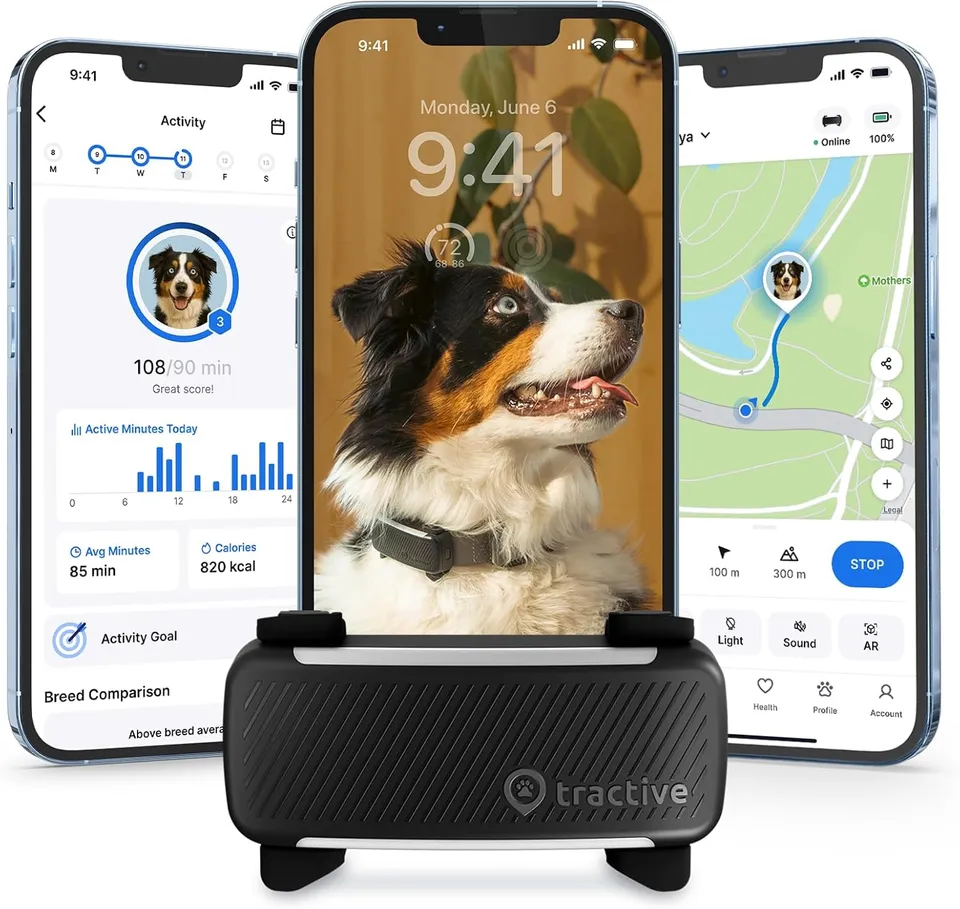
The Tractive is the value benchmark: around $79 for the hardware and roughly $108–$120/year for the plan. It rides on LTE with satellite-assisted positioning, so its “range” is anywhere there’s a signal — genuinely global, which is handy if you travel. Independent testers measured about 25 days of battery against an advertised 14, so the real-world life comfortably beats the box. There’s an XL version for large dogs with even longer runtime.
It does everything a town-and-campground dog needs: live tracking, escape alerts when your dog leaves a set zone, and activity history. Just remember the ceiling — the moment you’re out of coverage, it’s a stylish paperweight. Buy it if your adventures rarely leave cell service.
Disclosure: some links below are affiliate links. If you buy through them we may earn a small commission at no extra cost to you.
Check Tractive GPS on Amazon →
Fi Series 3+ — best for activity data and escape-artist dogs
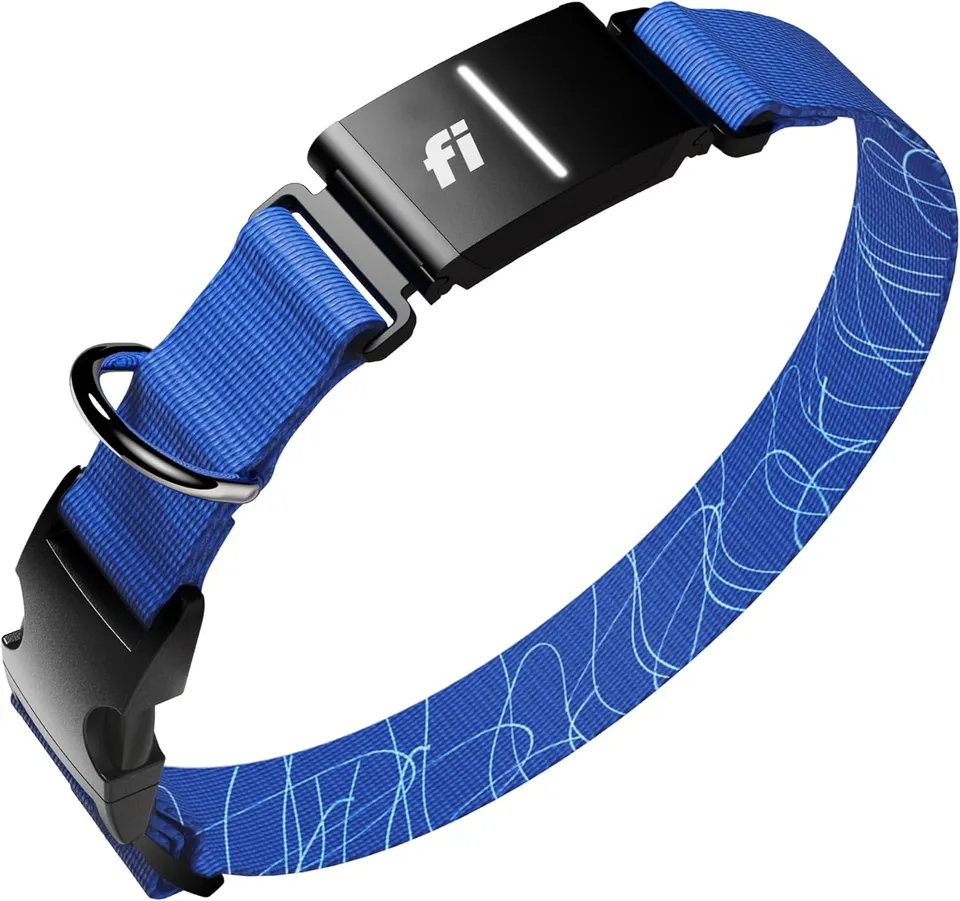
Fi plays the same cellular game as Tractive but leans into fitness and durability. It runs on AT&T’s LTE-M network, and testers reported an enormous ~10 weeks of battery on a charge — the standout number in the category. Plans run $99–$189/year depending on term.
Where Fi pulls ahead is the data: it automatically logs walks, distinguishes a car ride from real activity, and tracks sleep, which is genuinely useful for a working breed you’re trying to tire out. Its escape-detection and rugged, chew-resistant build make it a favourite for dogs that treat fences as suggestions. Same caveat as every cellular unit: no signal, no location. Buy it if you’re US-based, want activity and sleep tracking, and mostly stay in coverage.
Garmin Alpha (VHF) — the only true off-grid answer
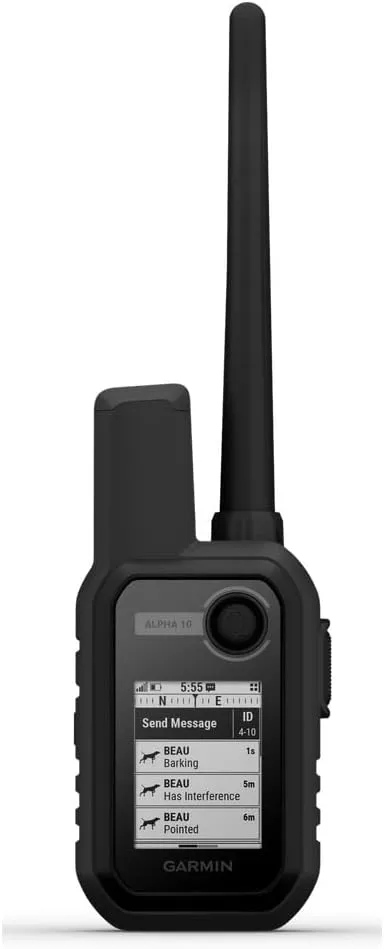
This is the one that changes the conversation. A Garmin Alpha system — a collar unit paired with a handheld like the Alpha 10 — doesn’t touch the phone network at all. The collar reads its position from GPS satellites and then broadcasts it straight to the handheld in your hand over MURS VHF radio, updating roughly every 2.5 seconds. No towers, no subscription, no dependence on anyone else’s infrastructure.
The honest numbers:
- Range: Garmin rates it at 9 miles, true across flat, open country with line of sight. In timber and rolling hills — most hiking terrain — owners report a realistic 1–3 miles. Still far more than you’ll ever need, and it works where nothing else does.
- Battery: around 40 hours on an Alpha 10 handheld and roughly 68 hours on collar units, extendable with a battery pack. A long weekend, not a whole week.
- Tracks up to 20 dogs at once, which is why hunters and working-dog handlers live on this system.
- Subscription: none, ever.
- The catch: you need the handheld. A collar-plus-handheld setup starts around $300 and climbs from there — the real reason it costs “twice the price” of a cellular tracker. You pay once, upfront, to never depend on a tower again.
Buy it if you genuinely hike or hunt in no-service country and your dog ranges off-leash. It’s the only category on this list that will still find your dog at a mile out with no bars on your phone.
Check Garmin Alpha on Amazon →
Garmin Alpha LTE — the middle ground
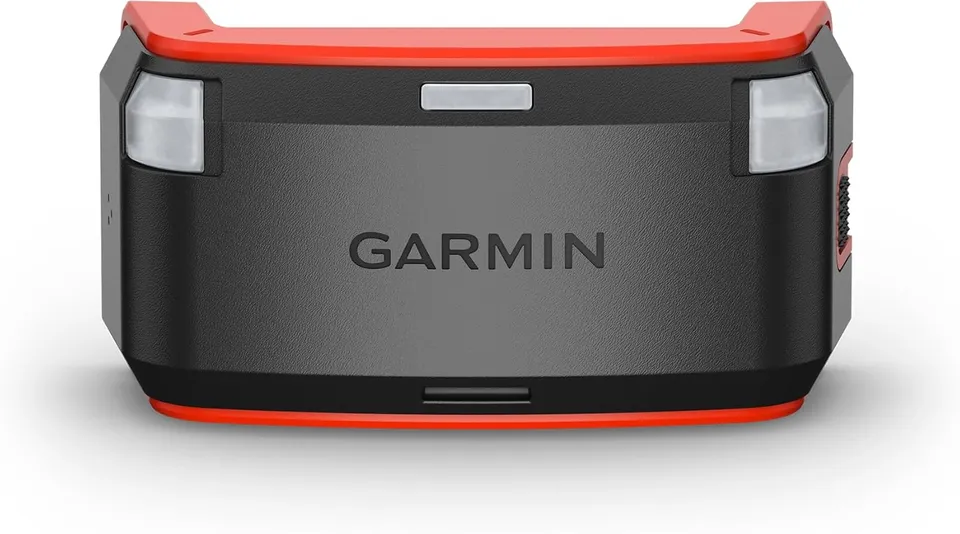
Garmin also makes a cellular version, the Alpha LTE — around $299 plus a $50/year plan. It ditches the handheld (your phone is the screen) and updates as often as every 10 seconds in active mode, which is superb for a fast, wide-ranging dog. The trade-off is that it’s back on the cellular network (AT&T and T-Mobile), so it needs LTE coverage like any other cellular tracker, and battery life drops to around 32 hours when it’s updating aggressively.
Think of it as the pick for a hard-charging dog in areas that still have signal — someone who wants Garmin’s responsiveness and doesn’t want to carry (or pay for) a handheld, and who isn’t regularly in dead zones.
Check Garmin Alpha LTE on Amazon →
Apple AirTag — the honest anti-recommendation
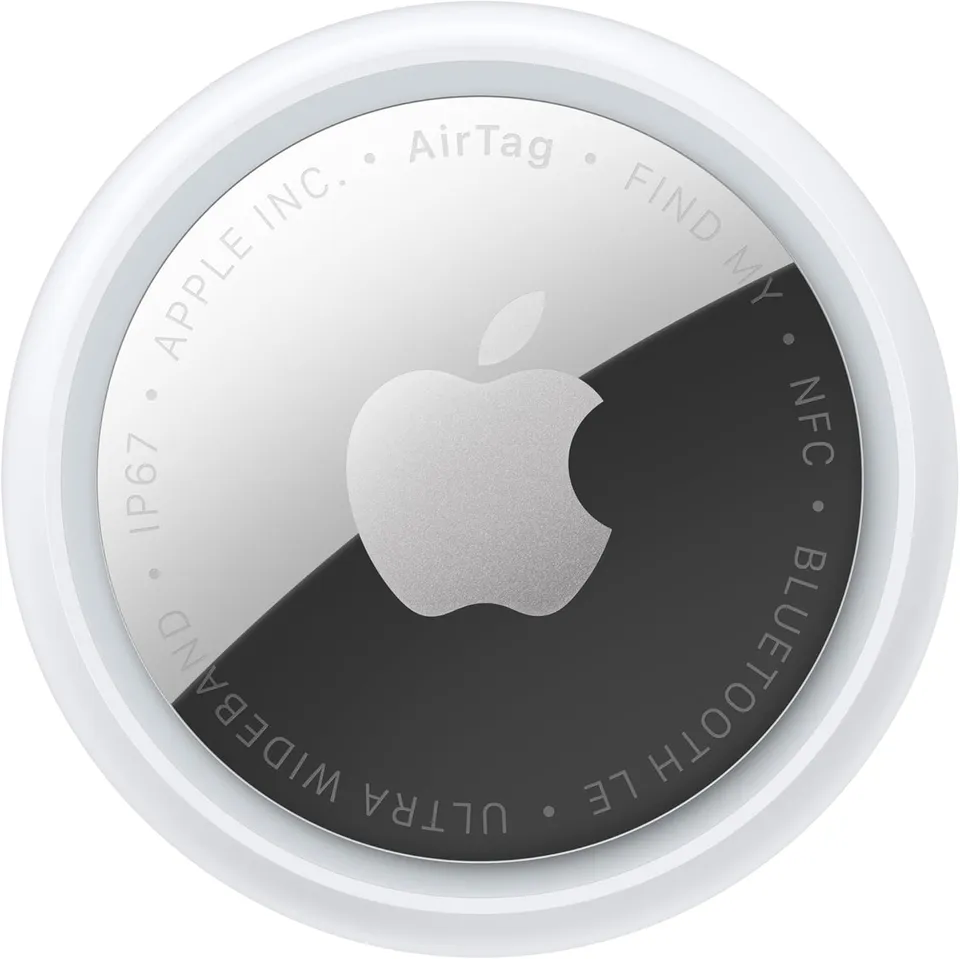
An AirTag is $29, and for the right job it’s genuinely useful — but hiking is not that job. An AirTag has no GPS. It’s a Bluetooth beacon that leans on Apple’s Find My network: it whispers its ID to any nearby iPhone, and that phone quietly reports the location back to you. In a city, thousands of iPhones make this feel like magic.
On an empty trail there are no iPhones to hear it. The moment your dog is more than about 30 feet from you — and you’re the only phone around — the AirTag has nothing to talk to. It’s not a weak hiking tracker; it’s the wrong tool entirely. Keep one on the collar as a backup for the “slipped the leash in the parking lot” scenario, and never rely on it past the trailhead. We pulled the AirTag apart on its own terms elsewhere — exactly where it works for a dog and where it doesn’t, including the collar-safety issue vets keep flagging.
Check Apple AirTag on Amazon →
Buyer’s guide: how to actually choose
Match the technology to the terrain — everything else is secondary
You’ve heard it three times now because it’s the whole point. Before you compare battery numbers or app features, answer one question honestly: where does my dog actually run off-leash? If the answer includes places your phone loses signal, no cellular tracker — however highly reviewed — will do the job. Sort by technology first, then optimise within the right category.
Battery life: read the tested number, not the box
Advertised battery life assumes gentle use. Real life is colder, wetter, and hungrier for updates — cold weather alone can cut lithium battery life noticeably, and every tracker drains far faster in a live “show me every few seconds” mode than in passive check-ins. The good news is that reputable testers have found real-world life often beats the advertised figure on cellular units (Tractive and Fi both over-delivered). VHF systems are the opposite: plan for a couple of days, and carry a way to recharge on multi-night trips.
Weight and fit for your dog
A cellular tracker clips onto an existing collar and adds about an ounce — a non-issue for any dog over roughly 10 lb. VHF collars are bigger and heavier because they carry a radio and a larger battery, so they’re best on medium and large dogs. You’ll see percentage-of-body-weight limits quoted for the whole collar, but none we found traces to a source. What matters is fit: the collar should ride high on the neck without sliding. For a deep-chested or double-coated breed, check that the tracker housing sits flat against the fur and doesn’t snag.
Waterproofing and durability are non-negotiable
Trail dogs swim, wade, and roll in things. Any tracker you take outside should be genuinely waterproof (look for an IP67 rating or better), not merely “water-resistant,” and the housing should survive being dragged through brush and rock. This is one area where the cheapest no-name trackers cut corners — a sealed, rated unit is worth the extra.
Do the subscription maths over three years
A $29 tracker with no fees and a $300 tracker with no fees look worlds apart until you add time. A cellular tracker at ~$120/year costs about $360 in fees over three years on top of the hardware — which quietly closes the gap with a no-subscription VHF system. If you’re buying for the long haul and hike off-grid, the “expensive” Garmin can be the cheaper choice by year three.
What kind of trips you take changes the answer
- The evening neighbourhood walk and the occasional dog-park bolt → an AirTag or a basic cellular tracker is plenty. You’re never far from phones and towers.
- Weekend car-camping at established campgrounds → a cellular tracker (Tractive or Fi). There’s usually enough signal, and you get activity data as a bonus.
- Day hikes into patchy-coverage country → this is the honest grey zone. A cellular tracker will work until it doesn’t. If your dog has rock-solid recall and stays close, you can risk it; if your dog ranges, step up to Garmin Alpha LTE (if there’s any coverage) or a VHF system (if there isn’t).
- Multi-day backcountry and true off-grid, dog off-leash → a VHF Garmin Alpha, full stop. It’s the only setup that keeps working when the map goes blank, and it doesn’t need a charger it can’t reach.
The other location leak: your own photos
Worth saying in an article about knowing where your dog is, because it runs the other way. Your phone writes GPS coordinates into every photo it takes — accurate to a few metres. A hundred photos of your dog in the garden is a hundred copies of your home address, sitting inside the files.
Most of the time it doesn’t matter: Instagram, Facebook and X strip that data when you upload, so a normal social post is safe. It’s everywhere else that keeps it — a photo emailed to a breeder or a buyer, sent on WhatsApp as a document, uploaded to a rehoming listing or a breed forum, or posted on your own site. Those all carry the coordinates through untouched.
If you’re selling a puppy, listing a dog, or posting to a forum full of strangers, it’s worth ten seconds. Any EXIF viewer will show you what’s hidden in a photo — location, device, timestamp — and strip it; pick one that works in the browser rather than uploading the picture somewhere to be cleaned. We run a browser-based one ourselves — disclosure: it is our own site, not a recommendation we were paid for, and there are plenty of alternatives.
The short version
The mistake that costs dogs isn’t buying a cheap tracker — it’s buying a cellular tracker because it topped a list, then carrying it somewhere the list never accounted for. A tracker that can’t call home is just a weight on your dog’s collar.
So skip the star ratings and answer the only question that matters: do you hike where there’s signal, or not? If yes, a Tractive or Fi is excellent and affordable. If no, a VHF Garmin Alpha is the only thing here that will actually find your dog — and over a few years, the “expensive” one is often the smarter buy. Match the tech to the terrain and any of these will do its job.
A tracker is one layer of the kit, not the whole thing. The rest of it: a crash-tested harness for the drive to the trailhead, a pack sized to your dog, and — if you’re buying this for someone else — which dog gear actually lands as a gift.
Trackers are also the category that discounts hardest in November, which is a mixed blessing: a hardware saving does nothing about the subscription, and the subscription is most of the cost. Dog gear on Black Friday works through that trap and the categories where the saving is real.
Sources
- Treeline Review — 7 Best GPS Dog Collars of 2026 (Tested)
- Garmin — Alpha LTE Sporting Dog Tracker
- Garmin — Alpha 100 GPS Dog Tracker (VHF system overview)
- Gun Dog Supply — Garmin Alpha LTE vs VHF systems
Frequently asked questions
Do GPS dog trackers work without cell service?
Most don't. Popular trackers like Fi and Tractive rely on the cellular network — no signal means no location update. The only trackers that genuinely work off-grid are VHF radio systems (like the Garmin Alpha), which talk directly from the collar to a handheld device and need no towers at all. Satellite messaging trackers are a third option but update slowly.
Do AirTags work for tracking a dog on a hike?
Not for an off-leash trail dog. An AirTag has no GPS — it borrows the location of nearby iPhones through Apple's Find My network. On a busy street that's fine, but on an empty trail there are no iPhones to relay the signal, so the tag goes dark exactly when you need it. Great for a dog that slips its leash in town; useless in the backcountry.
Is a monthly subscription worth it for a dog GPS tracker?
If you hike where there is cell coverage, yes — cellular trackers like Tractive cost under $120/year and give unlimited range plus activity tracking. If you hike where there is no coverage, a subscription buys you nothing, because the tracker can't connect. That's when a no-subscription VHF system earns its higher upfront price.
What is the best GPS tracker for a dog that runs far off-leash?
For a wide-ranging dog in areas with cell coverage, the Garmin Alpha LTE updates every 10 seconds and needs no handheld. For a dog that ranges far in genuine backcountry with no signal, a VHF Garmin Alpha system (collar plus handheld) is the only thing that will still find them at a mile out.
How much does a dog GPS tracker weigh, and is it safe for the collar?
Cellular trackers are small — most clip to an existing collar and add roughly an ounce, fine for any dog over about 10 lb. VHF collar units are bigger and heavier because they house a radio and a larger battery, so they suit medium and large dogs. You will see percentage-of-body-weight limits quoted for the whole collar, but none we found traces to a source; what matters is that the unit sits flat and rides high on the neck without sliding.
How accurate are dog GPS trackers?
Under open sky, most modern trackers land within a few metres of your dog, which is close enough to walk right to them. Accuracy drops under heavy tree canopy, in deep canyons, and against tall rock, where GPS signals scatter — the same places cell coverage also disappears. That overlap is exactly why terrain, not the spec sheet, should drive your choice.
Comments
Got a question, a tip, or a correction? Leave a comment — no account, no sign-in. Just your name and your thoughts.
Loading comments…