
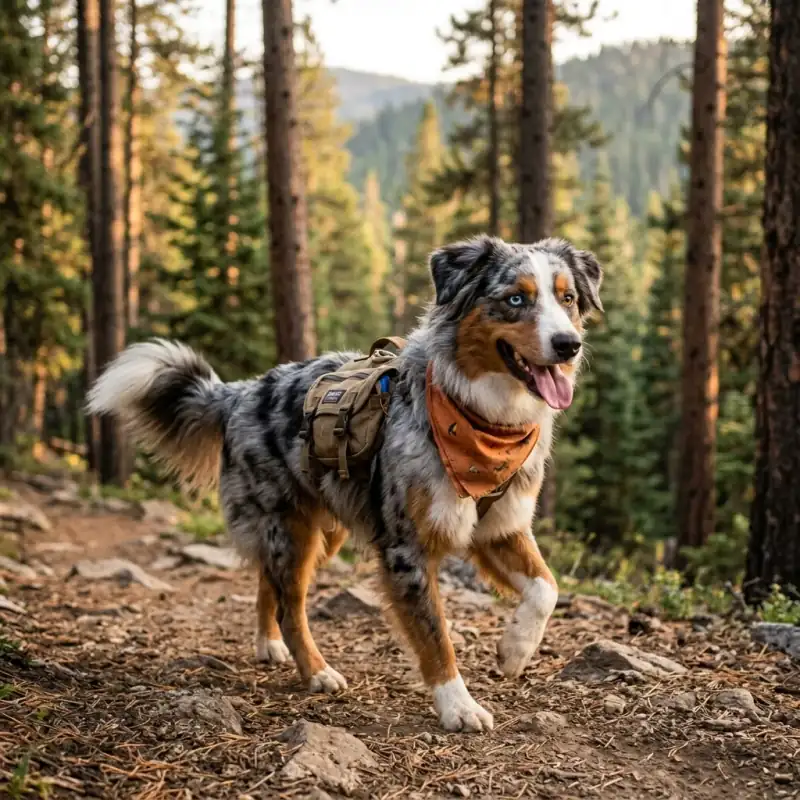
There’s a particular kind of dog — the one that finishes a five-mile hike looking for more — that a hiking pack transforms. Give that dog a pack and a job to do and something clicks: the pace steadies, the focus sharpens, and you both get more out of the trail. A dog pack lets your dog carry its own water and gear, and turns restless energy into purposeful work.
But a dog backpack is also one of the easier ways to quietly hurt a dog if you get the load or the fit wrong — and the weight rule most gear sites repeat is more generous than the evidence supports. So this guide covers both halves: the three hiking packs actually worth buying, and the load-and-fit rules that keep the pack a benefit instead of an injury.
Quick pick
- Best overall: Ruffwear Approach — the benchmark, and the one pick both independent field tests agree on.
- Best for multi-day: Ruffwear Palisades — removable saddlebags so your dog is unloaded at camp. Named best multi-day pack by both testers.
- Best affordable: Wilderdog — light, water-resistant, and the budget pack that actually tested well.
- Most adjustable: Mountainsmith K-9 — good harness, one design flaw worth knowing about first.
- Skip unless you have a reason: Kurgo Baxter — see below; one tester rates it best value, the other tested it and didn’t recommend it.
How these picks were chosen
We don’t field-test packs ourselves; two independent outfits have, and we’ve deferred to their results rather than to brand reputation. Treeline Review has tested 17 packs over six years with seven dogs from 20 to 98 lb, across 300+ trail miles including the Tahoe Rim and Chinook Trails. CleverHiker has run 15 packs past 1,000 miles with three primary testers.
Where they agree, we say so. Where they disagree — and on the Kurgo Baxter they flatly do — we show you the disagreement instead of picking the answer that reads more cleanly.
| Pack | Capacity | Fits | Verdict | Price |
|---|---|---|---|---|
| Ruffwear Approach | 6–24 L | 17–42″ chest | Best overall — top pick in both tests | Check price → |
| Ruffwear Palisades | 12.5–24 L | 22–42″ chest | Best multi-day — bags detach at camp | Check price → |
| Wilderdog Backpack | 5–12 L | 17–34″ chest | Best affordable — Treeline’s budget pick | Check price → |
| Mountainsmith K-9 | 3–18 L | 20–44″ chest | Most adjustable — but check the D-ring | Check price → |
| Kurgo Baxter | 3.75–7.5 L | to 110 lb (Big Baxter) | Split verdict — read before buying | Check price → |
| OneTigris Mammoth | ~3 L/side | S–L | Durable, but no independent test found | Check price → |
First, the rule that matters most: load
Before any product, understand the load, because it’s where most owners go wrong — usually by trusting a percentage more than it deserves.
You’ll see “10–25% of body weight” quoted everywhere, usually as if it came from a vet. We couldn’t find a veterinary source for it. The figures come from gear testers, and neither of the two independent teams we rely on cites a study. The research that does exist is a single controlled study, and it only reaches the bottom of that range.
What the one study found. In 2025, a University of Liverpool team working with the UK’s Defence Science and Technology Laboratory had working Labradors, shepherd breeds and spaniels trot while carrying sand-weighted bags either side of the back at 10% of body mass, or a tube along the spine at 5% or 10%. The loads changed how the dogs moved, and not in the same way. The shepherds changed their speed and stride the most, and both they and the Labradors slowed down. The spaniels kept their pace but bent their joints further to do it, which the authors suggest may cost them in muscle force and joint load. Their conclusion is that one breed’s response doesn’t predict another’s, even between breeds of similar build. These were trotting trials, not a day on the trail — fatigue and energy cost are left for future work — and no study we could find has put more than 10% on a dog’s back.
| Figure | Who says it | What’s behind it |
|---|---|---|
| 5–10% | The Liverpool study’s test loads | Measured: gait changed under load, differently by breed |
| About 10% | CleverHiker, for most dogs and any dog starting out | Field testing; no study cited |
| 10–15% | Treeline, for most dogs | Field testing; no study cited |
| Up to 25% | Treeline for “extremely well conditioned” dogs; CleverHiker as the most an average dog should carry | Field testing; no study cited |
Here’s how we’d use that. Build a grown, conditioned dog up toward 10% of body weight, pack included, and treat 15% as the ceiling. 10% sits inside both testers’ advice for most dogs and is the most anyone has measured on a dog’s back; 15% is the top of Treeline’s range. Past it, you’re relying on the testers’ judgement alone. Senior dogs and any dog with joint or health concerns carry nothing — more on that below. Puppies carry nothing until their growth plates close: an empty pack only.
Three things people forget:
- The pack counts. A 2 lb pack on a 50 lb dog is already 4% of body weight — two-fifths of a 10% load — before you put anything in it. Weigh the loaded pack, not the contents.
- Growth plates close later than you think, and it varies by size. Toy and miniature breeds are typically done around 6–8 months; large and giant breeds can stay open until 14–16 months, with the full range across dogs running from roughly 6 to 24 months. Big dogs are the ones people load too early, because they look grown at nine months.
- Terrain changes the math. The same load is a different job on a flat forest path than on a steep, rocky scramble where the dog is jumping and bracing. Drop the weight when the ground gets technical.
Build up over weeks, never on day one. Start with an empty pack so the dog adjusts to the bulk, then add a small amount, then a little more each outing. Water is the ideal first cargo — it’s useful, and the load lightens as your dog drinks.
Which dogs should skip a pack entirely
A hiking pack is not universal equipment. Leave it at home for:
- Puppies, until growth plates close (see above).
- Senior dogs, and any dog with hip, elbow, or spinal issues. The pack adds both weight and a small constant balance correction, and arthritic dogs pay for that. Dropping the pack does not mean dropping the trail — our guide to hiking with a senior dog covers what to change instead.
- Brachycephalic (flat-faced) breeds — pugs, bulldogs, boxers. These dogs are already working hard to breathe and to dump heat; a pack makes both harder.
- Any dog on a hot day. Covering the back and flanks reduces the surface a dog uses to shed heat. Our guide to keeping a dog cool on summer hikes covers this in detail, and the pavement and air-temperature numbers are worse than most owners assume.
- Dogs that aren’t fit yet. If you’re not sure where your dog sits, our guide to how much exercise a dog actually needs is the place to start.
If your dog is in one of these groups, you carry the gear. That’s not a compromise — it’s the correct answer.
The dog hiking packs worth buying
Ruffwear Approach — best overall
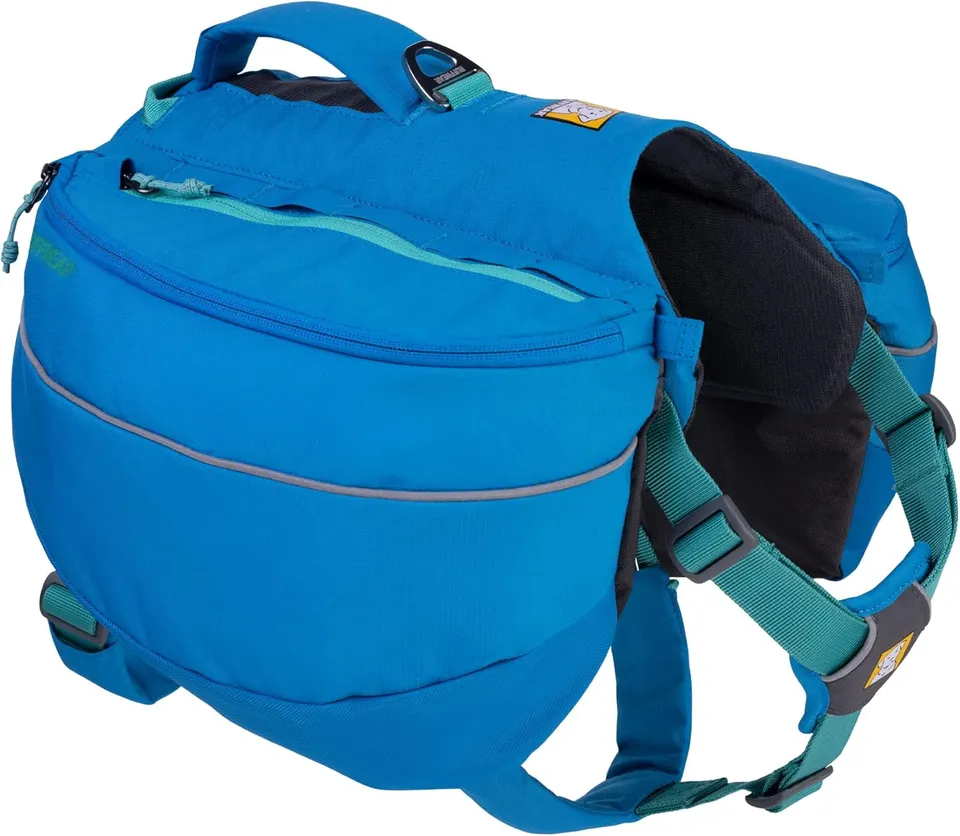
The Ruffwear Approach is the dog pack most experienced hikers land on, and for good reason. Its integrated harness and five adjustment points dial in a stable, no-slip fit, and the weight-forward saddlebags keep the load over the dog’s shoulders — the position that least disturbs their gait.
Interior pockets sit close to the body for heavier items like water and food, so the pack stays balanced and bounce-free even on rock scrambles and tight, brushy trail. A “flopper stopper” strap stops the saddlebags swinging, which is the failure mode that makes cheap packs miserable over a long day. It’s light, genuinely durable, and reflective for low light.
If you want one hiking pack to buy and stop thinking about, this is it.
Disclosure: some links below are affiliate links. If you buy through them we may earn a small commission at no extra cost to you.
Check Ruffwear Approach Pack on Amazon →
Kurgo Baxter — the split verdict, and why we changed ours
An earlier version of this guide called the Baxter our best-value pick and the answer for big dogs. Having gone back through the two field tests we cite, that recommendation was stronger than the evidence behind it, so here’s the honest picture.
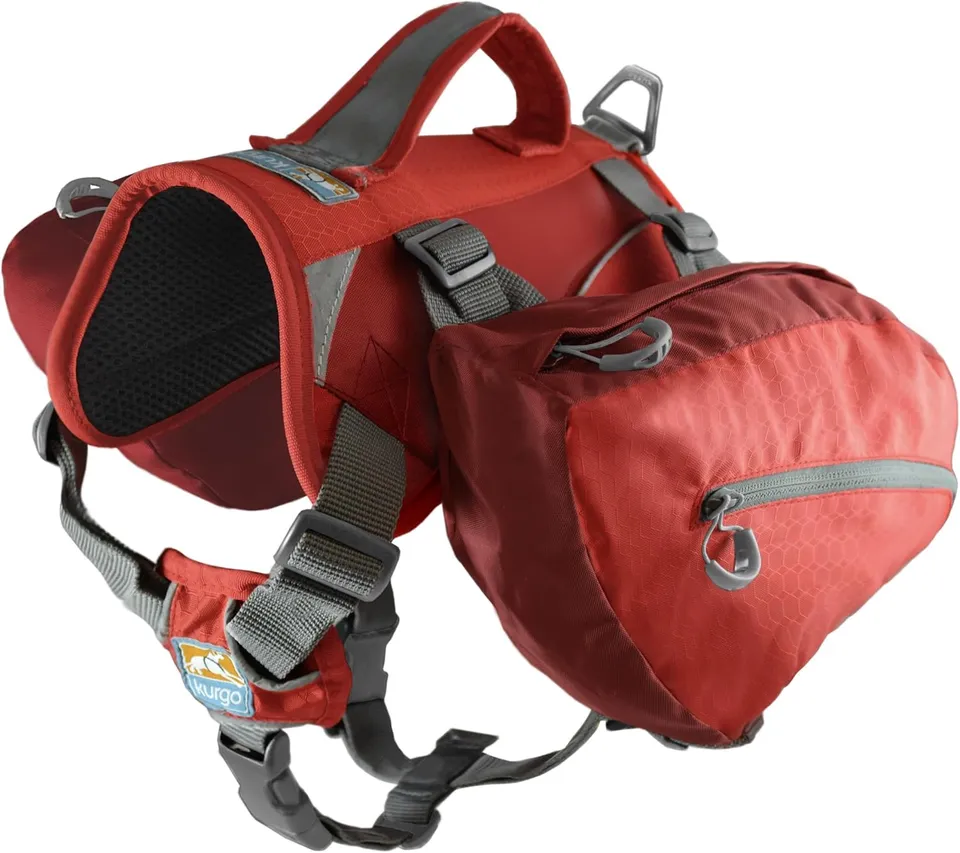
The specs are genuinely appealing. The standard Baxter fits dogs 30–85 lb with 3.75 L of space; the Big Baxter stretches to 50–110 lb and 7.5 L. Eight adjustment points, a padded contoured spine support, a sturdy grab handle for hoisting your dog over obstacles, and Kurgo’s lifetime warranty when bought new from an authorized seller. It’s also the cheapest pack here by a distance.
The testers split on it. CleverHiker names it their Best Value, praising the price, the low weight and the eight adjustment points, while noting minimal padding and limited capacity. Treeline Review tested it and did not recommend it: they found the saddlebags sit too low on the dog, the fit is inferior to their top picks, and the straps slip on some dogs.
Low-riding saddlebags matter more than they sound. The whole argument for a weight-forward design is keeping load over the shoulders, where it least disturbs a dog’s gait; a bag that rides low and back moves the load toward the hips and adds sway. That’s a fit problem, and fit is the part of a dog pack you can’t fix with a better strap.
Our position: if budget is the constraint, the Wilderdog below tested better at a similar price and is the pack we’d point you to first. The Baxter is still a real option for a very large dog — the Big Baxter’s 110 lb range is genuinely hard to match — but check how it sits on your dog loaded, and if the bags hang low or the straps creep, send it back rather than hiking it.
Check Kurgo Baxter on Amazon →
OneTigris Mammoth — durable, but nobody independent has tested it
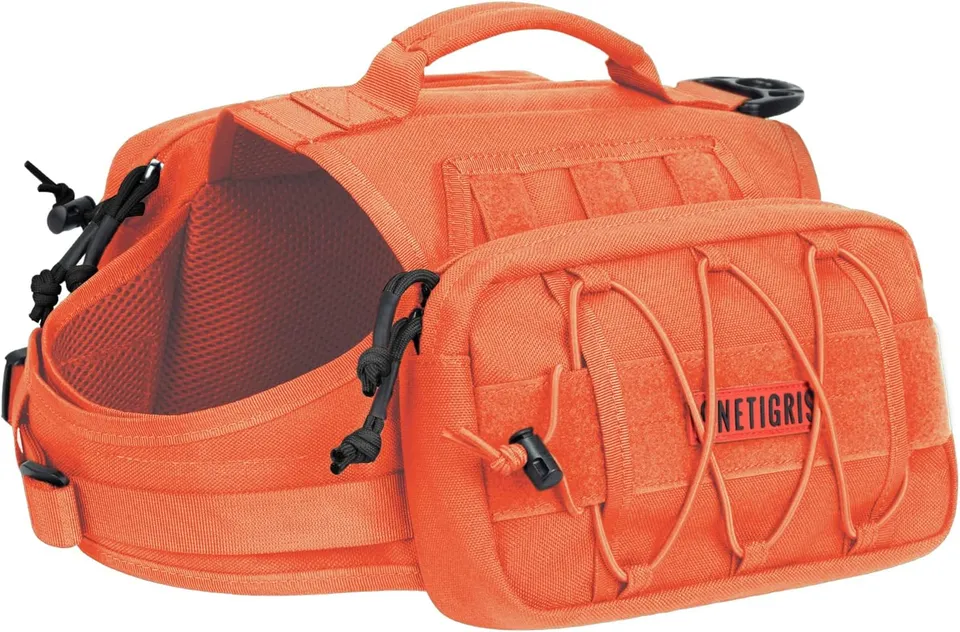
If your trails are rough on gear, the OneTigris Mammoth is built like a tank for a mid-range price. Where most dog packs use 600D fabric, the Mammoth is 1000D nylon with reinforced stitching at every stress point. It carries roughly 3 L per side (1.5 L on the small size), with concealed zippers that don’t snag fur and UTX-Duraflex buckles. OneTigris built its name on tactical working-dog gear, and the Mammoth shows it.
One caveat we owe you: neither field test we rely on has put this pack on a dog. It doesn’t appear in Treeline Review’s 17-pack history or CleverHiker’s line-up, so everything above is fabric spec and owner reports rather than measured trail performance. That’s not a mark against it — it’s a gap. The heavier denier is a real, checkable difference and the reason we still list it, but if you want a pack that independent testers have actually fitted and loaded, buy from the four above instead.
Check OneTigris Mammoth on Amazon →
Wilderdog — best affordable, and the one to buy on a budget
Treeline Review’s budget pick, and CleverHiker’s choice for shorter and urban hikes. It runs 5 L (S), 8 L (M) and 12 L (L), fits chests from 17 to 34″, and weighs only 9.5–14.5 oz — light enough that the pack itself barely eats into your dog’s load budget, which matters more than it sounds when the whole allowance is a few pounds.
Both testers liked the water-resistant fabric and the built-in poop-bag dispenser, and Treeline specifically called out good armpit clearance — the thing that quietly ruins a long day when a pack gets it wrong. The criticisms are consistent between them and worth knowing: no neck or chest padding, a front cut that sits low, a forward-positioned D-ring, and zippers that CleverHiker found can open in dense brush.
For a dog that hikes regularly but doesn’t need 20 L of capacity, this is the honest budget answer — and it’s the pack that replaced the Baxter in our recommendations.
Check Wilderdog Backpack on Amazon →
Mountainsmith K-9 — most adjustable, with one flaw to check
Mountainsmith built one of the industry’s first dog packs in the 1980s, and the current K-9 was designed with a Colorado veterinarian. It’s the most adjustable pack here — a 4-point adjustable chest harness with a padded sternum pad plus an independently adjustable back harness — in 3 L (S), 10 L (M) and 18 L (L), fitting chests from 20 to 44″. CleverHiker names it their most adjustable pick.
The flaw is specific and worth deciding on before you buy: Treeline found the leash D-ring sits too far forward, which causes the pack to shift, and on long-bodied dogs it can ride up into the armpits. If your dog is long through the body, or you clip a leash to the pack rather than a separate harness, that combination is exactly where this one struggles.
Check Mountainsmith K-9 on Amazon →
Ruffwear Palisades — best for multi-day trips
Both testers name the Palisades their multi-day pick, and the reason is one design decision: the saddlebags come off. Four attachment points and the flopper-stopper system hold them on the trail; at camp or a water break they clip away in seconds and the pack becomes a plain harness with a lift handle, so your dog is unloaded but still under control.
The current version (model 5020) carries 12.5 L (S), 17.5 L (M) and 24 L (L/XL), fits 22–42″ chests, includes two 1 L hydration bladders, and adds cross-load compression to keep a part-empty load from sloshing around. Five points of adjustment and a padded, contoured chassis. It weighs 1.75–2.15 lb empty, which is the trade-off — that’s real weight against a small budget, and both testers flag it as bulky on smaller dogs.
One thing to be clear about, because a bigger pack invites the mistake: your dog’s safe load doesn’t increase because the trip got longer. The Palisades is the right answer for carrying their food and water across several days without a mid-trip fit problem, not a licence to move more of your kit onto them. The extra days’ supplies still end up on your back.
Check Ruffwear Palisades on Amazon →
What we’d skip
Treeline tested two budget saddlebags we won’t recommend: the Outward Hound Quick Release, which rotates side to side in use and has durability limits, and the Life Union saddlebag, which they found genuinely difficult to fit with poor weight distribution. A pack that rotates or sits wrong isn’t a cheap version of a good pack — it’s a fit problem strapped to your dog for the length of the hike.
How to introduce a pack (the part most people skip)
A dog that’s never worn a pack shouldn’t meet one at a trailhead. Spread this over two or three weeks:
- Empty pack, indoors, minutes at a time. Put it on, reward, take it off before the dog starts trying to shed it. You want the pack to predict good things.
- Empty pack on normal walks. Let them learn the new width — dogs with saddlebags misjudge gaps between trees and posts at first, and they need to recalibrate.
- Add a token load, evenly split. A little water in each side. Watch the gait: it should look completely normal.
- Increase gradually toward your target percentage, one variable at a time — either more weight or more distance, never both in the same outing.
- Then, and only then, take it on real terrain.
Watch for the signals that say back off: a dog that lags behind when they normally lead, sits down repeatedly, or shifts oddly to one side. Those aren’t stubbornness. That’s a load or fit problem.
Buyer’s guide: getting it right
Fit before features
The best hiking pack fitted badly is worse than a basic pack fitted well. The saddlebags should ride high over the shoulders and stay put — if they slide toward the hips or swing side to side, the dog’s balance and gait suffer and the straps rub.
Measure your dog’s chest girth just behind the front legs and match the maker’s chart, rather than going by weight alone: two 60 lb dogs can be different sizes. Check for clearance at the armpits, where chafing starts, and make sure the shoulders move freely at the front. Prioritize packs with several adjustment points, and re-check the fit once there’s weight in it — an empty pack that sits perfectly can slump when loaded.
Load both sides evenly
An unbalanced pack pulls your dog off-center all day. Split the weight evenly between the two saddlebags, keep heavy items (water, food) low and close to the body, and pack soft items to the outside. A little planning here prevents a lot of chafing and fatigue. Re-balance after your dog drinks — half-empty bladders on one side create exactly the lopsided load you started out avoiding.
Match capacity to your dog, not your gear
It’s tempting to buy the biggest pack and fill it. Don’t. Size the pack to your dog and the load you’re building toward, then pack only what fits that budget. Extra empty volume just tempts you to overload, and a half-empty large pack sags and shifts more than a full small one.
What should actually go in it
The best cargo is the stuff that’s for the dog and gets lighter as you go:
- Water, and a collapsible bowl. This is the main event — it’s heavy, it’s essential, and it lightens as the day goes on.
- The dog’s food and treats for the day.
- Waste bags — including the full ones, which is exactly the job a pack is good for. Our Leave No Trace guide covers why packing them out actually matters.
- A small first-aid kit with paw-specific supplies.
- Paw balm, or boots if the ground is rough or hot.
Keep your own heavy or bulky items on your back. The pack is for the dog’s gear, not your overflow.
Which dogs do best with a pack?
The dogs that thrive under a load are the ones bred to work all day: the herding and sporting breeds with real engines and the joints to match. A German Shepherd, a Labrador, or a Border Collie in good condition is exactly the profile — high stamina, solid structure, and a temperament that visibly settles when given a job.
If you’re still choosing a dog with this kind of hiking in mind, our guide to the best adventure dog breeds ranks them by what actually limits them on trail, which is usually heat rather than stamina.
The bottom line
A dog hiking pack is one of the best upgrades for a high-energy trail dog — as long as the fit is snug, the load is honest, and the dog is grown and conditioned. Build toward 10% of body weight including the pack, treat 15% as the ceiling rather than the 25% the internet repeats, and take weeks rather than days getting there.
Get the Ruffwear Approach if you want the proven all-rounder, the Palisades if you’re going out overnight, or the Wilderdog if budget is the constraint. Then start light, build slowly, and let your dog do the carrying.
New to all of this? Start with our beginner’s guide to hiking with your dog, and make sure the drive there is as safe as the walk — most “car safety” harnesses have never passed a crash test.
One last note if this is going to someone else rather than your own dog: a pack has to be fitted to a specific ribcage, which makes it one of the harder things in dog gear to give. Our gift guide for adventure dog owners sorts the whole category by exactly that problem — what is safe to buy without measuring, and what genuinely is not.
Sources
- Treeline Review — Best Dog Backpacks of 2026 (Field-Tested)
- CleverHiker — Best Dog Backpacks of 2026, Tested & Reviewed
- Charles JP, Comerford EJ, Ratcliffe VF, et al. The biomechanics of working dog locomotion II: Loaded trotting. Journal of Experimental Biology (2025)
- Journal of Experimental Biology — Trotting spaniels outperform labradors and shepherds when bearing a heavy load (Inside JEB summary of the study, 2025)
- Ruffwear — Approach Pack
- Dog Discoveries — When do puppy growth plates close? (vet answers)
Frequently asked questions
How much weight can a dog carry in a hiking pack?
There is no research-backed percentage. Independent gear testers put most dogs at around 10–15% of body weight, including the pack, and set 25% as the absolute maximum — but neither team cites a study for it. The one controlled study of dogs carrying weight on their backs tested only 5–10%, and even that changed how the dogs moved, differently by breed. Build a grown, conditioned dog up toward 10% over weeks and treat 15% as the ceiling. Seniors, dogs with joint problems and puppies carry nothing.
What is the difference between a dog pack and a dog backpack?
Nothing — they're the same product under different names. You'll see 'dog pack', 'dog hiking pack', 'dog backpack' and 'saddlebag pack' used interchangeably. What actually varies between products is the harness underneath: some hiking packs are a harness with saddlebags permanently attached, others let you remove the bags and keep using the harness on its own. The removable kind is more useful if you want your dog to have rest days from the load.
At what age can a dog wear a loaded backpack?
Only once they're fully grown, because loading a puppy stresses open growth plates. Closure timing varies a lot by size: toy and miniature breeds are typically done around 6–8 months, while large and giant breeds can stay open until 14–16 months, and the overall range across dogs runs from about 6 to 24 months. Until your dog is through it, let them wear an empty pack to get used to the bulk, and confirm timing with your vet.
Are dog backpacks a good idea?
For the right dog, yes — carrying a job channels a high-energy dog's focus and can make them calmer and more satisfied on the trail. But it's not for every dog: skip it for puppies, seniors, dogs with joint issues, and brachycephalic (flat-faced) breeds that already struggle to breathe under exertion. Fit and load matter far more than the brand on the bag.
How should a dog hiking pack fit?
Snug and stable, with the saddlebags sitting high over the shoulders rather than sliding back toward the hips. You should be able to slip two fingers under the straps. The pack needs clearance at the armpits so it doesn't chafe, and enough freedom at the front that the dog's shoulders move normally. Re-check the fit once there's weight in it — an empty pack that sits well can still slump when loaded.
Should my dog wear a pack in hot weather?
Be very careful. A pack covers a large area of the dog's back and torso, reducing the surface available to shed heat, and the added work raises core temperature faster. On genuinely hot days the right call is usually to carry the gear yourself and let your dog move unencumbered. If you do use a pack in warmth, go lighter than usual, start early, and watch for heavy panting or a dog that starts hunting for shade.
What should I look for in dog packs for hiking?
Fit first, capacity second — a hiking backpack for a dog is sized to the ribcage, not to bodyweight, and a pack that shifts will rub on a long day. After that, judge it on load: the weight rule most sites repeat is more generous than it should be, and a dog needs building up to carrying anything at all. Look for a harness-style base rather than saddlebags hung off a strap, balanced panniers you can pack evenly, and a handle. Skip a pack entirely for puppies, seniors, and dogs still under skeletal maturity.
Comments
Got a question, a tip, or a correction? Leave a comment — no account, no sign-in. Just your name and your thoughts.
Loading comments…