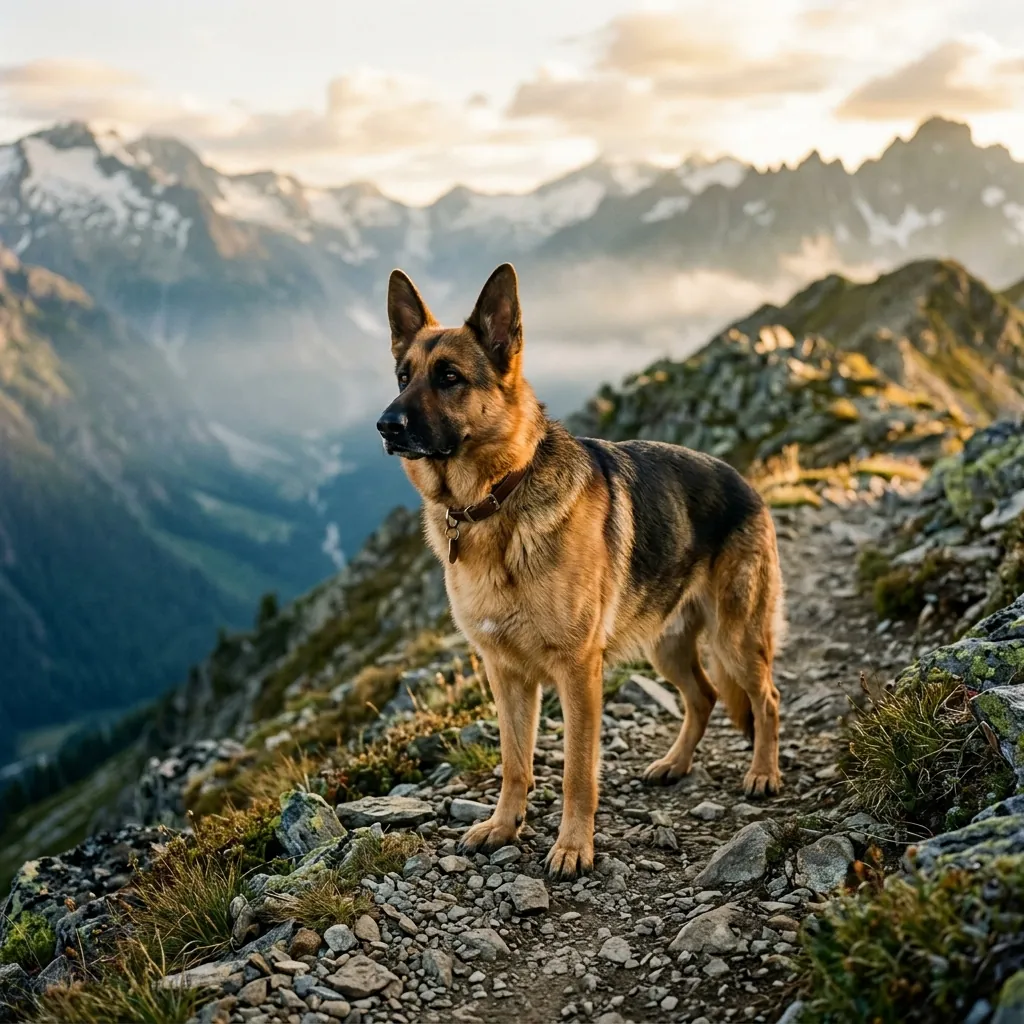
There is a reason the German Shepherd is the dog you picture doing a job — police work, search-and-rescue, military service, guiding the blind. The AKC calls it “dogkind’s finest all-purpose worker,” and on capability alone that is hard to argue with. Few breeds can match a Shepherd for the combination of athleticism, intelligence, weatherproofing and sheer willingness to work alongside a person all day, in any terrain.
That same capability is exactly why this guide comes with more caveats than the two retrievers most people compare it to. A Labrador or a Golden forgives a casual owner. A German Shepherd does not. This is a serious working dog, and the difference between a magnificent Shepherd and a difficult one is almost entirely the person holding the leash.
So this is an honest guide to what it actually takes: the working temperament, the off-leash reality the AKC states in unusually plain language, and the two health conditions that should shape how you buy one and how you hike one.
German Shepherd at a glance
| Height | 24–26 in (males), 22–24 in (females) |
| Weight | 65–90 lb (males), 50–70 lb (females) |
| Life expectancy | 12–14 years |
| Coat | Dense double coat; sheds heavily (“the German Shedder”) |
| Shedding | Very heavy — year-round plus big seasonal moults |
| Energy | Very high; needs a job, not just a walk |
| Adventure verdict | One of the most capable outdoor dogs alive — for an experienced, active handler |
Heights, weights, life expectancy and health flags come from the official AKC breed standard; the health and off-leash points below are sourced to peer-reviewed research and the AKC’s own breed guidance, linked at the end.
The dog behind the uniform
The AKC describes the German Shepherd as “loyal, confident, courageous, and steady,” a dog of “noble character and high intelligence.” What that formal language is circling is a specific kind of dog: one that forms an intense bond with its own people, is naturally watchful of everyone else, and possesses enough raw intelligence to be a genuine partner — or a genuine handful.
Two traits define the ownership experience. The first is drive — a Shepherd wants to work, and a Shepherd with nothing to do does not relax, it deteriorates. The second is discernment — this is a breed with guarding instincts, wary of strangers by default, which is precisely why early, thorough socialisation is not optional. A well-socialised Shepherd is confident and stable around new people, dogs and situations. An under-socialised one becomes reactive and anxious, and a reactive 80-pound dog is a serious problem on a busy trail.
This is the breed’s whole story in one sentence: everything that makes a Shepherd extraordinary needs a handler who will meet it. Give it the work, the training and the socialisation, and you have arguably the most versatile adventure dog there is. Skip any of them and the same intelligence turns inward.
Exercise needs: a job, not just a walk
A German Shepherd needs well over an hour of real activity a day, and — this is the part people miss — physical exercise alone will not satisfy one. This is a working breed bred to think. A Shepherd that gets a long walk but no mental challenge is still an under-stimulated Shepherd, and it will find its own job: patrolling, barking, digging, chewing, or fixating.
For an adventure owner, this is actually good news, because the outdoors is the perfect outlet. Hiking with terrain to read, scent to follow, and tasks to perform hits both the physical and mental need at once. Structured trail work — carrying a pack, practising recalls and stays, navigating obstacles — will settle a Shepherd in a way that a flat road walk never does. Add scent games and training sessions at home and you have a fulfilled dog.
The usual growth-plate rule applies, and it matters here because the breed’s joints are already a weak point: keep hard exercise, jumping and long distance moderate until the skeleton matures at roughly 18 to 24 months. Our guide to how much exercise a dog needs helps you scale it by age, and if you are building up to trail days, how to start hiking with your dog covers the fundamentals.
Shepherds are weatherproof and handle cold well thanks to that double coat, but the same coat means heat deserves respect — go early on hot days and carry water. Our summer heat-safety guide covers the warning signs.
The off-leash reality nobody wants to hear
This is the section that matters most, and it is not our opinion — it is the AKC’s own guidance about its own breed:
Do not let the dog off leash, as even the best-trained dog can become distracted.
That is unusually direct language from a breed authority, and it is worth taking seriously. A German Shepherd carries strong prey and guarding instincts. A Shepherd that locks onto a deer, a jogger or another dog is not being disobedient — it is being a Shepherd — and eighty pounds of driven dog is a lot to have running loose in the backcountry.
For the overwhelming majority of owners, the practical answer is not “off-leash or bust.” It is:
- A long-line for controlled freedom. A 30-foot line gives a Shepherd room to explore and sniff while you keep genuine control. Build real recall on it before you ever consider more. See our long-line guide.
Check Long-Line Leashes on Amazon →
- A GPS tracker as backup. For a dog with this drive in real terrain, a tracker is not an admission of failure — it is the plan. Our GPS tracker guide explains the difference between cellular and radio trackers honestly, and our piece on whether AirTags work for dogs covers the cheaper option’s real limits.
Check Tractive GPS on Amazon →
Reliable off-leash Shepherds absolutely exist — but they belong to experienced handlers who earned it over years of work, and who still know their dog’s limits. If you are not that handler yet, the long-line is not a compromise. It is the responsible choice.
Trainability: brilliant, and a double-edged sword
German Shepherds are among the most trainable dogs on the planet — this is the breed that learns complex police and service tasks — and that intelligence is exactly why they are unforgiving of poor training. A Shepherd learns what you actually teach it, including the accidental lessons. Inconsistency, unintended rewards and skipped socialisation all get learned just as fast as the good stuff.
Prioritise, in order: early and extensive socialisation (the single most important investment you will make in a Shepherd), a bombproof recall built on a long-line, a reliable “leave it,” and structured impulse-control work. Reward-based methods work superbly; this is a sensitive, handler-focused breed that does not need heavy-handedness and often gets worse with it. If you are a first-time owner, budget for a good trainer early — not because the dog is difficult to train, but because it is easy to train wrong.
Toys and play: channel the drive
Play is not optional decompression for a Shepherd — it is a training and bonding tool. Most Shepherds are strongly toy-driven, and that drive is one of your best levers: tug (played with rules), fetch, and flirt poles give a physical outlet and a reward you can train with. Puzzle and scent-work toys feed the mental side that a walk cannot reach. Choose genuinely tough toys — a bored Shepherd is a capable destroyer — and avoid leaving it alone with anything it can shred and swallow.
Gear that fits a German Shepherd
A Shepherd’s large, athletic, deep-chested build is well served by mainstream gear built for big dogs:
- A strong padded harness with a handle — useful for control, for helping over obstacles, and gentler than a collar on a powerful puller. Fit it properly to that deep chest.
Check Ruffwear Front Range on Amazon →
- A pack, once mature — a fit adult Shepherd is a strong, willing load-carrier, and having a job on the trail suits the breed’s temperament perfectly. Load it lightly and read our dog hiking backpack guide on fit first.
Check Ruffwear Approach Pack on Amazon →
- Paw protection for rough or hot terrain — the right boots, conditioned before a real hike, protect against sharp rock and hot ground.
Feeding a German Shepherd
For a breed whose signature weaknesses are the joints and a deep chest, feeding is a genuine health tool, not an afterthought. The principles, all to be set with your vet:
- Control the growth of a puppy. German Shepherd puppies should grow steadily on a large-breed puppy formula, not as fast and as big as possible. Because hip and elbow dysplasia are the breed’s defining orthopaedic risks, over-fast growth is exactly what you want to avoid — the goal is a lean, slow-built youngster.
- Keep the adult lean. Every extra pound is load on hips and elbows that are already a breed weak point. You should feel the ribs easily and see a waist. Lean dogs stay sounder, longer.
- Feed to defend against bloat. As a deep-chested breed, the Shepherd carries gastric dilatation-volvulus (GDV) risk. Split the daily ration into two or more measured meals rather than one large one, use a slow-feeder if your dog gulps, and keep hard exercise out of the window right around meals.
- Measure everything, including the training rewards. A dog you train and work this much earns a lot of treats; count them as part of the daily total.
As always, the right amount depends on the individual dog’s age, size, activity and health — your vet sets the target, and you adjust to the dog.
Health and lifespan: the two that shape your decision
German Shepherds live around 12 to 14 years, and two conditions in particular should shape how you buy one.
Degenerative myelopathy (DM). This is a progressive, ultimately fatal disease of the spinal cord that causes painless hind-limb weakness and loss of coordination, advancing to paralysis over months to years. It is strongly associated with a mutation in the SOD1 gene, and the German Shepherd is one of the breeds most affected — a UK study of young Shepherds found the at-risk genotype and carriers were common in the population sampled. The crucial practical point: a DNA test exists, identifying clear, carrier and at-risk dogs. Responsible breeders test, and you should ask for the results of both parents.
Hip and elbow dysplasia. The Shepherd is arguably the poster breed for hip dysplasia — a malformation of the joint that leads to pain and arthritis. This is exactly why the breed’s parents should be screened and graded (through OFA or PennHIP) before breeding, and why you should insist on seeing those results. A dog you intend to hike hard for a decade needs the best joints its genetics can offer.
Also on the list, shared with other deep-chested breeds: bloat (gastric dilatation-volvulus), a life-threatening emergency — learn the signs and avoid hard exercise right around big meals.
The through-line is the same as the temperament section: buy from a breeder who health-tests and socialises, and ask direct questions about DM status and hip and elbow scores. For this breed, the breeder matters as much as the breed.
This is the honest health picture of the breed, not a diagnosis. Screen through a good breeder and manage your individual dog with your vet.
Grooming and shedding
“The German Shedder” is not a joke — it is a warranty. The dense double coat sheds steadily year-round and blows out heavily twice a year, and no amount of wishing changes it. Plan on brushing two or three times a week, daily during the seasonal moult, and accepting that hair on your clothes, floor and car is simply part of the deal.
The upkeep is otherwise straightforward: the coat is relatively dirt-shedding, baths are occasional, and regular brushing does most of the work. As with any double-coated breed, never shave it to reduce shedding or “keep the dog cool” — the coat insulates in both directions and protects the skin. Manage heat with timing and water instead.
Is a German Shepherd right for you?
Be genuinely honest here, because this is the breed where self-honesty matters most:
- Can you give it a job, not just a walk? A Shepherd needs mental work daily. If you only have time for a stroll, this is the wrong dog.
- Will you commit to early socialisation and training — and pay for help if needed? This is non-negotiable for a guarding breed of this size and drive.
- Are you honest about the leash? If you were picturing a dog running free on every ridge, the breed authority is telling you to adjust the picture.
- Will you buy from a breeder who tests for DM and screens hips and elbows? For this breed, that decision shapes the next fourteen years.
If you can meet those, there are few dogs on earth more rewarding to take into the backcountry — a tireless, intelligent, deeply loyal partner that will work beside you all day and guard your camp all night. If you cannot, a Shepherd’s gifts curdle into problems, and both of you will be miserable.
For a genuinely easier all-round adventure dog, the Labrador Retriever and the Golden Retriever are far more forgiving of a first-time or casual owner. And to see how the Shepherd sits among every other trail breed against the veterinary data, start with our hub guide, The Best Adventure Dog Breeds for Hiking & Camping.
Sources
- American Kennel Club — German Shepherd Dog breed profile
- Holder AL, et al. A retrospective study of the prevalence of the canine degenerative myelopathy associated SOD1 mutation (SOD1:c.118G>A) in a referral population of German Shepherd dogs from the UK (2014)
- Hall EJ, Carter AJ, O’Neill DG. Incidence and risk factors for heat-related illness (heatstroke) in UK dogs under primary veterinary care in 2016. Scientific Reports (2020)
- Orthopedic Foundation for Animals — Hip Dysplasia
Frequently asked questions
Are German Shepherds good hiking and adventure dogs?
Exceptionally so, in the right hands. German Shepherds are athletic, weatherproof, tireless and intensely bonded to their handler, which makes them outstanding trail and backcountry dogs. The caveats are handler-side, not dog-side: they need serious daily exercise, real training and early socialisation, and the AKC advises against trusting them off-leash. This is a working dog that thrives with an experienced, active owner and struggles with a casual one.
Can you let a German Shepherd off-leash on trails?
The AKC's own guidance is blunt: do not let the dog off leash, as even the best-trained dog can become distracted. Shepherds have strong prey and guarding instincts, and a distracted Shepherd is a lot of dog to have running loose around wildlife or other trail users. The honest answer for most owners is a long-line for freedom with control, plus a GPS tracker as backup. Reliable off-leash work is possible for experienced handlers, but it is earned over years, not assumed.
What is degenerative myelopathy in German Shepherds?
Degenerative myelopathy (DM) is a progressive, ultimately fatal disease of the spinal cord that causes painless weakness and loss of coordination in the hind legs, advancing to paralysis over months to years. It is strongly linked to a mutation in the SOD1 gene, and German Shepherds are among the most affected breeds. A DNA test exists that identifies clear, carrier and at-risk dogs, so responsible breeders test their breeding stock. It is one of the two health conditions that should shape which Shepherd you buy.
How much exercise does a German Shepherd need?
A great deal — plan on well over an hour of real activity daily, and ideally a job to do on top of it. Physical exercise alone is not enough for this breed; a Shepherd needs mental work — training, scent games, structured tasks — or it will invent its own, usually destructively. Keep a young Shepherd's hard exercise moderate until the growth plates close at around 18 to 24 months to protect the joints, which are already a breed weak point.
Do German Shepherds shed a lot?
Enormously — the nickname 'German Shedder' is earned. They have a dense double coat that sheds year-round and blows out heavily twice a year. Expect to brush two or three times a week, daily during the seasonal moult, and to find hair on everything regardless. Never shave the double coat to reduce it; the coat regulates temperature in both directions and protects the skin.
Are German Shepherds good for first-time owners?
Usually not the ideal first dog. Shepherds are highly intelligent, powerful, and driven, with guarding instincts that need careful early socialisation and a handler who can provide consistent training and real daily work. In experienced, active hands they are magnificent; in under-prepared ones, their intelligence and drive turn into anxiety, reactivity and destruction. A first-time owner who is genuinely committed to training can succeed, but this breed is far less forgiving of mistakes than a Labrador or Golden.
Comments
Got a question, a tip, or a correction? Leave a comment — no account, no sign-in. Just your name and your thoughts.
Loading comments…