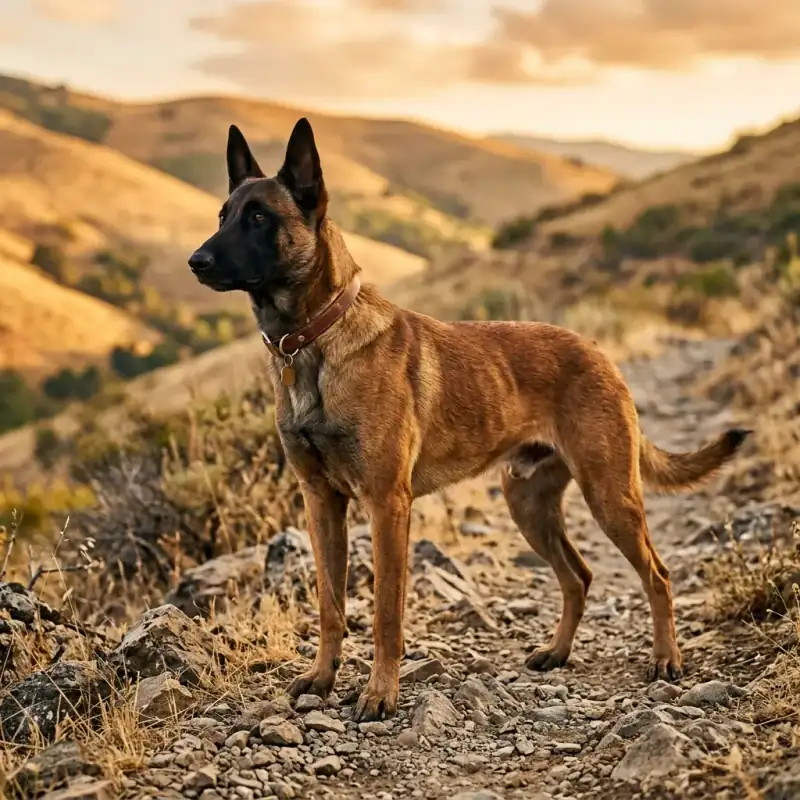
Let us be honest in a way most breed pages are not: the Belgian Malinois is probably the most capable working dog on the planet, and for the large majority of the people who want one, it is the wrong dog. Those two facts are not in tension. They are the same fact, seen from two sides. Everything that makes the Malinois the choice of elite military and police units (its relentless drive, its speed, its intensity, its need to work) is exactly what makes it overwhelming as a pet, and exactly why breed rescues are quietly overflowing with them.
This guide is different from the others in our breed series, because the most useful thing it can do for most readers is talk them out of the breed, honestly and with respect for the dog. For the small number of experienced, working-oriented owners the Malinois genuinely suits, it covers what living with one really takes. And for everyone drawn in by a video of a Malinois scaling a wall or leaping from a helicopter, it offers the reality check that the internet never does.
Belgian Malinois at a glance
| Height | 24–26 in (males), 22–24 in (females) |
| Weight | 60–80 lb (males), 40–60 lb (females) |
| Life expectancy | 14–16 years |
| Coat | Short, straight, weather-resistant double coat |
| Shedding | Moderate year-round, heavier seasonally |
| Energy | Extreme; a working dog that needs a job, not a hobby |
| Adventure verdict | The ultimate working partner — and, for most people, far too much dog |
Heights, weights, life expectancy and health notes come from the official AKC breed standard. Our verdict is deliberately blunt: in the hands of an experienced, committed owner with a real working outlet, the Malinois is a phenomenon: athletic beyond almost any other breed, trainable to an astonishing degree, loyal and tireless. In the wrong hands, which is most hands, it is a fifteen-year commitment to a dog whose needs will dominate your life whether you meet them or not. Note that lifespan: 14 to 16 years is a long time to get this decision wrong.
The dog behind the reputation
The Belgian Malinois is one of four Belgian herding varieties, developed as a hard-working stock dog and then, over the last century, refined into the premier protection, police and military working dog in the world. When you see footage of a “super-dog” apprehending a suspect, detecting explosives, or parachuting with special forces, it is very often a Malinois. Militaries and police have increasingly chosen the breed over the German Shepherd for its lighter frame, greater agility, and sheer relentless drive.
Understand what that heritage means for the dog in your living room. This is not a high-energy pet that happens to be trainable; it is a purpose-built working animal whose entire being is oriented around having a job and a handler to do it with. Malinois are intensely bonded, hyper-alert, sensitive and phenomenally intelligent, and all of that is directed, at all times, toward working. Take away the work and the drive does not switch off. It turns inward, and the results (obsessive behaviours, reactivity, destruction, anxiety) are the reason so many end up surrendered.
The honest core: this is the wrong dog for most people
This is the part the internet never shows you. For the overwhelming majority of the active, well-meaning people drawn to it, the Belgian Malinois is simply more dog than they can handle, and the evidence is the sheer number of them sitting in rescue.
Breed-specific Malinois and working-dog rescues exist in real numbers across the country, and they are candid about why. People acquire a Malinois expecting the heroic, obedient super-dog of the videos, and discover a high-drive working animal that needs a genuine job, experienced handling and constant structure that ordinary homes cannot provide. “Active” is often not enough; a family that hikes and runs on weekends can still be catastrophically under-matched to a Malinois’s needs. The dogs are not failing anyone; they are being exactly what they were bred to be, in homes that were never equipped for them. As one rescue puts it, Malinois “end up in rescues and shelters for being themselves: high-energy, driven dogs looking for a job, any job to do.”
So the single most valuable thing this guide can tell you is this: if you do not have serious dog experience and a real plan for a working outlet, this is not your breed, no matter how much you admire it. That is not gatekeeping; it is the kindest thing that can be said, for your sake and the dog’s. The responsible path for most people drawn to a Malinois is to channel that admiration into a more forgiving high-energy breed (and there are wonderful ones) and to spend real time around Malinois and the people who train them before ever committing.
If you are that experienced, working-oriented owner, read on. If you are honest with yourself and you are not, the best possible outcome of this article is that you choose a different dog.
Where the Malinois genuinely shines
For a small, specific group of people, the Malinois is not too much dog; it is exactly the right one, and it is worth saying so clearly. If you compete in protection sport or agility, do search-and-rescue or detection work, train dogs as a serious ongoing pursuit, or simply have deep experience with high-drive breeds and a life built around working a dog, the Malinois can be the partner of a lifetime. These are homes where the dog’s drive is an asset to be used rather than a problem to be contained, where hours of daily training read as a pleasure rather than a chore, and where the owner already understands, in their hands, what a working dog needs. For that person, everything in this guide reads differently: less a warning than a spec sheet for a phenomenal companion. The honest test is simple, and only you can answer it: are you seeking out that working life because you genuinely love it, or talking yourself into it because you love the dog’s image? The first one produces a great partnership. The second fills the rescues.
What it actually takes: a job, not just exercise
The AKC sums up the Malinois’s needs as “exercise, and plenty of it,” but that phrasing undersells the reality, and the shortfall is where most homes fail. A Malinois does not need exercise so much as employment. Hours of hard physical activity are the baseline, but on their own they build a fitter, more frustrated dog. The real requirement is purposeful work:
- A dog sport or working discipline — protection sport (IGP), agility, obedience competition, scent detection, herding, or dock diving. This is not enrichment for a Malinois; it is close to a need.
- Daily structured training, which channels the intelligence and gives the drive a legitimate target.
- Physical exercise (running, hiking, biking) as the foundation the working outlets sit on top of.
Get this right and a Malinois is a stunning adventure partner: an all-day athlete that will out-hike, out-run and out-work almost anything. Get it wrong, treat a Malinois like a Labrador with more energy, and the same engine dismantles your home and your peace of mind. For scaling the physical side sensibly by age and fitness, our guide to how much exercise a dog really needs helps, but remember that for this breed exercise is the floor, not the ceiling.
Trainability: the best on earth, which is the point
No breed is more trainable than the Belgian Malinois, and its dominance in the most demanding working roles on earth proves it. It learns at a startling pace, works with total focus, and will do almost anything for a handler it trusts. This is genuinely one of the marvels of the dog world.
But read that correctly: the Malinois’s trainability is not a convenience that makes it an easy pet; it is a requirement that makes it a demanding one. A mind that capable needs to be trained and worked, constantly, or it finds its own projects. Prioritise, from day one and ideally with professional guidance:
- Early, thorough socialisation — essential for a sensitive, hyper-alert, protective breed, to raise a stable adult rather than a reactive one.
- Rock-solid obedience and recall, built on a long-line, given the breed’s speed and drive.
Disclosure: some links below are affiliate links. If you buy through them we may earn a small commission at no extra cost to you.
Check Long-Line Leashes on Amazon →
- Impulse control around motion, since the herding and prey drives readily latch onto running children, animals, bikes and cars.
Most Malinois owners who thrive are plugged into a training community or a working discipline. If that world does not appeal to you, that is itself a strong signal the breed does not either.
Gear that fits a Belgian Malinois
A Malinois’s athletic, medium-large build is easy to outfit, and its drive makes a couple of items genuinely important:
- A well-fitted harness for training and hard activity, giving control without throat pressure. The Ruffwear Front Range suits the build.
Check Ruffwear Front Range on Amazon →
- A GPS tracker. A driven, fast dog that bolts after a stimulus can cover ground alarmingly quickly; a live tracker is sensible insurance; see our GPS tracker guide.
Check Tractive GPS on Amazon →
For gift-buyers: the 40–80 lb range above is the widest of any breed on this site, and a Malinois is lean enough that weight alone still under-describes the shape. Assume nothing sized to the body can be bought sight-unseen. Our gift guide for adventure dog owners covers what can.
Health and lifespan
One of the Malinois’s genuine advantages is robust health and a long life — the AKC gives 14 to 16 years, notably long for a dog of its size. One honest caveat on that figure: it is a breed-level estimate rather than a measurement. The Malinois is too uncommon to appear in the large veterinary datasets that have measured lifespan in breeds like the German Shepherd, so nobody has confirmed it — a point we go through in our German Shepherd vs Belgian Malinois comparison. Responsible breeders screen for:
- Hip and elbow dysplasia — the standard orthopaedic screens; ask for the parents’ results.
- Eye conditions — a good breeder health-tests eyes.
The breed is otherwise relatively hardy. The sobering flip side of that long life is worth restating: a Malinois’s demands do not fade quickly, and you are potentially committing to a decade and a half of a working dog’s needs.
None of this is a diagnosis. It is the honest health picture of the breed — screen through a good breeder and manage your individual dog with your vet.
Grooming and shedding
Grooming is one of the few genuinely easy things about a Malinois. The short, weather-resistant double coat needs only a weekly brush most of the year, stepped up during the seasonal sheds when the undercoat lets go. It is low-maintenance, reasonably weatherproof, and quick to clean up after trail days. As with other double coats, it should not be shaved. Grooming, in other words, is the least of your commitments with this breed; every other section of this guide matters far more.
Is a Belgian Malinois right for you?
Be more honest with yourself here than with any other breed in our series: the cost of getting it wrong is fifteen years, borne mostly by the dog:
- Do you have serious dog experience? The Malinois is widely, and rightly, considered a breed for experienced owners. If this would be your first high-drive dog, the responsible answer is to start elsewhere.
- Can you provide a real job, not just exercise? A dog sport or working discipline, plus daily structured training, plus hard physical exercise. If that prospect sounds like a burden rather than a draw, the breed is not for you.
- Can you commit for 14–16 years? This is a long-lived, high-maintenance dog. The intensity does not fade fast.
- Are you choosing the dog, or the image? If your interest traces back to a video or a reputation, pause. The reality is nothing like the highlight reel.
If every one of those answers is a confident yes, the Belgian Malinois can be the most extraordinary partner of your life: a dog of near-limitless capability and devotion that will meet you at the edge of what you can do and ask for more. If any of them wavers, the most respectful thing you can do for this magnificent breed is to admire it from a distance and choose a dog that fits your life.
For a working dog with much of the Malinois’s capability and a more livable temperament, compare the German Shepherd, the honest next step for many people drawn here. For high energy without the working-dog intensity, the Labrador and the field in our hub guide, The Best Adventure Dog Breeds for Hiking & Camping, are far safer places to start.
Sources
- American Kennel Club — Belgian Malinois breed profile
- American Belgian Malinois Rescue (ABMR)
- Adopt a Pet — Surrendering a Belgian Malinois: why the breed ends up in rescue
Frequently asked questions
Is a Belgian Malinois a good pet for an active family?
For most active families, honestly, no, and breed rescues will tell you the same. The Malinois is a working dog bred for police, military and protection work, with a drive and intensity that go far beyond even a very energetic pet breed. 'Active', meaning a family that hikes and runs, is often not enough; the Malinois typically needs a genuine job and structured working outlets, plus experienced handling. Many are surrendered precisely because well-meaning, active owners discover the breed is more dog than they can manage. It can be an extraordinary companion for the right, experienced home, but it is the wrong dog for the large majority of people who are drawn to it.
What is the difference between a Belgian Malinois and a German Shepherd?
They look similar and share working roots, but the Malinois is generally lighter, faster, more intense and higher-drive, with less of a natural 'off-switch.' A German Shepherd, while still a demanding working breed, is usually a bit more settled and forgiving as a companion. Militaries and police increasingly favour the Malinois for its agility and relentless drive, but those same qualities make it harder to live with as a pet. If you are cross-shopping the two, be honest that the Malinois is the more demanding of an already demanding pair.
How much exercise does a Belgian Malinois need?
More than exercise alone can satisfy. The AKC sums it up as needing 'exercise, and plenty of it,' but the deeper truth is that a Malinois needs a job, not just miles. Hours of hard physical activity combined with intense mental work and structured training (obedience, agility, protection sport, scent work, herding) is the real requirement. A Malinois run ragged but left without mental challenge and purpose will still be a coiled, frustrated, often destructive dog. Physical exercise is necessary but nowhere near sufficient.
Why do so many Belgian Malinois end up in rescue?
Because they are acquired for their image and surrendered for their reality. The breed's fame from military, police and social-media contexts drives people to buy a Malinois expecting a heroic, obedient super-dog, then discover a relentless, high-drive working animal that needs a job, experienced handling and structure most homes cannot provide. Breed-specific rescues exist in numbers precisely because so many owners become overwhelmed. The dogs are not failing; they are being themselves in homes that were never equipped for them.
Are Belgian Malinois good with children and other pets?
They can be, in an experienced home with early, thorough socialisation, but there are real cautions. The breed's intense herding and prey drives can translate into chasing and nipping at running children or other animals, and its sheer drive and reactivity demand careful management. A well-raised Malinois in a knowledgeable household can be a devoted family dog, but this is not a breed to bring into a busy family on looks or reputation alone. Supervision, socialisation and honest expectations are essential.
Can a first-time owner handle a Belgian Malinois?
It is strongly discouraged. The Malinois is widely considered a breed for experienced, committed owners, ideally those involved in a dog sport or working discipline, and it can overwhelm even people who have owned other high-energy dogs. The combination of extreme drive, intelligence, intensity and need for a job is a great deal to handle without prior experience. If you are drawn to the breed as a first dog, the responsible path is to gain experience with a more forgiving high-energy breed first, and to spend real time with Malinois people before committing.
Comments
Got a question, a tip, or a correction? Leave a comment — no account, no sign-in. Just your name and your thoughts.
Loading comments…