
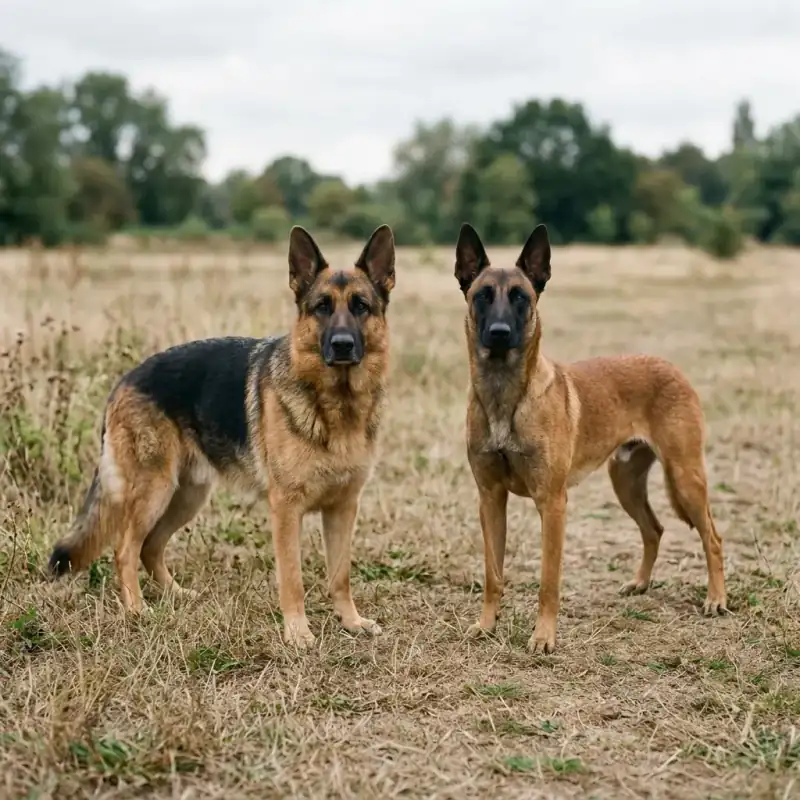
Search these two breeds against each other and you will get the same article back a dozen times: the Malinois is smaller, faster, more intense; the Shepherd is calmer, family-friendly, more prone to hip problems. Some of that is true. Most of it is repeated rather than checked.
There is a better source, and almost nobody writing this comparison uses it. The United States Department of Defense runs both breeds side by side, in the same job, under the same veterinary care and the same management, and it writes down why each dog stops working. In 2025, researchers published the analysis of 1,230 military working dogs discharged between 2019 and 2021 — 45.6% Belgian Malinois and 42.5% German Shepherds, near parity.
That dataset does not answer every question a pet owner has. It answers two of the biggest ones better than any temperament survey could.
The short answer
- Same height, different weight. Both breeds stand 24–26 inches at the shoulder for males. The Shepherd carries 65–90 lb on that frame; the Malinois carries 60–80 lb.
- The Shepherd is the more forgiving dog, and the working data supports the folklore for once: German Shepherds were far less likely than Malinois to be discharged from military service for fear-anxiety.
- The Malinois is the better athlete for most trail purposes — the AKC explicitly names running, hiking and biking as its element — but it is also the breed that washed out for heat injury more often.
- Neither is a first dog. If you are reading this to choose between them for a pet home, the honest answer is that the Shepherd is the one that survives an ordinary life.
They are not two sizes of the same dog
Here is the comparison as the AKC’s own breed data gives it:
| German Shepherd Dog | Belgian Malinois | |
|---|---|---|
| Height (male) | 24–26 in | 24–26 in |
| Height (female) | 22–24 in | 22–24 in |
| Weight (male) | 65–90 lb | 60–80 lb |
| Weight (female) | 50–70 lb | 40–60 lb |
| AKC life expectancy | 12–14 years | 14–16 years |
| AKC popularity rank | 4 of 210 | 32 of 210 |
| Breed-club health tests | Hip · Elbow · Temperament test | Hip · Elbow · Ophthalmologist evaluation |
The heights are identical. Every “the Malinois is a smaller Shepherd” article is describing weight and calling it size — and the difference in weight is smaller than people think, too: a top-of-range Malinois male outweighs a bottom-of-range Shepherd male.
What actually differs is build. The Shepherd is the longer, angulated dog with the famous trot; the Malinois is square, light-boned relative to its height, and built to change direction. Stand them side by side and the Malinois looks like the Shepherd with the mass stripped out and the springs left in.
Note the last row too. The breed clubs recommend different tests, and the difference is telling: the German Shepherd Dog Club asks breeders for a temperament test; the Belgian Malinois club asks for an eye exam. The Shepherd community treats nerve as a heritable trait worth certifying. That is not a criticism of either club — it is a clue about which trait each community has had to work on.
The evidence nobody else uses: both breeds, one job
The military working dog analysis covered dogs discharged from service in fiscal years 2019–2021. Most were dual-purpose patrol and detection dogs. The five commonest reasons for discharge — accounting for 83.5% of all of them — were neuromusculoskeletal disease, training failure, fear-anxiety, neoplasia and heat injury.
Three findings bear directly on the pet question.
1. Nerve. German Shepherds were 65.24% less likely than Belgian Malinois to be discharged for fear-anxiety. This is the opposite of the internet’s mental model, in which the Malinois is the bombproof one and the Shepherd is the nervy modern breed. In dogs selected for working ability and managed identically, it was the Malinois that more often came apart at the nerve end.
2. Heat. German Shepherds were 73.98% less likely than Malinois to be discharged for heat injury. Neither of these is a hot-weather breed, and heat injury discharges happened more often early in a dog’s career than late. If you are choosing a training partner for summer work, this is a real difference and it points the way most people would not guess.
3. Career length. Mean service life was 6.64 years for German Shepherds against 6.25 years for Malinois and 5.85 for other breeds. The Shepherd’s mean differed significantly from both of the others; the Malinois did not differ from the non-typical breeds. The margin is a few months, not a chasm — but it is in the same direction as everything above.
Read that dataset honestly, though. It describes the distribution of reasons for discharge among dogs that were discharged — not how common these problems are in the general population of either breed. These are selected animals: dogs that passed procurement screening at one to three years old, with radiographic orthopaedic screening already behind them. And they live a life no pet lives. What the data does uniquely well is remove the confounders that ruin every other breed comparison: same job, same handlers, same vets, same records.
For the pet-home question, the translation is roughly this. The Malinois is not the tougher dog; it is the more specialised one, and specialised things break in specific ways when the conditions are wrong.
Lifespan: what is stated versus what has been measured
This is where the two breeds diverge in a way that deserves care.
The AKC lists 12–14 years for the German Shepherd and 14–16 for the Malinois. Those are breed-level estimates of the kind every registry publishes, not measurements from a dataset.
The German Shepherd has actually been measured, twice, by independent teams:
- 10.16 years life expectancy at birth in UK life tables built from 1,110 German Shepherds
- 10.3 years median longevity (IQR 8.0–12.1) in a VetCompass study of Shepherds under UK primary veterinary care
Two datasets, two methods, agreement to within two months — and both roughly two years below the stated range. Our own German Shepherd guide quotes the AKC’s 12–14, and that is the figure the breed’s own literature uses; the measured number is lower, and both belong in an honest picture.
The Malinois has not been measured on anything comparable. It is not among the breeds with life tables, and no VetCompass breed study exists for it. So the correct statement is: the Malinois is believed to be a long-lived breed for its size, on breed-level estimates, and nobody has confirmed it with a large dataset. If a comparison article gives you a confident Malinois lifespan and a confident Shepherd lifespan in the same sentence, it is treating two very different kinds of number as equivalent.
For what the underlying evidence on canine lifespan actually supports — and why breed lifespan figures vary so wildly between sources — see how long dogs really live.
Health: one breed has a longer list, and it is not close
The German Shepherd’s list is genuinely longer. The VetCompass study of Shepherds in UK primary care found the commonest recorded disorders were otitis externa (7.89%), osteoarthritis (5.54%), diarrhoea (5.24%), overweight/obesity (5.18%) and aggression (4.76%, more common in males). More striking are the causes of death: musculoskeletal disorder at 16.3% and inability to stand at 14.9% were the top two. A breed whose two commonest recorded causes of death are both about the back end losing function is telling you exactly what to screen for.
Behind that sit the two conditions our Shepherd guide covers in detail — degenerative myelopathy, which has a DNA test, and hip and elbow dysplasia, which has a screening scheme. Add bloat, as with any deep-chested breed.
The Malinois’s list is short, and its breed club’s recommended screens are hips, elbows and eyes. The breed is widely described as robust. That reputation is not well tested by large veterinary datasets, for the same reason its lifespan is not: there are not enough of them in the databases. Treat “healthy breed” here as not known to have breed-specific problems, which is a weaker claim than known to be healthy.
This is educational information, not veterinary advice. Nothing here is a diagnosis, and none of it replaces a conversation with your own vet about your own dog.
Temperament, with the one measurement that exists
Owner-reported behaviour has been surveyed at scale in Finland: 13,715 dogs across 264 breeds, with 14 breeds sampled well enough for breed-level comparison. The German Shepherd was one of them (n = 461). The Malinois was not.
In that dataset, German Shepherds were among the breeds with the highest owner-reported hyperactivity and impulsivity — alongside mixed breeds, Spanish Water Dogs and Staffordshire Bull Terriers — and among the three breeds whose owners most often reported compulsive behaviour, with mixed breeds and Staffies again. For context on how common this stuff is in general: noise sensitivity was the most prevalent anxiety-related trait across the whole sample, at 32% of dogs.
That is worth holding next to the military data. In a working context with a job and structure, the Shepherd is the steadier of the two. In a pet context, the Shepherd is a breed whose owners frequently report a dog that cannot switch off. Both can be true, and together they say something practical: the Shepherd’s steadiness is conditional on having something to do.
For the Malinois there is no equivalent survey, and the honest source is the breed community itself — which is unusually blunt. Malinois rescues exist in numbers because people acquire the breed for its reputation and then discover that “active” is nowhere near enough. Our Malinois guide makes that argument at length, and it is not a rhetorical flourish.
On the trail: which one actually suits an active household
This is where the comparison finally favours the Malinois — with conditions.
The AKC’s exercise guidance for the Malinois names the activities directly: “Malinois make great running, hiking, and biking companions,” alongside agility, tracking, herding and protection sports. It also says, in the same breath, that this is “not a dog who can be left in the backyard, and daily walks are not enough, either.” The lighter frame, the square build and the endurance make it a superb distance companion once mature. If you run, see how to start running with your dog for the maturity and heat rules that apply to any high-drive breed.
For the Shepherd, the AKC’s exercise section contains the sentence that should shape every trail plan: “do not let the dog off leash, as even the best-trained dog can become distracted and not follow every command.” It is unusually direct for a registry, and it aligns with the breed’s build: a 65–90 lb dog with a long back that trots beautifully for miles is a wonderful hiking partner and a poor candidate for casual off-lead freedom in stimulating terrain.
The prey-drive warning on the Malinois side is comparable but different in character — the AKC flags a high prey drive and strong interest in moving objects that can turn into chasing children, vehicles or other animals. That is a management problem on shared trails, not a recall problem, and the fix is the same either way: a long line while you build the behaviour, and a recall you have actually proofed against distraction. Our recall training guide and long line guide cover the mechanics.
On gear, the two breeds size differently despite their identical heights: the Shepherd’s deeper chest and heavier frame means Shepherd-fit harnesses often swim on a Malinois of the same height. We went through the fit evidence in the best harness for a German Shepherd, and the measuring method there applies to both.
Which one, for whom
Choose the German Shepherd if:
- You want a dog that bonds to a household rather than a handler.
- You can commit to real daily work but not to a structured training discipline.
- You accept a shorter measured lifespan and a longer health-screening checklist, and you will buy from a breeder who tests hips, elbows and DM status.
- You are prepared to manage a large, powerful dog on-lead in stimulating places for its whole life.
Choose the Belgian Malinois if:
- You already have a sport or working discipline, or you are certain you will build one.
- Your week has structure in it that will not collapse when work gets busy.
- You want a distance athlete and you will build the summer plan around a breed that washed out for heat injury more often than its rival.
- You have spent real time with adult Malinois — not puppies, not videos.
Choose neither if what attracted you was the look of a working dog. That is the honest failure mode for both breeds, and it is the more expensive mistake with the Malinois. If you want a capable adventure dog without a working-dog household, our guide to the best adventure breeds for first-time owners is the better starting point, and the best adventure dog breeds covers the wider field against the veterinary evidence.
The bottom line
They are the same height and different animals. The German Shepherd is the more popular breed, the more forgiving temperament, the shorter measured life and the longer health list. The Malinois is the lighter athlete, the sharper mind, the thinner evidence base, and — on the only dataset that has ever put the two breeds in identical jobs — the one more likely to leave the work over nerve or heat.
Most people asking this question want the working dog’s silhouette and a normal life. Between these two, that is the Shepherd, and it is still a great deal of dog.
Sources
- American Kennel Club — German Shepherd Dog breed profile
- American Kennel Club — Belgian Malinois breed profile
- United States military working dogs from 2019 to 2021: analysis of causes of service discharge and decreased service life. Frontiers in Veterinary Science (2025)
- O’Neill DG, et al. Demography and disorders of German Shepherd Dogs under primary veterinary care in the UK. Canine Genetics and Epidemiology 4:7 (2017)
- Teng KT, et al. Life tables of annual life expectancy and mortality for companion dogs in the United Kingdom. Scientific Reports 12, 6415 (2022)
- Salonen M, et al. Prevalence, comorbidity, and breed differences in canine anxiety in 13,700 Finnish pet dogs. Scientific Reports 10, 2962 (2020)
- American Belgian Malinois Rescue
Frequently asked questions
Is a Belgian Malinois just a smaller German Shepherd?
No — and the size assumption is backwards in an interesting way. The AKC gives both breeds exactly the same height: 24–26 inches for males and 22–24 for females. What differs is mass and build. German Shepherd males run 65–90 lb against 60–80 lb for a Malinois, and females 50–70 lb against 40–60 lb. So they are the same height and different weights: the Malinois is the lighter, squarer, more elastic dog, not the smaller one.
Which breed is calmer, a German Shepherd or a Malinois?
The German Shepherd, and there is now a data point behind what used to be pure lore. Among 1,230 US military working dogs discharged from service between 2019 and 2021, German Shepherds were 65% less likely than Belgian Malinois to be discharged for fear-anxiety. Those are selected working dogs rather than pets, and it describes reasons for discharge rather than population prevalence — but it is two breeds doing identical work under identical management, which is as close to a controlled comparison as this question gets.
Which one handles heat better?
The German Shepherd, on the only side-by-side evidence available. In the same military working dog analysis, German Shepherds were 74% less likely than Malinois to be discharged from service for heat injury. Neither breed is heat-adapted, and the usual rules — walk early, watch humidity, know the signs — apply to both.
Do Belgian Malinois really live longer than German Shepherds?
Probably, but be careful how much weight you put on the figures. The AKC lists 14–16 years for the Malinois against 12–14 for the German Shepherd, and those are breed-level estimates rather than measurements. Where the German Shepherd has been measured, the real number is lower: 10.16 years in UK life tables and a median of 10.3 years in a VetCompass study of primary-care records. No comparable dataset exists for the Malinois, so nobody can currently tell you its measured lifespan.
Which is better for a first serious working-dog owner?
The German Shepherd, comfortably — with the caveat that neither is a beginner dog. The Shepherd tolerates a mistake, settles more readily in a household, and attaches to a family rather than to one handler. The Malinois is the sharper instrument: it is more forgiving of hard work and less forgiving of an unstructured week. Breed rescues exist for the Malinois in large part because people acquire the reputation and then meet the dog.
Can either breed be trusted off-leash on trails?
Plan on managing both. The AKC's guidance on the German Shepherd is unusually direct — do not let the dog off leash, because even the best-trained dog can become distracted. For the Malinois, the AKC flags a high prey drive and a strong interest in moving objects that can turn into chasing children, vehicles or other animals. A long line and a genuinely proofed recall are the honest middle path for either dog.
Comments
Got a question, a tip, or a correction? Leave a comment — no account, no sign-in. Just your name and your thoughts.
Loading comments…