
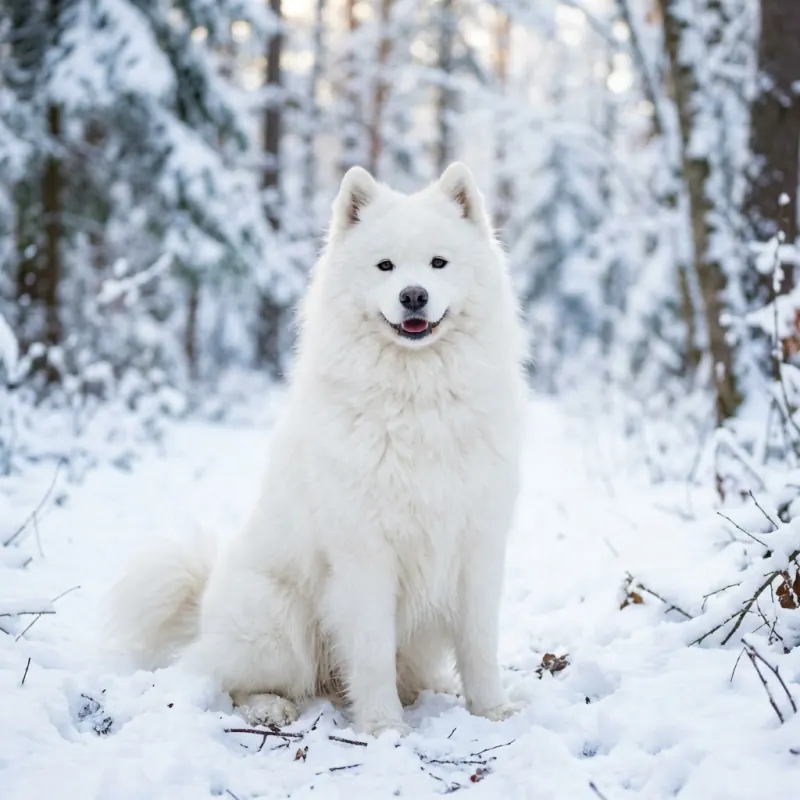
Search for the Samoyed and you’ll drown in the smile. The upturned mouth corners, the reason for them (they stop the dog drooling and forming ice on its face in Arctic cold), the photogenic white coat.
All true. None of it is what decides whether you should get one.
The things that actually matter are less charming and much more useful: a kidney disease that kills affected male puppies before their second birthday and has a DNA test, a diabetes risk among the highest of any breed, and a coat whose parent club has to keep publicly correcting the claim that it’s hypoallergenic.
This guide covers those first, because they’re the ones you can act on while you’re still choosing.
Samoyed at a glance
| Height | 21–23.5 inches |
| Weight | 45–65 lb |
| Life expectancy | 12–14 years |
| Group | Working |
| Coat | Dense white double coat; blows undercoat annually |
| Built for | Reindeer herding, sled work, living inside with people |
| Best at | Cold-weather hiking, sociable family life, snow sports |
| Worst at | Heat, isolation, off-leash freedom, low-grooming households |
The health picture, stated plainly
Most breed guides bury health at the bottom. For this breed it belongs at the top, because two of the three items are decidable before you buy.
Samoyed hereditary glomerulopathy
This is the one nobody mentions in the listicles and every serious Samoyed person knows.
It’s an inherited kidney disease caused by a nonsense mutation in the COL4A5 gene, which sits on the X chromosome. That location determines everything about how it behaves. Males have one X, so an affected male has no second copy to fall back on: the disease progresses to renal failure and affected males typically die by around 15 months of age. Female carriers, with two X chromosomes, get a much milder version that does not progress to renal failure.
The same gene causes Alport syndrome in people, which is why the Samoyed version has been studied as a model for the human disease.
The practical part: there is a DNA test. Ask for it. A breeder who tests and can show you the result has removed this from your list of worries entirely; a breeder who’s vague about it has told you something important.
One thing worth being precise about, because it cuts against us: the recommended health panel the AKC publishes for this breed is a hip evaluation, a cardiac exam, an ophthalmologist evaluation, and DNA tests for retinal dysplasia/oculoskeletal dysplasia (RD/OSD) and X-linked progressive retinal atrophy (XLPRA1). A glomerulopathy test is not on that list. So this is a question you raise yourself rather than one the standard panel answers for you — and it’s worth asking about the eye tests on the list too, since two of the five are DNA tests you can simply be shown.
Diabetes mellitus
Samoyeds carry one of the highest diabetes risks in dogs. The Samoyed Club of America — the AKC parent club, so about as close to a primary source as breed health data gets — puts the breed’s odds at roughly 7.58 to 21.7 times those of other breeds, with onset typically between four and ten years and an average around seven.
The club describes it as immune-mediated: “the insulin producing cells of the body are destroyed.” That’s the same broad mechanism as type 1 diabetes in humans, and it means this isn’t a condition you prevent by keeping the dog lean, however worthwhile that is for other reasons.
Canine diabetes is manageable with insulin and dietary control. It is also a twice-daily, years-long commitment with real cost attached, and it’s a reasonable thing to factor in before choosing this breed rather than after.
That breed-level picture is corroborated independently. A study of diabetes mellitus in a population of 180,000 insured dogs (Fall et al., Journal of Veterinary Internal Medicine, 2007) found an overall incidence of 13 cases per 10,000 dog-years at risk, with Samoyeds among the breeds showing the highest incidence — and identified breed itself, along with female sex and previous hyperadrenocorticism, as risk factors. Two independent bodies of data, same conclusion.
The club also reports thyroid data from OFA submissions: 1.2% confirm autoimmune thyroiditis and 13.1% come back equivocal.
These are breed-level statistics, not predictions about a specific dog, and nothing here is diagnosis or treatment advice. If something about your own dog worries you, that’s a conversation for your vet.
The coat: what you’re actually signing up for
Two corrections, both from the breed’s own parent club.
It is not hypoallergenic. The Samoyed Club of America states it outright: “Although Samoyeds don’t have as much dander, they are not hypo-allergenic.” The club specifically flags the undercoat as an allergy concern, and notes that these dogs also carry pollen indoors on that coat. The myth is durable — helped along by the fact that Samoyed fur is genuinely spinnable into yarn — but it’s a myth.
The shedding is seasonal and enormous. The club describes the breed blowing its undercoat roughly once a year, or twice a year for unspayed females. Weekly brushing covers ordinary maintenance. During a coat blow it becomes daily, and the volume of fur is the thing new owners describe with a certain shell-shocked awe.
Don’t shave it. The double coat regulates temperature in both directions and shaving can permanently damage regrowth.
Temperament: a dog that has to be with you
The Samoyed’s history is unusual among northern breeds. The Samoyed Club of America describes dogs that were “originally used to hunt, herd reindeer, and haul sledges,” and — the part that matters here — that the Samoyedic people treated them as “members of the family.” They slept inside the family’s tent and helped keep the household warm. Centuries of that produced a dog that is genuinely people-centred rather than merely tolerant.
That’s a strength and a constraint. The parent club is direct about the constraint:
- Exercise has to involve humans. “Simply shooing the dog out into a fenced back yard” doesn’t work.
- A Samoyed left outside and isolated from its family is “likely to get loud, destructive, or both.”
If you want a dog that lives in the garden and is pleased to see you at the weekend, this is emphatically the wrong breed. If you want a dog that’s underfoot, sociable and involved in everything, it’s close to ideal.
Barking deserves its own line. Samoyeds are vocal. It’s a real consideration in an apartment or a terraced house, and it gets worse — not better — when the dog is under-exercised or left alone too long.
Exercise, and what suits the breed
Moderate-to-high, and best when it involves company. Long brisk walks, hiking, fetch, snow sports, and canine sports that reward a working dog with a job to do. This is a breed that will happily do a full day on the trail in cold weather and is far more comfortable there than in a July heatwave.
Our guide on how much exercise a dog needs covers the general framework; for this breed, the constraint isn’t stamina, it’s temperature and company.
Heat: treat it as a genuine limit. Dense double coat, white but thick, built for the Arctic. Move summer activity to the cool end of the day and check the ground before you set off — our guide to how hot is too hot to walk your dog has the thresholds.
Cold is where this dog belongs. The cold-weather breeds guide puts the Samoyed alongside the other genuinely Arctic-equipped breeds, and our winter paw care guide covers the one problem heavily furred feet reliably run into in snow. Where the ground is icy or salted rather than simply deep, dog boots are the more direct fix.
Diet and feeding
Standard large-ish working-breed feeding applies, with one breed-specific overlay.
Given the diabetes picture above, keeping a Samoyed lean is worth more here than in most breeds. That isn’t because leanness prevents an immune-mediated condition — it doesn’t — but because a diabetic dog that is also overweight is a substantially harder dog to manage, and obesity complicates insulin control. Body condition scoring beats a measuring cup: you should be able to feel ribs easily and see a waist from above.
Practically: a large-breed puppy formula during growth, meals split across the day, no hard exercise immediately after eating, and treats counted as part of the daily total rather than as extras. If your dog develops diabetes, feeding becomes a timed, measured, vet-directed routine — which is a real lifestyle change and one more reason to know about the risk before you choose the breed.
A word on the history, because it explains the dog
The Samoyed’s job list is unusual: hunting, reindeer herding, sled hauling — and living inside with the family rather than staked outside. Both the Samoyed Club of America and the AKC describe dogs kept as members of the household who helped keep their families warm on Arctic nights.
That last part is not folklore trivia. It’s the reason this breed is so people-oriented compared with other northern dogs, and the reason isolation hits it so hard. A Husky left in a yard is under-stimulated. A Samoyed left in a yard is being kept away from the thing it was bred for.
(You’ll also see a widely repeated story about parents leaving a Samoyed to guard the children while they hunted. The AKC presents that one explicitly as legend, so we’ll leave it there rather than reporting it as history.)
The breed has a documented polar-expedition record too — Samoyeds were used as sled dogs in Siberia by Nordenskiöld as early as 1870, and on Arctic expeditions by Nansen in 1893–94 and Jackson-Harmsworth in 1894. The Samoyed Club of America notes that of the dogs taken on those expeditions, only a few came home.
Grooming, in practical terms
Beyond the frequency figures already covered — which come from the parent club — the technique points below are standard grooming practice rather than anything published, so take them as craft, not evidence:
- Brush down to the skin in sections. The dense undercoat can mat near the skin while the outer coat still looks perfectly fine.
- An undercoat rake earns its keep during a coat blow; a slicker brush alone tends not to clear it.
- Dry the dog properly after a bath. A damp undercoat is where skin problems start.
- Never shave. The double coat regulates temperature in both directions and regrowth can be permanently damaged.
The parent club’s own figures are the ones to plan around: weekly brushing most of the year, daily while the coat is coming out. If that sounds like a lot, it’s a genuine reason to choose a different breed rather than a thing to power through.
This has a practical consequence worth flagging for gift-buyers. That coat makes a Samoyed read a full size larger than the 45–65 lb dog inside it, so anything girth-sized bought on appearance will be wrong. Measure under the coat, or give something that does not need measuring — our gift guide for adventure dog owners splits the category on exactly that line.
Containment and recall
The AKC’s description is the useful one here: a “strong urge to run away and roam,” with the note that a loose Sammy might travel for miles. The parent club adds that they’re escape artists and that plenty end up as strays.
None of this makes the Samoyed a difficult dog to live with — it’s a friendly breed, not a bolting one. It just means recall is not the tool you should be relying on in open country. Secure fencing at home, a long line for open ground, and the structured approach in our recall training guide are the realistic combination. A GPS tracker is a sensible backstop for a breed with this reputation.
Samoyed, Husky or Malamute?
These three get compared constantly, usually on looks. The useful split is by what each was bred to do and what that costs you. If your shortlist is really just the two sled breeds, our Husky vs Malamute comparison goes deeper on that pair specifically.
| Samoyed | Siberian Husky | Alaskan Malamute | |
|---|---|---|---|
| Bred for | Herding reindeer, sled work, living with the family | Pulling light loads at speed over distance | Hauling heavy freight at a steady pace |
| Size | 45–65 lb | 45–60 lb | 75–85 lb |
| People-focus | Highest of the three | Sociable but independent | Sociable, independent, strong-willed |
| Off-leash | Unreliable | Unreliable | Unreliable |
| Standout health issue | X-linked kidney disease; high diabetes risk | Comparatively low incidence of hip and eye disease | Chondrodysplasia, polyneuropathy, cone degeneration |
| Best suited to | An active household that’s home a lot | A runner or skijorer in a cold climate | Loaded hiking and hauling |
The pattern: all three need secure containment and serious grooming, and none is a low-effort dog. The Samoyed is the one that most needs to be with you, which is either the deciding advantage or the deciding problem depending on your household.
Is a Samoyed right for you?
Yes, if: you live somewhere with real winters, you want a dog fully integrated into family life, you’re genuinely prepared for the coat, and you’ll ask a breeder for the glomerulopathy DNA test result without embarrassment.
No, if: someone in the house has dog allergies, you need a quiet dog, you’re out of the house for long stretches, you live somewhere hot, or you want an off-leash trail dog you can trust in open country.
It’s a beautiful, sociable, hardy breed with a genuinely nice temperament. The reason to read past the smile isn’t that the smile is misleading — it’s that the two decisions that matter most, the health test and the grooming commitment, both have to be made before the dog arrives.
If you’re weighing this breed against the other northern options, our Siberian Husky and Alaskan Malamute guides cover the two it’s most often compared to, and the adventure breeds hub sets all three against the wider field.
Sources
- American Kennel Club — Samoyed breed page and breed history (height, weight, life expectancy, group, the roaming description, and the expedition record; the child-guarding story is presented there as legend)
- American Kennel Club — Working Group health testing requirements (recommended panel: hips, cardiac, ophthalmologist, RD/OSD and XLPRA1 DNA tests)
- Samoyed Club of America — Breed Origin and History (original jobs, dogs treated as members of the family, expedition losses)
- Fall T. et al. (2007). “Diabetes mellitus in a population of 180,000 insured dogs: incidence, survival, and breed distribution.” Journal of Veterinary Internal Medicine (PMID 18196728)
- Samoyed Club of America — Breed FAQ (hypoallergenic status, coat blowing and grooming frequency, exercise and isolation, escape behaviour, temperament with children)
- Samoyed Club of America — Health Issues: Metabolic System (diabetes odds ratios, age of onset, mechanism; OFA thyroid figures)
- Samoyed Health Foundation — Hereditary Nephritis / X-linked glomerulopathy (inheritance, sex differences, age at renal failure, availability of DNA testing)
- Jansen B. et al. (1986). “Mode of inheritance of Samoyed hereditary glomerulopathy: an animal model for hereditary nephritis in humans.” Journal of Laboratory and Clinical Medicine (PMID 3711721)
- Laboratoire de génétique vétérinaire — Samoyed familial nephropathy / COL4A5 mutation
Frequently asked questions
Are Samoyeds hypoallergenic?
No. The Samoyed Club of America answers this directly on its own breed FAQ: “Although Samoyeds don't have as much dander, they are not hypo-allergenic.” The myth persists partly because the coat is famously clean and low-odour and partly because Samoyed undercoat is sometimes spun into yarn. Neither makes the dog safe for an allergy sufferer, and the parent club specifically notes the undercoat as an allergy concern. If someone in the household reacts to dogs, this is not the workaround.
How much do Samoyeds shed?
Heavily, with a dramatic annual peak. The Samoyed Club of America describes the breed blowing its undercoat roughly once a year — twice a year for unspayed females — and the workload changes completely during that period: weekly brushing is enough the rest of the time, but daily brushing is necessary while the coat is coming out. There is no low-maintenance version of this coat, and it should never be shaved.
What is Samoyed hereditary glomerulopathy?
An inherited kidney disease caused by a mutation in the COL4A5 gene on the X chromosome. Because it is X-linked, it hits the sexes very differently: affected males, who have only one X chromosome, progress to renal failure and typically die by around 15 months of age, while female carriers show much milder disease that does not progress to renal failure. The same gene causes Alport syndrome in humans, which is why the canine version has been studied as a model for the human disease. A DNA test is available, so ask any breeder for the result.
Do Samoyeds get diabetes?
At an unusually high rate. The Samoyed Club of America reports the breed carrying odds of developing diabetes roughly 7.58 to 21.7 times those of other breeds, with onset typically between four and ten years and an average around seven. The club describes the mechanism as immune-mediated: “the insulin producing cells of the body are destroyed.” It is manageable with insulin and dietary control, but it is a real, lifelong commitment and it is worth knowing about before you buy rather than after.
Can a Samoyed be let off-leash?
Treat it as unreliable. The AKC describes a “strong urge to run away and roam” and notes that a loose Sammy might travel for miles, and the parent club is blunt about them being escape artists whose owners frequently meet them again at a shelter. Secure fencing and a long line for open ground are the realistic tools. This is a sociable breed rather than a bolting one, but sociable does not mean it will come back.
Are Samoyeds good family dogs?
Generally yes, and unusually so. The Samoyed Club of America notes they tend to be good with children, which tracks with a breed the club describes as historically treated as “members of the family” and kept inside rather than staked outside. The caveat is that this closeness is a requirement rather than a bonus: a Samoyed shut out in a yard away from its people is likely, in the club's own words, to become “loud, destructive, or both.” They are a family dog in the literal sense — they need to be in the family.
Comments
Got a question, a tip, or a correction? Leave a comment — no account, no sign-in. Just your name and your thoughts.
Loading comments…