
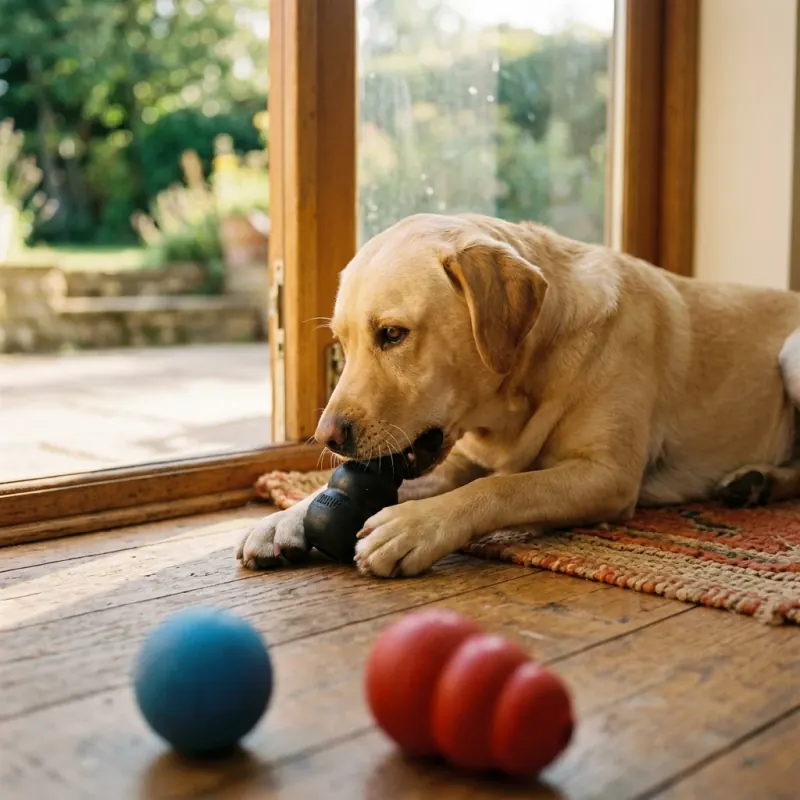
Search for Labrador toys and you get one word back, over and over: indestructible. It is the entire marketing category. Tough. Heavy-duty. Guaranteed.
It is also aimed at the wrong problem.
Labradors are not, as a rule, shredders in the way a determined terrier is. What they are is retrievers with an appetite — dogs built to carry things in their mouths, attached to a documented tendency to swallow them. The veterinary numbers say the real toy risk for this breed is not a toy that breaks. It is a toy that goes down, and a toy that quietly makes an already food-obsessed dog fatter.
Get those two things right and the durability question mostly answers itself.
What actually goes wrong
The clearest picture of how often dogs swallow things comes from Banfield Pet Hospital records covering roughly 2.4 million dogs across more than 890 hospitals. Ranked by prevalence of gastrointestinal foreign bodies:
| Breed | Cases per 10,000 dogs seen |
|---|---|
| Pit bulls | 42.78 |
| Labrador Retrievers | 37.47 |
Two patterns in that data matter more than the ranking. Prevalence rises with body size — giant breeds highest, toy and small breeds lowest. And it is highest in dogs under one year old, which is exactly when most people are buying toys in bulk.
A separate surgical case series backs up the picture from the other end. Of 52 dogs operated on for chronic gastrointestinal foreign body obstruction across 21 breeds, Labrador Retrievers were 10% of cases — third behind mixed breeds (31%) and American Pit Bull Terriers (13%). The reassuring part of that study: 94% overall survival. The unreassuring part: 15% had major post-operative complications, and every dog that died had needed intestinal resection.
This is not a reason to panic about toys. It is a reason to choose them for the right property. The question is not “will it break?” but “if it breaks, what is the biggest piece?”
The tennis ball problem
The second documented risk is the one sitting in nearly every Lab owner’s car boot.
The AKC, quoting Dr. Thomas Chamberlain, a board-certified veterinary dental specialist, describes tennis ball fuzz as abrasive enough that it “acts like sandpaper, gradually wearing down her teeth in a process called blunting.” Taken far enough, that ends in exposed tooth pulp and difficulty chewing — and the wear does not grow back.
There is a mechanical risk too. A dog with a large mouth can compress a standard tennis ball, and it can lodge in the throat. Swallowed fuzz is its own obstruction risk.
The AKC’s advice is not “never” — it is supervised play only, one ball at a time (so the dog isn’t trying to hold two), a trained “drop it,” and rubber balls built for chewers as the everyday alternative. That is a proportionate position, and it is ours.
The three jobs framework
Most people buy five versions of the same toy: a rubber thing, a slightly different rubber thing, and three squeaky animals that lasted a weekend. A Lab actually needs three different jobs covered.
Job 1 — the settle. Something to work on alone, in a crate or a bed, that turns a restless hour into a nap. Requires: stuffable, freezable, tough enough to survive the frustration of an empty toy.
Job 2 — the meal. A Lab that eats a bowl of food in ninety seconds has just wasted twenty minutes of daily enrichment. Requires: holds real portions, dispenses slowly, easy to clean — because a toy that’s a pain to wash gets used twice.
Job 3 — the retrieve. The thing this breed exists for. Requires: floats, throws well, is not a chew toy, and is big enough that it cannot go behind the molars.
Everything else — plush, tug, squeakers — is optional. These three are not.
Job 1: the settle
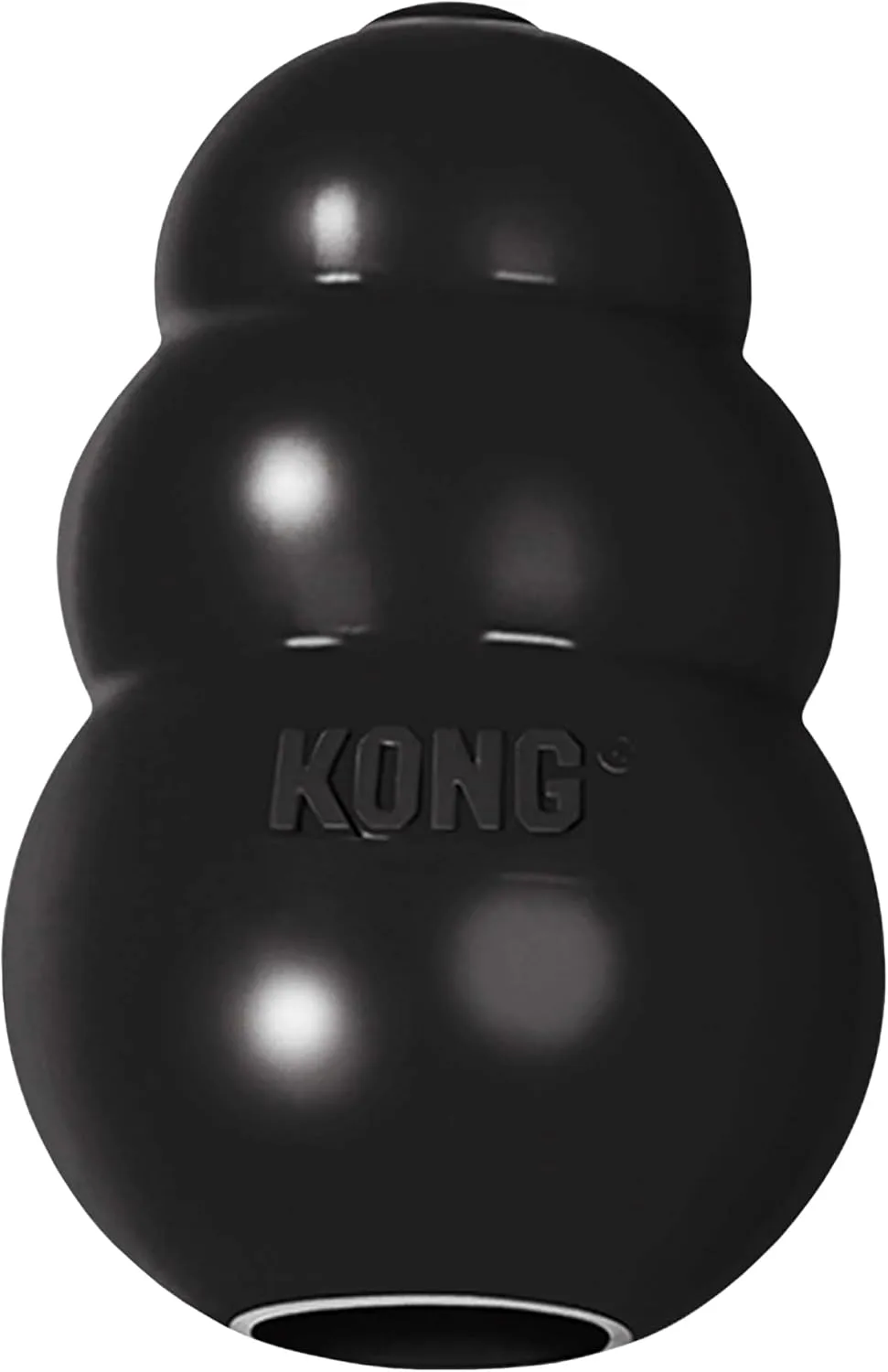
KONG Extreme, X-Large — the default, in the right size
The black KONG Extreme is the toughest rubber KONG makes, and the listing is straightforward about what it’s for: power chewers, treat-fillable, dishwasher safe, made in the USA.
The part people get wrong is the size. KONG’s official chart puts Large at 30–65 lb and X-Large at 60–90 lb, and the AKC lists Labrador Retrievers at 65–80 lb. So an adult Lab is an X-Large, not a Large — and KONG adds that “power chewers may need to size up one or two sizes.”
That is not upselling. A rubber toy that fits behind the back teeth is the one that gets cracked and swallowed. Oversized is the safe direction to be wrong in.
Disclosure: some links below are affiliate links. If you buy through them we may earn a small commission at no extra cost to you.
Check the KONG Extreme (X-Large) on Amazon →
Stuff it with part of the day’s kibble bound with something wet, then freeze it. A frozen KONG lasts several times longer than a loose-packed one, and the difference between a ten-minute toy and a forty-minute toy is the whole point.
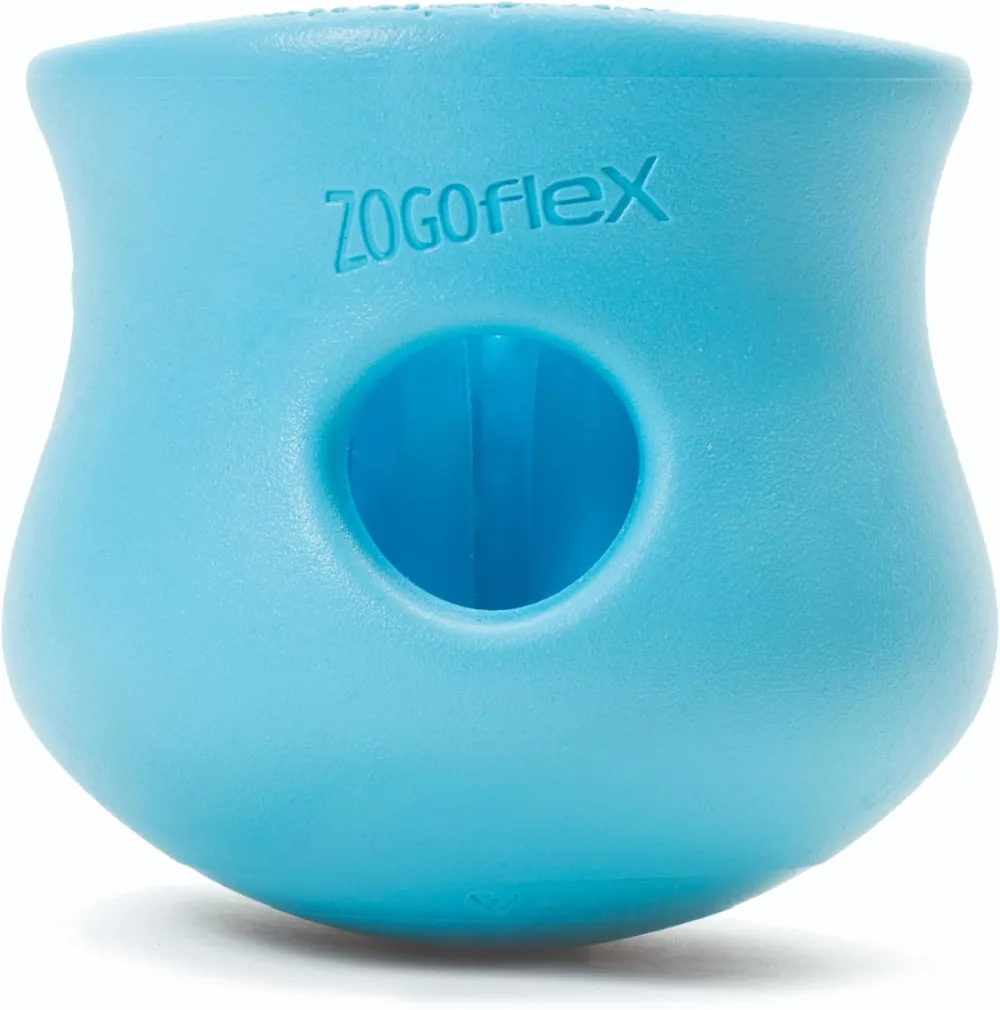
West Paw Zogoflex Toppl, Large — the one you’ll actually clean
The Toppl solves the KONG’s most annoying flaw: the narrow cavity that never quite comes clean. It’s an open bowl shape with soft internal prongs that hold food back, made from West Paw’s Zogoflex material — BPA-free, top-rack dishwasher safe, freezable, made in Bozeman, Montana, and recyclable through the company’s take-back programme.
Practical note from the design: the Large and X-Large sizes clip together to make a harder puzzle, which buys you a second difficulty level without a second purchase.
Check the West Paw Toppl on Amazon →
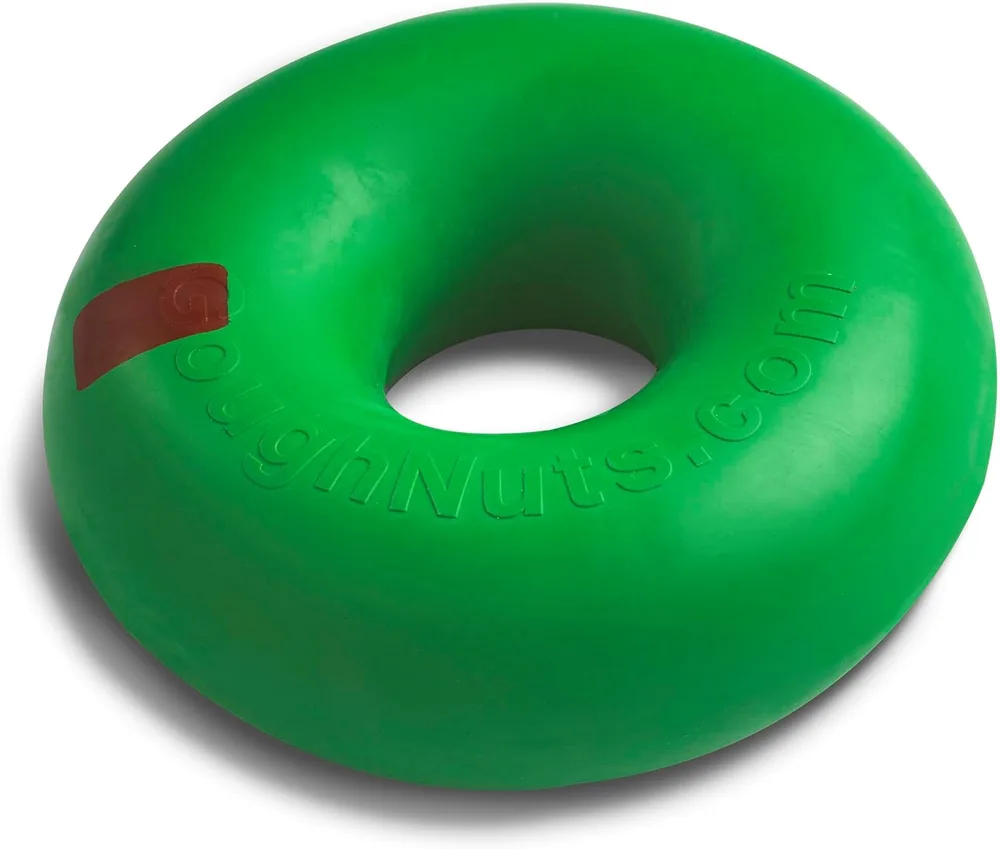
Goughnuts ring, Large — for the Lab that beats rubber
Some Labs really do destroy KONGs. For those dogs, Goughnuts does something unusual: it builds the safety check into the toy. Every ring is two layers — an outer colour that indicates strength and an inner core that is always red. The company’s position is simply “Red means stop.” Reach the red layer and Goughnuts replaces the toy under a lifetime guarantee; you pay shipping.
That is a materially better system than guessing. Goughnuts sizes its large ring for dogs 60–100 lb (the Amazon listing quotes 60–120 lb), which covers essentially every Labrador.
Check the Goughnuts ring on Amazon →
Job 2: the meal
This is where the Labrador case is different from every other breed, and it is genetic.
Researchers at the University of Cambridge identified a 14-base-pair deletion in the POMC gene, present at roughly 12% allele frequency in Labradors, that is associated with higher body weight, greater adiposity and greater food motivation. Among the breeds tested it appeared only in Labradors and the closely related flat-coated retriever — and it was more common in Labs selected as assistance dogs.
So the joke that your Lab is permanently starving has a citation behind it. Which makes how food is delivered a real lever.
The American Veterinary Society of Animal Behavior’s guidance on food puzzle toys is measured but clear: they slow fast eaters, “feeding pet dogs via toys rather than bowls can lead to an increase in activity levels,” and they may help as part of a weight-management programme. Shelter research found dogs given puzzle toys barked less and stayed more engaged.
KONG Wobbler — dinner, but it takes twenty minutes
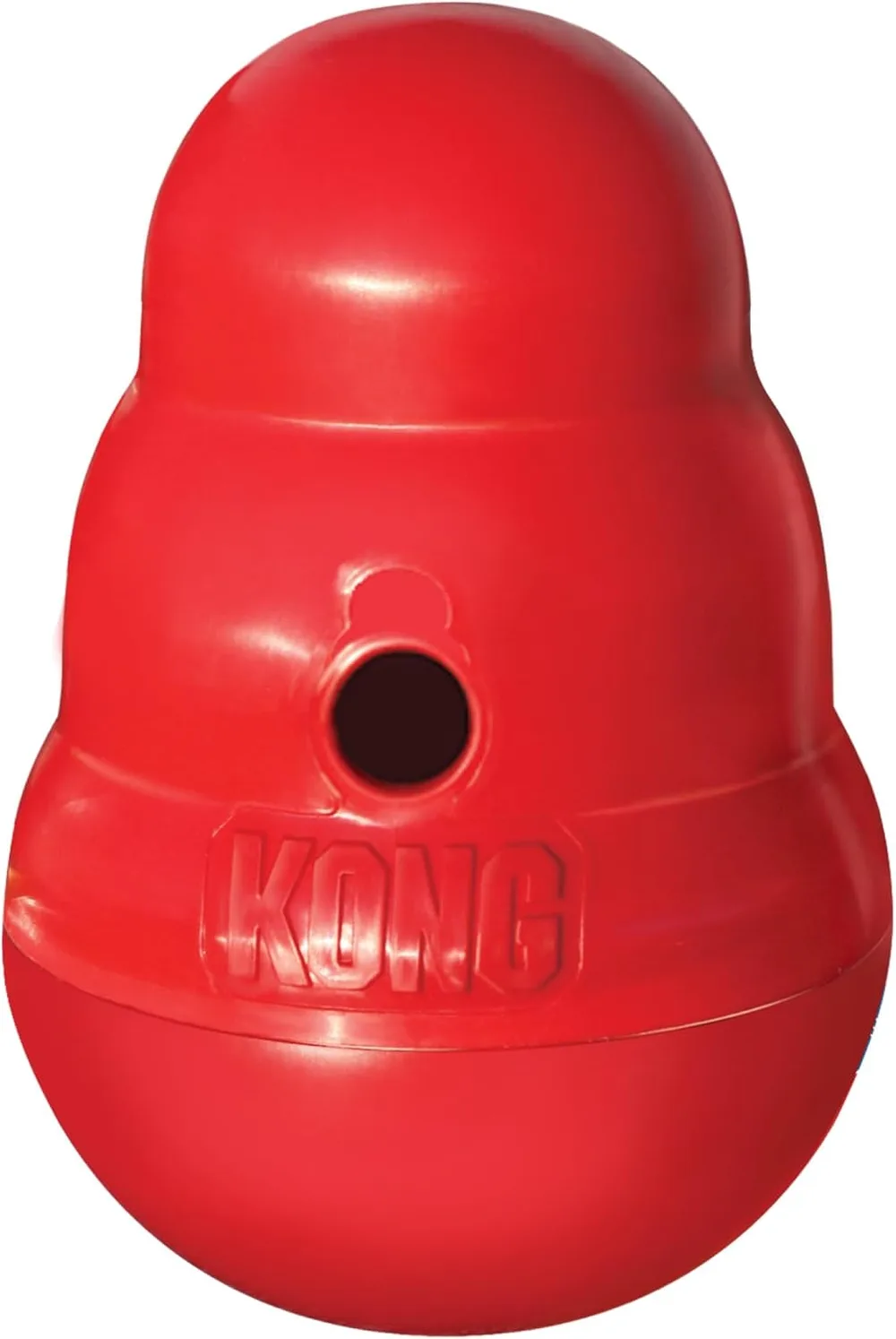
The Wobbler is a weighted, upright feeder that tips and spins when nosed. It unscrews to fill, it’s dishwasher safe, and KONG positions it explicitly as a bowl replacement.
The rule that makes it work: the food in the Wobbler is the day’s ration, not an extra. Puzzle feeding a Lab on top of normal meals is how you end up with an enriched, overweight dog.
Check the KONG Wobbler on Amazon →
Nina Ottosson Dog Brick — for rainy days and recovery
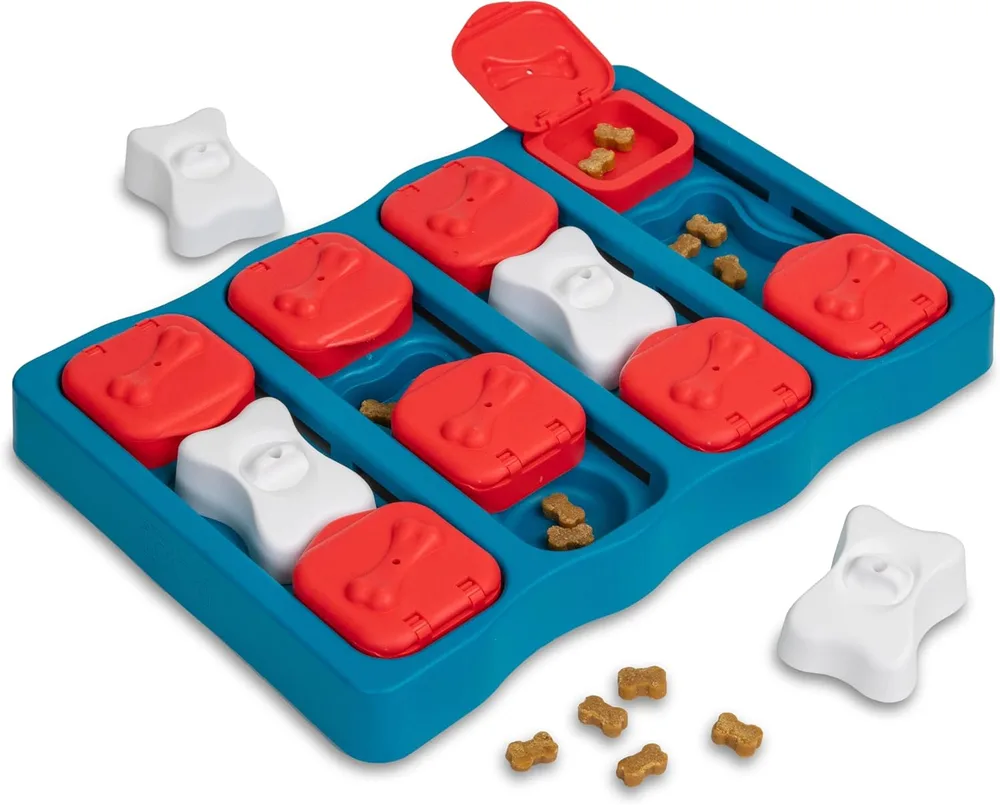
A board puzzle with sliders, flip-lids and bone-shaped plugs, holding about ¾ cup. It is the toy for a wet week, or for the fortnight after a vet tells you to keep a dog quiet — the situation where physical exercise is off the table and boredom becomes the actual problem.
One honest flag. The listing claims “15 minutes of brain-engaging play equals 30 minutes of physical activity.” We could not find any published research behind that equivalence. Treat it as marketing. The puzzle is genuinely useful; the exchange rate is invented.
Check the Dog Brick puzzle on Amazon →
Job 3: the retrieve
Chuckit! Ultra Ball, Large — the tennis ball replacement
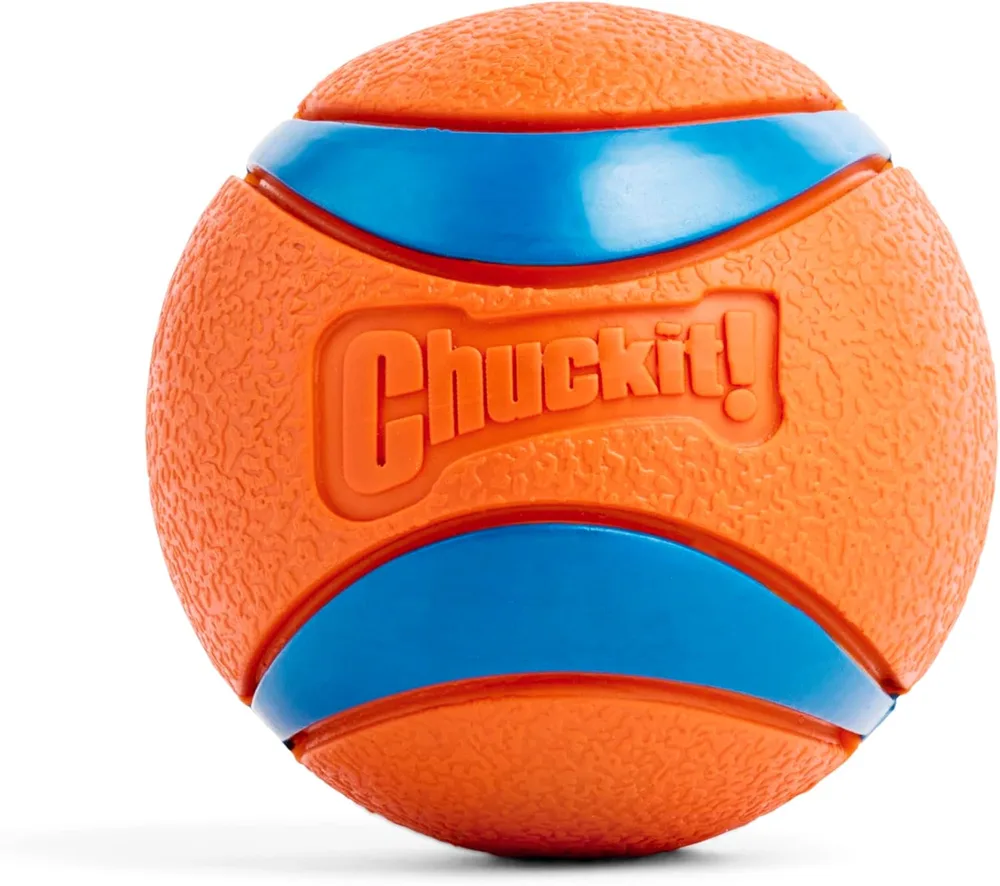
Rubber instead of abrasive fuzz, 3 inches across, rated for dogs 60–100 lb, and it floats — which for a breed with a water-repellent double coat and webbed feet is not a bonus feature, it is the point.
Read the manufacturer’s own warning, because it is the most useful sentence on the listing: the Ultra Ball is “not intended as a chew toy or for aggressive chewers.” This is a fetch object. A Lab that lies down and grinds a ball between the molars needs the KONG or the Goughnuts instead — and needs the ball put away between sessions.
Check the Chuckit! Ultra Ball on Amazon →
The part nobody sells you: fetch has a ceiling
A ball launcher makes it trivially easy to throw further than you could, for longer than you meant to. Two breed-specific reasons to keep an eye on that.
Exercise-induced collapse (EIC). The AKC lists EIC among the Labrador’s screened conditions, and there is a DNA test. Affected dogs are typically fine at rest and collapse after intense, excited exercise — which is precisely what twenty minutes of flat-out ball chasing is.
Heat. In a study of 905,543 dogs, 74.2% of heat-related illness events were triggered by exertion — not hot cars, which accounted for 5.2%. The dog most at risk of exertional heatstroke is a fit, enthusiastic dog with an owner who has not noticed the temperature. Our guide to how hot is too hot to walk your dog covers the thresholds, and the pavement temperature tool estimates surface heat for today.
Neither is an argument against fetch. Both are arguments for finishing while the dog still looks good, rather than when they finally stop.
Buying and using them safely
The AVSAB’s practical guidance, plus the manufacturers’ own:
- Supervise. KONG’s instruction is “supervised use only.” Solo chewing is for the tough rubber, in the crate, on a toy you’ve inspected.
- Size up, not down. Anything that fits behind the molars is the wrong size. This is the single highest-value rule in this article.
- Start puzzles easy. Easiest setting, high-value food, so the dog wins early. Frustration teaches a dog that puzzles aren’t worth it.
- Check the peanut butter for xylitol. It is toxic to dogs and appears in some sugar-free brands. Read the label every time you buy a new jar.
- Separate multi-dog households. Food toys plus proximity is how resource guarding starts. Different rooms, or different times.
- Inspect weekly, bin ruthlessly. KONG: “discontinue use if damaged.” A toy you’re not sure about has already told you the answer.
What we’d actually buy
If you’re starting from nothing with an adult Labrador, three toys cover it:
- KONG Extreme, X-Large — stuffed and frozen, for settling.
- KONG Wobbler — for one meal a day, out of the normal ration.
- Chuckit! Ultra Ball, Large — for the job the breed was built for, put away between sessions.
Add the Toppl if you know yourself well enough to admit you won’t scrub a narrow cavity. Add the Goughnuts only if your Lab has genuinely destroyed rubber before — it’s a solution to a problem most Labs don’t have.
For everything else about living with the breed — exercise load, feeding, the health picture behind the appetite — our complete Labrador Retriever guide is the full version, and how much exercise a dog actually needs covers the daily arithmetic. If your Lab’s toys mostly get used outdoors, a long-line leash makes retrieving practice possible in places where off-leash isn’t.
The bottom line
Buy for what happens if it breaks, not for the promise that it won’t. Size up rather than down. Deliver a meal through a toy instead of a bowl, and take that food out of the daily total rather than adding to it. Keep the tennis balls occasional and supervised, and give the rubber ball the everyday job.
Do that and your Labrador is entertained, slower to eat, less likely to end up in surgery — and you will spend less on toys than the person buying a new indestructible one every month.
If your dog is at the extreme end of this — the one that has already been through everything on this page — gifts for dogs that destroy everything covers the part we’ve deliberately left alone here: what veterinary dentists say about chew hardness, and why the antler you’re about to buy is the worst option on the shelf.
Sources
- Today’s Veterinary Practice — Prevalence of Gastrointestinal Foreign Bodies (Banfield data, ~2.4 million dogs): https://todaysveterinarypractice.com/gastroenterology/pet-health-numbersprevalence-gastrointestinal-foreign-bodies/
- Clinical findings and patient outcomes following surgical treatment of chronic gastrointestinal foreign body obstructions in dogs and cats: 72 cases (2010–2020), Canadian Journal of Veterinary Research: https://pmc.ncbi.nlm.nih.gov/articles/PMC9536220/
- American Kennel Club — Are Tennis Balls Safe for Dogs? (Dr. Thomas Chamberlain, veterinary dentist): https://www.akc.org/expert-advice/advice/are-tennis-balls-safe-for-dogs/
- Animal Medical Center of New York — Dogs and Tennis Balls: It’s Not Always a Match: https://www.amcny.org/blog/2020/08/26/dogs-and-tennis-balls-its-not-always-a-match/
- American Veterinary Society of Animal Behavior — A Guide to Using Food Puzzle Toys with Your Dog: https://avsab.org/a-guide-to-using-food-puzzle-toys-with-your-dog/
- Raffan E. et al., A Deletion in the Canine POMC Gene Is Associated with Weight and Appetite in Obesity-Prone Labrador Retriever Dogs, Cell Metabolism (2016): https://pmc.ncbi.nlm.nih.gov/articles/PMC4873617/
- Hall E.J., Carter A.J., O’Neill D.G., Dogs Don’t Die Just in Hot Cars — Exertional Heat-Related Illness Is a Greater Threat to UK Dogs, Animals (2020): https://www.mdpi.com/2076-2615/10/8/1324
- KONG Company — official KONG Extreme sizing and safety guidance: https://www.kongcompany.com/kong-extreme/
- Goughnuts — safety indicator and lifetime guarantee: https://www.goughnuts.com/guarantee
- American Kennel Club — Labrador Retriever breed standard and health: https://www.akc.org/dog-breeds/labrador-retriever/
Frequently asked questions
What is the best toy for a Labrador?
There isn't one — a Lab needs a toy for each of three different jobs. A stuffable rubber chew (the KONG Extreme in X-Large) for solo settling, a food-dispensing feeder (the KONG Wobbler or a West Paw Toppl) to slow down meals, and a rubber fetch ball built for retrieving rather than chewing (the Chuckit! Ultra Ball). Buying one toy to do all three is how toys get destroyed and dogs get bored.
What size KONG does a Labrador need?
X-Large for most adult Labs. KONG's official sizing puts Large at 30–65 lb and X-Large at 60–90 lb, and the AKC lists Labrador Retrievers at 65–80 lb. KONG also advises that power chewers may need to size up one or two sizes, so if your Lab has destroyed rubber before, go bigger rather than smaller — a toy that fits behind the molars is the dangerous one.
Are tennis balls bad for Labradors?
They carry two documented risks. The AKC, quoting board-certified veterinary dental specialist Dr. Thomas Chamberlain, describes the fuzz acting like sandpaper and wearing teeth down in a process called blunting, which can expose tooth pulp. The second risk is mechanical: a large dog can compress a standard tennis ball and lodge it in the throat, and swallowed fuzz can cause obstruction. Occasional supervised play is not a crisis; a Lab that carries one everywhere is a different situation.
Why do Labradors swallow their toys?
Partly appetite, partly retrieving instinct, partly size. Banfield hospital data across roughly 2.4 million dogs put Labrador Retrievers at 37.47 gastrointestinal foreign body cases per 10,000 dogs seen — second only to pit bulls at 42.78 — and noted that incidence rises with body size and is highest in dogs under a year old. There is also a genuine genetic appetite factor in the breed: a deletion in the POMC gene, found in roughly 12% of Labrador alleles studied, is associated with greater food motivation.
Can toys help a Labrador lose weight?
They can help you deliver the same food more slowly, which is not nothing. The American Veterinary Society of Animal Behavior notes that feeding dogs via toys rather than bowls can increase activity levels and may support weight-management programs. The critical rule is that puzzle food comes out of the daily ration, not on top of it. Any actual weight-loss plan for a Lab belongs with your vet.
How do I know when to throw a dog toy away?
KONG's own guidance is blunt: supervised use only, and discontinue use if damaged. Run your thumb over the toy weekly — any piece small enough to swallow, any tear you can get a fingernail into, and it goes in the bin. Goughnuts builds this into the product with a red inner layer that becomes visible as a wear indicator, and replaces the toy when a dog reaches it.
Comments
Got a question, a tip, or a correction? Leave a comment — no account, no sign-in. Just your name and your thoughts.
Loading comments…