
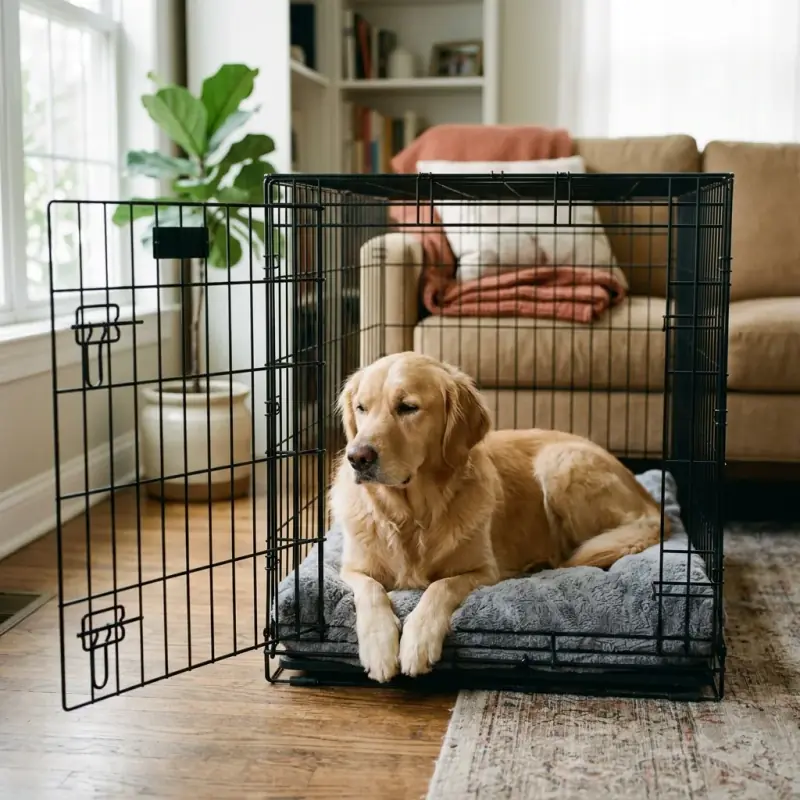
Here is the short answer, so nobody has to scroll for it: a 42-inch crate fits almost every adult Golden Retriever. The AKC puts the breed at 23–24 inches tall and 65–75 lb; 42-inch crates give roughly 42.5 × 28.5 × 30.5 inches of interior space, which clears a standing Golden’s head with room left over.
That is the easy part, and it’s where most crate articles stop.
The questions that actually decide whether crating goes well for you are different ones. Why a bigger crate can make house-training worse. Why the crate in your living room is not a safety device in your car. How long is genuinely too long — and why no veterinary source will give you the tidy number that blogs quote so confidently. And why, for this breed in particular, the crate is a tool with a fairly specific job description.
Measure the dog, not the breed
Weight charts are a proxy. Goldens vary — a compact field-line female and a heavy show-line male are not the same dog wearing different coats.
Two measurements, both taken with the dog standing normally:
- Length: tip of the nose to the base of the tail (not the tip). Add 2–4 inches.
- Height: floor to the top of the head. Add 2–4 inches.
VCA’s veterinary guidance sets the bar plainly: the crate needs “enough floor space for your dog to comfortably lie down and stretch and tall enough for your dog to stand comfortably without hitting his head.”
Here is how the crates in this guide actually measure up:
| Crate | Interior / stated size | Weight | Job | Price |
|---|---|---|---|---|
| MidWest iCrate 42″ | 42.88 × 28.75 × 30.38 in | 37 lb | Everyday home crate | Check price → |
| MidWest LifeStages 42″ | 42.5 × 28.5 × 30.5 in | 40.7 lb | Home crate, heavier gauge | Check price → |
| Diggs Revol Large | 42.5 × 28 × 30 in interior | 53 lb | Premium, movable, safety-engineered | Check price → |
| Petmate Sky Kennel 40″ | 36.25 × 24.75 × 28.8 in interior | ~30 lb | Air travel only | Check price → |
Note the last row. The airline kennel is smaller inside than the home crates — because IATA’s standard is “stand, turn and lie down naturally,” not “stretch out comfortably.” That is a deliberate difference, not a manufacturing flaw.
Why bigger is not better
The single most common mistake is buying the largest crate that fits the room.
Crate training works because dogs generally avoid soiling where they sleep. A crate with enough floor space for a sleeping area and a bathroom area quietly deletes that mechanism. The puppy learns the crate is a room with a toilet in it, and you spend three months undoing it.
This is exactly what the divider panel included with the MidWest crates is for. You buy the 42-inch crate once, partition it down to puppy dimensions, and slide the divider back as the dog grows. One purchase, twelve months of correct sizing.
The honest answer on time
Search “how long can a dog stay in a crate” and you’ll get confident numbers: four hours, six hours, eight hours, one hour per month of age. They are repeated everywhere and sourced almost nowhere.
We looked for a veterinary body that publishes a specific limit and did not find one. VCA’s crate training guidance gives no hour figure at all. What it says is that “extended periods of confinement are not healthy for animals,” that dogs need “daily social interaction as well as physical and mental exercise,” and — critically — that if a dog “salivates, vocalises persistently, tries to escape, or does not settle,” you should “consult your veterinarian before continuing with your training plan.”
So the honest framework is behavioural, not numeric:
- A dog that walks in, turns around and sleeps is telling you the arrangement works.
- A dog that pants, drools, digs at the tray, or has wet fur around the mouth when you come home is telling you it does not — regardless of how few hours have passed.
- Never as punishment. VCA is explicit, and it is the fastest way to poison the whole thing.
- Don’t open the door mid-protest. VCA notes that opening while the dog vocalises teaches the dog that vocalising works.
The Golden-specific caveat
There is a reason this matters more for this breed than for some others.
In a study of 1,002 dogs across 13 breeds using a standardised cognitive test battery, the Golden Retriever stood out as the most human-directed breed on the unsolvable task — the dog that turns and looks to a person for help rather than persisting alone. The Hovawart sat at the opposite end, working independently.
That’s a lab measurement of something Golden owners already know: this is a breed that orients hard toward people. A crate is an excellent tool for teaching such a dog to switch off. It is a poor tool for storing one.
The four jobs, and the crate for each
1. The everyday home crate — MidWest iCrate 42″
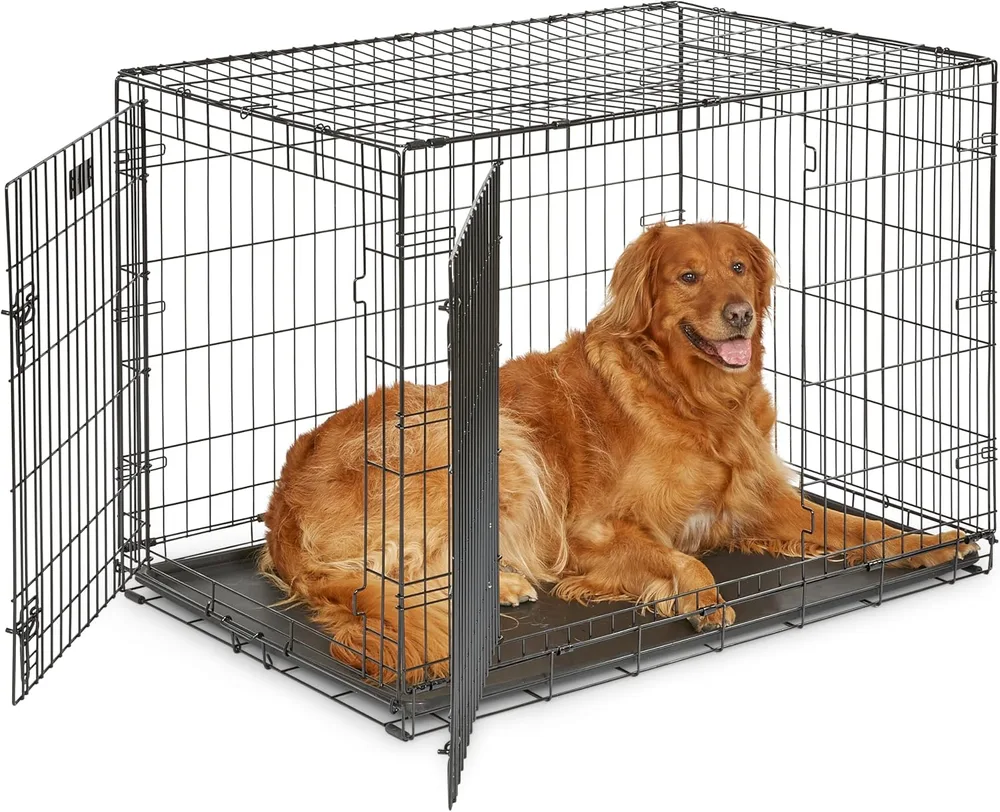
The default, and the one most Goldens will live with. Folding wire, double door, divider panel, leak-proof tray, rubber feet, carry handle, tool-free assembly. MidWest’s slide-bolt latches include a “Paw Block” feature aimed at stopping paws slipping through the latch, and the listing names Golden Retrievers directly in its 71–90 lb sizing band. It is the #1 best seller in Basic Dog Crates on Amazon, which is not evidence of quality but is evidence it does the ordinary job without drama.
Disclosure: some links below are affiliate links. If you buy through them we may earn a small commission at no extra cost to you.
Check the MidWest iCrate 42″ on Amazon →
2. The one that survives a determined dog — MidWest LifeStages 42″
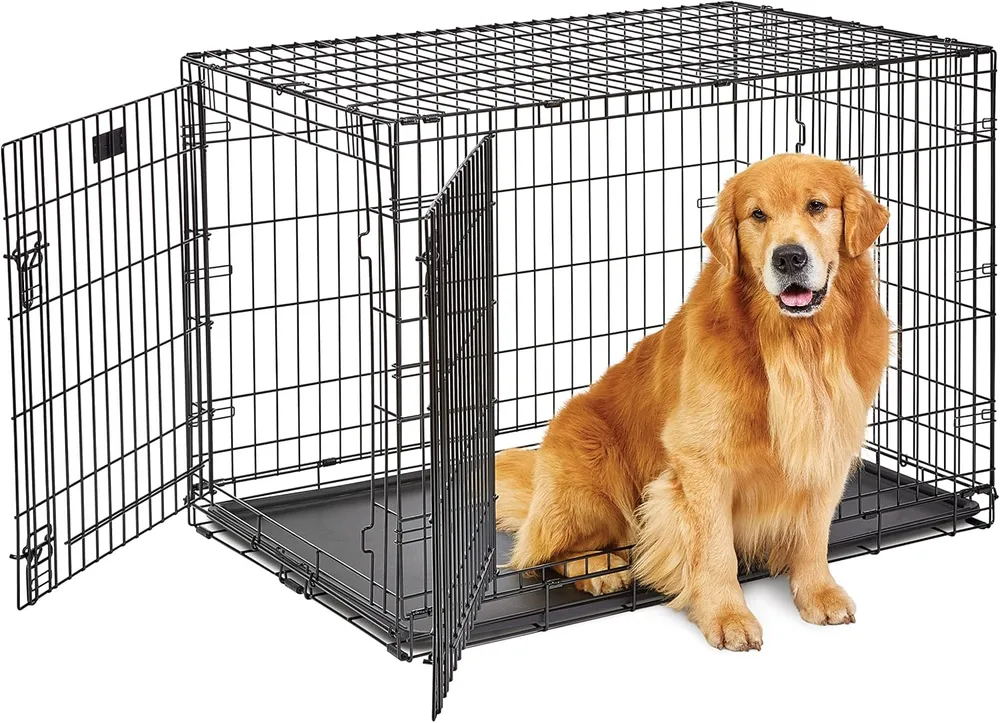
Same maker, same footprint, same divider — but reinforced with heavier-gauge wire. If your Golden is an adolescent who leans, digs and tests, or if the iCrate you already own has developed a bowed panel, this is the direct upgrade rather than a different concept. It weighs 40.7 lb against the iCrate’s 37 lb, which is where the extra steel went.
Check the MidWest LifeStages on Amazon →
3. The one you’ll move around the house — Diggs Revol Large
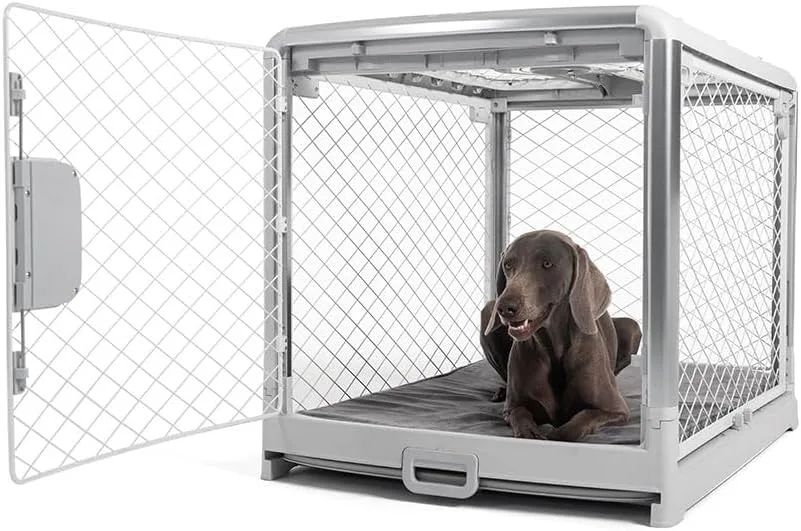
The Revol is the premium option, and what you’re paying for is engineering rather than branding. Built to baby-industry safety standards, with a patented diamond mesh designed to prevent paw and jaw pinching, dual latches the dog can’t reach from inside, a single-piece frame with rounded corners, built-in wheels, and three access points — front door, garage-style side door, and a ceiling hatch you can reach through to drop a treat without opening anything.
Its Large size lists interior dimensions of 42.5 × 28 × 30 inches and explicitly names Golden Retrievers in its 70–90 lb, 26–28 inch band.
Two honest caveats. It is 53 lb, so “portable” means wheeled between rooms, not carried up stairs. And Diggs’ own note is that the one-handed setup applies to the small and medium sizes — the Large is a two-handed job.
Check the Diggs Revol on Amazon →
4. The flight — Petmate Sky Kennel 40″
If your Golden is flying cargo, none of the above will do. Cargo crates are governed by USDA/APHIS rules and the IATA Live Animals Regulations: hard-sided, solid leak-proof floor, ventilation on multiple sides, secure non-snap hardware, and enough room to stand, turn and lie down naturally.
The Sky Kennel is built to that standard — Petmate states it meets IATA requirements, with 360-degree ventilation and tie-down strap holes, interior dimensions of 36.25 × 24.75 × 28.8 inches for dogs 70–90 lb, made in the USA, and it ships with the “LIVE ANIMAL” stickers, ID stickers, absorbent pad and cups you’d otherwise be scrambling for the night before.
Buy it weeks early. A dog meeting its travel kennel at the airport is a bad plan; our guide to flying with a dog covers the rest of the paperwork maze.
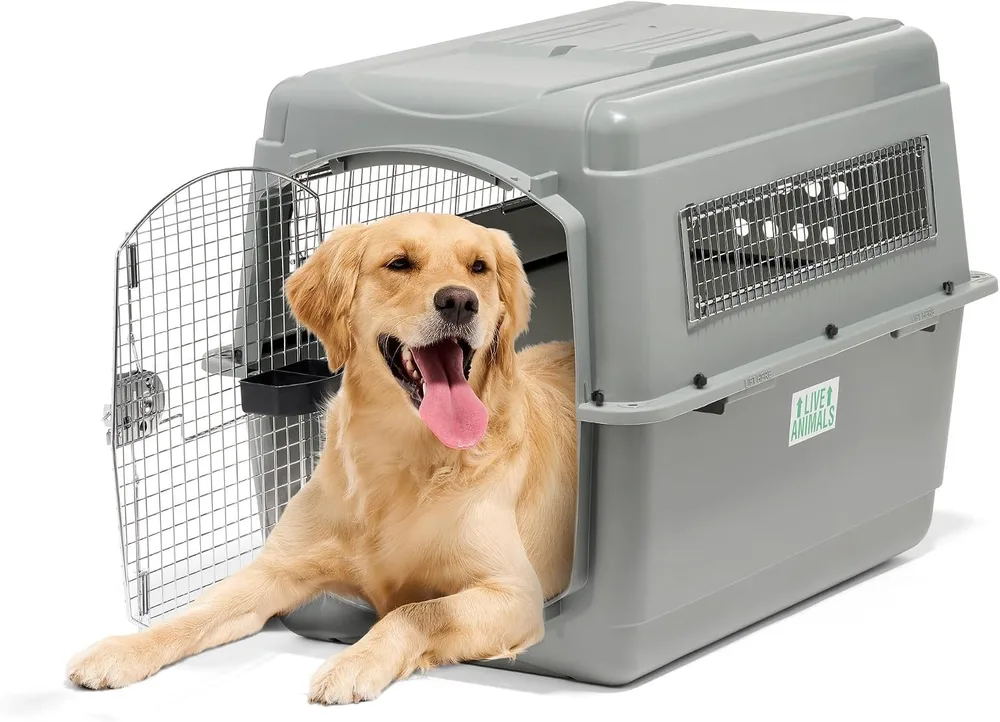
Check the Petmate Sky Kennel on Amazon →
The crate that isn’t on this list
Here is the thing the crate industry would rather you didn’t dwell on: almost no crate has been crash-tested, and a crate in a car is not a safety device by default.
The Center for Pet Safety runs an independent certification programme, and the pet travel crates that have earned its 5-Star Crash Test Rating are Gunner’s G1 series. The G1 Intermediate was certified under CPS standard CPS-002-016.01, tested with a 75 lb test dog and with the company’s strength-rated anchor straps — the straps are part of the certified configuration, not an accessory.
Gunner sells direct rather than through Amazon, which means we cannot link you to it here. We would rather say that than substitute an uncertified crate and let the word “heavy-duty” do the lying.
For most families, the practical answer for the car is a crash-tested harness rather than a crate — our guide to the safest dog car harnesses covers what has actually been tested and what merely looks sturdy.
Introducing the crate without wrecking it
The crate only works if the dog chooses it. That takes a fortnight of patience and saves years of trouble.
- Set it up and leave the door open. No ceremony. Let it become furniture.
- Feed meals inside, bowl at the back, door open. The crate should predict good things before it ever predicts confinement.
- Build duration in seconds, not hours. Door shut for five seconds, open before the dog asks. Then ten. The goal is that closing the door is boring.
- Give it a job to do. A stuffed, frozen chew turns crate time into an activity. Our Labrador toy guide covers which rubber toys survive being left alone with a retriever — the same picks apply to Goldens.
- Exercise first, crate second. A Golden with an unmet exercise need does not settle, and no crate design fixes that. How much exercise a dog actually needs has the arithmetic.
- Watch for distress, and take it seriously. Persistent vocalising, drooling, escape attempts — that’s a veterinary conversation, not a training-through-it situation.
The bottom line
42 inches, with a divider panel, is the correct answer for almost every Golden Retriever. The MidWest iCrate does that job at the lowest sensible price; the LifeStages is the same crate in heavier wire for dogs that have proved they need it; the Diggs Revol is the one to buy if design and movability matter more than cost; and the Petmate Sky Kennel is the separate, non-negotiable purchase if your dog is flying.
And then the part that isn’t about products at all. A crate is a bedroom, not a storage solution — least of all for a breed measured, in a proper study, as the most people-oriented of thirteen. Buy the right box, teach the dog to love it, and use it less than you expected to.
For the full picture on living with the breed, our complete Golden Retriever guide covers exercise, feeding, grooming and the health issues worth screening for.
Sources
- VCA Animal Hospitals — Life Skills for Pets: Crate Training and Confinement for Puppies and Dogs: https://vcahospitals.com/know-your-pet/crate-training-your-dog---an-overview
- Center for Pet Safety — Gunner Kennel G1 Intermediate certification record (5-Star Crash Test Rating, standard CPS-002-016.01): https://www.centerforpetsafety.org/cps-certified/gunner-kennel-g1-intermediate/
- Junttila S. et al., Breed differences in social cognition, inhibitory control, and spatial problem-solving ability in the domestic dog, Scientific Reports (2022): https://www.helsinki.fi/en/news/dogs/dog-breeds-differ-each-other-their-cognitive-traits
- American Kennel Club — Golden Retriever breed standard, size and health: https://www.akc.org/dog-breeds/golden-retriever/
- IATA — Live Animals Regulations, container requirements guidance: https://www.iata.org/en/programs/cargo/live-animals/
- Manufacturer specifications: MidWest Homes for Pets (iCrate 1542DDU, LifeStages 1642DDU), Diggs Revol Large, Petmate Sky Kennel 40″ — read from current Amazon listings, August 2026.
Frequently asked questions
What size crate does a Golden Retriever need?
A 42-inch crate for almost every adult Golden. The AKC lists the breed at 23–24 inches tall and 65–75 lb, and 42-inch crates run roughly 42.5 x 28.5 x 30.5 inches — enough to stand without ducking, turn around and stretch out. A 48-inch crate is only worth considering for an unusually tall male. Measure your own dog rather than trusting a weight chart: nose to tail base plus a few inches for length, floor to the top of the head while standing for height.
Is a bigger crate always better for a Golden?
No, and this is the most common expensive mistake. A crate roomy enough to have a bathroom corner and a bedroom corner removes the whole mechanism that makes crates work for house-training. That is exactly what the divider panel included with most wire crates is for — you buy the 42-inch crate once and shrink it to puppy size, expanding as the dog grows.
How long can a Golden Retriever stay in a crate?
Shorter than most blogs will tell you, and no veterinary source we could find publishes a specific hour limit. VCA's guidance says only that 'extended periods of confinement are not healthy for animals' and that dogs need daily social interaction plus physical and mental exercise. We are not going to invent a number that no vet has published. The practical test is the dog: a Golden that settles and sleeps is fine; one that salivates, vocalises persistently or tries to escape needs a vet's input, not a longer stretch.
Are wire crates safe in a car?
Not as crash protection, unless the specific model has been crash-tested. The only pet travel crates carrying a Center for Pet Safety 5-Star Crash Test Rating are Gunner's G1 series, tested with strength-rated anchor straps — and Gunner sells direct rather than through Amazon. Any other crate in a car is containment, not a safety device. For most families a crash-tested harness is the more practical answer.
Can I use my home crate for a flight?
No. Cargo travel is governed by USDA/APHIS rules and the IATA Live Animals Regulations, which require a hard-sided kennel with a solid leak-proof floor, ventilation on multiple sides and secure non-snap hardware. A folding wire crate meets none of that. You need a purpose-built airline kennel — for a Golden, the 40-inch size — and you need it weeks early so the dog is comfortable in it before the trip.
Should I cover my Golden Retriever's crate?
Often yes, if the dog likes it. A cover reduces visual triggers and can help a dog settle, which is the entire point of a crate. Watch for two things: airflow in warm weather, and whether your dog is actually calmer or just less able to see what is worrying them. If covering it makes them more agitated, uncover it — the crate is supposed to be the place they choose.
Comments
Got a question, a tip, or a correction? Leave a comment — no account, no sign-in. Just your name and your thoughts.
Loading comments…