
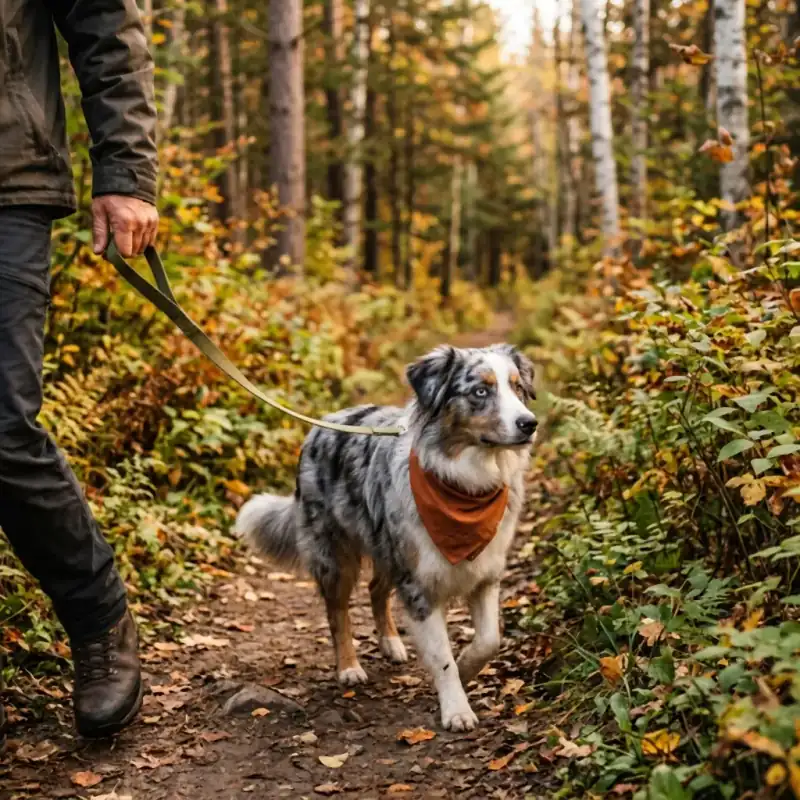
There is a belief about dogs in bear country that almost everyone who hikes with a dog holds, and almost nobody has ever checked. It goes like this: the dog will smell or hear the bear first, the dog will make noise, and the encounter you would have blundered into simply never happens. The dog is an early warning system with a wagging tail.
In June 2026 that belief got measured for the first time, and it did not survive well.
Before the numbers, though, one fact resets the question for a lot of readers: in the parks most people picture when they think “bear country,” this decision has already been made for them. Dogs are barred from the trails and the backcountry in Glacier, Yellowstone, Grand Teton and Rocky Mountain. The first three are the core of grizzly country in the lower 48; the fourth has black bears and the same rule. The federal rule behind all of it is short, and it gives each superintendent the authority to close areas to pets outright. If your plan involves a national park, start with where dogs are actually allowed in the national parks, because the answer is usually “not on that trail.”
Which means the real subject here is national forest and other public land. That is where hiking with a dog in bear country actually happens — and, as we will get to, it is the one place where the rule that would protect you is not the rule that applies.
The one study that exists
Smith, Herrero, Ciarniello and colleagues, The Journal of Wildlife Management, June 2026. The title is “The canine conundrum: Is a dog a help or hindrance in bear country?” and the author list matters: Stephen Herrero wrote the standard reference on bear attacks, and Tom Smith is the lead author on the bear spray and firearms studies that this page also leans on. This is not a fringe paper.
They assembled 326 human-bear conflicts involving domestic dogs across North America, covering black, brown and polar bears.
| What they found | Figure |
|---|---|
| Conflicts where the dog initiated the incident | 54% |
| People injured / killed | 170 / 5 |
| Dogs killed | 56 — “more than 10 times as many dogs died as people” |
| Setting: wilderness hiking / front country | 45.1% / 35.3% |
| Off-leash dog flushing a bear out of brush | 8.3% of cases |
| Owner injured in those flushing cases | 70% |
| Unleashed : leashed incidents | ≈ 6 : 1 |
| Odds of conflict with a dog present, versus a same-size group without one | ”more than doubled” |
And the early-warning belief? Smith told Mountain Journal that the dogs alerted their owners to a bear in roughly one encounter in eleven. His summary of it: “If you think a house pet is likely going to be your bear, not only detector but deterrent, you might want to think twice about that.”
One piece of arithmetic the news coverage never joined up: 8.3% of 326 is 27, which is the same 27 cases reported elsewhere as “the dog brought the bear back to its owner.” Two framings of one finding — and it is the finding that matters most, because it is the only one that describes a sequence rather than a category.
What that study cannot tell you
Here is where most writing on this topic goes wrong in one direction or the other, so it is worth being precise.
The study was criticised in public, in detail, by the journalist Wes Siler, and the core of his objection is correct: 326 conflicts across 122 years is a numerator with no denominator. The researchers deliberately excluded interactions that went fine. So “54% were started by the dog” means 54% of the conflicts that occurred — not 54% of walks, and not any kind of per-hike probability. The paper was also written for wildlife managers drafting guidance, and it treats companion dogs, not purpose-trained bear dogs.
The interesting part is that the study’s own lead author says the same thing. Smith, in that same interview: the data show encounters “that went majorly wrong,” and “for the most part, people and their dogs pass through bear country without incident.”
So this is not a study-versus-critic fight. Both sides agree the paper does not measure how likely a bear conflict is. What it measures is the shape of the conflicts that do happen — and shape does not need a denominator. Four findings survive the objection completely, because each of them compares conflicts to conflicts:
- unleashed incidents outnumbered leashed ones by close to six to one
- the flush-and-return sequence injured the owner 70% of the time
- carrying a bear deterrent decreased the odds of injury
- larger groups had fewer incidents
Those four are the actionable content of the paper. The “more than doubled the odds” headline is the one to hold loosely: it is a comparison inside a dataset of conflicts, not a risk multiplier for your Saturday.
And there is evidence pointing the other way, which belongs here too. The largest review of brown bear attacks worldwide — 664 cases across North America, Europe and Asia — found dog presence was a factor in 17% of the attacks where the scenario was known. That is a real cost. But the same authors note, in the same paper, that in Alaska dogs have been found to help terminate attacks in nearly half of the cases, while in others dogs are known to have initiated the attack. Both of those are true, from one set of researchers looking at one dataset, and the variable separating them is almost certainly what the dog does rather than whether it is there — which is the whole argument for the leash.
A real base rate does exist — in a different paper. A 2024 study in Ursus looked at 1991 to 2022 in Yellowstone and found roughly one bear-inflicted human injury per 88 grizzly backcountry interactions, and one per 343 for black bears. Off-trail travel carried about twice the attack rate of on-trail. You cannot multiply that against the dog research, because Yellowstone bans dogs from the backcountry and the two populations do not overlap. But it tells you the order of magnitude, which is what people are really asking when they ask whether this is safe: the absolute risk is low, and the dog moves it in the wrong direction.
The mechanism, in the agencies’ own words
The most persuasive thing about the flush-and-return sequence is that wildlife agencies were describing it before anyone counted it. The Park Service page for Great Smoky Mountains — the most-visited national park in the country, updated in August 2026 — says it flatly:
“Dogs are involved in most bear-related incidents with people. If your dog runs after a bear, it may lead the bear back to you.”
Parks Canada arrives at the same place independently: keep the dog leashed and under physical control at all times, and “we recommend leaving your dog at home if you plan to camp, hike or go into the backcountry.” Off-leash dogs, its Banff guidance notes, can trigger aggressive behaviour from grizzlies and elk — and this is enforced, not advisory: charges were laid after a July 2026 encounter on a Banff trail where an off-leash dog repeatedly ran at a grizzly, under regulations carrying a maximum penalty of 25,000 CAD.
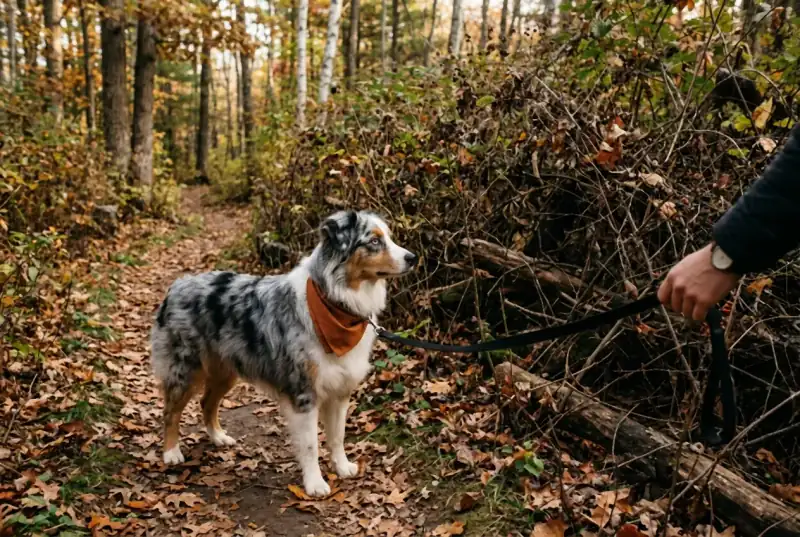
A federal agency page and a peer-reviewed paper, reaching the same conclusion by completely different routes. That convergence is worth more than either on its own.
Where the rule that protects you isn’t the rule that applies
This is the part almost nothing written for dog owners covers, and it is the most practically useful thing on this page.
In the national parks, the leash rule is federal and it is six feet — that is 36 CFR 2.15, and the parks each restate it. Fine, and largely academic, because dogs are off the trails there anyway.
On national forest land, where you will actually be hiking, the rule is 36 CFR 261.16, and the wording is the thing to notice:
“Bringing in or possessing an animal, other than a service animal, unless it is crated, caged, or upon a leash not longer than six feet, or otherwise under physical restrictive control.”
That prohibition sits inside a section titled Developed recreation sites — and here is the part worth knowing, because it is genuinely odd. The regulations do not tell you what a developed recreation site is. The definitions section, 36 CFR 261.2, says only this:
“Developed recreation site has the same meaning as in chapter 50 of Forest Service Handbook 2309.13.”
So the scope of the single rule that most reliably prevents the sequence in that study is set by an internal agency handbook rather than by the regulation — and forests read it differently. Superior National Forest, covering the Boundary Waters, issued a clarification in 2024 listing hiking trails and portages as developed recreation sites, alongside campgrounds and boat landings, with a six-foot leash required at all times. Its worked example is a good illustration of how fine the line is: your dog does not need a leash in a canoe in the middle of a lake, and does need one the moment you land at the portage.
Two consequences follow, and neither is the one you might expect:
You cannot read the regulation and work out whether a leash is required where you are standing. The answer lives in a handbook and in your particular forest’s orders. Assume it applies, and check before you go rather than at the trailhead. Where it genuinely does not apply, the leash has quietly become your decision rather than the ranger’s — and the 6-to-1 ratio in the study does not care which of those two situations you are in.
A long line is not a leash for this purpose. A long line is a genuinely useful training tool, and it is the wrong equipment in bear habitat — thirty feet of line is thirty feet of dog, and the flush-and-return sequence needs about that much room to start. Keep the long line for recall work in open country. And if you are relying on recall instead of a leash, recall training is worth being honest with yourself about: the relevant question is not whether your dog comes back in the garden, but whether they come back off a moving animal, which is a different behaviour entirely.
The deterrent, and how to buy one properly
Almost everything sold for the outdoors is sold on the manufacturer’s word. Bear spray is the rare exception, and it is worth knowing why: it is regulated as a pesticide, so a legitimate canister carries an EPA registration, and the agencies that actually deal with grizzly bears publish what one looks like. Combining the Interagency Grizzly Bear Committee guidelines with the Alaska Department of Fish and Game specification gives four things you can check on the shelf in about fifteen seconds:
| Check | Requirement |
|---|---|
| EPA registration number | Printed on the front label. Not “EPA compliant”, not “EPA approved” — a number |
| Active ingredient | 1–2% capsaicin and related capsaicinoids |
| Size | Minimum 7.9 oz / 225 g |
| Range | 25 feet or greater |
The size and concentration checks exist to catch the substitution that actually happens at the till: personal defence pepper spray runs closer to 1.33% capsaicinoids in a canister a fraction of the size. It is not bear spray, whatever the label art suggests, and a small canister has a second problem — ADFG notes that a full can holds only about 7 to 9 seconds of spray.
Those four checks are the entire decision, and there is no brand recommendation coming. Bear spray that meets the specification is a commodity: the registration number and the numbers on the label are the test, and IGBC is explicit that it does not endorse any particular product either.
Now the comparison, from three studies by the same research group:
| Study | What it measured | Result |
|---|---|---|
| Bear spray, Alaska 1985–2006, 83 incidents | Did the spray stop the bear’s behaviour? | 92% brown bears, 90% black, 100% polar. 98% of people carrying spray were uninjured. All three injuries were minor, none needing hospitalisation |
| Firearms, Alaska 1883–2009, 269 incidents | Did the firearm stop the bear? | Long guns 76%, handguns 84% — no significant difference. And: “firearm bearers suffered the same injury rates in close encounters with bears whether they used their firearms or not.” Bears were killed in 61% of cases |
| Spray performance, 2021 lab and modelling | Does cold or wind break it? | At −23°C the range was still over 4 m, though the plume was narrow. Under head and crosswinds above 10 m/s the spray still reached a target about 2 m in front of the user |
The Interagency Grizzly Bear Committee draws the conclusion itself, and it is unusually direct for an interagency document: compared to all other methods, including firearms, bear spray “has demonstrated the most success in fending off threatening and attacking bears and preventing injury to the person and animal involved.”
Which brings us to the number that should bother dog owners most. In those 326 dog-related conflicts, in the figures Smith gave Mountain Journal, bear spray was deployed in roughly 10% of cases — and firearms in roughly 33%. Dog owners in bear country are reaching, three times more often, for the tool with the measurably worse record. Smith’s line on this: “You have no business being in bear country without a deterrent.”
Three practical details from the 2021 performance study and the agency guidance, all of which contradict something people commonly do:
- Do not test-fire your can. Over half of a new seven-second canister’s pressure is lost in the first one second of spray. Practise with an inert trainer instead.
- Retire it at four years. The researchers found unused canisters slowly losing propellant through the seals, and recommend replacement at four years or older regardless of how it looks.
- Never pre-spray anything. The IGBC list is explicit — not people, not tents, packs, other equipment or the area around you — and ADFG explains why: the residue’s strong odour “may actually attract a bear.” Your dog and your dog’s bedding fall under the same logic.
The part nobody writes: your dog is inside the cone
Here is the thing that follows logically from all of the above and that I have not seen addressed anywhere.
You are on a forest trail. Your dog is on a six-foot leash in your left hand. A bear is at twenty-five feet and closing, and you deploy a cloud of aerosolised capsaicin into the space between you.
Your dog is in that space.
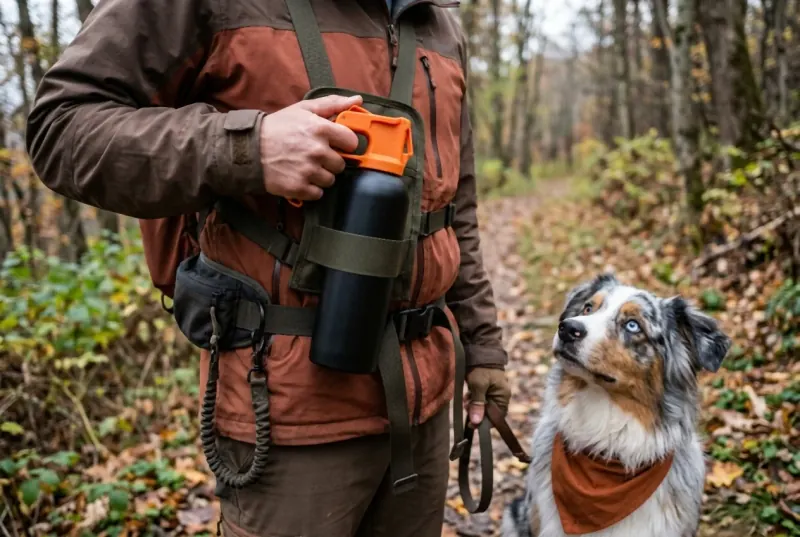
In the Alaska bear spray study, 14% of users reported negative effects from their own spray — 11% minor irritation, and 3% close to incapacitated. Wind interfered with accuracy in 7% of incidents, and ADFG’s warning is blunt: “you may be affected by even a small amount of the spray, making it difficult for you to function. Stay out of the spray!” A dog at leash length cannot stay out of the spray. They are lower to the ground, breathing harder, and have a nose built to concentrate exactly what you just released.
No study has measured this. I searched the full text of the bear spray research for any mention of dogs and found none; neither IGBC document addresses pets. There is no veterinary protocol for bear-spray exposure in dogs, because nobody has run one.
What exists is general decontamination guidance, and it is worth knowing before you need it. The ASPCA’s advice for a pet contaminated with an oily substance: gloves and old clothes on first, then mild liquid dish soap rather than dog or human shampoo, because dish soap is what actually cuts an oily residue — capsaicin is an oil, which is why water alone spreads it around. No blow dryer afterwards, since heat can spread residue and irritate skin further. And the ASPCA Animal Poison Control Center is on (888) 426-4435.
None of this is an argument against carrying spray. It is the best-evidenced protective equipment in this entire article and you should carry it. It is an argument for having decided, in advance, that you will spray anyway — because the alternative to a temporarily miserable dog is a dog in a fight with a bear, and the study counted 56 dead dogs.
Why September is the wrong month to relax
If you are reading this in autumn, the timing is not neutral. Bears are in hyperphagia — the pre-denning feeding push. BearWise, which is run by bear biologists and backed by state wildlife agencies, describes bears “finding 20,000 calories a day or more,” roughly ten times their normal intake, and sleeping no more than three or four hours a day.
The operative consequence is the one they name directly: bears in this state “can be more willing to take risks, like venturing near homes, campgrounds and trails.”
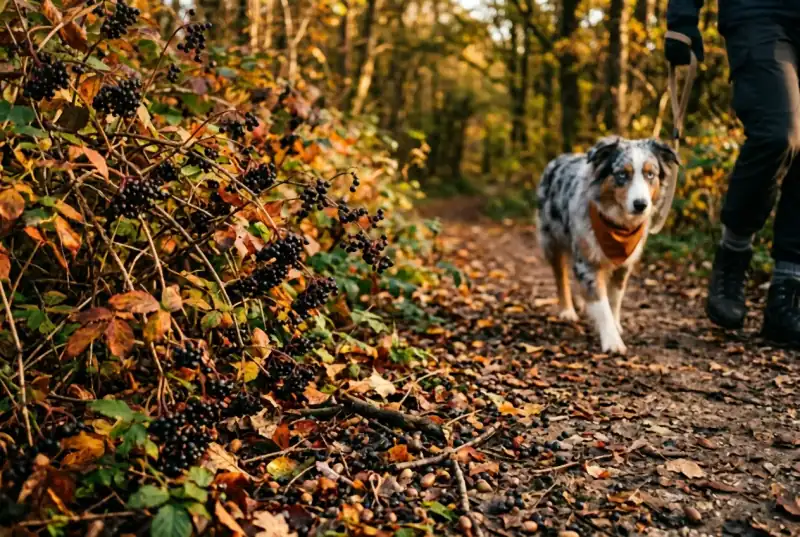
So the shoulder season that feels like the best hiking of the year — cool air, no crowds, no heat risk for the dog — is also the season with the most bear on the landscape, moving further, for longer, and less inclined to avoid you. This is the same window covered in our guide to autumn hiking hazards for dogs, and it belongs on the same list. If you camp, food storage stops being etiquette and becomes the main event; the dog camping checklist covers stowing your dog’s food along with your own, which people forget because it does not feel like food to them.
If you meet a bear with a dog on the leash
The agency protocol for a bear encounter is well established, and it is worth being honest that none of it is dog-specific. No agency publishes a dog-modified version. Parks Canada’s guidance, which is as clear as any:
- Stay calm and do not run. Speak to the bear in a firm voice so it identifies you as human. Back away slowly.
- A defensive encounter — a surprised bear, or a female with cubs — calls for appearing large, backing off, and playing dead only if contact actually happens.
- A non-defensive encounter — a bear that follows you — calls for standing your ground, shouting, and acting aggressively.
- A predatory attack, which is rare, is the one case where you do not play dead: use the spray and fight back.
The dog-specific parts are the ones the study points at rather than the ones any agency writes down:
Shorten the leash, do not release it. Letting the dog go is how the flush-and-return sequence starts, and it is how a bear that was interested in a dog becomes a bear that arrives where you are standing.
Do not intervene in a fight. This is the hardest instruction in this article and the best evidenced. Of the owners who went to their dog’s aid in a dog-bear conflict, 85% were injured. Spray the bear. Do not close the distance.
Travel in a group. Both the study and Parks Canada land in the same place — larger groups have fewer serious encounters, and Parks Canada suggests a tight group of four or more. If you routinely hike alone with your dog, this is the cheapest change available to you.
This is educational information, not veterinary or emergency-services advice. Bear behaviour varies by species, region, season and individual animal, and rules for specific parks and forests change. Confirm current regulations with the land manager before you travel, and take a local bear-safety briefing where one is offered. If your dog is injured by wildlife, contact a veterinary practice or emergency clinic immediately; if you are injured, treat it as an emergency and report the encounter to the managing agency, because bears involved in incidents are managed on the basis of those reports.
The short version
A dog is not an early warning system. That belief has now been checked against 326 conflicts, and dogs alerted their owners in about one encounter in eleven while initiating 54% of the conflicts outright.
The study cannot tell you how likely a bear encounter is — it has no denominator, and its own lead author says most people and dogs pass through bear country without incident. But the conditional findings hold: unleashed incidents outran leashed ones by roughly six to one, the sequence where a loose dog flushes a bear and brings it back injured the owner 70% of the time, and carrying a deterrent lowered the odds of injury.
So the plan is short. Leash the dog on the trail, including everywhere you cannot tell whether the law requires it. Carry EPA-registered bear spray in a holster where your hand can reach it, check that it is 1–2% capsaicinoids and at least 225 grams, and retire it at four years. Make noise with your voice rather than relying on the dog’s. Hike with other people. And decide now that if it comes to it, you will spray the bear with your dog standing next to you — because a dog that gets a face full of capsaicin recovers, and 56 of the dogs in that study did not.
If your honest answer to all of that is “I would rather not manage it,” then Parks Canada already said the quiet part for you: for a backcountry trip in bear habitat, the safest option is leaving the dog at home. That is not a failure of nerve. It is the same conclusion the people who study this for a living keep arriving at. Our guide to starting out hiking with your dog covers plenty of terrain where the calculation is much easier.
Frequently asked questions
Do dogs attract bears?
The evidence says they change encounters more than they attract bears. A 2026 study in the Journal of Wildlife Management examined 326 human-bear conflicts involving domestic dogs across North America and found the dog initiated 54% of them, with unleashed incidents outnumbering leashed ones by close to six to one. Separately, a worldwide review of 664 brown bear attacks found dog presence was a factor in 17% of the cases where the scenario was known. Neither figure tells you how likely a bear encounter is on your next hike — both describe the conflicts that happened, not the walks that didn't.
Should I keep my dog leashed in bear country?
Yes, and this is the one recommendation every source on this page agrees on. In the 2026 study, incidents involving unleashed dogs outnumbered leashed ones by nearly six to one, and the specific sequence where an off-leash dog flushed a bear out of brush accounted for 8.3% of cases and left the owner injured 70% of the time. Parks Canada goes further and recommends leaving the dog at home for backcountry trips. A leash is also a legal requirement in the national parks and at developed recreation sites in the national forests.
Does a barking dog scare a bear away?
Sometimes, and that is the problem — it is not reliable, and the same bark can do the opposite. A worldwide review of brown bear attacks notes that in Alaska dogs have helped terminate attacks in nearly half of the cases, while in others dogs are known to have initiated the attack. What agencies actually recommend for warning bears is your own voice: the Interagency Grizzly Bear Committee suggests periodically calling out, especially in dense vegetation, near loud streams and on windy days. A human voice is unmistakably human. A barking dog reads to a bear as a small predator, which is a different message.
Will bear spray hurt my dog if I have to use it?
Almost certainly it will affect them, and no study has measured how much. In the Alaska bear spray research, 14% of users reported negative effects on themselves from their own spray — 11% minor irritation, 3% near incapacitation. A leashed dog is within six feet of the canister and inside the same cloud. There is no veterinary or agency protocol for bear spray exposure in dogs; the nearest guidance is general decontamination advice from the ASPCA, which is gloves first, mild liquid dish soap rather than shampoo because capsaicin is an oil, no blow dryer, and a call to the Animal Poison Control Center on (888) 426-4435. This does not make spray the wrong choice. It makes it a thing to have thought about in advance.
Is it safe to hike with a dog where there are grizzlies?
The honest answer is that the absolute risk is low and the dog moves it in the wrong direction. For scale, a 2024 study of Yellowstone found roughly one bear-inflicted human injury per 88 grizzly backcountry interactions, and one per 343 for black bears, across 1991 to 2022. That figure comes from a park where dogs are banned from the backcountry, so it cannot be combined with the dog research — but it does show what order of magnitude we are discussing. If you take the dog, the leash and the bear spray are not optional extras, they are the plan.
What do I do if a bear follows my dog back to me?
This is the sequence the research singles out, and the answer is that you deal with the bear, not the dog. Get the bear spray out and the safety off, keep the dog beside you and short on the leash rather than chasing it, stand your ground, speak firmly and do not run. If the bear keeps coming, spray at 20 to 30 feet, aiming slightly downward in front of its head. The instinct to go and retrieve your dog is the one to fight: in the 2026 study, 85% of owners who intervened in a dog-bear fight were injured.
Sources
Every figure in this piece traces to one of these. Dates are when we read the source — certified lists, prices and park rules all move.
- The canine conundrum: Is a dog a help or hindrance in bear country?Smith TS, Herrero S, Ciarniello L, Hristienko H, Lewis E, Bendio F, Wiggins L — The Journal of Wildlife Management 90(6):e70236 (2026)The central study on this page. Source of the 326 conflicts, the 54% dog-initiated figure, the 8.3% flushing cases and their 70% owner-injury rate, the 6-to-1 unleashed-to-leashed ratio, and the doubled-odds finding.Read 9 September 2026
- Think your dog makes you safer in bear country? The data say otherwise.Mountain JournalInterview with lead author Tom Smith. Source of the figures that sit in the paywalled body rather than the abstract — the 1-in-11 alerting rate and the deterrent split — and of Smith's own statement of the study's limits.Read 9 September 2026
- The Literacy Crisis Reaches Dog-Bear ScienceWes SilerThe published criticism of how the study was reported. The denominator objection summarised here is his.Read 9 September 2026
- Brown bear attacks on humans: a worldwide perspectiveBombieri G, Naves J, Penteriani V, et al. — Scientific Reports 9:8573 (2019)Dog presence as an attack scenario in 17% of 289 attacks worldwide, 2000–2015, and the authors' own note that in Alaska dogs have helped terminate attacks in nearly half of cases.Read 9 September 2026
- Grizzly bear and American black bear interactions with people in Yellowstone National ParkGunther KA, Atkins KM, Wyman TC, Reinertson EG — Ursus 2024(35e16):1-13The base rate used here: 1 bear-inflicted injury per 88 grizzly backcountry interactions and 1 per 343 for black bears, 1991-2022, plus the on-trail versus off-trail comparison.Read 9 September 2026
- Efficacy of Bear Deterrent Spray in AlaskaSmith TS, Herrero S, Debruyn TD, Wilder JM — The Journal of Wildlife Management 72(3):640-645 (2008)83 incidents, Alaska 1985-2006. Source of the 92/90/100% figures, the 98% uninjured figure, and the self-contamination rates that the section on your own dog rests on.Read 9 September 2026
- Efficacy of Firearms for Bear Deterrence in AlaskaSmith TS, Herrero S, Layton CS, Larsen RT, Johnson KR — The Journal of Wildlife Management (2012)269 incidents, 1883-2009. Long-gun and handgun success rates, and the finding that firearm bearers were injured at the same rate whether or not they fired.Read 9 September 2026
- An Investigation of Factors Influencing Bear Spray PerformanceSmith TS, Wilder JM, York G, Obbard ME, Billings BW — The Journal of Wildlife Management 85(1) (2021)Lab and computational-fluid-dynamics testing. Source of the cold and wind results, the four-year retirement recommendation, and the finding that over half a canister's pressure goes in the first second.Read 9 September 2026
- IGBC Bear Spray Guidelines 2017Interagency Grizzly Bear CommitteeThe interagency standard: EPA registration on the front label, one can per person, two cans considered, holster carry, and the explicit statement that spray has outperformed all other methods including firearms.Read 9 September 2026
- Bear SprayInteragency Grizzly Bear CommitteeThe minimum canister size of 7.9 oz, the 20-30 foot range, and the capsaicinoid difference between bear deterrent and personal pepper spray.Read 9 September 2026
- Hikers and Campers — Be Bear AwareInteragency Grizzly Bear CommitteeThe noise recommendation quoted here: periodically yell "Hey bear!", especially in dense vegetation and blind spots, travelling upwind, near loud streams or on windy days. The page says nothing about dogs.Read 9 September 2026
- What you should know about Bear SprayAlaska Department of Fish and Game (2025)The purchase specification quoted here, the 7-9 seconds of spray per can, the wind warning, and the instruction never to pre-spray objects because the residue may attract a bear.Read 9 September 2026
- 36 CFR 261.16 — Developed recreation sitesLegal Information Institute, Cornell Law SchoolThe Forest Service leash requirement, quoted here in full, and the fact that it attaches to developed recreation sites rather than to National Forest System land as a whole.Read 9 September 2026
- 36 CFR 261.2 — DefinitionsLegal Information Institute, Cornell Law SchoolThe reason the scope of that leash rule cannot be read off the regulation: the definition of a developed recreation site is delegated to chapter 50 of Forest Service Handbook 2309.13.Read 9 September 2026
- Forest Service offers clarification on dog leash rulesEly Echo, 13 July 2024, reporting the Superior National Forest clarificationOne forest reading the handbook definition to include hiking trails and portages, with the canoe-versus-portage example used here. Reported locally rather than published by the Forest Service, which is why it is presented as one forest interpretation and not as the national position.Read 9 September 2026
- 36 CFR 2.15 — PetsLegal Information Institute, Cornell Law SchoolThe federal source of the six-foot leash rule in the national parks, and the superintendent authority to close areas to pets entirely.Read 9 September 2026
- Pets — Great Smoky Mountains National ParkNational Park ServiceThe Park Service's own statement that dogs are involved in most bear-related incidents with people and may lead a bear back to the owner. Page updated 17 August 2026.Read 9 September 2026
- Park Statistics — Great Smoky Mountains National ParkNational Park ServiceThe park's own statement that it is consistently the most visited national park in the country, with more than 12 million recreational visits in 2024.Read 9 September 2026
- Safe travel in bear countryParks CanadaLeash requirement, the recommendation to leave the dog at home for backcountry travel, the group-of-four guidance, and the defensive-versus-predatory encounter protocol.Read 9 September 2026
- Fall is power-eating time for bearsBearWise — created by bear biologists, supported by state wildlife agenciesAutumn hyperphagia: 20,000 calories a day or more, three to four hours of sleep, and the willingness to take risks near campgrounds and trails.Read 9 September 2026
- Pet Decontamination at Home: What to Do After ExposureASPCADermal decontamination guidance for pets: gloves first, mild liquid dish soap rather than shampoo, no blow dryer, and the Animal Poison Control Center number.Read 9 September 2026
Comments
Got a question, a tip, or a correction? Leave a comment — no account, no sign-in. Just your name and your thoughts.
Loading comments…