
Flying with a dog is less about the flight and more about the fine print — and the fine print is a moving target. Rules differ by airline, by aircraft, by destination, and they change. But underneath the chaos there’s a stable framework that applies almost everywhere. Learn it and you can plan confidently, then just confirm the specifics with your carrier.
One rule above all: verify everything with your airline directly, well before you book. This guide decodes the system; your airline’s current policy is the final word.
The first fork: in-cabin vs. cargo
Where your dog rides comes down mostly to size.
In-cabin is for small dogs only. If your dog fits comfortably in an airline-approved carrier that slides under the seat in front of you, it can usually fly in the cabin with you, and it must stay inside the closed carrier the entire flight.
Ignore the “20 lb limit” that gets repeated as though it were a rule. It is not universal. United publishes no weight limit and no breed limit at all for in-cabin pets — what it publishes instead is a carrier ceiling: 11 x 18 x 11 inches soft-sided, or 9 x 17.5 x 12 inches hard-sided. Plenty of other airlines do set a weight, and it differs between them.
So the number to check is never the dog’s weight in the abstract. It is (a) your airline’s carrier dimensions and (b) the under-seat space on your specific aircraft, which is not constant even within one airline. United, for example, allows two pets per person on most flights but only one on the A319, A320, A321neo, 737-800/8 and 737-900/9 — the same ticket, a different plane, a different answer.
Cargo (the pressurised, temperature-controlled hold) is the only option for larger dogs — and here is the blunt 2026 reality: for most people, with most US airlines, it is no longer available.
This is the single biggest change owners get wrong, so it is worth being specific. Checking your dog as baggage at the counter has largely become a benefit for two groups only:
- United states plainly that it no longer checks pets through its PetSafe program, and that pets can fly in cargo only with certain active-duty military or State Department employees.
- American likewise accepts checked pets at the ticket counter only for active-duty US Military and US State Department Foreign Service personnel travelling on official orders.
There is still a route for everyone else, but it is a different product with different economics: American Airlines Cargo runs American PetEmbark, booked separately from your own ticket rather than added to it, for pets that do not qualify as carry-on or checked. Expect to be quoted rather than to pay a published fee — American lists cargo pricing as varying by booking.
So if your dog is too big for an under-seat carrier, plan on one of three things: a dedicated pet-cargo booking, an airline outside the big carriers that still runs a checked-pet program, or not flying. For a lot of large-dog owners the honest answer is the drive — our dog road trip checklist covers doing that properly, starting with the restraint, since riding unrestrained is what actually injures dogs in cars.
Service dogs are a separate legal category with their own rules and aren’t covered by these pet policies.
The carrier and crate rules
In-cabin carriers must be airline-approved, soft-sided, leak-proof, ventilated, and small enough to fit under the seat while your dog can still stand up and turn around. Measure your under-seat space (it differs by airline and plane) before buying.
Disclosure: some links below are affiliate links. If you buy through them we may earn a small commission at no extra cost to you.
Check Travel Carriers on Amazon →
If your dog already has a crate they genuinely like at home, that habit is most of the battle — our crate sizing guide covers why a crate that is too big causes as many problems as one that is too small, which is the same measuring logic that applies here.
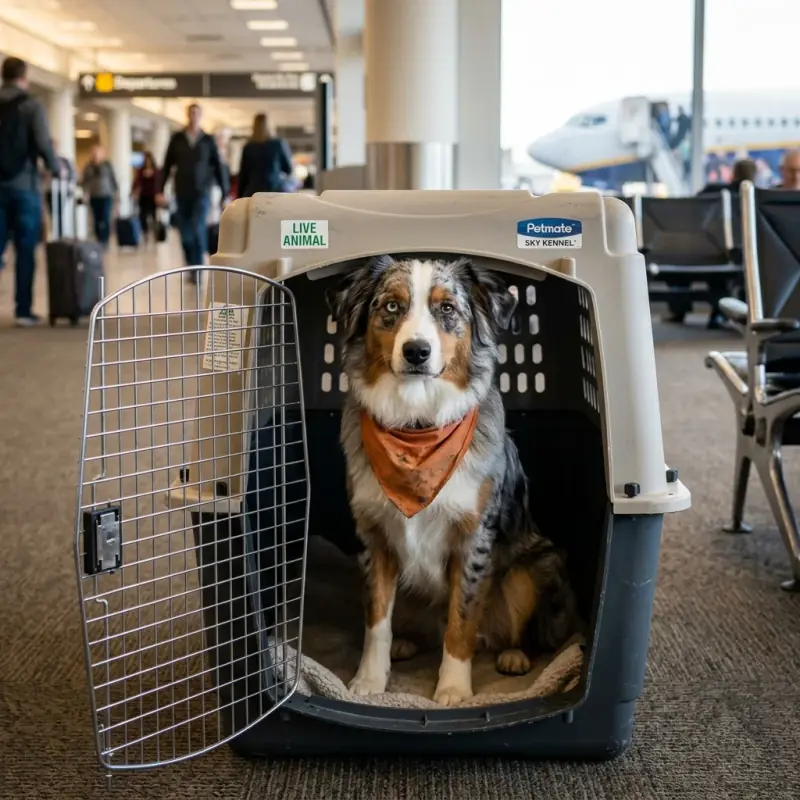
Cargo crates must comply with IATA Live Animal Regulations — the global standard for size, ventilation, and sturdiness. An IATA-compliant crate is hard-sided, has ventilation on multiple sides, secure (non-snap) hardware, and is large enough for the dog to stand, turn, and lie down naturally. Don’t guess on sizing; airlines reject non-compliant crates at check-in.
An IATA-compliant travel crate is worth buying early so your dog can get comfortable in it before the trip.
The rule that catches Americans coming home
Start here, because it is the one people miss — including people who never thought of themselves as doing “international pet travel.”
Every dog entering or returning to the United States needs a CDC Dog Import Form receipt. Not just imported dogs. Your dog, coming home from your holiday, needs one. The CDC states it plainly: all dogs entering or returning to the U.S. must be accompanied by that receipt. It is free, filled in online, and you show the receipt printed or on your phone.
Three baseline conditions come with it, and they apply to every dog regardless of where it is flying in from:
- At least 6 months old. This is a much higher bar than the eight-week minimum airlines apply, and it is the one that surprises people — a puppy old enough to board a plane can still be too young to enter the country.
- Microchipped, with a chip a universal scanner can actually read. The CDC warns that if the chip cannot be scanned on arrival for a dog coming from a high-risk rabies country, the dog may be denied entry and returned to the country of departure at the importer’s expense. If your chip number starts with anything other than a 9, the CDC specifically suggests checking with your vet that it is readable.
- Healthy on arrival.
Where your dog has been then decides how much more you need. Dogs that have only been in dog-rabies-free or low-risk countries need nothing beyond the above. Dogs that have been in a high-risk country in the previous six months need additional documentation, and foreign-vaccinated dogs in that category are restricted to arriving at an airport with a CDC-registered animal care facility — they cannot come in over a land border at all.
Two practical notes that catch North American travellers:
- The form covers land borders too. The CDC is explicit that the requirements apply even to dogs merely transiting the US by road, and even if the dog never leaves the vehicle.
- For Canada and Mexico the receipt is reusable — valid for multiple entries for six months, as long as the country of departure does not change. Travel to Canada regularly and one receipt covers you; add a Mexico trip and you need a new one listing Mexico.
Screwworm: the new requirement almost nobody has heard of
This one is weeks old at the time of writing, and it is going to strand people over the holidays.
From 3 August 2026, dogs travelling into Mexico must present a New World Screwworm inspection certificate — and United, which publishes the requirement, notes it applies to service dogs and in-cabin pets alike, not just cargo. To get one, the dog must show no sign of infectious or contagious disease, be free of internal and external parasites as confirmed by a health certificate, and have no wounds. The certificate has to be signed by a USDA-accredited veterinarian and issued no more than 5 days before travel.
That five-day window is the trap. It is tight enough that it has to be planned around rather than squeezed in, and an accredited vet is not the same thing as your usual vet — check that yours holds USDA accreditation before you count on the appointment.
Screwworm also runs in the other direction: the USDA may require certification for dogs arriving in the US from regions where it is known to exist, which covers many countries across Africa, Asia and Latin America.
The rest of the paperwork
Most airlines require a health certificate — a veterinary certificate of health — issued within a set window before departure. “Around 10 days” is the usual shorthand, but the real schedules have more moving parts than that. American, for instance, publishes three different windows depending on your itinerary: within 10 days of travel, within 60 days of your return if the return is on the same ticket, and within 10 days of your return if it is on a separate ticket.
Book the return on a separate ticket without noticing and you can need a second vet visit abroad. That is worth checking before you book, not after.
- Domestic (US): the certifying vet generally does not need USDA accreditation, but you still need the certificate.
- International: requirements jump — a USDA-accredited vet, destination-specific vaccinations, import permits, microchip and rabies documentation, sometimes titre tests and quarantine. Start months ahead; some countries’ requirements take that long to satisfy.
Airlines generally require puppies to be at least eight weeks old to fly — but as above, that is the airline’s floor, not the country’s.
Breed restrictions you need to know
Brachycephalic (snub-nosed) breeds — Bulldogs, Pugs, Boxers, Boston Terriers and similar — are frequently barred from cargo travel, and some airlines won’t accept them at all, including “mixes.” The reason is real: their compromised airways make altitude and heat stress genuinely dangerous. A small flat-faced dog may still qualify for in-cabin travel, but check the specific policy first — never assume.
Comfort and safety rules that apply in the air
- Water access: USDA rules require animals to be offered water at set intervals (every 12 hours), which shapes how long a cargo journey can be. Choose direct flights and shorter routes. That 12-hour figure is the only published watering interval for dogs in the US, and what it does and does not mean is worth reading before a long routing.
- Temperature embargoes: many airlines won’t fly pets in cargo during very hot or very cold periods for safety — another reason large-dog travel needs flexible planning.
- Don’t sedate without veterinary guidance: sedation can be dangerous at altitude and is discouraged by many vets and airlines. Ask your vet.
How to prepare your dog
- Crate-train in advance. Buy the carrier or crate weeks early and make it a normal, comfortable space — feed meals in it, build up time inside. A dog that already loves its crate travels far better.
- Exercise before the airport. A well-exercised dog is a calmer passenger.
- Manage food and water. Follow your vet’s guidance on the last meal before travel; a light stomach reduces nausea. Attach a water dish to cargo crates as required.
- Pack the essentials: paperwork (printed and on your phone), a familiar blanket, waste bags, and ID tags plus a microchip that’s registered and up to date.
The bottom line
Flying with a dog isn’t hard once you see the structure. Small dogs go in-cabin in an under-seat carrier, and the carrier’s dimensions matter more than the dog’s weight. Large dogs mostly can’t be checked any more — that has quietly become a military and State Department benefit at the big US carriers, leaving a separate cargo booking or the drive. Everyone needs a timely health certificate, and anyone flying a dog into the United States needs a CDC Dog Import Form receipt plus a dog that is at least six months old and readably microchipped. Flat-faced breeds face extra restrictions. Mexico now wants a screwworm certificate dated within five days.
Two habits cover most of it: book the vet appointment around the tightest window on your itinerary, not the loosest, and check the aircraft, not just the airline. Then confirm every specific with your carrier before you book — because at the gate, their current policy is the only one that counts.
If the paperwork math turns out worse than the mileage, that is a legitimate answer. The road trip checklist and our guide to whether dogs are allowed where you’re going are the two things worth reading before you swap the flight for a drive.
Sources
Airline and government policy pages change without notice. These were read on 19 August 2026; treat them as the starting point and reconfirm before you book.
- CDC — Frequently Asked Questions on Dog Importations — the Dog Import Form, the 6-month age floor, microchip readability, high-risk vs low-risk countries, land-border rules
- United — Traveling With Pets — PetSafe withdrawal, in-cabin carrier dimensions, per-aircraft pet limits, the Mexico screwworm certificate
- American Airlines — Traveling With Pets — checked-pet eligibility, American PetEmbark, the three health-certificate windows
- USDA APHIS — Pet Travel, US to Mexico — New World Screwworm certification
- US Department of Transportation — Flying With a Pet
Frequently asked questions
Can my dog fly in the cabin with me?
Only if it fits in an airline-approved carrier that slides under the seat in front of you, and stays shut in there for the whole flight. Be careful with the '20 lb limit' you'll read everywhere — it is not universal. United, for example, publishes no weight or breed limit for in-cabin pets; the binding constraint is the carrier, capped at 11 x 18 x 11 inches soft-sided. Other airlines do set a weight. The only limit that always applies is whether the carrier fits under that specific seat, so check your airline and your aircraft.
Do dogs need a health certificate to fly?
Most airlines require a health certificate (a veterinary certificate of health) issued within a set window before travel — often 10 days, but it varies. For domestic US flights the vet doesn't need USDA accreditation; for international travel it does, plus destination-specific requirements. Always check both your airline's and your destination's rules well in advance.
What is the CDC Dog Import Form, and do I need one?
Yes — if your dog is entering or returning to the United States, every dog needs a CDC Dog Import Form receipt, including US dogs coming home from a holiday. It is free and filled in online. The CDC also requires the dog to be at least 6 months old, microchipped with a chip a universal scanner can read, and healthy on arrival. Dogs that have been in a high-risk rabies country in the previous 6 months need more paperwork on top. Note this catches people driving back from Canada or Mexico too — the rules apply at land borders even if you never get out of the car.
Can flat-faced breeds like Bulldogs and Pugs fly?
Often not in cargo. Brachycephalic (snub-nosed) breeds are frequently barred from cargo travel because their airways make them dangerously prone to breathing trouble at altitude, and several airlines refuse them outright. A small flat-faced dog may still fly in-cabin, but check your airline's specific breed policy first.
Comments
Got a question, a tip, or a correction? Leave a comment — no account, no sign-in. Just your name and your thoughts.
Loading comments…