
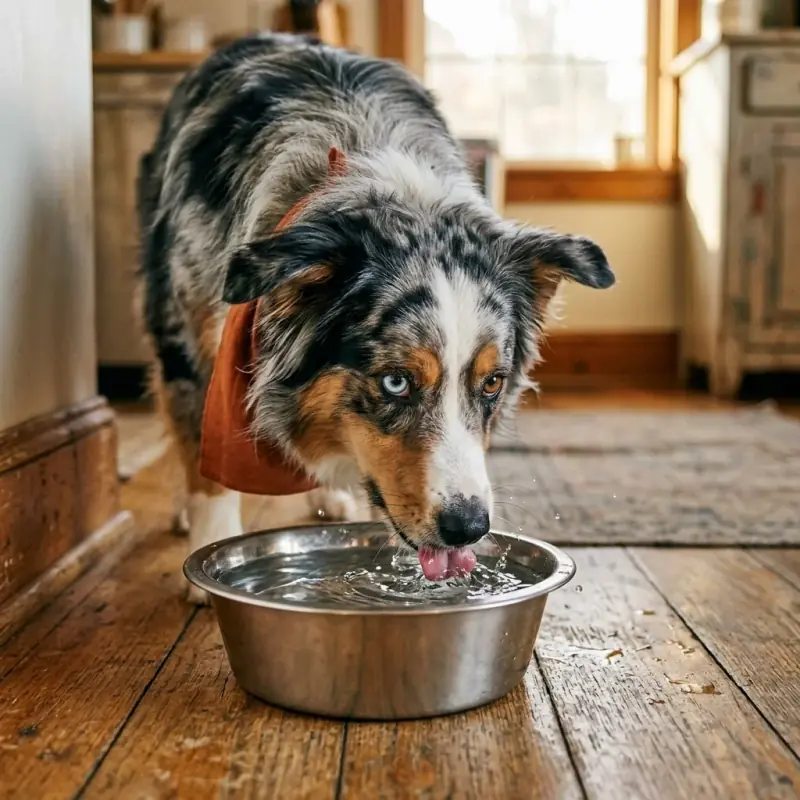
Nobody looks this up out of curiosity. The question arrives attached to something: a bowl found dry at the end of a long workday, a flight with a layover that grew, a dog that has not touched its water since yesterday, a gate left open and a dog back on the doorstep two days later.
The answer everyone gives is about three days. It is worth knowing where that number comes from, because it did not come from dogs.
”Three days” is a human mnemonic, borrowed
It is the rule of threes, the wilderness survival maxim: three minutes without air, three hours without shelter in a harsh environment, three days without water, three weeks without food. It exists to rank what will kill you fastest when you have to choose what to deal with first, and it is honest about itself — it is “a generalization (or rule of thumb), not scientifically accurate,” and it is about people.
Nothing in it was ever derived from a dog. Dogs have a different kidney, a different cooling system, a different surface-area-to-mass ratio and a fifty-fold size range between the smallest and largest of them. A single number cannot be right across all that, and this one is not.
What is strange is that the canine evidence does exist. It is just old, buried in physiology journals, and it says something more interesting than three days.
What the actual dog studies found
In 1979, Hardy and Osborne published the paper that still sets the reference values for the canine water deprivation test. Twenty dogs with normal kidney function, deprived of water under supervision, measured on the way down.
Two findings matter here, and the second one is the one nobody quotes.
The dog kidney is extraordinarily good at this. Mean maximal urine osmolality was 2,289 mOsm/kg, and maximal urine specific gravity averaged 1.062, ranging up to 1.076. The ratio of urine concentration to blood concentration at that point was 7.3 to 1. A dog under water stress produces urine more than seven times as concentrated as its own plasma, and keeps the water.
And the consequences were mild. In the authors’ words: “abnormal increases in serum urea nitrogen and serum creatinine concentrations occurred rarely, even though some dogs had water withheld for periods of up to 96 hours.”
That is the closest thing to a direct answer that exists, and it needs its conditions stated out loud, because on its own it is the most misreadable sentence in this article. Those were healthy adult dogs with normal kidneys, at rest, indoors, in a controlled temperature, under supervision, with their body weight tracked on the way down — weighing the dog was one of the things the study was checking. It is a measurement of physiological tolerance. It is not a description of a safe or acceptable interval, and it is not about your dog, who is a different dog under different conditions with a kidney nobody has measured.
The other deprivation work agrees on the direction. Zucker and colleagues restricted water in conscious dogs for four days and reported elevated plasma sodium, osmolality and renin activity — a body working hard, and working. Thrasher’s group measured what a single day does to a dog that is still eating: after 24 hours without water, plasma sodium was up 6.0 mEq/L, plasma protein up 0.8 g/dL, and vasopressin — the hormone that tells the kidney to keep water — up 5.3 pg/mL.
So a dog one day into this is not fine and not in danger. It is measurably dehydrated, and it is compensating.
These are studies from the 1970s and 1980s, run under the oversight of their time, and they would be designed differently today. They are also the only controlled canine data on the question, and the thresholds every veterinary textbook uses rest on them. Quoting them without saying so would be dishonest in both directions.
The three published standards nobody quotes
If the physiology says “longer than you think,” the rule-makers say something much tighter — and the gap between those two is not a contradiction. It is the whole point.
At home, the legal answer is “always”
Every USDA-licensed kennel, breeder, exhibitor and research facility in the United States operates under 9 CFR Part 3. The watering section is one paragraph, and the sentence about dogs contains no interval at all:
“Potable water must be continuously available to the dogs, unless restricted by the attending veterinarian or except as provided in § 3.17(a).”
The detail worth noticing is the next sentence, which is about cats:
“If potable water is not continuously available to the cats, it must be offered to the cats as often as necessary to ensure their health and well-being, but not less than twice daily for at least 1 hour each time, unless restricted by the attending veterinarian.”
So the people who wrote the rule did consider scheduled watering. They wrote it out, for one species, and did not extend it to dogs. In a licensed facility a dog with an empty bowl is not a judgement call about how long is too long — it is a finding on an inspection report. None of this governs private homes, and it is worth copying anyway, because it is the only published watering standard for dogs in the country.
In transit, the number is twelve hours
The same subpart covers dogs travelling in commerce, and there the regulation does give an interval:
“Each dog and cat must be offered potable water at least once every 12 hours.”
Two things around that sentence sharpen it. Food, for a dog 16 weeks or older, is required only once every 24 hours — water is required twice as often as food. And an animal handed to a carrier must have been offered food and potable water within the four hours before it went.
Twelve hours is the closest thing to a published maximum for a healthy adult dog, and the conditions it assumes are worth reading: a crate, a temperature-controlled hold, an animal at rest and not working. Not a warm car, an autumn trail or a garden in the sun. If you are planning air travel, the airline’s own paperwork sits on top of this — that is the subject of our guide to flying with a dog.
When vets restrict water deliberately, they stop at 5% of body weight
The modified water deprivation test is still used to work out why a dog is drinking and urinating excessively, and it is not run by the clock.
The Merck Veterinary Manual sets out the protocol. The daily allowance is reduced gradually — “restricted by 5%–10% each day” — and body weight, hydration status and urine concentration are checked daily. It stops at whichever of three endpoints comes first: urine specific gravity above 1.025, 5% of body weight lost, or the daily allowance falling below 60 mL/kg. The instruction attached is explicit: monitor carefully “to prevent a loss of > 5% body weight and severe dehydration.”
That last endpoint is quietly interesting. Merck elsewhere puts a normal requirement at roughly 44–66 mL/kg per day in a thermoneutral environment. The floor built into the protocol — the point at which a supervised, deliberate restriction is called off — is approximately one ordinary day’s water.
Nobody who does this professionally answers the question in hours. They answer it in body weight and millilitres. So should you.
What is actually being lost
Water is not stored in a dog the way fuel is stored in a tank. It is a compartment that turns over continuously.
In an adult dog, total body water is about 60% of body weight; in a puppy it is around 80%. Two-thirds of it sits inside cells. Of the remaining third, roughly three-quarters is in the tissue spaces between them and only a quarter is in the bloodstream — which is why a dog can be meaningfully dry before anything shows up in the part of the system that keeps blood pressure up.
The losses never stop: urine, faeces, and evaporation from the respiratory tract, which in a dog is also the cooling system. Panting is water leaving. None of it pauses because the bowl is empty. And the baseline is not a full tank either — as Ramsay and Thrasher put it, at the normal plasma osmolality set point animals sit in mild dehydration all the time. Thirst is a system that runs a small deficit and corrects it, not one that keeps a reserve topped up.
Two numbers define the visible window, and both come from clinical practice rather than folklore:
- 5% is the minimum percentage dehydration that can be detected on physical examination. Below that, a dehydrated dog looks like a dog. Merck’s own grading starts a fraction lower, with semidry gums at 4–5%; that is the same line drawn with a slightly different pencil, and neither version is a number you can act on at home.
- Above 12% is likely to be fatal.
Everything anyone will ever see happens inside those seven percentage points. The first 5% is invisible — and it is invisible to your vet too.
The arithmetic, by size
To turn percentages into time you need one more figure: how much water a dog of a given size goes through in a day. The veterinary maintenance formula is
132 × body weight (kg)0.75 = millilitres per 24 hours
Look at the exponent before you look at the number. It is not 1. Water requirement scales with metabolic rate rather than body mass, which means every per-pound rule of thumb is a straight line drawn through a curve — including one on this site, which we come back to at the end.
Everything in this table is calculated from that formula. The right-hand columns are the 5% deficit — the point at which dehydration first becomes detectable, and the point at which vets stop their own test — and how fast that deficit would build if nothing were coming in and nothing were being held back.
| Dog | Water per day | 5% of body weight | Deficit builds that far in |
|---|---|---|---|
| 5 lb / 2.3 kg | 8 oz (244 mL) | 3.8 oz (113 mL) | ~11 hours |
| 10 lb / 4.5 kg | 14 oz (410 mL) | 7.7 oz (227 mL) | ~13 hours |
| 20 lb / 9.1 kg | 23 oz (690 mL) | 15 oz (454 mL) | ~16 hours |
| 40 lb / 18.1 kg | 39 oz (1,160 mL) | 31 oz (907 mL) | ~19 hours |
| 60 lb / 27.2 kg | 53 oz (1,573 mL) | 46 oz (1,361 mL) | ~21 hours |
| 80 lb / 36.3 kg | 66 oz (1,952 mL) | 61 oz (1,814 mL) | ~22 hours |
| 100 lb / 45.4 kg | 78 oz (2,307 mL) | 77 oz (2,268 mL) | ~24 hours |
| 130 lb / 59 kg | 95 oz (2,809 mL) | 100 oz (2,948 mL) | ~25 hours |
That last column is a floor, not a forecast. It is what the arithmetic gives with no compensation at all — and compensation is precisely what Hardy and Osborne measured. A real dog’s urine output collapses, its urine concentrates sevenfold, and the deficit builds far more slowly than the table suggests. That is why healthy dogs in those studies went days rather than hours.
So the honest shape of the answer is two bookends. The floor is about half a day for a small dog and about a day for a large one. The ceiling, for a healthy adult at rest in a controlled temperature, runs into days. Your dog is somewhere between, and the position is set by two things: how much reserve that particular animal has, and what is spending it. Merck’s summary of the general case is one sentence long — water is the most important nutrient, and “a lack of water can lead to death in a matter of days.”
Two footnotes on the numbers. The maintenance formula is a clinical figure written for hospitalised animals, and a dog at home also takes in water with its food. And it disagrees with Merck’s own 44–66 mL/kg band at the small end, returning 107 mL/kg for a 2.3 kg dog. That disagreement is not an error to paper over — it is this article’s thesis. Flat per-kilo figures are mid-size averages.
The reserve, and the dogs that do not have it
Everything above rests on one mechanism. Water stops arriving, the pituitary releases vasopressin, the kidney reabsorbs water that would have left as urine, and the urine concentrates — up to that 7.3-to-1 ratio. The margin in the studies is that mechanism.
It is also invisible from the outside, unmeasurable at home, and absent or reduced in three groups of dogs.
Dogs with kidney disease. The inability to concentrate urine when challenged is one of the early signs of chronic kidney disease, appearing at around two-thirds nephron loss — well before most owners notice anything. Merck lists the consequences plainly: losing the ability to conserve water by concentrating urine, and later the nausea and reluctance to drink that come with it, “contribute to increased risk for dehydration.” A dog can look entirely normal and have already spent the reserve this whole article depends on.
Puppies. A neonate is about 80% water, cannot concentrate or dilute urine properly, and runs a high metabolic and respiratory rate — three separate reasons to lose water faster and hold less back. Worse, the two tests owners use both fail on exactly this animal: skin water content is low enough that skin-tenting cannot be used at all, and the standard signs are harder to read in a neonate generally. The dog with the least margin is the dog you can least assess by eye.
Dogs that are already behind. Vomiting, fever, a hot afternoon, a hard run — all of it comes out of the same account before the bowl goes empty.
What spends the margin faster
Heat. A panting dog cools itself by evaporating water, so the hotter it is, the faster the deficit builds — and the 44–66 mL/kg band above is explicitly for a thermoneutral environment. The temperature thresholds themselves are a separate subject, and how hot is too hot to walk your dog is where the lines are.
Work. Water turnover in working dogs runs far above maintenance, and the measured figures have their own home on this site: do dogs need electrolytes on the trail has them, along with the two ways salt goes wrong outdoors and the question of whether anything needs to be in the water. The short version there is no.
Vomiting and diarrhoea. This is the accelerator that matters, and it is the one that actually puts dogs on a drip. A dog losing fluid from both ends covers ground in hours that would otherwise take a day. Two things from Cornell’s Riney Canine Health Center are worth holding onto, because owners commonly get the first one backwards: after an isolated vomit you may withhold food for 12 hours, but not water — and if vomiting lasts more than 24 hours, or comes with lethargy or fever, that is a call to the vet rather than a waiting game.
Fever and illness. Insensible losses rise with fever, wounds and higher metabolic demand — enough to add 15–20 mL/kg per day on their own. For a 40 lb dog that is another quarter of its daily requirement, on top of whatever else is happening.
Two different emergencies, and people conflate them
The question splits in half, and the halves need opposite responses.
No access. The bowl was empty, the dog was shut in somewhere, the dog was lost. The clock above applies: restore water, then work out how much was spent, from how long, how hot, and how old and how big the dog is.
Access, but not drinking. The bowl is full and the dog is ignoring it. This is not a hydration problem — it is a symptom, and the physiology says so clearly. A dog that has genuinely gone without does not need persuading: given water after 24 hours, dogs in these studies drank enough to cover their deficit within a five-minute window, and took 60% of their total intake in the first sixteen minutes. A thirsty dog with water in front of it drinks now. One that does not is telling you about nausea, pain, fever or something else, and that is what needs attention. Cornell’s guidance is to talk to a vet as soon as possible if a dog refuses both food and water or cannot keep fluids down. Do not spend a day waiting to see whether it gets thirsty enough.
Water that is there and cannot be drunk
There is a third case that gets counted as “the dog had water,” and it is worth its own section because it is the one people discover afterwards.
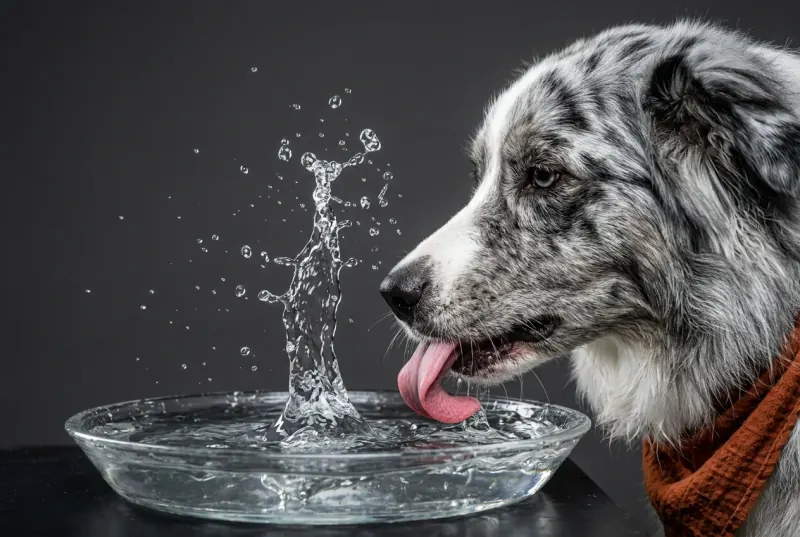
Dogs cannot drink the way we do. The PNAS study that filmed nineteen of them doing it opens with the reason: “Dogs lap because they have incomplete cheeks and cannot suck.” A dog throws a column of water upward with its tongue and bites the column off. That mechanism needs an open surface of water at a reachable height, and it fails completely on anything that requires suction.
Which produces a short list of ways a full container is not water:
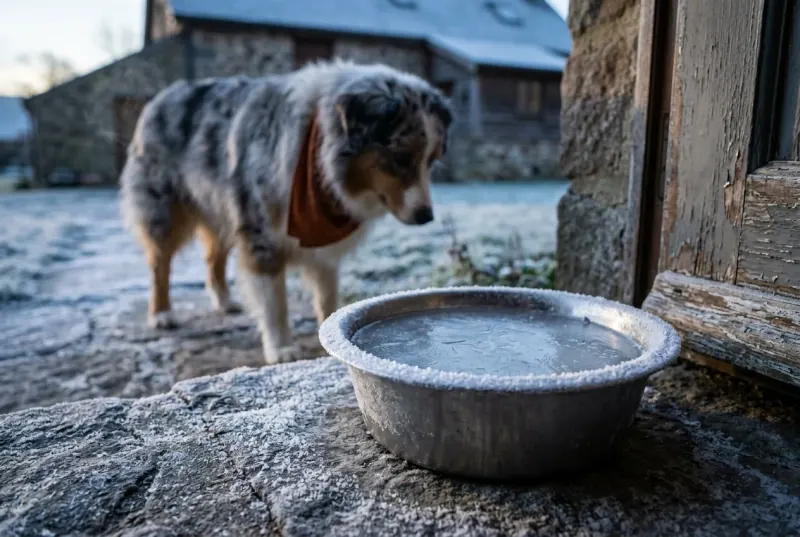
- A frozen bowl. The first hard frost of the year turns an outdoor bowl into a lid. It looks full from a window.
- A bottle or lixit the dog has never used. Common in crates and travel kit, and a dog that has not learned one will not work it out while stressed in a car.
- A bowl that went over an hour after you left. A crate bowl tipped at 9am is an empty crate at 6pm, and the evidence is a damp blanket.
- Water the dog cannot reach, because a door swung shut, a gate latched, or the bowl is at the top of stairs a senior dog stopped using.
Two bowls in different places costs nothing and removes most of this list. It is the single cheapest thing on this page.
How to check, best test first
The order matters here, and it is roughly the reverse of the order most people use. It is also not a matter of opinion: Hardy and Osborne tested four indicators against each other and reported which ones held up.
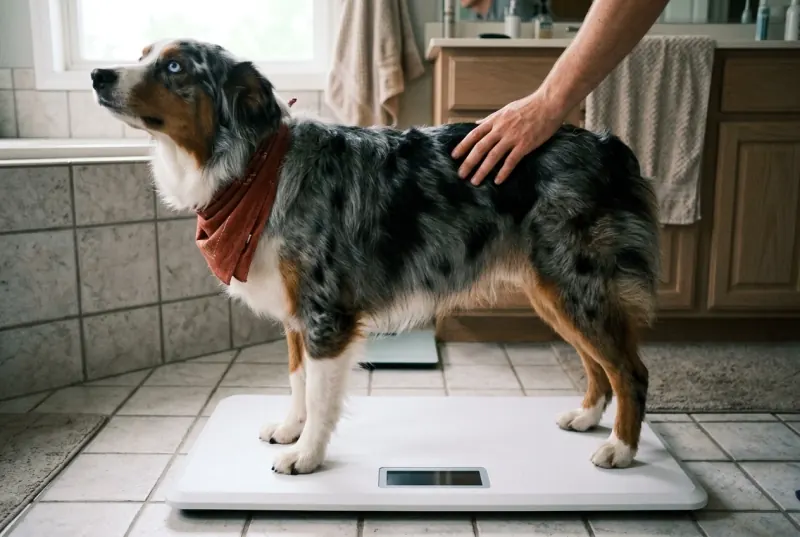
1. Weigh the dog. Weight loss was one of the two consistent indicators in that study — the other, total plasma protein, needs a blood sample. It is the only test on this list that produces a number. Five percent is the professional stopping point, and on a real dog it is a small quantity: half a pound on a 10 lb terrier, one pound on a 20 lb spaniel, four pounds on an 80 lb shepherd. If you know last month’s weight you have a baseline no other test can give you. Bathroom scales are enough — weigh yourself, then weigh yourself holding the dog.
2. Gums. Run a finger along the gum above a canine tooth. Merck’s grades: semidry at 4–5% dehydration, dry at 6–7%, and very dry with possible altered consciousness at 12% and above. A nauseated dog may be drooling, which muddies this one.
3. Eyes. Retracted, sunken eyes appear in the 8–10% band — by which point this has stopped being something to keep an eye on at home.
4. The skin tent, last. Lift the skin over the shoulders and let go. Merck puts “mild loss of skin turgor” at 6–7% and “considerable loss” at 8–10%, and then explains why it misleads: emaciated and geriatric animals show poor turgor whatever their hydration, and young animals’ skin is too elastic to read. Hardy and Osborne found skin pliability was not a consistent indicator at all. Merck’s own summary of the whole business: “estimating dehydration in a patient is always, to some extent, subjective.”
The test every owner knows is the one the evidence supports least.
What to do when you find the bowl empty
Offer water. Do not stage a drinking competition.
The reason is specific, and it is in Merck’s guidance on hypernatraemia. Sodium rises during a stretch without water — Thrasher’s dogs were up 6.0 mEq/L after a single day. Bring it down too fast and water follows the osmotic gradient into brain cells: “once water access is restored, due to a rapid decrease in serum sodium concentration, intracellular water influx into neurons along the osmotic gradient can lead to cerebral edema.” The instruction that follows is the one to copy — water “initially in small amounts at frequent intervals.” In a hospital the target is a fall of 0.5–1.0 mEq/L per hour, slower the longer it has been going on.
Then work through this in order:
- Offer water at room temperature, in normal-sized amounts, every few minutes. Small dogs and puppies especially.
- Offer again in twenty minutes, and again after that. Dogs stop drinking before the deficit is restored — the satiety signal arrives before the water has been absorbed. A dog walking away from the bowl has usually not finished.
- If heat was involved, cooling comes first. That is a separate emergency with its own protocol, and it outranks the water.
- Do not withhold water because the dog vomited. Food, maybe, for a few hours. Water, no.
- Call the vet if the dog is lethargic, will not drink at all, cannot keep water down, has sunken eyes or very dry gums — or is a puppy, a senior, a dog with known kidney disease, or a small dog that has gone a long stretch without. Our printable emergency card exists so those numbers are written down before you need them.
And the one-ounce-per-pound rule, since we use it
The most repeated hydration rule for dogs is one ounce of water per pound of body weight per day. It appears on this site, in our dog camping checklist, and it is worth measuring against the formula rather than passing along.
One ounce per pound is 65 mL/kg. The veterinary formula returns 65 mL/kg at almost exactly 37 lb. Which means:
| Dog | One oz per pound gives you | Against the formula |
|---|---|---|
| 5 lb | 5 oz | 61% of requirement |
| 10 lb | 10 oz | 72% |
| 20 lb | 20 oz | 86% |
| 37 lb | 37 oz | 100% |
| 60 lb | 60 oz | 113% |
| 100 lb | 100 oz | 128% |
| 130 lb | 130 oz | 137% |
The rule is not so much wrong as it is a straight line through a curve: accurate for a spaniel, roughly a third short for a Chihuahua, a third over for a Newfoundland. Which direction matters depends on one thing only — whether the dog can get more.
With a full bowl at home, none of this is a target to hit. Given ample water, healthy animals self-regulate, and the food moves the number as much as the dog does: when researchers switched dogs from canned food to dry, water drunk from the bowl rose from about 24 to 62 mL/kg per day while urine output did not change at all. The rule only bites when you are the supply — carrying water on a trail, rationing it in a car, or packing for a weekend. In those cases round up, and round up hardest for the smallest dogs, which is the opposite of what the rule does on its own.
The short version
- “Three days” is a human survival mnemonic, not a dog number, and it says of itself that it is not scientifically accurate.
- The canine studies say longer, under conditions you do not have. Healthy adult dogs in a 1979 reference study rarely showed abnormal kidney values even when water was withheld up to 96 hours — at rest, indoors, supervised, weighed. That is physiological tolerance, not permission.
- The rule-makers say much less. Continuous at home for licensed facilities, every 12 hours in transit, and stop at 5% of body weight when vets restrict water on purpose.
- Below 5%, dehydration cannot be seen — not by you and not by a vet. Above 12% is likely fatal.
- The margin is renal, and it is invisible. A dog concentrates urine to seven times the concentration of its blood, and that is what buys the days. Kidney disease takes it early, puppies never had it, and heat, work, vomiting and fever spend it fast.
- A dog that will not drink is a different emergency from a dog that cannot. A thirsty dog with water in front of it drinks within minutes; one that does not is reporting a symptom.
- Check the water is drinkable, not just present. A dog cannot suck. Frozen, tipped, unreachable and untrained-bottle all count as empty.
- Weigh the dog. It is the only test here that returns a number, and it is the one the evidence supports.
This article is general information, not veterinary advice. If you think your dog is dehydrated, call your vet.
Frequently asked questions
Can a dog go all night without water?
A healthy adult dog asleep in a cool room is barely losing anything: it is not panting, not working, and its kidneys are holding water back. Eight hours of sleep sits well inside the margin. What should make people more nervous is the other eight — the workday is the same length and nothing like the same conditions, because the dog is awake, warmer and moving. The federal standard for a licensed kennel is continuous availability rather than any interval at all, which is the simplest thing to copy: leave the bowl down.
Should I take the water bowl away at night to stop accidents?
This is usually asked about a puppy in housetraining, and it is worth knowing what is being traded. A puppy is roughly 80% water against an adult's 60%, cannot concentrate urine the way an adult can, and runs a higher metabolic and respiratory rate — so a puppy has less room for error, not more. If you restrict water overnight it should be a short, deliberate window close to bedtime, discussed with your vet if the puppy is very small or unwell, not an empty bowl from dinner onward. Restricting water is a real intervention: when veterinarians do it on purpose, they weigh the animal daily.
My dog barely drinks. Should I worry?
Check the food before you worry about the bowl. When researchers moved dogs from canned food to dry, drinking water intake rose from about 24 to 62 mL/kg per day while urine output did not change — the water was simply arriving from a different place. Canned food is over 60% moisture and dry food is 3–11%, so a dog on wet food genuinely needs less out of the bowl. What deserves attention is a change: a dog that used to drink normally and now does not, or one drinking far more than it used to, which is its own warning sign.
How should I rehydrate a dog that has gone without water?
Small amounts, often, rather than an unlimited bucket. The reason is in the Merck Veterinary Manual's guidance on hypernatraemia: when sodium has risen during a period without water, a sudden fall pulls water into brain cells and can cause cerebral oedema, so water is offered "initially in small amounts at frequent intervals." There is a second reason to keep offering after the first drink. Dogs given water after a day without it stop before the deficit is fully restored — the satiety signal arrives before the water has been absorbed — so a dog that walks away from the bowl has usually not finished.
Is the skin tent test reliable?
No, and this is not a matter of opinion. The 1979 study that established the normal values for canine water deprivation assessed skin pliability alongside body weight, plasma protein and packed cell volume, and found weight loss and plasma protein to be the consistent indicators while skin pliability was not. The reason is that skin elasticity tracks body condition as much as hydration: an emaciated or elderly dog can tent badly while properly hydrated, a young dog's skin springs back regardless, and in a neonate the skin's water content is low enough that the test cannot be used at all.
Sources
Every figure in this piece traces to one of these. Dates are when we read the source — certified lists, prices and park rules all move.
- Water deprivation test in the dog: maximal normal valuesHardy RM, Osborne CA — Journal of the American Veterinary Medical Association 174(5):479–483 (1979)Twenty dogs with normal renal function. Source of the maximal urine osmolality of 2,289 mOsm/kg, the maximal urine specific gravity of 1.062 (range 1.050–1.076), the 7.3 urine-to-serum ratio, the finding that weight loss and total plasma protein were the consistent indicators while skin pliability and packed cell volume were not, and the statement that azotaemia occurred rarely even in dogs withheld water for up to 96 hours.Read 16 September 2026
- Sodium balance and aldosterone during dehydration and rehydration in the dogThrasher TN, Wade CE, Keil LC, Ramsay DJ — American Journal of Physiology 247(1 Pt 2):R76–83 (1984)What 24 hours without water does to a dog that is still eating: plasma sodium up 6.0 mEq/L, plasma protein up 0.8 g/dL, vasopressin up 5.3 pg/mL, renin activity up, and a negative sodium balance of 1.9 mEq/kg.Read 16 September 2026
- Thirst following water deprivation in dogsRamsay DJ, Rolls BJ, Wood RJ — American Journal of Physiology 232(3):R93–100 (1977)Eight dogs, 24-hour deprivation. Source of the finding that dogs given access drank enough to restore their deficits, that drinking is driven by both osmotic and volume signals with osmotic predominating, and that drinking ceased before the deficit was fully restored.Read 16 September 2026
- Regulation of fluid intake in dogs following water deprivationRamsay DJ, Thrasher TN — Brain Research Bulletin 27(3–4):495–499 (1991)Source of the canned-to-dry food figures — drinking water intake rising from 24.2 ± 4.3 to 62.2 ± 8.8 mL/kg with urine output unchanged — and of the observation that at the normal plasma osmolality set point animals sit in mild dehydration.Read 16 September 2026
- Plasma and cerebrospinal fluid vasopressin and osmolality in relation to thirstSzczepańska-Sadowska E, Simon-Oppermann C, Gray DA, Simon E — Pflügers Archiv 400(3):294–299 (1984)Dogs dehydrated for 24 hours took 60% of their total water intake within the first 16 minutes of access, with no measurable change in plasma osmolality over that window.Read 16 September 2026
- Renal and endocrine response to water deprivation in dogZucker A, Gleason SD, Schneider EG — American Journal of Physiology 242(3):R296–302 (1982)Four days of water restriction in conscious dogs: plasma sodium, osmolality and renin activity elevated, potassium and aldosterone unaffected, with marked sodium and potassium retention on the first day of rehydration.Read 16 September 2026
- Dogs lap using acceleration-driven open pumpingGart S, Socha JJ, Vlachos PP, Jung S — PNAS 112(52):15798–15802 (2015)Nineteen dogs filmed drinking. Source of the sentence this article leans on: "Dogs lap because they have incomplete cheeks and cannot suck."Read 16 September 2026
- The Fluid Resuscitation Plan in AnimalsMerck Veterinary ManualThe dehydration grades quoted here (4–5%, 6–7%, 8–10%, 12% and above) with their mucous-membrane, skin-turgor and eye findings, the deficit formula, and the statement that the estimate is always to some extent subjective.Read 16 September 2026
- Maintenance Fluid Plan in AnimalsMerck Veterinary ManualSource of the 132 × body weight (kg)^0.75 maintenance formula every figure in the table is calculated from, the 30 × BW + 70 alternative for 2–70 kg dogs, and the 15–20 mL/kg/day added by fever and other insensible losses.Read 16 September 2026
- Nutritional Requirements of Small AnimalsMerck Veterinary ManualWater as the most important nutrient, death in a matter of days, the 44–66 mL/kg thermoneutral band, self-regulation given ample water, and the moisture content of canned versus dry food.Read 16 September 2026
- Diabetes Insipidus in AnimalsMerck Veterinary ManualThe modified water deprivation test: the 5–10% daily reduction in water allowance, daily weighing, and the three stopping points — urine specific gravity above 1.025, 5% of body weight lost, or an allowance below 60 mL/kg.Read 16 September 2026
- Renal Dysfunction in Dogs and CatsMerck Veterinary ManualLoss of urine-concentrating ability as an early sign of chronic kidney disease, appearing at roughly two-thirds nephron loss, and the resulting increased risk of dehydration.Read 16 September 2026
- Salt Toxicosis in AnimalsMerck Veterinary ManualThe instruction that water must be offered "initially in small amounts at frequent intervals," the cerebral-oedema mechanism behind it, and the 0.5–1.0 mEq/L per hour target for correcting serum sodium.Read 16 September 2026
- Fluid Therapy in Hospitalized Patients, Part 1: Patient Assessment and Fluid ChoicesLyons BM, Waddell LS — Today's Veterinary Practice (2017, updated August 2024)Total body water at approximately 60% of body weight in adults and 80% in paediatric animals, the compartment split, the 5% minimum detectable on physical examination, the statement that above 12% is likely to be fatal, and why body condition distorts the skin tent.Read 16 September 2026
- Management of Hypovolaemia and Dehydration in the Neonatal PatientJudge PR, BVSc MVS MACVSc — Vet EducationWhy neonates have no margin: high daily fluid requirement, inability to concentrate or dilute urine, high metabolic and respiratory rate, and skin water content low enough that skin-tenting cannot be used at all.Read 16 September 2026
- 9 CFR 3.10 — WateringLegal Information Institute, Cornell Law SchoolThe continuous-availability requirement for dogs at licensed facilities, and the twice-daily one-hour concession written for cats and not extended to dogs.Read 16 September 2026
- 9 CFR 3.17 — Food and water requirementsLegal Information Institute, Cornell Law SchoolWater offered at least once every 12 hours in transport, food every 24 hours for dogs 16 weeks and older and every 12 for those younger, and food and water within 4 hours of handing an animal to a carrier.Read 16 September 2026
- VomitingRiney Canine Health Center, Cornell University College of Veterinary MedicineWithhold food but not water for 12 hours after an isolated vomit, and contact a veterinarian if vomiting lasts more than 24 hours or comes with lethargy or fever.Read 16 September 2026
- Rule of threes (survival)WikipediaThe wording of the human survival mnemonic the three-day answer is borrowed from, and its own description of itself as "a generalization (or rule of thumb), not scientifically accurate."Read 16 September 2026
Comments
Got a question, a tip, or a correction? Leave a comment — no account, no sign-in. Just your name and your thoughts.
Loading comments…