
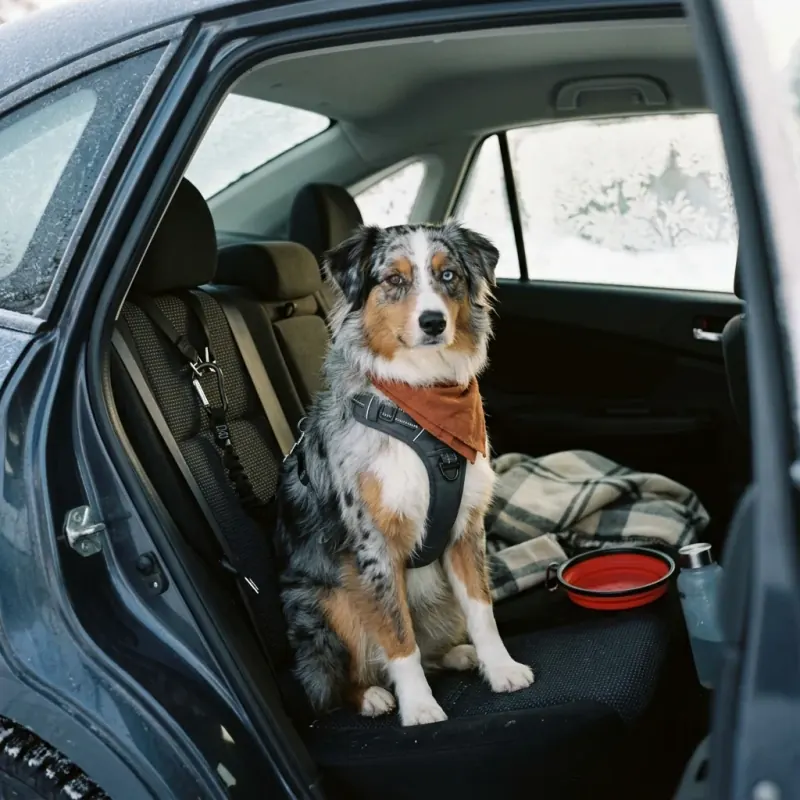
Search for a dog road trip checklist and you’ll get variations on the same list: food, water, bowl, leash, poop bags, favourite toy, treats for the journey. All of it sensible. None of it addressing the thing most likely to actually hurt your dog on the drive.
A dog riding loose in a car is unrestrained mass. In a collision or a hard stop, that mass keeps moving at the speed the car was doing until something stops it — the dashboard, a window, a seat back, or a person. It’s also the reason an otherwise routine journey turns into a serious injury.
So this checklist is ordered by consequence rather than by convenience. The restraint comes first because it’s the only item on the list that changes whether your dog survives a crash. Then everything else — and there’s plenty of everything else, including the items people reliably leave on the kitchen counter.
1. The restraint — the only item that isn’t optional
What actually counts as tested
“Crash tested” is an unregulated marketing phrase. A brand can run one test, decide privately whether it liked the outcome, and print the words on the box. What matters is independent certification to a published standard, and in the US that means the Center for Pet Safety, which tests to a protocol adapted from FMVSS 213 — the federal child-restraint standard.
Checked against CPS’s own certified-product list on 12 August 2026, exactly three harnesses hold current certification:
| Harness | Rating | Certified for |
|---|---|---|
| Sleepypod Clickit Sport | 5 star | up to 90 lb |
| Sleepypod Clickit Range | 5 star | 18–110 lb |
| Saker Bomber Harness | 5 star | sizes XS–L |
That’s the whole list. Everything else on the shelf is untested, has failed testing, or holds only a test the manufacturer commissioned and graded itself.
Two practical notes. The Clickit Sport tops out at 90 lb, so for a genuinely large dog the Range is the one carrying certification. And the Amazon listing you’ll find is usually the “Clickit Sport Plus” — that’s the same certified harness bundled with an S-Clip and Buckle Shield, not a different product.
Disclosure: some links below are affiliate links. If you buy through them we may earn a small commission at no extra cost to you.
Check the Sleepypod Clickit on Amazon →
The full picture — including which previously recommended harnesses have dropped off the certified list, and why there is currently no certified option for small dogs — is in our guide to the safest dog car harnesses.
Or a certified crate, anchored
If your dog travels better contained, or you’re carrying more than one, a certified travel crate is the other tested route. CPS certifies the Gunner G1, Cabela’s GunDog Kennel and the Lucky Duck Lucky Kennel — the last of which is the one you can straightforwardly buy on Amazon, in medium, intermediate and large.
The rule that comes with it matters as much as the crate: it only protects if it’s strapped down. An unsecured crate in a cargo area is a heavy object moving at the speed of the car, and it will keep moving. Anchor it to the manufacturer’s instructions, every trip, including the short ones.
Wire crates are house equipment. No wire crate is a car restraint.
Check the Lucky Duck Kennel on Amazon →
A note on the number everyone quotes
You’ll see it repeated everywhere: an 80 lb dog in a 30 mph crash “exerts 2,400 pounds of force.” Notice that 80 × 30 = 2,400. It’s a rule of thumb, not a measurement — real crash forces depend on how quickly the vehicle decelerates and over what distance, variables the tidy number leaves out. The defensible version is that a sudden stop imposes forces on the order of 20 to 30 times a dog’s body weight, which is more than enough to make the point without inventing precision.
2. Before you leave the house
- Vaccination records, especially rabies — pet-friendly hotels and campgrounds ask more often than people expect
- Your vet’s phone number, and the number of an emergency clinic near your destination
- Microchip details confirmed current — a chip registered to a phone number you no longer use is decoration
- ID tag on the collar with a mobile number that works while you’re travelling
- A current photo of your dog on your phone. Nobody wants to need it; describing a dog from memory to a stranger is worse
- Medication, with two or three spare days’ worth in case the trip stretches
- Book the accommodation’s pet policy in writing, not from a listing badge
3. Food, water and the things that spill
- Their normal food, measured into daily portions. A road trip is the wrong moment to change diet
- More water than you think you need, in a bottle designed not to leak in a footwell — how much a dog actually gets through in a day scales with size in a way the usual per-pound rule gets wrong at both ends
- A collapsible bowl — the one item that’s genuinely worth its space every single stop
- Treats, ideally the boring functional kind rather than novelty ones
- Feed lightly before travelling rather than a full meal immediately before setting off
Check dog water bottles on Amazon →
4. In the car
- Back seat only. The front seat puts a dog in range of an airbag that deploys with enough force to seriously injure them
- A short tether. CPS testing found extension tethers increase injury risk — every extra inch lets the dog accelerate before the restraint catches
- Head inside the vehicle. The window-out-the-window image is charming and the debris risk to eyes is real
- Something familiar to lie on — a blanket or bed from home does more for settling than anything you can buy for the trip
- A towel, for the weather you didn’t plan for
- A seat cover or cargo liner if you’d like the car back afterwards
5. On the road
- Stop every two to three hours for water, a toilet break and a short leash walk
- Leash on before the door opens. Motorway services are the classic place to lose a dog — unfamiliar, loud, and next to fast traffic
- Never leave the dog in a parked car. In summer this is well understood; in winter the ASPCA’s warning is that cars “can act as refrigerators.” Both directions are dangerous
- Check the pavement before walking on it at stops. In summer the surface runs far hotter than the air — the numbers are worse than most owners assume — and in winter it’s salted
- Waste bags, and use them at every stop rather than saving it for later
Check dog waste bags on Amazon →
6. The winter-specific additions
Holiday travel is winter travel, and a few things change.
- Wash and dry your dog’s feet after walks at stops. Road salt and deicers are chemical irritants — the ASPCA’s Animal Poison Control Center classes all ice-melting products that way, and “pet-safe” is marketing language rather than a regulated standard
- Watch for antifreeze in car parks and driveways. Ethylene glycol tastes sweet, is highly toxic, and the treatment window in dogs is roughly eight hours. If you suspect exposure, call your vet or the ASPCA Animal Poison Control Center on (888) 426-4435 immediately — a consultation fee applies
- A coat, if your dog is one that needs one. Thin-coated, lean, senior and very young dogs benefit; most thick double-coated northern breeds don’t and can overheat in one. Our winter coat guide works through which is which
- Keep walks at stops short in genuinely cold weather. How short is a real question with no single agreed answer — we’ve written up why the veterinary sources disagree
- A blanket in the car in case you’re stopped longer than planned
7. First aid and the trip that doesn’t go to plan
- A dog first-aid kit, stored where you can reach it without unpacking the boot — what to put in it
- Cleaning kit — paper towels, bin bags, an enzymatic cleaner. Car sickness happens, and it happens to dogs that have never had it before
- A spare leash. Leashes break and get left at service stations
- A long line if your destination has space to let the dog stretch out safely without going off-leash in unfamiliar terrain
Check dog first-aid kits on Amazon →
8. Car sickness, which is more common than people expect
The cleaning kit above isn’t pessimism. Motion sickness is a genuinely common reason road trips go badly, it’s more frequent in puppies and young dogs than in adults, and plenty of dogs grow out of it as they mature.
Part of it is mechanical — the inner ear structures involved in balance are still developing in a young dog. But a meaningful part is learned, and that’s the part you can do something about. A dog whose entire car history is trips to the vet has formed a reasonable opinion about cars, and anxiety and nausea reinforce each other in both directions.
What tends to help, none of which is medical treatment:
- Don’t feed a full meal immediately before setting off. A light meal a few hours ahead is easier than a full bowl twenty minutes ahead.
- Face them forward and let them see out, which is easier with a harness on the back seat than in a covered crate. Conflicting signals between eyes and inner ear are part of the problem.
- Crack a window for airflow — a small amount, not enough for a head to fit through.
- Keep the car cool. Warm and stuffy makes nausea worse.
- Rebuild the association. Short drives that end somewhere good, before you attempt a long one. This is slow and it works.
- Take the stops seriously. Fresh air and a short walk reset a dog who’s starting to struggle.
If your dog is severely affected, that’s a conversation with your veterinary practice rather than an internet purchase — there are prescription options, and choosing between them is their job, not ours. Don’t give a dog human motion-sickness medication.
9. Arriving
The trip isn’t over when the engine stops, and the first hour somewhere new is when dogs bolt.
- Leash on before the car door opens, every time, in an unfamiliar car park
- Walk the perimeter of wherever you’re staying before letting the dog loose in it — check fencing, gaps, gates that don’t latch, and anything they can eat
- Set up their bed and water first, before unpacking your own things. It gives them somewhere to be while everything else is chaos
- Toilet break immediately, on leash, somewhere you’ve chosen rather than somewhere they choose
- Keep the first evening dull. A long drive followed by an exciting evening is how you get a dog that can’t settle at midnight
10. The five things people actually forget
Every list above is standard. These are the ones that get left behind:
- Vaccination records. Remembered at check-in, never before.
- The spare leash. One leash is one failure away from a problem.
- A photo of your dog on your phone. Takes five seconds now.
- Enough water. The bottle that’s fine for a walk isn’t fine for a six-hour drive plus stops.
- The dog’s own bed or blanket. The cheapest settling aid there is, and it’s already in your house.
Before the first long trip
If your dog hasn’t done a proper journey before, don’t let the holiday be the test run. Build up: the harness on in the house first, then a short drive somewhere good, then longer. A dog whose entire car history is trips to the vet has drawn a reasonable conclusion about cars, and that’s worth rewriting before you attempt five hours of motorway.
The same principle applies to the crate if you’re using one. A crate the dog meets for the first time in a moving vehicle is a much harder ask than one that’s been a comfortable place at home for a fortnight. Our crate sizing guide covers getting the dimensions right, which is the part people get wrong in the direction of “bigger must be kinder.”
Where you’re going
If the drive ends at a campsite, the packing list changes again — our dog camping checklist covers the fourteen things people forget once the car doors are shut and you’re setting up in the dark. If you’re flying rather than driving, the airline rules are their own maze.
And if you’d rather generate a list tailored to your dog and trip than work from a generic one, our trail checklist builder does that.
The short version
Restrain the dog — a CPS-certified harness in the back seat, or a certified crate that’s strapped down. Everything else on this page improves the trip. That one item is the one that changes the outcome of the worst version of it.
Then: water, bowl, food, meds, records, waste bags, first-aid kit, a familiar blanket, a spare leash, and a photo on your phone. Stop every couple of hours, leash on before the door opens, and never leave them in the car — in any season.
Winter driving adds its own short list — a towel that actually dries a dog, and water kept in the cabin rather than the boot, where it freezes. The winter dog gear checklist has the car section, along with everything else worth having in place before the first freeze.
Sources
- Center for Pet Safety — CPS Certified product list (certified harnesses, crates and carriers checked against this list on 12 August 2026)
- Center for Pet Safety — Sleepypod Clickit Sport certification · Clickit Range · Saker Bomber Harness
- Center for Pet Safety — 2013 Harness Crashworthiness Study results (extension tethers increase injury risk)
- ASPCA — Cold Weather Safety Tips
- ASPCA — Getting the Facts on the Dangers of Antifreeze and Your Pets
- National Capital Poison Center — Ice melt products harmful to pets and kids
Frequently asked questions
What is the safest way for a dog to travel in a car?
Restrained in the back seat, using either a harness that holds current Center for Pet Safety certification or a certified travel crate that is strapped down. As of 12 August 2026 exactly three harnesses hold CPS certification — the Sleepypod Clickit Sport (to 90 lb), the Sleepypod Clickit Range (18–110 lb) and the Saker Bomber. A tether clipped to a walking harness or, worse, a collar is not a restraint system. Never the front seat, where an airbag can seriously injure a dog.
How often should you stop on a road trip with a dog?
Roughly every two to three hours is the common working rule, though it isn't a veterinary standard so much as accumulated practice. Use stops for water, a toilet break and a short leg-stretch on a leash. Puppies, seniors and dogs on medication that affects the bladder need stops more often. Plan the stops in advance rather than improvising — the ones you find in a hurry tend to be roadside verges right next to fast traffic.
Can I leave my dog in the car in winter?
No, and the ASPCA is direct about why: in cold weather, cars “can act as refrigerators” that hold in the cold. The summer version of this warning gets all the attention, but the winter version is the same physics running the other direction. Combined with the fact that a running engine plus a parked car is its own hazard, the practical rule for a road trip is that the dog comes with you or somebody stays in the car.
What documents should I bring when travelling with a dog?
Current rabies vaccination records, your vet's contact details, and proof of any other vaccinations your accommodation requires — many pet-friendly hotels and campgrounds ask. Confirm your microchip registration details are current before you leave, since a chip is only useful if the contact number attached to it still works. If you're crossing state or national borders, requirements vary and you should check the destination's rules well in advance rather than at the border.
Do I need a crate for a road trip, or is a harness enough?
Either can be a tested option, and which suits you depends on the vehicle and the dog. A certified harness keeps the dog on the back seat; a certified crate contains them and is the better answer for dogs that can't settle loose, for multiple dogs, and for anyone whose trip ends at a campsite. The critical detail with a crate is that it only protects if it's anchored — an unsecured crate in a cargo area is a heavy object travelling at the speed of the car.
What should I pack for a dog on a long car journey?
Beyond the restraint: more water than you think you need plus a collapsible bowl, their normal food measured into daily portions, any medication with a couple of spare days' worth, a first-aid kit, waste bags, a leash and a spare, something familiar to lie on, and a towel. The frequently forgotten items are the ones this list is really for — vaccination records, a current photo of your dog, a spare leash, and a cleaning kit for the journey that doesn't go to plan.
Comments
Got a question, a tip, or a correction? Leave a comment — no account, no sign-in. Just your name and your thoughts.
Loading comments…