
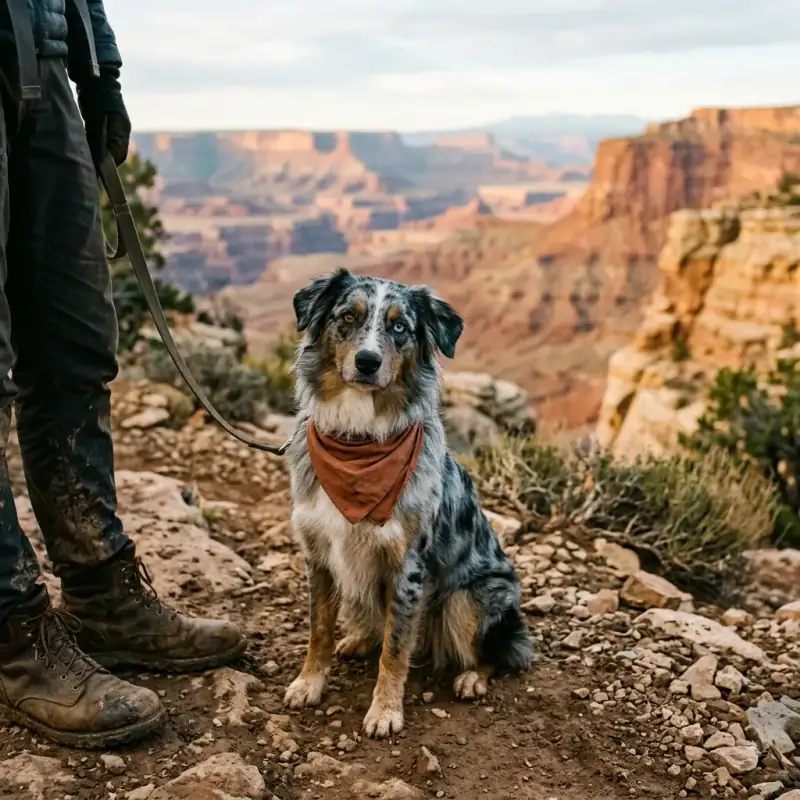
The question has an answer, but it isn’t the one people are looking for. “Are dogs allowed in national parks?” gets answered yes — and then someone drives eleven hours to Yellowstone and discovers their dog may not legally walk more than a hundred feet from the car park.
There is no national park dog policy. There are 63 national parks among the 433 units the National Park Service manages, and each one writes its own rules. Two ban pets outright. Several of the most famous restrict them to the point of uselessness. A handful will hand you a hundred miles of trail.
So this is not a yes-or-no article. It’s a map. Everything below comes from the parks’ own pages, checked in August 2026, and every park is linked so you can verify it before you drive.
The rules that apply almost everywhere
Three things hold across the system.
The leash is six feet. The NPS guidance is unambiguous: always keep your dog on a 6-foot leash. Parks restate it as a legal requirement rather than a suggestion — Acadia’s page says “federal law requires that all pets must be kept on a leash no longer than 6 feet (2 m) at all times,” and Shenandoah specifies a physical leash of no more than 6 feet. A retractable lead run out to twenty feet does not comply, and this is a rule rangers do enforce.
Developed areas yes, trails maybe. The general pattern is that pets are welcome in developed areas — roads, parking, campgrounds, picnic areas — and everything beyond that is park-specific. Whether “trails” is included is the single question worth researching before any trip.
B.A.R.K. is the framework. The NPS pet programme spells out the expectations in its own acronym:
- Bag your pet’s waste
- Always leash your pet
- Respect wildlife
- Know where you can go
Individual parks build their own version around it. Some run a pledge, some a ranger-led walk, some issue a card or a badge. It’s genuinely worth doing with kids in the group — at Petrified Forest you ask at an entrance booth or visitor center, agree to the Bark Ranger card rules, and your dog gets a treat out of it.
Why the rules exist, in one story
It’s easy to read pet restrictions as bureaucratic fussiness. The reason they exist is more concrete than that, and Isle Royale is the clearest case in the system.
Isle Royale is an island in Lake Superior with a famous, closely studied wolf population. In 1980, canine parvovirus was likely carried to the island by a pet dog. It infected the wolves. The population fell from 50 animals to 14.
That is the park’s own account, on its own pet page, and it explains the severity of the rule that followed better than any policy language could. Dogs, cats and other mammals are not allowed on the island — and the prohibition extends to pets aboard boats within park boundaries, 4½ miles out into Lake Superior.
The other restrictions across the system are versions of the same logic: disease transmission to wildlife, pet waste introducing bacteria into water sources, and dogs startling or provoking animals. Whether you find every application of it proportionate, that’s the reasoning, and it’s the reason a well-behaved dog isn’t an exception to it.
The two parks that ban pets entirely
| Park | Policy | Exception |
|---|---|---|
| Isle Royale (MI) | “Dogs, cats and other mammals are not allowed on the island” — including on boats 4½ miles into Lake Superior | Service dogs only, with advance approval, veterinary documentation and the superintendent’s sign-off |
| Channel Islands (CA) | “In order to protect island wildlife, pets are not allowed in the park. Please leave your pets at home.” | Service animals at the mainland visitor center only, after a vaccination, parasite-prevention and health-exam protocol |
Channel Islands’ concern is its endemic island foxes, which have no immunity to diseases mainland dogs carry routinely. Note that even service animals are barred from the islands themselves — arrangements are made through the Chief Ranger.
The famous parks are the restrictive ones
This is the part that catches people out. The parks with the biggest names have the tightest pet rules, and the reasoning is usually a combination of fragile terrain, dense wildlife and heavy visitor traffic.
Yellowstone
The strictest interpretation in the system. Pets are permitted only in developed areas and must stay within 100 feet of roads, parking areas and campgrounds. They must be in a car, in a crate, or on a leash no longer than six feet, and may not be left unattended or tied to an object.
Pets are not allowed on boardwalks, hiking trails, in the backcountry, or in thermal areas — and the park is explicit that this applies even if you carry the animal, in your arms, a stroller, a backpack or a carrier.
If Yellowstone is the trip, plan around boarding. There is no version of this where the dog comes on the walk.
Grand Canyon
More workable, with one hard line. Leashed pets are allowed on trails above the rim, at Mather and Desert View campgrounds, at Trailer Village and throughout developed areas. That’s a genuinely pleasant rim walk with big views.
Below the rim, no. The park’s stated reasoning is that “inner canyon trails are narrow, include steep sections, and are well-traveled by humans, mules, and wildlife.”
Usefully, the South Rim has a kennel near Maswik Lodge, open daily 7:30 am–5 pm, which takes dogs and cats for day or overnight boarding with proof of current vaccinations. Reservations are strongly recommended in summer and around holidays — call 928-638-0534. If you want to hike into the canyon and still bring the dog on the trip, that’s the mechanism.
The parks that actually work
Here’s where the article turns useful. Four parks are genuinely good with a dog, and the numbers are specific.
Acadia, Maine — the best in the system
100 miles (161 km) of hiking trails and 45 miles (72 km) of carriage roads where pets are permitted. That is a real hiking holiday, not a consolation walk.
Six trails are closed to pets, all of them steep, exposed or ladder-assisted routes where a dog genuinely can’t go safely:
- Precipice
- Beehive
- Ladder Trail to Dorr Mountain
- Beech Cliffs Trail
- Perpendicular Trail (Mansell Mountain)
- Jordan Cliffs Trail
A further ten are listed as not recommended rather than prohibited, including Acadia Mountain, Flying Mountain, Giant Slide, the west face of Cadillac Mountain, the Bubble and Jordan Ponds Path, Norembega Goat Trail, Bubbles-Pemetic, Penobscot Mountain Spring Trail, Upper Beachcroft and Upper Gorge. Take that list seriously — “not recommended” here means iron rungs and granite slabs.
Two things surprise visitors. Most lakes in the park are public water supplies, and neither pets nor people may swim in them. And two of the best-known swimming spots close to pets seasonally: Sand Beach from 15 June to 8 September, and Echo Lake from 15 May to 15 September — exactly the months you’d want them.
For camping: Blackwoods, Seawall and Schoodic Woods take pets. Duck Harbor does not.
Shenandoah, Virginia — the best ratio
More than 500 miles of trail, with fewer than 20 miles closed to pets. Proportionally, this is the most dog-open large park in the system.
The named closures are short, popular, heavily trafficked trails:
- Fox Hollow Trail (mile 4.6)
- Stony Man Trail (mile 41.7)
- Limberlost Trail (mile 43)
- Post Office Junction to Old Rag Shelter, plus the Old Rag Ridge, Saddle and Ridge Access trails
- Dark Hollow Falls Trail (mile 50.7)
- Story of the Forest Trail (mile 51)
- Bearfence Mountain Trail (mile 56.4)
- Frazier Discovery Trail (mile 79.5)
Everything else — including long stretches of the Appalachian Trail through the park — is open to a leashed dog. Note that dogs cannot join ranger-led programmes, and the park asks that waste bags be carried out rather than left beside the trail or hung in a tree, which is a request worth taking personally.
Petrified Forest, Arizona — the outlier
The most permissive policy we found anywhere: “Pets are allowed on any paved road or trail as well as all designated wilderness area in the park.”
Wilderness access with a dog is close to unheard of in the national park system. The leash rule still applies — six feet or less — and only service animals go inside buildings. This is also one of the parks running an active B.A.R.K. Ranger programme.
White Sands, New Mexico — open, with a serious caveat
Leashed dogs are allowed across the dunes and on all trails; the visitor center and other federal buildings are the exception. There are waste stations near the visitor center.
The caveat is heat, and the park makes it itself: inside a parked vehicle, the temperature climbs 25°F above the outside air within ten minutes and more than 30°F within thirty. Leaving a pet unattended in a vehicle is prohibited by federal regulation.
Add the surface. White gypsum sand reflects rather than absorbs, which makes the dunes cooler underfoot than dark rock — but it is still a desert, there is no shade, and the glare is severe. Go early, carry more water than you think you need, and read how hot is too hot to walk your dog before you go, because the air temperature is not the number that matters.
Planning a trip that actually works
Check the park’s own page, not ours and not a listicle. Policies change, trails close, seasonal restrictions move. Every park’s pet page lives at nps.gov/[park code]/planyourvisit/pets.htm, and it is the authority. We’ve linked all of them below.
Look past the 63 national parks. They’re only 63 of 433 NPS units. National seashores, lakeshores, recreation areas, historic sites and national forests frequently have far more relaxed pet rules than the headline parks — a national recreation area next door to a restrictive park is often the answer to the whole problem.
Have a plan for the dog on the days it can’t come. Either a kennel like Grand Canyon’s, or a genuine plan for one adult to stay with the dog. “We’ll leave them in the car for an hour” is not a plan, and in most parks it’s a violation.
Bring more water than the trail suggests. Many parks prohibit dogs from swimming in water supplies, and pet waste near water sources is one of the main reasons for trail restrictions in the first place. Our dog camping checklist and road trip checklist both cover the water and waste logistics.
Six feet means six feet. If your dog currently walks on a retractable lead, switch before the trip rather than in the car park.
Recall doesn’t exempt you. The leash rule is not a judgement about your dog’s training. It’s about the wildlife, the other visitors, and the parvovirus that reached an island in 1980.
If you’re new to this kind of trip, our guide to starting hiking with your dog covers conditioning and gear, leave no trace with dogs covers the waste question properly, and GPS trackers are worth considering for unfamiliar terrain. For a region with a lot of dog-friendly options outside the headline parks, our Pacific Northwest trail guide is a good place to start. And if your dog is going to carry its own water, dog hiking backpacks covers the fit problem that ruins most of them.
The short answer
Yes, dogs are allowed in most national parks — and no, they usually can’t come on the hike.
If the trip is about hiking with your dog, choose the park for that reason: Acadia, Shenandoah, Petrified Forest or White Sands. If the trip is Yellowstone, the Grand Canyon below the rim, Isle Royale or Channel Islands, plan for the dog to sit it out — or leave them at home with someone who loves them.
The worst version of this trip is the one where you find out in the car park.
Sources
All policies below are from the National Park Service’s own pages, checked August 2026. Park rules change — verify before you travel.
- NPS — Pets in parks and Be a B.A.R.K. Ranger
- NPS — I Didn’t Know That!: Hiking with Pets (the 6-foot leash rule and the reasoning behind restrictions)
- NPS — The National Park System (433 units, 63 national parks; page updated 1 July 2026)
- Isle Royale National Park — Pets
- Channel Islands National Park — Pets
- Yellowstone National Park — Pets
- Grand Canyon National Park — Pets
- Acadia National Park — Pets
- Shenandoah National Park — Pets
- Petrified Forest National Park — Pets
- White Sands National Park — Pets
Frequently asked questions
Are dogs allowed in US national parks?
Usually yes, but rarely where you want them. Most parks allow leashed pets in developed areas — roads, parking areas, campgrounds and picnic areas — while prohibiting them on hiking trails and in the backcountry. There is no single national policy: each of the 63 national parks sets its own rules, and they vary enormously. Two parks, Isle Royale and Channel Islands, prohibit pets entirely.
Which national parks ban dogs completely?
Two. Isle Royale National Park in Michigan states that dogs, cats and other mammals are not allowed on the island, and the restriction extends to boats within park waters — 4½ miles into Lake Superior. Channel Islands National Park in California states that pets are not allowed in the park at all in order to protect island wildlife. Both make narrow, documented exceptions for service animals, with advance approval required.
What is the leash rule in national parks?
Six feet. The National Park Service's guidance is to always keep your dog on a 6-foot leash, and individual parks restate it as a federal requirement — Acadia's page says federal law requires pets be kept on a leash no longer than 6 feet at all times, and Shenandoah specifies a physical leash no longer than 6 feet. Retractable leads extended beyond six feet do not comply.
What is a B.A.R.K. Ranger?
It's the National Park Service's pet programme, and the acronym is the rule set: Bag your pet's waste, Always leash your pet, Respect wildlife, and Know where you can go. Individual parks design their own version — some run a pledge, some a walk with a ranger, some hand out a card or a badge. At Petrified Forest, for example, you ask at an entrance booth or visitor center, agree to the Bark Ranger card rules, and your dog gets a treat.
Can I take my dog on a trail in Yellowstone?
No. Yellowstone allows pets only in developed areas, and they must stay within 100 feet of roads, parking areas and campgrounds. Pets are not allowed on boardwalks, hiking trails, in the backcountry or in thermal areas — and the park states this applies even if the animal is carried in your arms, a stroller, a backpack or a carrier. Yellowstone is one of the most restrictive parks in the system for dog owners.
Which national parks are actually good for dogs?
Four stand out. Acadia permits pets on 100 miles of hiking trails plus 45 miles of carriage roads. Shenandoah closes fewer than 20 miles out of more than 500. Petrified Forest allows pets on any paved road or trail and in all designated wilderness. White Sands allows leashed dogs across the dunes, though the heat there demands real planning. If your trip is built around hiking with your dog, these are the parks to build it around.
Comments
Got a question, a tip, or a correction? Leave a comment — no account, no sign-in. Just your name and your thoughts.
Loading comments…