
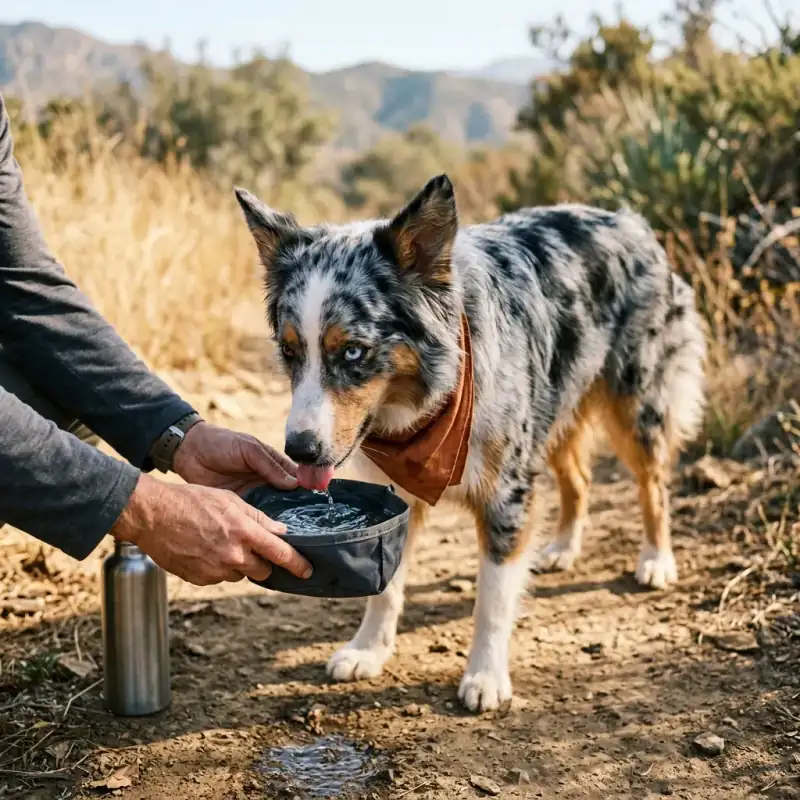
Somewhere between the third and fourth hour of a hot walk, a reasonable thought arrives: I’d be reaching for an electrolyte tab about now — should the dog have something too? An entire product category exists to answer yes, and the answer sounds obvious, because the analogy with human endurance sport is doing all the work.
The analogy breaks at the first step. Dogs do not sweat.
What leaves a dog, and where from
A human runner in heat loses water and a meaningful load of sodium through the skin, across the whole body, continuously. That is the mechanism the entire human sports-drink category is built on, and dogs do not have it. The Merck Veterinary Manual is direct: dogs and cats “thermoregulate primarily by panting, drooling, and spreading saliva on their coats,” and while “limited sweating occurs in dogs and cats,” it “could play a minor role in cooling the body.” The sweat glands that do exist are on the footpads.

So a hot dog is losing water largely as evaporation from the airway and the mouth, and whatever electrolytes go with it go in saliva. That is a smaller and different channel than skin, and it is the reason the human comparison cannot be lifted across intact. We go into what panting can and cannot do, and where its ceiling sits, in how hot is too hot to walk your dog.
The evidence that says yes — and the distance it lives at
There is real research supporting electrolyte repletion in dogs, and it deserves to be reported straight rather than waved away.
In 2020, a team put sixteen client-owned Siberian Huskies through twelve weeks of incremental conditioning and sampled their saliva before running, after 5.7 km and after 39.0 km. Three electrolytes climbed with distance:
| Electrolyte | Pre-run | After 39.0 km |
|---|---|---|
| Sodium | 82.41 mmol/L | 97.08 mmol/L |
| Chloride | 71.43 mmol/L | 89.71 mmol/L |
| Magnesium | 0.66 mmol/L | 1.26 mmol/L |
| Potassium | no change at any timepoint | — |
The authors concluded that sodium, magnesium and chloride “are the electrolytes primarily lost in saliva by exercising dogs,” and suggested that physically active dogs may benefit from electrolyte repletion alongside basic hydration.
That is a genuine finding and it points genuinely towards supplementation. Note where it sits. Conditioned sled dogs, on a twelve-week programme, sampled at 39 kilometres. That is the workload the recommendation attaches to. It is not a claim about a dog that did a hilly six miles on Sunday, and nothing in the paper says otherwise.
The field study that complicates it
The closest thing to a real-world test came three years earlier, and it is the single most useful paper on this question.
Researchers followed seven Border Patrol detection dogs — Malinois and German Shepherds — working vehicle screening in Texas at a median 29.3°C and 70% humidity, across shifts averaging 5.7 hours. Three hydration strategies were compared: free access to plain water, a chicken-flavoured oral electrolyte solution, and subcutaneous fluids.
Two results matter, and they pull in different directions.
First, the flavoured solution worked. Dogs offered it drank 15.61 mL/kg/h against 7.04 on plain water — well over twice as much — and their hydration markers moved accordingly: packed cell volume fell, total CO₂ rose.
Second, plain water was not failing them. The paper reports that no electrolyte abnormalities were detected — in any group, including the water-only dogs, after six-hour shifts in that heat. Searching behaviour and odour detection performance were independent of hydration strategy.
And then the authors say the quiet part themselves: “It is unknown if the electrolytes in the OES were beneficial or the effects were simply a function of increased consumption.”
That sentence is the whole argument. The measured benefit could not be separated from the fact that the dogs simply liked the taste and drank more. Chicken flavour is not a mineral.
How much plain water can carry
If plain water were quietly insufficient at high workloads, that would show up in the dogs doing the most work. It does not.
A 2018 study measured water turnover in two groups of canine athletes: fifteen explosive-detection Labradors covering 155–179 km over five days in 21–29°C heat, and sixteen Alaskan huskies running a 222 km stage race across two days.
| Group | Water turnover |
|---|---|
| Detection Labradors, unconditioned | ~143–150 mL/kg/day |
| Detection Labradors, conditioned | ~171 mL/kg/day |
| Alaskan sled dogs | ~267 mL/kg/day |
Requirements tracked “the amount of work done” rather than ambient temperature. And the dogs, drinking freely, were “normally hydrated throughout the study.”
Read that against the ordinary hiking case. Five days, up to 179 kilometres, up to 29°C — and ad-lib water was enough. Those numbers are turnover in working dogs and should not be treated as a target to hit for a pet on a day walk, but they do settle the direction of the argument.
The resting requirement is a different question with a different answer, and so is what happens when the water runs out: how long a dog can go without water covers both, including why the dehydration test most owners use is the one clinicians trust least.
The study everyone cites, and who paid for it
There is one paper that gets quoted whenever enhanced water for dogs comes up, and it is worth reading properly rather than by its title.
Twelve working dogs, a crossover design, three thirty-minute exercise challenges. Dogs drinking a “nutrient-enriched water” alongside free tap water recovered slightly cooler and slightly slower-pulsed: on day 11, ear temperature 0.6°F lower and pulse 3.4 bpm lower over a sixty-minute recovery; on day 3, core temperature 0.6°C lower.
Small, real effects. Two things belong beside them.
The funding. The paper states: “The study was fully funded by Nestle Purina Research.” The lead author is described as employed within the R&D department of Nestlé Purina Pet Care, conducting nutrition research for potential use in future commercial applications. That is disclosed openly in the paper and it does not make the results false — it makes them a result you weigh differently than an independent one.
The product. The test drink was “94% water, 2.4% whey protein, 1% glycerin, 1% poultry flavor, 0.6% gums, and 1.0% vitamins and minerals.” That is a flavoured protein drink. Anyone citing this study as evidence for a dog electrolyte powder is citing it for something it did not test.
There is no standard here, and that is the story
On this site we keep coming back to a simple question: is there an independent body that tests whether the product does what it claims? For dog car harnesses there is one, and it changes everything about how that category can be written about.
For canine electrolyte supplements, there is no equivalent.
The FDA’s Center for Veterinary Medicine does not pre-approve pet supplements; they are regulated as food or as drugs depending on the claims made, under a long-standing arrangement of enforcement discretion. AAFCO writes model regulations for the states and has no enforcement authority of its own. The nearest thing to third-party oversight is the National Animal Supplement Council’s Quality Seal, and it is worth knowing exactly what that seal covers. To carry it, a company must pass an independent quality audit, keep a quality manual with written standard operating procedures, run an adverse event reporting system, meet labelling requirements, and “submit to random product testing by an independent lab to ensure products meet label claim.”
Read that last clause carefully. Random independent testing to label claim answers “is what is on the label in the tub.” It is a real and useful assurance, and a product carrying the seal is a better bet than one that does not. But it says nothing at all about whether the contents help your dog. There is no crash test here. There is no pass and fail list.
The risk that is genuinely in your pack
The practical hazard is not the dog’s supplement — it is yours.
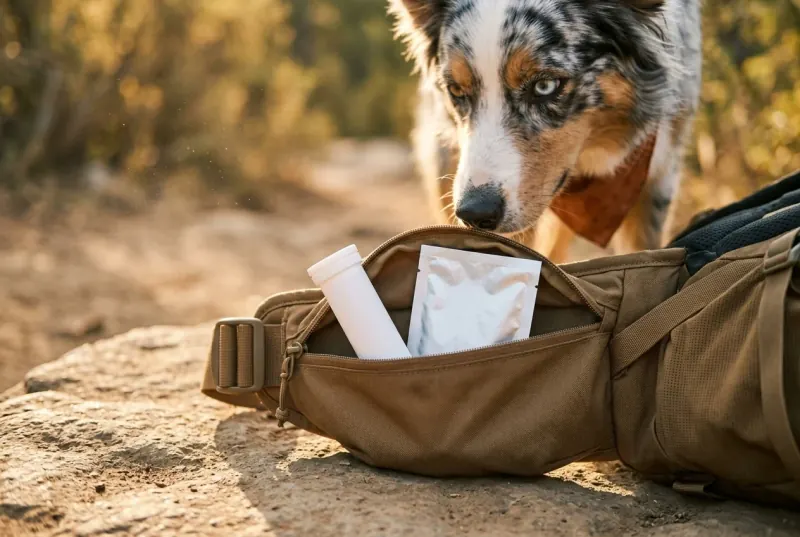
Xylitol is a common sweetener in sugar-free electrolyte tablets, powders, chewable vitamins and supplements, and it is dangerous to dogs at doses that are genuinely small. The Merck Veterinary Manual: in dogs xylitol “stimulates a rapid, dose-dependent insulin release that can result in profound hypoglycemia,” with that risk above roughly 100 mg/kg, and severe hepatic insufficiency or failure possible in some dogs above 500 mg/kg.
For a 20 kg dog, that first threshold is about 2 grams. Signs can appear within 30 minutes or be delayed 12 to 18 hours, and liver injury may not show for 24 to 48 hours — so “he seems fine” is not information.
It is also not always labelled as xylitol. The FDA notes it turns up as birch sugar or wood sugar on ingredient lists, which is exactly the kind of thing you cannot check on a trail at speed. If you carry electrolyte tabs for yourself, know now whether yours contain it, and keep them where a nosy dog cannot get into the lid pocket.
The two ways salt goes wrong
Neither of them is a supplement dose, and it is worth saying so rather than manufacturing a scare.
Merck puts the point at which clinical signs of salt toxicosis appear at 2–3 g/kg of salt. For a 20 kg dog that is 40 to 60 grams. No labelled electrolyte dose approaches it, and “you might over-salt your dog with a supplement” is not a worry.
The two that are real:
- Seawater. Dogs have developed hypernatraemia after swimming or playing in the ocean — around 3.5% sodium — without access to fresh water. A beach day needs a full bottle for the dog, not just a bowl at the car.
- Water intoxication, the opposite failure. Reported cases are typically dogs gulping large volumes while playing in ponds and lakes, dropping blood sodium fast enough to cause cerebral oedema. Signs come on within hours: vomiting, restlessness, cramping, weakness, in severe cases seizures. A dog that retrieves obsessively from water for an hour is the profile.
This is educational information, not veterinary advice. It does not establish a veterinarian-client-patient relationship and cannot account for your individual dog. Puppies, seniors, and dogs with kidney, heart or endocrine disease have different fluid and electrolyte needs, and dogs losing fluid to vomiting or diarrhoea are a separate clinical problem entirely — that is a call to your vet, not a supplement decision. If your dog is lethargic, disoriented, vomiting or collapses after exertion, contact your veterinary practice or an emergency clinic immediately.
So what should you carry
The kit list here is short, and there is nothing to sell you at the top of it.
Water, and a way to offer it often. The intervention that has evidence behind it is frequency, not chemistry. A portable dog water bottle or a collapsible bowl exists to remove the friction, because the practical failure on hot walks is not that owners carry no water — it is that stopping to unpack it feels like a hassle and the stops get skipped.
If your dog won’t drink, flavour the water. That is the one intervention on this page with a measured field result behind it, and it costs nothing: a splash of the water from a tin of plain tuna, or low-sodium unsalted broth, offered in the same bowl. Check any commercial broth for onion and garlic, which are toxic to dogs, and for xylitol.
Manage the heat rather than the minerals. Everything that reduces heat load reduces the problem upstream: earlier starts, shade, water crossings, and turning around sooner than planned. The hot-weather hiking section of our heat guide covers the sequence, and if you are considering a cooling vest that piece explains where evaporative cooling genuinely helps and where it just adds a wet layer.
Match the day to the dog. A dog conditioned to long days handles them differently from one that walks twenty minutes on weekdays; how much exercise a dog really needs is the starting point, and how to start hiking with your dog covers building up to a full trail day without arriving at hour four in trouble.
The short version
Dogs do not sweat, so the human electrolyte model does not transfer. The research that supports supplementation is real and it lives at 39 kilometres in conditioned sled dogs. In the closest thing to a field trial, working dogs at 29°C for nearly six hours showed no electrolyte abnormalities on plain water at all — and where a benefit was measured, the authors could not separate the electrolytes from the flavour. The study most often waved at in this argument was fully funded by Purina and tested a whey-protein drink.
No independent body certifies that any of these products do anything, and the NASC seal — the best signal available — audits whether the label is accurate, not whether the contents work.
So: water, offered more often than feels necessary. If your dog won’t drink, make the water taste of something. And check your own electrolyte tabs for xylitol before they go in the pack, because that is the one part of this whole question that can hurt your dog today.
Frequently asked questions
Do dogs lose electrolytes when they exercise?
Yes, but by a different route than people do, and that route matters. Dogs have no meaningful whole-body sweating — the Merck Veterinary Manual describes limited sweating in dogs and cats that may play a minor role in cooling, with panting and drooling as the primary mechanism. So the losses are in saliva, not skin. A 2020 study of sixteen conditioned Siberian Huskies found salivary sodium, chloride and magnesium all rose with distance run, and the authors concluded these are the electrolytes primarily lost in saliva by exercising dogs. Potassium did not change at any timepoint.
Does my dog need an electrolyte supplement on a normal hike?
On the evidence, no. The workloads where researchers measured meaningful electrolyte movement are 39 km sled runs and multi-hour working shifts. In the closest thing to a field trial, seven detection dogs worked mean shifts of 5.7 hours in 29.3°C heat and 70% humidity, and no electrolyte abnormalities were detected in any group — including the dogs that only had plain water. A dog on a three-hour weekend walk is a long way below that.
Is there any proven benefit to flavoured or electrolyte water for dogs?
One benefit was measured, and it is about drinking, not chemistry. In that detection-dog study, dogs offered a chicken-flavoured oral electrolyte solution drank 15.61 mL/kg/h against 7.04 for plain water — well over twice as much — and their hydration markers improved accordingly. But the authors state plainly that it is unknown whether the electrolytes were beneficial or the effect was simply a function of increased consumption. Detection performance was the same either way. If your dog is a reluctant drinker, that is a real finding; it just is not a finding about electrolytes.
Are human electrolyte tablets or powders safe for dogs?
Check the label for xylitol before anything else. It is a common sweetener in sugar-free tablets, powders and chewable supplements, and it is dangerous to dogs at small doses: the Merck Veterinary Manual puts the hypoglycaemia threshold at roughly 100 mg/kg and severe liver injury at above 500 mg/kg. For a 20 kg dog that first threshold is about 2 g. It is not always called xylitol on a label — the FDA notes it also appears as birch sugar or wood sugar. Do not give a human supplement to a dog without your vet's say-so.
Can a dog get too much salt from a supplement?
Realistically, no, and the numbers say why. The Merck Veterinary Manual puts the point where clinical signs of salt toxicosis appear at 2–3 g/kg — for a 20 kg dog, 40 to 60 grams of salt. No labelled electrolyte dose is remotely near that. The genuine sodium risks for a dog outdoors are different: swimming in seawater with no fresh water available, and, in the opposite direction, gulping large volumes of fresh water while playing in a lake.
How much water does a dog need on a long day out?
More than most people carry, and there is no single number that transfers from a study to your dog. What the research does show is how much plain water can cover: detection Labradors covering 155–179 km over five days in 21–29°C heat turned over roughly 143–171 mL/kg/day and were, in the authors' words, normally hydrated throughout — drinking freely, on water. The practical version is to carry more than you think and offer it more often than you would think to.
Sources
Every figure in this piece traces to one of these. Dates are when we read the source — certified lists, prices and park rules all move.
- Evaluation of Three Hydration Strategies in Detection Dogs Working in a Hot EnvironmentOtto CM, Hare E, Nord JL, et al. — Frontiers in Veterinary Science 4:174 (2017)Seven Border Patrol dogs, 29.3°C and 70% humidity. Source of the 15.61 vs 7.04 mL/kg/h intake figures, the "no electrolyte abnormalities" finding, and the authors own flavour-versus-electrolyte caveat.Read 3 September 2026
- Changes in salivary electrolyte concentrations in mid-distance trained sled dogs during 12 weeks of incremental conditioningTempleman JR, McCarthy N, Lindinger MI, Shoveller AK — Physiological Reports 8(12):e14493 (2020)Sixteen Siberian Huskies. The strongest evidence for supplementation on this page, and the source of every sodium, chloride and magnesium figure.Read 3 September 2026
- Water requirements of canine athletes during multi-day exerciseStephens-Brown L, Davis M — Journal of Veterinary Internal Medicine 32(3):1149–1154 (2018)Fifteen detection Labradors over 155–179 km in five days, plus sixteen sled dogs. Source of the water-turnover figures and the finding that ad-lib water was enough.Read 3 September 2026
- Working Dogs Drinking a Nutrient-Enriched Water Maintain Cooler Body Temperature and Improved Pulse Rate Recovery After ExerciseZanghi BM, Robbins PJ, Ramos MT, Otto CM — Frontiers in Veterinary Science 5:202 (2018)The study most often cited in favour of enhanced water. Funding statement and the composition of the test drink both quoted directly from the paper.Read 3 September 2026
- The Integumentary System in AnimalsMerck Veterinary ManualPanting and drooling as the primary route of canine thermoregulation; sweating as a minor one.Read 3 September 2026
- Xylitol Toxicosis in DogsMerck Veterinary ManualBoth dose thresholds — roughly 100 mg/kg for hypoglycaemia, 500 mg/kg for liver injury — and the delayed-onset windows.Read 3 September 2026
- Paws Off Xylitol; It's Dangerous for DogsU.S. Food and Drug AdministrationFDA consumer warning. Xylitol also appears on labels as birch sugar or wood sugar.Read 3 September 2026
- Salt Toxicosis in AnimalsMerck Veterinary ManualSeawater hypernatraemia, and the 2–3 g/kg figure used here to show that a labelled supplement dose is nowhere near it.Read 3 September 2026
- NASC Quality SealNational Animal Supplement CouncilWhat the seal actually requires: independent audit, written SOPs, adverse event reporting, and random independent testing to label claim.Read 3 September 2026
- Supplement companies made changes after facing crackdownJAVMA News — American Veterinary Medical AssociationBackground on how animal supplements sit between FDA enforcement discretion, AAFCO model regulations and NASC self-regulation.Read 3 September 2026
Comments
Got a question, a tip, or a correction? Leave a comment — no account, no sign-in. Just your name and your thoughts.
Loading comments…