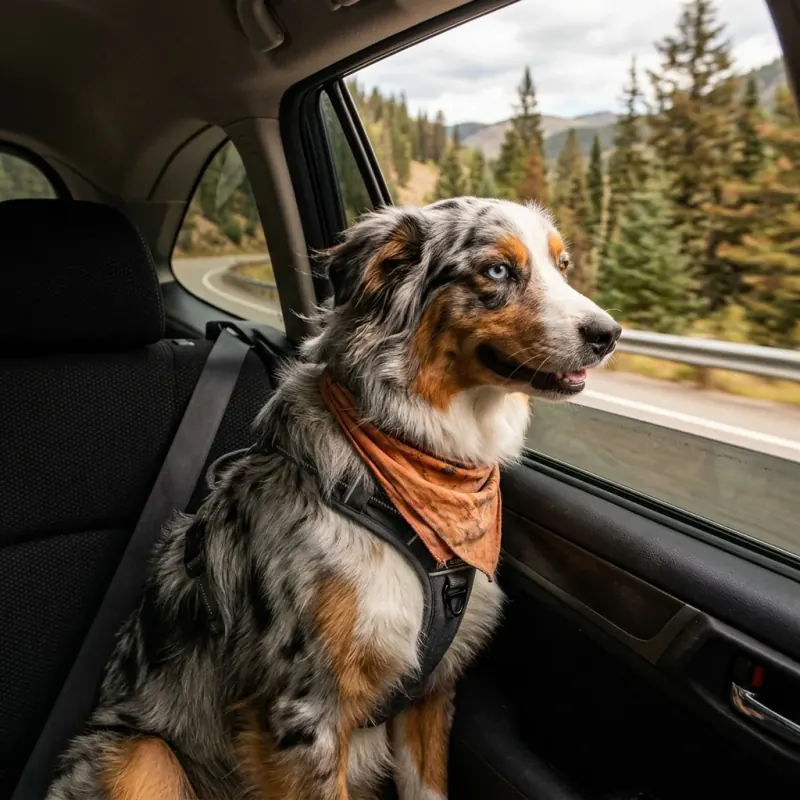
Here’s the uncomfortable truth the pet aisle won’t tell you: most dog “car safety” harnesses have never been crash-tested, and when an independent lab tested eleven products that claimed they had, exactly one kept the dog on the seat. A harness that holds your dog on a calm drive can still fail — or injure — at 30 mph, when it suddenly has to absorb many times your dog’s body weight. The word “seat belt” on the package means nothing on its own.
So this guide ignores the marketing and follows the only thing that matters: independent crash testing. There’s one organization that actually does it, a short list of products that pass, and a long list that don’t. Here’s how to tell them apart.
Quick pick
- Safest overall (most dogs): Sleepypod Clickit Sport — CPS certified, five stars, up to 90 lb.
- Big dogs, and deep or narrow chests: Sleepypod Clickit Range — five stars, certified 18–110 lb, and the only certified harness that goes past 90 lb.
- Also certified, if you can find it: Saker Bomber Harness — five stars, sizes XS–L. Not easy to buy on Amazon.
- Small dogs and cats (under 25 lb): there is currently no certified option you can buy. The one that held certification, the ZuGoPet Rocketeer Pack, has been discontinued. Consider a certified carrier or crate instead.
- Everything else: assume it is untested until it names a certification. Most are.
Certification changes, so this list is dated — the date of our latest check is at the top of this page. Products drop off the Center for Pet Safety’s list when they’re discontinued or when a certification isn’t renewed — three on this page have done exactly that since we first published. Check the live CPS list before you buy.
Why “crash tested” is an almost meaningless phrase
A walking harness spreads gentle, steady pressure. A crash is the opposite: a violent, instantaneous load. A harness that isn’t engineered for that either breaks — and your dog becomes a projectile — or transfers the force to the wrong place: the neck, the throat, the spine.
The problem is that “crash tested” is an unregulated marketing claim. A company can strap a harness to a sled once, film it, decide for itself whether it liked the result, and print the phrase on the box. Nothing requires them to publish the footage, state the speed, disclose the dummy weight, or define what counts as a pass. There is no regulator checking.
What’s missing is an independent test to a published standard, with stated pass/fail criteria and a dummy that represents a real dog. Without those four things, “crash tested” tells you a test happened. It doesn’t tell you the harness worked.
The one standard that matters: the Center for Pet Safety
The Center for Pet Safety (CPS) is a non-profit that independently crash-tests pet restraints using a protocol adapted from FMVSS 213 — the U.S. federal standard for child safety seats. They use instrumented dog dummies, run real dynamic crash tests, and publish which products pass and which fail. They don’t sell harnesses, so they have no reason to flatter one.
Their pass criteria are specific. A harness has to keep its hardware, webbing and connection points intact, and it has to keep head excursion — how far the dummy’s head travels forward — within the FMVSS 213 threshold. And it has to do it on every run, not its best one.
When you shop, that’s the filter: is it CPS certified? If a listing can’t answer that, it doesn’t belong in a “safest” conversation, no matter how padded or expensive it looks.
What the crash tests actually found
This is the part most gear roundups skip, and it’s the most useful thing in this article.
CPS bought harnesses at retail from brands that advertised “testing,” “crash testing,” or “crash protection” — products already on shelves, already being trusted by owners. Then they crashed them.
Exactly one kept its test dog on the seat through every run: the Sleepypod Clickit Utility, the predecessor of today’s Clickit line.
Seven failed the crash test outright, including the RC Pet Canine Friendly, the Klein Metal Allsafe, the Ruff Rider, the Bergan car harness, the IMMI PetBuckle, the original Solvit Safety Harness — and the Kurgo Tru-Fit Enhanced Strength, which we’ll come back to in a moment.
Four never reached the crash test at all, failing preliminary strength checks first: the USA K-9 Outfitters Champion, the CLIX Car Harness, the Coastal EZ Rider (also sold as PetSmart’s Top Paw), and the Snoozer Pet Safety Harness and Adapter.
Read that again: products that failed a basic strength check before anyone crashed them were being sold as car safety equipment. The failures weren’t marginal, either — testers recorded torn webbing, deformed hardware, and dummies launching off the seat entirely.
The study also produced one finding worth committing to memory: extension tethers increase injury risk. The longer the link between dog and anchor, the more the dog accelerates before the restraint catches, and the harder the load lands when it does.
The harnesses that actually pass
Sleepypod Clickit Sport — safest overall
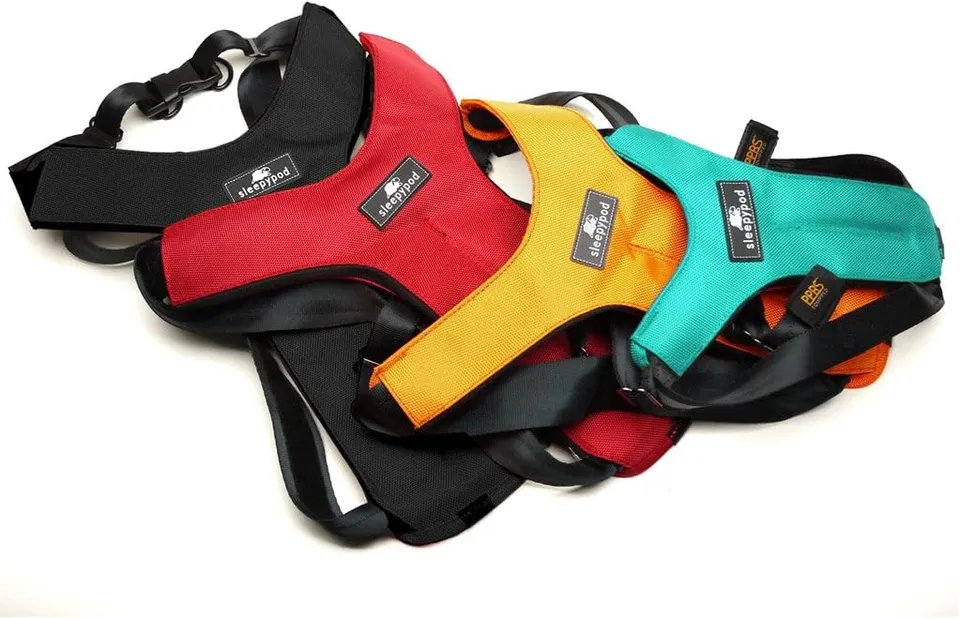
Sleepypod’s Clickit line is the benchmark, and it earned that position by being the only thing left standing. The Clickit Sport holds a five-star CPS certification for dogs up to 90 lb.
Instead of relying on a leash clip, it uses a wide, energy-absorbing padded vest and an “infinity loop” design that threads the car’s own seat belt through the harness. Crash forces spread across the chest and shoulders — the strongest part of a dog’s body — rather than yanking at the neck. It doubles as a walking harness with D-rings at the neck, and reflective strips add night visibility.
It’s not cheap, and the fit is snug by design. Measure your dog’s chest carefully. But for a dog you actually want protected, it’s the one to beat.
Disclosure: some links below are affiliate links. If you buy through them we may earn a small commission at no extra cost to you.
Check Sleepypod Clickit on Amazon →
Sleepypod Clickit Range — for big dogs, and chests the others don’t fit
The Clickit Range is the only certified harness that goes past the 90 lb ceiling: CPS rates it five stars for dogs 18 to 110 lb, tested November 2024 with a 110 lb test dog. It also solves a specific fit problem — dogs with narrow, deep or barrel chests that the standard vest shape fits badly. Sighthounds, deep-chested working breeds, and dogs whose ribcage is much deeper than it is wide have always been awkward to restrain safely, because a harness that doesn’t sit right doesn’t load right.
Sleepypod builds it in five sizes (S through 2XL, with XL and 2XL in black only) — more range than the Sport, which is the point. If you’ve measured your dog for a Clickit Sport and the numbers landed between sizes, or the fit looked wrong across the chest, look here before you compromise. Deep-chested breeds like the German Shorthaired Pointer are exactly the shape it was designed around.
One practical catch: at the time of writing we could not find the Range on Amazon — only the Sport and Sport Plus. You’ll likely be buying it direct.
Saker Bomber Harness — the certified one nobody mentions
The third name on the certified list is the one no roundup seems to carry: the Saker Bomber Harness, five stars, tested November 2022 with a 75 lb test dog, certified in sizes XS through L.
We’re listing it because the honest version of “what’s certified” is a list of three, not a list of Sleepypods. The practical caveat is the same as the Range’s, only stronger: we could not find it on Amazon under that name, so buying means going to the manufacturer. If you’re shopping strictly by certification and the Sleepypod sizing doesn’t work for your dog, it’s the remaining option.
The two that dropped off the list
Both of these were recommended in earlier versions of this guide, on certifications that were real at the time. Neither is on the CPS certified list today, and we’re not going to quietly delete the paragraphs and pretend otherwise.
Sleepypod Clickit Terrain. In 2020 the Terrain earned a five-star CPS rating at a raised 110 lb weight — genuinely news at the time, because it broke the 90 lb ceiling. It no longer appears on the CPS certified-product list, and Sleepypod now describes the Terrain as a predecessor that the Clickit Range “builds on.” Sleepypod still sells Terrain variants and stock turns up at retailers, so you may well see it recommended elsewhere on the strength of that 2020 announcement. If it’s certification you’re buying, the Range is the model carrying it now.
ZuGoPet Rocketeer Pack. This was the answer for small dogs — CPS certified for dogs and cats up to 25 lb, anchoring through the vehicle’s child-seat (LATCH) points and headrest and cradling the whole torso upright rather than restraining from a single point. It has since been discontinued, per CPS’s own notification, and we’ve removed the buy link rather than send you after a product that isn’t being made.
That leaves a real hole, and it’s worth stating plainly: there is currently no CPS-certified car harness you can readily buy for a dog under about 18 lb. Small dogs are badly served by most car harnesses anyway, because they’re scaled-down big-dog designs and scaling down a design doesn’t scale down the physics. Until something new is certified, the better-tested route for a small dog is a certified carrier or crate, covered further down.
The Kurgo question — and why we changed our answer
The Kurgo Tru-Fit Enhanced Strength is the harness most “best crash-tested harness” lists recommend as the budget pick, and an earlier version of this guide did too. The full history is more complicated, and you deserve it.
In the CPS study, the Tru-Fit Enhanced Strength failed. Testers recorded tearing of the neck strap, deformation of the hardware, and head excursion beyond the FMVSS 213 threshold in the medium size. In the small and large sizes, the failures were catastrophic — the harness let the dummy launch, risking a secondary impact.
Kurgo’s response was better than most. They redesigned the product, and in June 2018 had the revised Enhanced Strength Tru-Fit Smart Harness (v3) and their Impact seat belt harness tested at Calspan’s Buffalo facility — a legitimate lab that runs FMVSS 213 child-restraint testing. In October 2018 they contacted CPS to explain the redesign.
Here’s the part that matters: CPS has not retested or certified the current version. CPS invited Kurgo to certify voluntarily through their program. As of this writing, the harness does not hold CPS certification.
So where does that leave it? The current Kurgo is not the harness that failed in 2013 — that’s a real distinction, and a manufacturer who redesigns after a bad result is behaving well. But a self-commissioned test the buyer can’t independently verify is not the same as certification by an organization with no stake in the outcome. That’s precisely the gap this article exists to point at, and we’re not going to wave it through because the price is friendlier.
Our honest position: if budget genuinely rules out a Clickit, the redesigned Kurgo is a more considered product than the untested majority, and it is far better than a leash clipped to a walking harness. But it is not in the same category as a certified harness, and we’re no longer going to call it one.
Check Kurgo Tru-Fit on Amazon →
Dog seat belts, tethers and adapters: the strap is not the restraint
Search “dog seat belt” and you’ll get a wall of $12 nylon straps with a clip at one end and a seat belt tongue at the other. It’s worth being precise about what these are, because the naming causes real confusion.
A dog seat belt is the link, not the restraint. It connects a harness to the car’s anchor. The harness is what actually absorbs and distributes crash force across the dog’s body. Buying a good tether and clipping it to an ordinary walking harness gets you a well-made connection to a component that was never designed to take that load.
Three rules follow:
- A tether clipped to a collar is dangerous, not partial protection. In a crash it concentrates the entire load on the neck. There is no weight, speed, or trip length where this is acceptable.
- Shorter is safer. CPS found extension tethers increase injury risk. Adjust so your dog can sit and lie down, and no further.
- Don’t add links. Every aftermarket extender, swivel, or carabiner is another failure point and more slack. Use the attachment the manufacturer tested.
A “seat belt adapter” that lets you clip into the buckle receiver is fine as hardware — but it doesn’t upgrade anything it’s attached to. The restraint quality is set by the harness.
What about a dog car seat or booster seat?
Booster seats sell well because the problem they solve is visible: a small dog can’t see out of the window, and a booster fixes that. What they mostly don’t do is restrain.
Most booster seats are held in place by an elastic loop over the headrest and a strap around the seat back. That’s enough to stop the box sliding around on a normal drive. It is not a crash restraint, and very few boosters have been through any dynamic crash test at all. A booster with a short internal tether clipped to your dog’s collar is arguably worse than nothing, because it looks like a safety product.
If you want an enclosed option that has actually been tested, the tested category is crates and carriers, not boosters — see the next section. That goes double for small dogs now that the Rocketeer is gone: with no certified small-dog harness on the market, a certified carrier is the only tested answer, and your dog trades the window view for it.
Crates and carriers: the other certified path
A harness isn’t the only restraint CPS tests. For owners who’d rather contain than tether — and for flying, where a crate is mandatory anyway — certified hard-sided travel crates are a genuinely good answer.
CPS currently certifies travel crates from Gunner (the G1 kennel in small, medium and intermediate), Lucky Duck (Lucky Kennel in medium, intermediate and large), Cabela’s (GunDog Kennel in intermediate and large) and Rock Creek Crates (the Aluminum Kennel in medium). On the soft-carrier side, certified options include the Away pet carrier, several Sleepypod carriers, and carriers from PawsInCar.
Two cautions. First, certification applies to the exact model and size named — a brand having one certified crate does not certify its other products. Second, a crate only protects if it’s anchored. An unsecured crate in a cargo area is a heavy object moving at the speed of the car. Strap it down to the manufacturer’s instructions, every time.
Check the Lucky Duck Kennel on Amazon →
Wire crates are a different matter entirely: no wire crate is a car restraint. They’re house equipment. If you’re crate-shopping for home use, that’s a separate sizing question.
How to use a car harness safely
Buying the right harness is half of it. Even a certified harness fails if it’s fitted or used wrong.
Back seat only
Dogs ride in the back seat, period. The front seat puts them in range of an airbag that deploys with enough force to seriously injure or kill a dog. The back seat also keeps them from climbing into your lap — a crash you cause is still a crash your dog is in.
Use the harness’s own attachment
Attach it the way the manufacturer designed it: the Clickit threads the car’s seat belt through the vest; other systems use their own included tether. Don’t substitute a walking leash, and don’t add an extender. Keep it short.
Fit it snug, and measure before you buy
A loose car harness is barely better than none — the dog moves before the harness catches, and the load lands harder. Measure chest girth just behind the front legs and match it to the maker’s size chart rather than going by weight alone. Two dogs at 60 lb can need different sizes. Cinch every adjustment point until you can slip two fingers under the straps and no more.
If your dog sits between sizes, don’t split the difference and hope. Size selection is part of the tested system; a harness worn outside its fit range hasn’t been tested in that configuration.
Retire it after a crash
Like a child seat, a harness that’s been through a real collision has absorbed forces you can’t see. Replace it. This applies even if it looks fine — especially if it looks fine.
Don’t let the car become the hazard
The best harness in the world doesn’t help with the other car risk: heat. A parked car climbs dangerously fast even on mild days, and the numbers on hot surfaces and hot air are worse than most owners assume. Restraint solves crashes. It doesn’t solve leaving the dog in the car.
The bottom line
Skip the label and ask one question: is it CPS certified?
By that filter the list is genuinely short — three harnesses. The Sleepypod Clickit Sport for most dogs up to 90 lb, the Sleepypod Clickit Range for big dogs and awkward chest shapes at 18–110 lb, and the Saker Bomber in XS–L if the Sleepypods don’t fit. Certified crates from Gunner, Lucky Duck, Cabela’s and Rock Creek if you’d rather contain than tether — and for a small dog, a certified carrier is now the only tested option at all.
Everything else is padding with a hopeful name — and, as eleven retail products demonstrated under test, sometimes not even that. Fitted snug in the back seat on a short tether, a certified harness turns your dog from an unrestrained projectile into a genuinely protected passenger. That’s the whole job.
Actually making the journey is the other half of it — our dog road trip checklist covers everything from the restraint outward, in the order that matters. And heading somewhere once you’re out of the car? Our guides to starting out on trail with your dog and what to pack for camping pick up where the driveway ends.
Sources
- Center for Pet Safety — 2013 Harness Crashworthiness Study results
- Center for Pet Safety — CPS Certified product list (certified harnesses, crates and carriers checked against this list on 26 September 2026. The Clickit Sport does not currently appear in the list’s grid; its own certification page, below, still shows five stars)
- Center for Pet Safety — Sleepypod Clickit Sport certification (5 star, protocol CPS-001-014.01, tested July 2014)
- Center for Pet Safety — Sleepypod Clickit Range certification (5 star, tested November 2024, 110 lb test dog)
- Center for Pet Safety — Rock Creek Crates Aluminum Kennel certification (medium, 5 star, tested December 2020, 50 lb test dog)
- Center for Pet Safety — Saker Bomber Harness certification (5 star, tested November 2022, 75 lb test dog)
- Sleepypod — Clickit Range product page (rated 18–110 lb by CPS; sizes S–2XL)
- PR Newswire — Clickit Terrain earns five-star CPS rating at 110 lb (2020) — the Terrain no longer appears on the current CPS certified list
- Kurgo — crash testing methodology (Calspan, 2018)
- Vetstreet — Dog harness safety study: many won’t protect in car crashes
Frequently asked questions
Are dog car harnesses actually crash-tested?
Most aren't. The vast majority of harnesses sold as 'car safety' or 'seat belt' harnesses have never been through a dynamic crash test. Only a small number have been independently tested by the Center for Pet Safety (CPS) to a protocol based on the FMVSS 213 child-restraint standard. If a harness doesn't cite CPS certification, treat the words 'crash tested' as marketing — the phrase is unregulated and a brand can legally apply it after a single self-run test it never has to publish.
What is the safest dog car harness?
Checked against the Center for Pet Safety's certified-product list on 26 September 2026, exactly three harnesses hold current CPS certification: the Sleepypod Clickit Sport (five stars, rated to 90 lb), the Sleepypod Clickit Range (five stars, rated 18–110 lb) and the Saker Bomber Harness (five stars, sizes XS–L). That is the complete current list. The ZuGoPet Rocketeer Pack was certified for pets up to 25 lb but has been discontinued, and the Clickit Terrain no longer appears on the certified list. Everything else is either untested or has failed.
What is the best dog seat belt, and is a seat belt the same as a harness?
They are not the same thing, and the distinction matters more than any product choice. A 'dog seat belt' usually means the strap or tether that connects a harness to the car — it is the link, not the restraint. The harness is what absorbs and distributes crash force. A tether clipped to an ordinary walking harness or a collar is not a safety system at any price. Buy a certified harness first and use the tether that came with it.
Is a dog car seat or booster seat crash tested?
Almost never. Booster seats are comfort and visibility products — they lift a small dog up to window height and are typically held in place by nothing more than an elastic loop over the headrest. Very few have been through any dynamic crash test, and a booster is not a restraint on its own. If you want a genuinely tested enclosed option, look at CPS-certified travel crates and carriers rather than a booster seat.
Can I just clip a leash to a regular walking harness for the car?
No. A standard walking harness isn't built to absorb crash forces and can concentrate them on the neck or spine in a collision. CPS testing also found that adding an extension tether increases injury risk — every extra inch of slack lets the dog accelerate before the restraint catches. Use a harness designed and tested for car travel, with the manufacturer's own attachment — not a leash, not an aftermarket seat belt extender.
Where should my dog ride in the car?
In the back seat, secured with a crash-tested harness on a short tether — never in the front, where an airbag can seriously injure a dog, and never with their head out the window. The back seat protects the dog, stops them becoming a projectile, and keeps them from distracting the driver. An open pickup bed or an unsecured cargo area is not an acceptable substitute.
Which crash tested dog harness should I actually buy?
Be careful with the phrase itself: "crash tested" is close to meaningless on a package, because any manufacturer can commission a test and report whatever it likes. The bar worth using is independent certification from the Center for Pet Safety. When an independent lab tested eleven products that claimed crash testing, exactly one kept the dog on the seat. The harnesses that currently hold that certification are the Sleepypod Clickit Sport, the Clickit Range for larger dogs and deeper chests, and the Saker Bomber. Everything else is padding with a hopeful name.
Comments
Got a question, a tip, or a correction? Leave a comment — no account, no sign-in. Just your name and your thoughts.
Loading comments…