
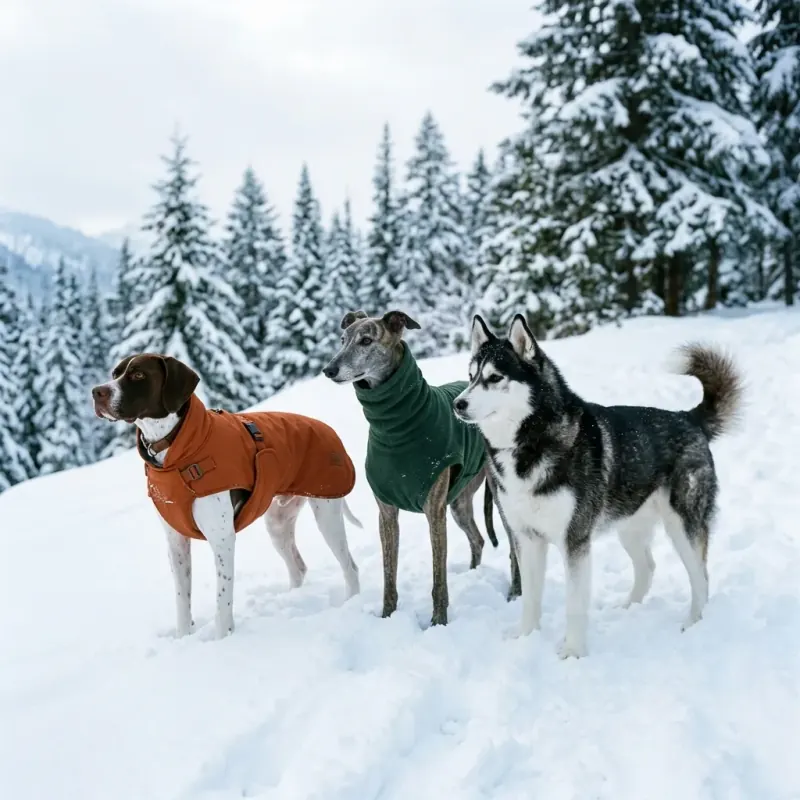
Most winter coat roundups start with the coats. This one has to start a step earlier, because the single biggest mistake in this category isn’t buying the wrong jacket — it’s buying one for a dog that shouldn’t be wearing one at all.
Then there’s the second problem: almost nobody measures. “Warmest” gets asserted constantly and demonstrated almost never. So this guide leans on the two outfits that actually put numbers to it, follows their results even where that’s inconvenient, and tells you plainly when a product hasn’t been independently tested at all.
First: does your dog need a coat?
Both independent test teams land in the same place, and it’s worth being blunt about it.
Dogs that genuinely benefit:
- Thin, single-coated breeds — pointers, Vizslas, Boxers, Boston terriers, pit-bull types
- Low-body-fat dogs — sighthounds and greyhounds especially, where there’s no fat layer regardless of height
- Seniors and puppies, who thermoregulate less well than healthy adults
- Dogs with medical conditions affecting circulation or mobility
Dogs that usually don’t: thick double-coated northern breeds — Huskies, Malamutes, Samoyeds. Treeline Review is explicit that these dogs risk overheating in a coat. That isn’t squeamishness about dressing dogs up; a double coat is already an insulation system, holding a layer of warm air against the skin under water-resistant guard hairs. Adding a jacket over the top of a working dog on a cold walk can push them the wrong way.
If you’re not sure which group your dog is in, our guide to cold-weather breeds works through where “built for cold” is genuinely true and where it stops being true. And if the underlying question is really how long can we be out there, that’s a separate article — the short version is that two veterinary schools give opposite answers and your dog’s coat is the biggest reason why.
How these picks were chosen
Two independent teams have tested dog coats properly, and we’ve deferred to their results rather than to brand reputation or Amazon ranking.
Treeline Review ran the only quantified warmth test we could find: a hot water bottle heated to 101–103°F (roughly canine body temperature) wrapped inside each jacket, with the temperature loss measured after 10 minutes. Waterproofing was tested by holding each coat under a running tap for one minute. Field testing ran from −2°F to 45°F across snow, wind and wet, using two resident dogs — one short-haired, one double-coated — plus six others.
Whole Dog Journal tested separately for warmth, water resistance and how easily a coat goes on and off, prioritising coats that handle “sub-zero temperatures; wet, crusty, or powdery snow; ice; and freezing rain.”
Where they agree, we’ve said so and that’s our strongest recommendation. Where a product hasn’t been tested by either, we say that too rather than dressing up spec-sheet copy as performance.
| Coat | Measured heat lost | Weather | Best for | Price |
|---|---|---|---|---|
| Hurtta Extreme Warmer | 1.6° — warmest tested | 10,000 mm | Serious cold | Check price → |
| Ruffwear Powder Hound | 2.0° | Water-resistant | Snow and active dogs | Check price → |
| Ruffwear Climate Changer | 2.9° | Not waterproof | Dry cold, layering | Check price → |
| Kurgo Loft Jacket | Not independently tested | Water-resistant | Budget, everyday | Check price → |
| Carhartt Chore Coat | 3.3° — last of the insulated coats | Water-resistant | See below | Check price → |
Hurtta Extreme Warmer III ECO — the warmest, and both testers agree
This is the only coat here where two independent sources converge, and that convergence is the reason it leads.
In Treeline’s measured test it lost 1.6° — the least of anything they wrapped — and they named it their pick for extreme cold. Whole Dog Journal, testing independently and by different criteria, made the Extreme Warmer a top four-paw pick.
What makes it different from a thicker jacket is the approach. Rather than piling on insulation, it uses a heat-reflective foil lining designed to bounce the dog’s own body heat back rather than let it escape. Practically that means warmth without the bulk that makes some coats awkward on an active dog. It has a high collar plus a lift-up tricot hood that covers the ears and head, adjustable back length, collar and waist, and a protective rear hem. The ECO version’s shell, wadding and belt are 100% recycled with a 50% recycled polyester lining, weatherproofed with a fluorocarbon-free DWR treatment.
Two things to get right before ordering. Hurtta sizes this coat by back length in inches — not girth — which is the single most common way people end up with the wrong one. And Treeline found it runs about one size large. Measure from the base of the neck to the base of the tail, check Hurtta’s chart, and factor that in.
Disclosure: some links below are affiliate links. If you buy through them we may earn a small commission at no extra cost to you.
Check the Hurtta Extreme Warmer on Amazon →
Ruffwear Powder Hound — best for snow and moving dogs
Treeline’s pick for snow, at 2.0° lost — within a rounding error of the top of the field, from a jacket that’s noticeably less bulky.
The design goal is warmth that doesn’t fight the dog. There’s 250 g of recycled insulation across the upper body and belly, but the side panels are four-way stretch and the sleeves — Ruffwear calls the system StormSleeve — flex with the stride rather than resisting it. The shell is a 75D polyester softshell with a DWR finish that sheds light snow and slush, and the formfitting cut with a smooth YKK Vislon zip is meant to stay put rather than twisting in deep snow. Reflective trim and a loop for a clip-on light handle the fact that winter walks happen in the dark.
The honest limitation from Treeline’s field testing: the sleeves got wet in melting snow. It’s water-resistant, not waterproof. For dry powder and cold it’s excellent; for a slushy thaw it’s the wrong tool.
This is the coat we’d point most active dogs toward — a dog that’s running, working or hiking rather than standing around, and that needs range of motion more than maximum insulation. It’s girth-sized, so measure around the widest part of the ribcage.
Check the Ruffwear Powder Hound on Amazon →
Ruffwear Climate Changer — the fleece, and what it’s actually for
Treeline’s lightweight pick, and the one on this page most likely to be bought for the wrong job.
At 2.9° lost it’s near the bottom of the measured field, and it is not waterproof at all. Read as a winter coat, that’s a poor result. Read as what it is — a technical fleece mid-layer — it’s the wrong test. Recycled fleece, a full-length zip so there’s no wrestling it over the head, articulated sleeves that keep the shoulders moving, front and back leash portals, reflective trim. Ruffwear designs it to be worn on its own in dry cold or layered underneath an insulated shell.
Amazon’s own listing describes it as keeping “short-haired pups, seniors, and small breeds comfortable,” which is a fair summary of who it suits. For a cold, clear, dry day, or as the layer under something waterproof when it turns, it earns its place. As your only winter coat in wet weather, it doesn’t.
Check the Ruffwear Climate Changer on Amazon →
Kurgo Loft Jacket — the popular one, with a caveat we owe you
This is comfortably the best-selling coat on this page — it sits around #30 in Amazon’s Dog Cold Weather Coats category, while the Powder Hound is near #196 and the Hurtta near #328. On features it’s easy to see why: reversible with two-tone colours, water-resistant Microtomic Ripstop fabric, reflective trim, a two-way zipper that gives you harness access without removing the coat — genuinely useful — and Kurgo’s lifetime warranty. It’s also the cheapest option here by a distance.
The caveat: neither independent test we rely on has measured it. It doesn’t appear in Treeline’s line-up or Whole Dog Journal’s ratings, so everything above is specification and popularity rather than tested warmth. We’re listing it because the harness-access zipper is a real design advantage and because pretending the most-bought coat doesn’t exist helps nobody. We’re not going to tell you how warm it is, because we don’t know and neither does anyone who’s published.
If tested performance is what you’re buying, the three coats above have it and this one doesn’t.
Check the Kurgo Loft Jacket on Amazon →
The Carhartt Chore Coat — why we’re not recommending it
Carhartt makes excellent workwear, the dog version looks the part, and brand recognition sells a lot of them. The measured result doesn’t support the reputation.
In Treeline’s test the Carhartt Chore Coat lost 3.3° — the worst of the insulated coats they tested, tied for last overall and more than double the Hurtta’s heat loss. They also criticised the fit and noted the limited size range. The construction is durable canvas, which is genuinely tough; toughness and warmth are just different properties, and this coat is being bought for the second while delivering the first.
One more thing worth knowing, which isn’t a test result but is on the product listing itself: Carhartt’s Amazon listings for this coat carry a “Contains PFAS” disclosure. We’re noting it because it’s stated on the listing and buyers can weigh it themselves, not because we’re drawing a health conclusion we’re not qualified to draw.
If you want the Carhartt look, that’s a legitimate reason to buy something and we’re not going to be sniffy about it. Just don’t buy it believing it’s the warm option.
Check the Carhartt Chore Coat on Amazon →
What we couldn’t include, and why
Treeline Review’s Best Overall was the Non-stop Dogwear Glacier Jacket 3.0 — 1.9° lost, a 20,000 mm waterproof rating, excellent range of motion, 14 sizes. Whole Dog Journal’s four-paw list includes Chilly Dogs’ Great White North, the Pomppa Toppa, and Mountain Mutt’s Powershield.
None of these turned up on Amazon when we looked. We’re telling you rather than quietly swapping in a worse coat that happens to be purchasable, because a roundup that only shows you what it can earn a commission on isn’t a roundup. If you’re willing to buy direct from the manufacturer, the Glacier Jacket is the coat the more rigorous of our two sources rated above everything else, including the Hurtta.
Getting the fit right
Fit is where most of the money in this category gets wasted, and it’s mostly one avoidable error.
Check which measurement the brand uses. Ruffwear sizes by girth — around the widest part of the ribcage. Hurtta sizes by back length — base of the neck to base of the tail. These are different numbers, and measuring for one while ordering from the other’s chart is the most reliable way to get a coat that doesn’t fit.
Then check coverage. Belly coverage is what separates a coat that works from one that just looks warm, particularly for short-legged and low-slung dogs walking through snow. Sleeves add warmth but also add the possibility of restricting the shoulder — which is why both testers rate range of motion, not just insulation.
And check it on a moving dog, not a standing one. A jacket that sits perfectly in the hallway can twist, ride up or slump once your dog is actually trotting through deep snow.
The bottom line
If your dog is double-coated and northern, you probably don’t need anything on this page — put the money toward paw protection instead, because pads are the part of those dogs that genuinely struggles with salt and ice.
If your dog is thin-coated, lean, old, young or unwell, then: the Hurtta Extreme Warmer for serious cold, on the strength of the only warmth result two independent testers agree on. The Ruffwear Powder Hound for an active dog in snow. The Ruffwear Climate Changer as a dry-cold layer rather than a standalone winter coat.
Measure before you order, check whether the brand wants girth or back length, and be honest about whether your dog is cold or you just think they look cold.
For the other end of the year, the same logic runs in reverse in our guide to cooling vests — where, as it happens, evaporative cooling has its own gap between what’s claimed and what’s been measured.
And if you’re buying one of these as a present, don’t — not without the dog’s measurements. A coat needs back length as well as girth, and sizing isn’t consistent between brands. Our gift guide for adventure dog owners splits the category on that line and suggests what to give instead.
If you’re kitting out for the season rather than buying one item, the winter dog gear checklist puts the coat where it actually belongs in the buying order — which is later than most people put it, behind a light, a towel and thirty seconds with the clippers.
Sources
- Treeline Review — 6 Best Cold Weather Coats and Jackets for Dogs of 2026 (Tested) — measured heat-loss testing, field-tested −2°F to 45°F
- Whole Dog Journal — The Best Dog Winter Coats and Jackets
- American Kennel Club — Reasons Why Northern Breeds Rock Cold Weather — double-coat and counter-current heat exchange
- Washington State University Veterinary Teaching Hospital — When is it too cold for your pet?
- Product specifications and category rankings read from live amazon.com listings, 12 August 2026
Frequently asked questions
Do dogs actually need winter coats?
Some do and some don't, and the split is fairly clear. Both independent test teams we follow say the dogs that need one are thin single-coated breeds (pointers, Vizslas, Boston terriers, pit-bull types), low-body-fat sighthounds, seniors, puppies, and dogs with medical conditions. Thick double-coated northern breeds — Huskies, Malamutes, Samoyeds — generally don't, and Treeline Review specifically notes they risk overheating in one. A coat is medical equipment for some dogs and a costume for others.
What is the warmest dog coat?
The Hurtta Extreme Warmer III ECO, and it's the one warmth claim on this page that two independent sources support. In Treeline Review's measured test — a hot water bottle at 101–103°F wrapped in each jacket, temperature loss recorded after 10 minutes — it lost only 1.6°, the least of anything tested. Whole Dog Journal separately rates the Extreme Warmer their top four-paw pick. Its distinguishing feature is a heat-reflective foil lining rather than bulk insulation.
How do I measure my dog for a winter coat?
Check which measurement the brand actually uses, because they differ and it's the main reason coats get returned. Ruffwear sizes the Powder Hound by girth — the measurement around the widest part of the ribcage. Hurtta sizes the Extreme Warmer by back length in inches, from the base of the neck to the base of the tail. Measuring one and ordering from the other's chart will reliably get you the wrong coat. Treeline also notes the Extreme Warmer runs about one size large.
Is a fleece enough, or does my dog need an insulated jacket?
It depends on whether the weather is cold-and-dry or cold-and-wet. A fleece like the Ruffwear Climate Changer is a mid-layer: it holds heat in dry cold and dries fast, but it isn't waterproof and it finished near the bottom of the measured warmth test at 2.9° lost. For wet snow, sleet or sustained sub-freezing temperatures you want an insulated shell over the top, or a coat that combines both. Layering a fleece under an insulated jacket is a legitimate approach and what Ruffwear designs the Climate Changer to do.
Are expensive dog coats worth it?
Sometimes, but not in the way the price implies. In the measured test the spread between the warmest coat and the worst insulated one was 1.7°, and the coat that finished last was neither the cheapest nor an obscure brand. What you get for money is usually fit range, weather resistance and durable hardware rather than raw warmth. The bigger risk is buying an untested coat on brand recognition — the best-selling option on Amazon appears in neither independent test we rely on.
Can a winter coat make my dog too hot?
Yes, and it's a real consideration for double-coated dogs rather than a theoretical one — Treeline Review flags overheating risk when putting coats on thick-coated northern breeds. A double coat already traps a layer of warm air against the skin; adding an insulating shell on top of a dog that's also working hard on a walk can push them the wrong way. If your dog is panting heavily on a cold walk in a coat, take it off.
Comments
Got a question, a tip, or a correction? Leave a comment — no account, no sign-in. Just your name and your thoughts.
Loading comments…