Every winter, two claims get made about northern dogs and both are half right.
The first is that Huskies and Malamutes are basically impervious to cold. The second, usually offered as a correction, is that this is a myth and they need just as much protection as any other dog.
The truth is more interesting and more specific than either. These breeds carry genuine, identifiable anatomical adaptations — not just “thick fur,” but a heat-exchange system in the paws and several other features that took a long time to evolve and do real work. And those adaptations have defined limits, which owners consistently overrun, and which in a growing number of jurisdictions are now written into law.
So this guide does both halves: which breeds are genuinely built for cold and what they’re built with, then exactly where that stops.
What “built for cold” actually means
The American Kennel Club’s description of northern breed adaptations is more detailed than the usual “they have thick coats,” and the details are worth knowing because they explain the limits later.
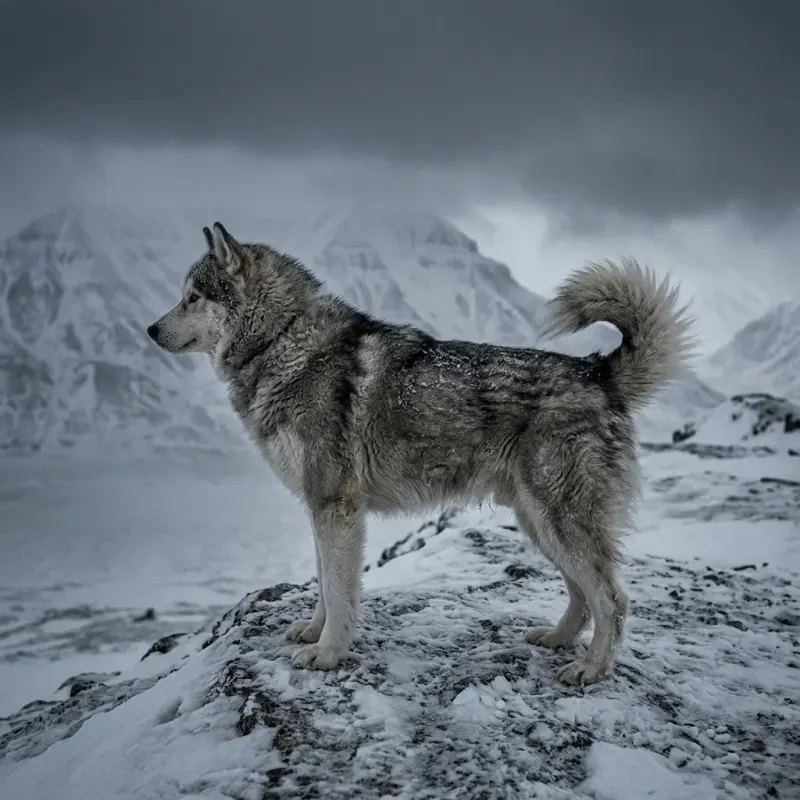
The double coat. An outer layer of “reflective, bristly, water-resistant guard hairs” roughly twice the length of the undercoat, over a dense downy undercoat that traps heat. Two layers doing two different jobs — shedding weather and holding warmth.
Counter-current heat exchange in the paws. This is the one people don’t know about. Heat travels from the warm blood inside the arteries into the cooler veins surrounding them, so warmth returns toward the core rather than being dumped into the ground through the feet. The result is a paw that keeps functioning in freezing conditions without bleeding the dog’s core temperature away.
Broad paws that grip ice and spread weight across snow.
Small, thick, hair-covered ears — less exposed surface area, less frostbite risk. Compare that with a breed carrying large thin erect ears.
A bushy plumed tail that, curled over the face while sleeping, pre-warms the air the dog breathes.
Extra footpad fat, which freezes more slowly than other tissue.
That’s a system, not a coat. And it’s why a Husky and a Whippet in the same weather are not remotely in the same situation — something even the Tufts weather assessment scale used by cruelty investigators accounts for, subtracting a full risk point for northern or heavy double-coated breeds.
The specialists
Siberian Husky
The benchmark, and genuinely extraordinary. Peer-reviewed work on racing sled dogs has documented an ultra-endurance metabolism that sustains extraordinary workloads in the cold — this is a dog built to work all day at temperature. The AKC notes they maintain condition on less food than comparable breeds, which is part of the same adaptation.
The limit isn’t cold, it’s containment. The AKC’s guidance is unusually blunt: it’s “vital to keep the dog on a leash, in harness, or in a fenced yard at all times.” A Husky that gets loose in winter wilderness covers ground fast and doesn’t come back on request. Cold-weather adventuring with this breed means never having an off-leash moment — our full Husky guide covers what that means in practice.
At a glance: 21–23.5″ · 45–60 lb · 12–14 years.
Alaskan Malamute
The freight dog. Where the Husky is built for speed and distance, the Malamute was bred to carry and haul heavy loads, and the AKC explicitly lists backpacking, sledding and skijoring among its suitable activities. Bigger, stronger and slower than a Husky, with the same cold hardware.
Same containment caution, plus the fact that a 85 lb dog with a serious pulling instinct is a different proposition on a lead than a 50 lb one. Cross-shopping the two is common enough that we gave it its own comparison — the short version being that the cold is not what separates them.
At a glance: ~25″ · ~85 lb · 10–14 years.
Samoyed
The white one everyone photographs in snow, and deservedly — the coat is spectacular and functional. The AKC’s caution here is roaming: they note a “strong urge to run away and roam,” and that a loose Sammie “might travel for miles.”
Also worth budgeting for the grooming. That coat is the reason they’re comfortable at temperatures that trouble other dogs, and maintaining it is not a small commitment.
At a glance: 21–23.5″ · 45–65 lb · 12–14 years.
The mountain breeds
Bernese Mountain Dog
A Swiss Alpine breed, and one of the best cold-weather camping and hiking companions there is — the AKC lists backpacking, camping and carting among its activities while describing exercise needs as “at least a half-hour of moderate exercise.” That combination of genuinely enjoying the outdoors and being content to lie down afterwards is rarer than it sounds.
The hard part is the lifespan: 7–10 years is short, and it’s the honest thing to know before falling in love with the breed. When it was measured directly in a Swiss breed-club cohort the median came out at 8.4 years, with cancer behind most of it — our full Bernese Mountain Dog guide goes through that evidence and what to ask a breeder.
At a glance: 25–27.5″ · 80–115 lb · 7–10 years.
Newfoundland
Built for cold water specifically — a thick wooly coat, enormous strength, and the AKC citing swimming, draft work and natural lifesaving. If your winter involves cold coastlines or lakes, no breed is more at home.
The trade-offs are size and lifespan: 130–150 lb and 9–10 years.
Great Pyrenees
A livestock guardian bred to work outdoors overnight in mountain weather, with a coat to match. The AKC describes them as “not a highly active breed” that conserves energy — which suits cold-weather living well, since they’re not burning through reserves.
Worth knowing: the same guarding instinct means a Pyr announces things, including at night. That’s a feature on a farm and a complication in a neighbourhood or at a campsite.
At a glance: 27–32″ · 100 lb+ · 10–12 years.
The all-rounders
These aren’t cold specialists, but they’re double-coated working dogs that handle winter well and are far more likely to be the dog you actually own.
German Shepherd — a proper double coat and enough substance to work in cold comfortably. The AKC’s own caution is about off-leash reliability rather than temperature: “do not let the dog off leash, as even the best-trained dog can become distracted.”
Australian Shepherd and Border Collie — both carry weather-resistant double coats and were bred to work outdoors in hill country in poor conditions. Neither is a northern breed, and neither is fragile in winter.
Australian Cattle Dog — a dense double coat over a compact, hard-wearing frame. Bred for heat as much as cold, but genuinely robust in both.
For how these breeds compare on the trail generally rather than in winter specifically, our adventure-breeds hub ranks by what actually limits dogs outdoors.
Where “built for cold” stops
This is the section most cold-weather breed lists skip, and it’s the one that matters.
Wet cold is a different problem
A double coat works by trapping a layer of warm air against the skin. Water displaces that air. A soaked coat isn’t a slightly less effective coat — it’s a coat doing a substantially different job.
The Tufts weather scale reflects this precisely: it subtracts a point for a northern or heavy double coat, and adds a full point for rain or sleet. Those two modifiers can cancel each other out. A snow dog in dry powder at 15°F and the same dog in freezing rain at 33°F are not in comparable situations, and the second one is often worse despite the higher number.
Puppies and seniors don’t get the breed discount
Thermoregulation is weaker at both ends of life regardless of coat. Texas A&M’s veterinary college adds a point that’s easy to miss: geriatric dogs “may take medications that alter their ability to regulate their temperature and blood flow,” which stacks on top of age itself.
A Malamute puppy is not a small Malamute where cold is concerned, and a fourteen-year-old Husky is not the dog it was at four.
Acclimatization is real, and it has no reliable clock
A dog living through the winter is genuinely more cold-tolerant than the same breed that arrived from a warm climate last week — Texas A&M ties safe outdoor duration directly to how acclimated the individual dog is.
We’d like to give you a number of days. We aren’t going to, because we couldn’t find one established for dogs; the figures that circulate trace back to human cold-exposure research. Treat acclimatization as a real effect you shouldn’t try to quantify.
They still get frostbite and hypothermia
The adaptations reduce risk. They don’t remove it. Frostbite targets the least-furred extremities — Texas A&M lists ears and tails, Washington State University’s teaching hospital lists paw pads, nose and ears, noting affected dogs may “appear to prance when walking” with tissue turning grey.
Hypothermia is staged identically across veterinary sources: mild at 90–99°F body temperature, moderate at 82–90°F, severe below 82°F. The sign to know is that in severe cases the shivering stops — a dog that has stopped shivering has not warmed up.
For how all of this translates into “how long can we actually be outside,” we’ve written that up separately — including why two veterinary schools give opposite answers.
”Cold-hardy” is not a licence to leave them out
The AKC, immediately after describing every adaptation above, adds the caveat directly: these do not justify leaving dogs outside in extreme cold without shelter, food and water.
This has increasingly stopped being only an ethical question. A number of US states and municipalities now regulate leaving or tethering dogs outdoors in extreme temperatures, and the rules vary a great deal in both substance and structure.
Pennsylvania is a useful illustration of why the detail matters. Its tethering provision — 18 Pa.C.S. § 5536 — is widely reported online as “it’s illegal to leave your dog outside below 32°F,” which isn’t quite what it does. The statute creates a rebuttable presumption that a dog tethered outdoors for under nine hours in twenty-four has not been neglected, provided conditions are met: a tether at least three times the dog’s length or ten feet, whichever is longer, a well-fitted collar or harness with a swivel anchor, access to potable water and shade, and not tethered more than 30 minutes in temperatures above 90°F or below 32°F.
That’s a different legal mechanism from a flat ban, it concerns tethering rather than simply being outdoors, and the threshold is 32°F rather than the 30°F several news write-ups report.
None of which is legal advice, and none of which necessarily applies where you live. The point is narrower: assuming your cold-hardy breed exempts you is a bad assumption on welfare grounds and possibly on legal ones too. Check your own state and municipality.
The breeds that look cold-hardy and aren’t
Thin single coats with low body fat. Sighthounds and greyhounds are the clearest case — long-legged, athletic, and with essentially no insulation regardless of size. Pointers, Vizslas and similar smooth-coated sporting breeds are in the same group.
Small dogs generally, because surface-area-to-volume ratio works against them. Texas A&M notes smaller dogs lose body heat faster.
Shaved double-coated dogs. Removing the undercoat removes the insulation system, and it doesn’t grow back correctly in every dog. This is a reason not to shave a double coat that has nothing to do with summer.
These are the dogs that genuinely benefit from a coat — and our winter coat guide covers which models independent testing actually measured as warm, along with why the popular ones often haven’t been tested at all.
What to actually buy for a cold-hardy dog
Not a jacket, usually. Independent testers specifically flag overheating risk when thick double-coated northern breeds wear insulated coats — you’re adding insulation to a dog that already has a working system and is generating heat by moving.
The more useful purchase is paw protection. Pads are where these dogs are genuinely exposed: to road salt and deicers, which the ASPCA’s Animal Poison Control Center classes as chemical irritants, and to ice balling up between the toes. Our dog boot guide covers the fit problem that makes most boots fall off, and washing and drying the feet after every winter walk costs nothing and works on every dog.
The bottom line
The true cold specialists are the Siberian Husky, Alaskan Malamute and Samoyed, followed by the mountain breeds — Bernese Mountain Dog, Newfoundland, Great Pyrenees. The double-coated working breeds most people actually own — German Shepherd, Australian Shepherd, Border Collie, Australian Cattle Dog — handle winter comfortably without being specialists.
All of them are limited by the same four things: wet, age at either end, acclimatization, and the individual dog in front of you. And none of them, per the same organisation that documents the adaptations, should be left outside in extreme cold without shelter, food and water — a point that in some places now carries legal weight as well as ethical weight.
Built for cold is real. It’s just narrower than the phrase suggests.
Sources
- American Kennel Club — Reasons Why Northern Breeds Rock Cold Weather — double coat, counter-current heat exchange, paws, ears, tail, footpad fat, and the caveat on leaving dogs outside
- American Kennel Club breed pages — height, weight, life expectancy and exercise guidance for each breed named
- Tufts Animal Care and Condition (TACC) scales — Weather Safety Scale modifiers (−1 northern/heavy coat, +1 rain or sleet)
- Texas A&M College of Veterinary Medicine — Dashing Through the Snow: Signs of Hypothermia
- Washington State University Veterinary Teaching Hospital — When is it too cold for your pet?
- Animal Legal & Historical Center, Michigan State University — 18 Pa.C.S. § 5536, Tethering of unattended dog
- Animal Legal Defense Fund — Animal Protection Laws of Pennsylvania
- ASPCA — Cold Weather Safety Tips
Frequently asked questions
What dog breeds handle cold weather best?
The northern spitz breeds are purpose-built for it — Siberian Husky, Alaskan Malamute and Samoyed — followed by the heavy-coated mountain breeds: Bernese Mountain Dog, Newfoundland, Great Pyrenees and Saint Bernard. Working double-coated breeds like the German Shepherd and Australian Shepherd handle cold well without being specialists. What they share is a dense insulating undercoat beneath water-resistant guard hairs, plus, in the true northern breeds, several specific anatomical adaptations described below.
How do northern dog breeds stay warm in freezing conditions?
Through several adaptations working together, as described by the American Kennel Club. The double coat pairs reflective, bristly, water-resistant guard hairs — roughly twice the length of the undercoat — with a dense downy undercoat that traps heat. The paws use counter-current heat exchange, where heat transfers from warm arterial blood into the cooler veins running alongside, keeping the core warm while the feet stay functional. Broad paws grip ice and spread weight, small thick furred ears reduce frostbite exposure, a bushy tail pre-warms inhaled air when curled over the face, and extra footpad fat freezes more slowly than other tissue.
Can cold-weather dogs be left outside in winter?
No — and the AKC, describing those very adaptations, states plainly that they do not justify leaving dogs outside in extreme cold without shelter, food and water. Beyond welfare, this is increasingly a legal question: many US states and municipalities regulate leaving or tethering dogs outdoors in extreme temperatures, and the rules vary substantially. Check the law where you actually live rather than assuming a cold-hardy breed exempts you.
Do cold-weather breeds need winter coats?
Generally not, and putting one on can be counterproductive. Independent testers specifically flag an overheating risk when thick double-coated northern breeds wear insulated jackets — the coat is already a working insulation system. The exceptions are the usual ones regardless of breed: puppies, seniors, dogs that are unwell, and any dog that's wet. Paw protection is usually the more useful purchase for these dogs than body coverage.
Is wet cold worse than dry cold for dogs?
Considerably, and it's the limit owners overrun most often. A double coat works by trapping a layer of warm air; water displaces that air and strips the insulation. The Tufts Animal Care and Condition weather scale — an assessment tool used by cruelty investigators — reflects this by adding a full risk point for rain or sleet, while subtracting one for northern or heavy double-coated breeds. A snow-loving dog in freezing rain is in a different situation from the same dog in dry powder.
Which dogs are worst in cold weather?
Thin single-coated breeds with little body fat — sighthounds and greyhounds especially, plus pointers, Vizslas and similar. Small dogs lose heat faster because of their surface-area-to-volume ratio, and puppies and seniors thermoregulate less well at any size. Texas A&M's veterinary college also notes that geriatric dogs may take medications affecting their ability to regulate temperature and blood flow, which compounds it independent of coat type.
Comments
Got a question, a tip, or a correction? Leave a comment — no account, no sign-in. Just your name and your thoughts.
Loading comments…