
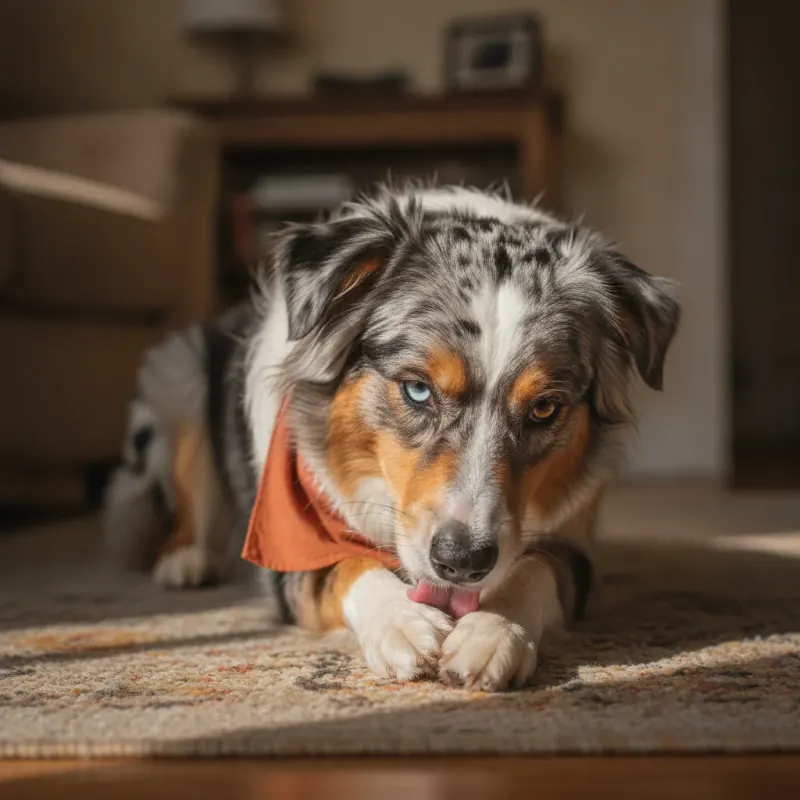
It is usually a sound that starts this. Not a visible problem — a wet, rhythmic, faintly obsessive noise from the end of the sofa at half past ten, night after night, that you eventually stop being able to ignore.
By the time most people search for this, they have already looked at the foot and found nothing obvious. What they want is not another list of possible causes. They want to know whether this is a problem, and what happens next.
So this page is built the other way round from the rest of the ones you will find. It starts with a way to measure what you are seeing, because there is a validated one and it takes about ten seconds. Then it walks through what a vet will actually do, in the order a 2023 veterinary guideline says to do it, with the real duration attached to every step. The causes are in here — but they sit inside that frame, not in place of it, because the cause is the one thing you cannot determine from the sofa.
First, score it — the scale your vet already uses
There is an owner-scored itch scale in veterinary dermatology, and it was built and validated precisely because “he licks a lot” is not a measurement. It was developed in 2007 and validated further in 2009 on 713 owners presenting dogs for veterinary attention.
It works like this. You are asked to place your dog on a continuous line from 0 to 10, where 0 is a dog that never itches and 10 is a dog whose itching is extreme and essentially constant — interrupting sleep, interrupting eating, not stoppable by distraction. The descriptions in between are behavioural rather than numerical: occasional and brief, noticeable at certain times of day, present most of the time, waking the dog at night.
Two findings from that validation are worth having in your head, and neither appears on any other page answering this question.
A normal dog is not a zero. Of the 305 dogs in the study with no skin disease at all, 90 of their owners still scored them above zero. That is close to three in ten. A small amount of foot licking is part of being a dog, and a page that tells you any licking is a red flag is going to send a lot of people to the vet with a healthy animal. From the comparison between the diseased and non-diseased groups, the authors established a normal range of 0 to 1.9.
And the scale is repeatable between people. In the development study, two owners of the same dog scoring independently correlated at R = 0.8. So the number your partner would give is close to the number you would give — which means the score is worth writing down and comparing later rather than re-estimating from memory.
Write today’s number down with today’s date. You are going to want it twice: once at the appointment, and once in two weeks.
Then look at the foot, in five specific places
Most owners have already “checked the paw”, which usually means turning it over and looking at the pads. The pads are the least likely place for this to be hiding.
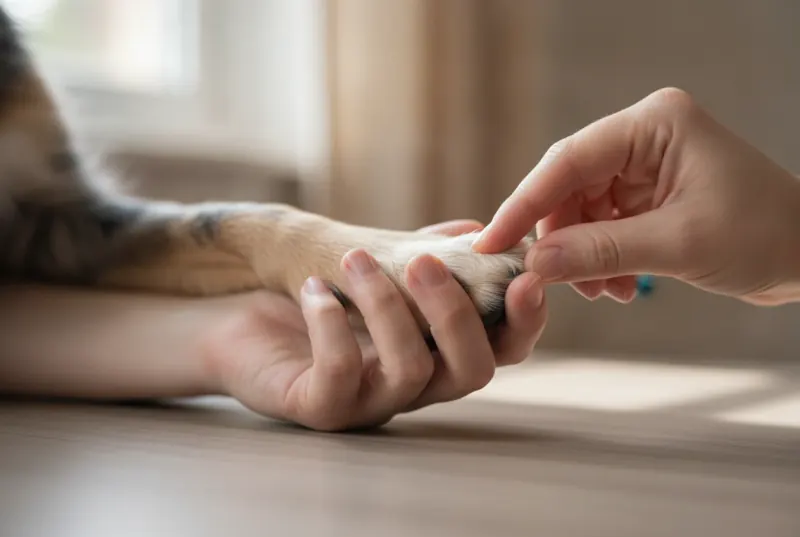
Spread the toes and look at the webbing between them, which is warm, humid, and where both of the common interdigital diseases live. Look at the nail folds, where the claw emerges from the skin, for redness or brown discharge. Look at the pads themselves for cracks, splits, or a foreign body pushed in edge-on. Look at the carpal pad higher up the leg, which people forget exists. And look at the colour of the fur on the foot compared with the other three.
That last one is the detail that gets over-read online. Reddish-brown staining on white or pale fur is saliva, not infection and not blood. It tells you the dog has been licking — which you already know — and roughly for how long. It is not a diagnosis of anything.
One paw, or all four? Front, or back?
This is the most useful question you can answer at home, and it genuinely changes what is likely.
One foot only points at something in that foot — a foreign body, an injury, a single infected nail fold, or pain referred from higher up the limb. It argues against an allergy, which is a whole-dog condition that does not usually pick a single foot.
Front feet more than back is the pattern of the conditions that bring most dogs in. “Affected front feet” is one of the eight published criteria for canine atopic dermatitis. And in a 2023 ultrasound study of 59 dogs with interdigital lesions, front-limb involvement ran at 88% in dogs with interdigital furunculosis and 75% in dogs with an abscess caused by a migrating grass awn. In the same series, licking or itching was recorded in 74% and 70% of the two groups, and a discharging wound between the toes in 63% of each.
All four feet, plus ears, plus armpits and groin is the distribution that points hardest at allergic skin disease, and it is the one that takes you into the next few sections.
What a trail leaves in a foot
This is the part the general pet-health sites treat as a footnote, and for a dog that walks in long grass it belongs near the front.
A grass awn — a foxtail, a mean seed, whatever it is called locally — is a seed head engineered to travel in one direction. Its barbs all point backwards, which means every movement of the surrounding tissue advances it and nothing reverses it. Between a dog’s toes, that geometry does exactly what it was designed to do: it goes in, and it keeps going.
The scale of the problem is easy to underestimate. In a retrospective series of 182 grass awn migrations at one veterinary hospital, awns accounted for 61% of all foreign-body cases seen that year. The external ear canal was the commonest site at 51%, and the interdigital webs are listed first among the other common sites. That series is from 1983 and from a single Californian teaching hospital, so it is a proportion rather than a current rate — but the anatomy has not changed, and neither has the grass.
The same paper found the problem was not evenly distributed by breed. Springer spaniels, golden retrievers, Brittany spaniels and Airedale terriers turned up more often than their share of the hospital population; German shepherds, miniature poodles and dachshunds turned up less. Coat and working style, not luck.
What this means in practice: if the licking started suddenly, in one foot, during or just after grass season, and especially if there is a small wet swelling or a discharging point between two toes, do not wait to see if it settles. An awn that is still shallow can be found and lifted out. One that has travelled cannot, and the longer it travels the more it costs to deal with. This is also the argument for checking feet as a habit on the way back to the car rather than at bedtime — the same habit our guide to starting out hiking with a dog recommends, and one of several reasons boots earn their place on dry, seedy ground in late summer.

The allergy answer, and the criteria vets actually use
If the licking is chronic rather than sudden, involves more than one foot, and comes with ears that need attention, allergic skin disease is where this usually lands. Skin is what fills veterinary waiting rooms: in a survey of 3,707 small-animal consultations in general practice, 21.4% involved a dermatological problem, and in dogs pruritus was the single most common presenting sign, accounting for 30 to 40% of those consultations.
Here is the part no consumer page carries. There is a published set of clinical criteria for recognising canine atopic dermatitis, derived from a large population of itchy dogs, and paw licking is in it by name.
| Favrot’s criteria, set 1 | |
|---|---|
| 1 | Age at onset under 3 years |
| 2 | Mostly indoor lifestyle |
| 3 | Pruritus that responds to corticosteroids |
| 4 | Chronic or recurrent yeast infections |
| 5 | Affected front feet |
| 6 | Affected ear pinnae |
| 7 | Ear margins not affected |
| 8 | Dorso-lumbar area not affected |
With five of the eight fulfilled, the set has a sensitivity of 85.4% and a specificity of 79.1%. Require six and it becomes much more specific and much less sensitive — 88.5% and 58.2% — which is why clinicians pick a threshold to suit the question they are asking rather than treating it as one fixed test.
Two of those criteria are worth reading twice, because they are the ones people misread. Criteria 7 and 8 are negatives: it is the absence of disease at the ear margins and along the lower back that supports the diagnosis, because those two sites are where the main mimics — mites, in particular — like to sit.
Now the part that matters more than the list. The guideline that publishes this table states the limit in its own words: these criteria “should not be used in isolation as a ‘diagnostic test’”, and the second set carries the explicit instruction to “rule out resembling diseases” first. They are a tool for a clinician who has already excluded the mimics, not a questionnaire that settles anything from a sofa. Read them as a way of understanding why your vet is asking about your dog’s ears when you came in about a foot.
Two things everyone gets wrong about the allergy question
“Year-round means food, seasonal means environmental.” It does not work. The original study behind those criteria compared food-induced and non-food-induced atopic dermatitis and found the two clinically indistinguishable, and the 2023 AAHA guidelines agree that there are “no historical or physical examination findings that can differentiate atopy from food allergy.” Three weak tendencies survive — atopy is likelier to be seasonal, food-allergic dogs more often have gut signs as well, and their itch may respond less well to steroids — and none of them settles anything. Non-seasonal itch also fits atopy driven by indoor allergens, or atopy anywhere the outdoor allergen season never really ends.
The “ears and rears” pattern. The long-standing rule of thumb that itchy ears plus an itchy back end means food allergy has been retired outright. The 2023 guideline’s wording is that it “is no longer accurate.”
And the age of onset is a real clue, with two published answers. The criteria set says onset under three years. The 2023 AAHA guidelines describe atopy as having “a more defined age of onset,” specifically between 6 months and 4 years, and note that food allergy can start at any age — so a first-ever bout of itching in a very young puppy or an older dog tilts slightly away from atopy. The two sources do not give quite the same window, and there is no point pretending otherwise; what they agree on is that when this started is information, and most owners never get asked for it until they are in the room.
What your vet will actually do, and in what order
This is the section that turns a worried evening into a plan. The 2023 AAHA guidelines lay out a sequence, and knowing it in advance means you can follow what is happening instead of feeling it is arbitrary.
Step 1 — History and physical exam, skin and ears. Expect questions about seasonality, how itchy the dog is, what flea and tick prevention it is on, and what has already been tried. This is where your written score and your start date earn their keep.
Step 2 — The minimum dermatologic database. Not sent away to a lab; done in the room. Skin cytology — a tape or slide impression, stained and read under the microscope. Flea combing. Skin scrapings, superficial and deep, to look for Demodex and Sarcoptes mites. Ear cytology too if the ears are involved. This is how a vet finds out whether there is a secondary infection and whether mites are in play, and it is also why “my dog has a yeast infection” is a conclusion rather than a starting point.
Step 3 — Treat the itch. Because a dog that is licking is damaging the skin, and damaged skin gets infected, which causes more licking.
Step 4 — Treat the secondary infections, parasites and any ear disease. Malassezia yeast lives on normal canine skin — a 2023 study measuring it between the toes by cytology, culture and qPCR found it present in healthy dogs and simply present in much higher numbers in dogs with pododermatitis before treatment. That is why the finding is a load, read on a slide, and why the diagnosis is confirmed by the response to antifungal treatment rather than by a smell.
Step 5 — Recheck. Response to treatment is assessed at 14 days, ideally in person. If several things were prescribed, expect them to come off one at a time. The guideline is blunt about why: stopping anti-itch and anti-infection treatment together “muddies the water and does not allow you to interpret what was causing the patient’s itch.”
Step 6 — The diet trial, if the itch is still there once infection and parasites are gone.
And a note on allergy testing, since it is what most owners assume the vet will reach for first. It is not a screening test and it does not come early. The 2023 guidelines put it in their top three takeaways: “Atopy is a diagnosis of exclusion. Allergy testing (intradermal or serum) to identify allergens should only be performed if immunotherapy is planned.” The diagnostic guideline agrees — those tests exist to choose what goes into an immunotherapy formulation, not to tell you what is wrong.
How long each step takes
Nothing about this is fast, and almost every frustrated owner is frustrated because nobody told them the timescale. Here it is in one place.
| Step | How long | What it means |
|---|---|---|
| Skin cytology, scrapings, flea comb | Same visit | Results in the room, not a wait |
| First assessment of anti-itch treatment | 14 days | In person if possible; one drug withdrawn at a time |
| Oral antibiotics for a superficial skin infection | 21 days, typically | Many such infections resolve on topical treatment alone |
| Elimination diet trial | 4–12 weeks | Over 80% of food-allergic dogs remit by 5 weeks, over 90% by 8; a small group needs the full 12 |
| Food challenge after a successful trial | Up to 14 days | The old food goes back in; if the itch returns, that is the diagnosis |
| Allergen-specific immunotherapy | Benefit possibly up to a year | Effective in 50–100% of dogs; other treatment continues meanwhile |
Two things in that table deserve calling out.
The diet trial has an end step almost nobody mentions. A trial on its own proves nothing, because a dog that improves over eight weeks may have improved for any number of reasons. The diagnosis is made by putting the previous food back and watching. If the itch returns within about a fortnight, you have your answer.
And the diet has to be the right kind of diet. Over-the-counter “limited ingredient” foods have repeatedly been found to contain proteins that are not on the label, which can quietly invalidate the whole eight weeks. The guideline’s position is that prescription hydrolysed or novel-protein diets are “the only acceptable commercial diet choices for a true elimination diet trial.” Two smaller details that catch people out: during a trial, monthly flavoured oral heartworm and flea preventives should be swapped for non-flavoured or topical alternatives, and treats, chews and flavoured toothpaste all count as food.
What actually helps while you wait
Here the evidence is thinner than the internet suggests, and it is worth being precise about how thin, because the thin bits are where most of the money gets spent.
The ICADA treatment guidelines grade every recommendation on a published scale: A means consistent, good-quality evidence in real patients; B means inconsistent or limited-quality evidence in real patients; C means consensus, usual practice, expert opinion or case series. Almost everything in this part of the subject is a B or a C, and saying so is more useful than pretending otherwise.
Bathing is the best-supported thing you can do at home. In the section of the guidelines dealing with acute flares, the recommendation is that “the intensity and frequency of bathing may be the most important factor in relieving pruritus” — graded SOR B. In the chronic-management section the same advice is carried forward at SOR C, and the 2023 AAHA guidelines describe routine bathing with a moisturising shampoo as adjunctive rather than curative. So: real support, modest effect, and better evidence than anything else on this list. Weekly, mild shampoo, lukewarm water. For dogs with repeated bacterial or yeast infections, AAHA specifically supports routine anti-infective shampoos, mousses or sprays to reduce how often those come back.
There is a genuine trade-off attached, and the guideline states it: frequent bathing can reduce the efficacy of topical flea control. Worth a sentence with your vet if your dog is on a spot-on.
Paw balms and wipes sit below that, honestly labelled. The guideline’s verdict on emollients other than two specific tested formulations is that they “have not been proven to consistently reduce signs” in dogs. That does not make a balm useless — it is cheap, it is harmless, and a cracked pad is a real thing to treat. It makes it a comfort measure rather than a treatment, and it should not be the reason a dog waits another month for a diagnosis. The same goes for wiping feet after a walk: it is sensible, it costs nothing, and there is no controlled canine evidence that it reduces itch. Do it; just do not expect it to be the answer.
And two things worth avoiding. Apple cider vinegar soaks, on skin that a dog has already licked raw, are an irritant applied to inflamed tissue. And the direct-to-consumer hair and saliva allergy kits do not work — not “are imprecise”, do not work. One study submitted fake fur and water alongside real samples and found the results indistinguishable from chance; another submitted 35 samples producing 12,075 results and got positives for synthetic fur and sterile saline, with the real-animal results correlating with the fake ones at r = 0.71. AAHA’s summary is one sentence: serum, saliva and hair tests “are of no value in the diagnosis and management of food allergy.”
What the weather does and does not predict
This site exists for people who plan their days outdoors, so it is worth reporting a result that cuts against the intuitive version of this story.
A 2024 study followed 37 atopic dogs in Bavaria from April to November, with owners recording a daily itch score while daily local weather and pollen counts were collected alongside. Of everything measured, only humidity and the dog’s medication score correlated with the itch. There was no correlation between a given pollen count and the itch scores of the dogs that had tested positive to that same pollen on intradermal testing. The authors’ own conclusion is that airborne pollen traps may simply not represent what a dog meets at ground level — which, when you think about where a dog’s nose and feet actually are, is not a surprising thing to find.
The practical version: the pollen number on your weather app is not a forecast for your dog. Your own written itch scores, over a few weeks, are a far better record of what sets your dog off than any published count.
There is a second finding in the same territory, and it needs its limits attached. A study of 2,445 Labradors and golden retrievers looked at what distinguished the 793 with atopic dermatitis from the 1,652 without. Being reared in an urban environment was a risk factor. So were being male, being neutered, and being allowed on upholstered furniture. Among Labradors, chocolate-coated dogs were at greater risk than black or yellow ones. And walking in woodlands, fields or beaches was associated with lower odds of the disease.
That last one is the finding an outdoor site would love to over-read, so: it is a retrospective questionnaire study. It shows association, not cause, and the arrow could easily run the other way — a dog whose skin is a constant problem is a dog that gets taken to fewer fields. It is a reason to keep walking your dog in interesting places, not evidence that doing so will treat anything.
Worth knowing too: the ICADA guidelines’ formal position is that there is “insufficient evidence to make general recommendations regarding the importance of the environment, humidity, detergents and stress as flare factors” — graded C. The 2024 humidity result does not overturn that, and it is not meant to. It sits beside it, as one study in one region, which is how it should be read.
Breed, briefly
Across 23,000 hospital records including 722 dogs with atopic dermatitis, five breeds came out as predisposed worldwide rather than just locally: boxer, bulldog, Labrador retriever, pug and West Highland white terrier. One clade of closely related breeds accounted for 81% of the significantly over-represented cases, which is a genetic story rather than a lifestyle one.
If you have a Labrador or a boxer, that is a reason to take chronic foot licking seriously earlier rather than later. It is not a reason to skip the workup — a predisposed breed can still have a grass awn between two toes.
When it is not the skin at all
Two things should stop anyone concluding “it is just anxiety” and leaving it there.
The first is the review literature on acral lick dermatitis — the thickened, ulcerated plaque a dog creates by licking one spot for months. The conditions that produce it include allergic disease, orthopaedic and neurological problems, mites, bacterial and fungal infection, and tumours, alongside genuine compulsive disorder, with secondary infection keeping the cycle running whatever started it. Compulsive licking is real, and it is a diagnosis of exclusion rather than a default.
The second is a small case series that makes the point better than any argument. Six dogs presented with lesions that looked exactly like a behavioural lick granuloma. The underlying causes turned out to be lymphoma, an orthopaedic pin, deep pyoderma, a mast cell tumour, leishmaniasis and presumptive sporotrichosis. Six for six, the licking was a symptom of something else.
Pain is the version of this most likely to apply to an active dog. A dog with an arthritic wrist or an old injury will sometimes work the skin over the sore area, and the foot gets blamed for the leg. If the licking is confined to one limb and your dog is stiff after long days, say so at the appointment.
And two outdoor causes of sore feet that this site has already covered in detail belong in your thinking before you conclude anything: pads burned on hot ground, where the test is seven seconds with the back of your hand, and winter irritation from road salt and de-icer, which has its own paw-care guide. Autumn adds its own list — the seasonal hazards guide covers what else is on the ground at this time of year.
What to take to the appointment
Most people arrive with a story and leave with a question they forgot to ask. Fifteen minutes of preparation changes the appointment entirely.
Take:
- Your itch score, and the date you took it. One number, 0 to 10.
- When it started, as precisely as you can manage, and how old your dog was at the first-ever episode.
- Which feet, and whether it is worse at any particular time of day.
- Photographs of the foot, taken before you started doing anything to it. Feet look different in a consulting room than they do at home at eleven at night.
- Everything already tried, including balms, wipes, shampoos, supplements and any food change — with dates. A diet already changed three weeks ago affects how a trial is designed.
- The exact flea and tick product your dog is on, and when it was last given.
- The food, photographed label and all, including treats and chews.
Our printable emergency card is built for a different situation, but it holds the same core details — weight, medications, your vet’s number — and it is a reasonable thing to have filled in already.
Then, two weeks after treatment starts, score your dog again on the same scale. Here is the benchmark that makes that number meaningful: in the validation study, the median reduction after treatment was 4.4 points. And when owners were asked what they would consider a satisfactory result, only 12% were content with the 50% reduction that clinical drug trials typically call a response. If you are two weeks in and the score has barely moved, that is not you being impatient. That is information, and it belongs in a phone call.
The honest summary
Paw licking is the most common presenting sign of the most common category of problem in canine general practice. It is worth taking seriously, and it is almost never an emergency.
What separates a frustrating year from a manageable one is usually not the treatment — it is knowing that there is an order to this, that each step has a length, and that a measurement taken at home is worth more than an impression. Score it tonight. Look at the foot properly, between the toes. And go in with the number, the date and the photographs rather than with the sound from the end of the sofa.
Frequently asked questions
How much paw licking is normal for a dog?
More than most articles imply, and there is a measured answer. When the owner-scored pruritus scale used in veterinary dermatology was validated on 713 owners, 305 of the dogs had no skin disease at all — and 90 of those owners still scored their dog above zero. Roughly three in ten perfectly healthy dogs do enough licking for an owner to notice it. The same comparison set a normal range of 0 to 1.9 out of 10. So grooming after a walk is normal; a dog that stops mid-evening to work one foot over and over is not, and that is the line worth measuring rather than guessing.
Why does my dog only lick their front paws?
Because the front feet are where this concentrates, and that fact is diagnostic rather than incidental. "Affected front feet" is one of the eight published criteria veterinary dermatologists use to recognise canine atopic dermatitis. In a 2023 ultrasound series of 59 dogs with interdigital disease, front-limb involvement ran at 88% for interdigital furunculosis and 75% for abscesses caused by a migrating grass awn. Front paws also do more: they land first, they carry more weight, and they meet whatever is on the ground before the back feet do. Licking confined to a single foot points harder at something in that foot than at an allergy.
How long should a dog food trial last?
The 2023 AAHA guidelines say four to twelve weeks. A critically appraised review of the evidence found more than 80% of food-allergic dogs had remitted by five weeks and more than 90% by eight, and AAHA adds that a small subset needs the full twelve. The part almost nobody mentions is that the trial does not end there: a food challenge has to follow it. You put the old food back, and if the itch returns within about 14 days, that is the diagnosis. A diet trial with no challenge has not proved anything, however long it ran.
Do at-home dog allergy tests using hair or saliva work?
No, and two independent studies took the trouble to demonstrate it. One submitted samples from an allergic dog, a normal dog, five pieces of fake fur and some water; the distribution of results was indistinguishable from random chance and the test-retest reliability was poor to slight. The other submitted 35 samples yielding 12,075 individual outcomes, including synthetic fur and sterile saline — the company returned positive allergy results for all of them, and the results for real animals correlated with the fake ones at r = 0.71. The 2023 AAHA guidelines put it in one line: serum, saliva and hair tests "are of no value in the diagnosis and management of food allergy."
Why does my dog lick their paws more at night?
Honestly: nobody has measured this in dogs. A search of the veterinary literature turns up no study of circadian or night-time itch in dogs, so any confident explanation you read is reasoning by analogy from human medicine. What can be said without inventing anything is that the evening removes the competition — no walk, no visitors, no food — so a low-grade irritation that was there all day finally gets the dog's full attention, and you finally get to hear it. If the licking is loud enough to wake you, that is worth scoring on the itch scale rather than explaining away.
Should I put a cone on my dog to stop the licking?
A cone stops the damage the licking does, which is worth something, because the licking itself drives secondary infection and that infection then drives more licking. What a cone does not do is treat the reason the foot itches, and a dog in a cone with an untreated itchy foot is a dog being asked to tolerate something. Use it as a short-term measure to break the cycle while a diagnosis is being worked out, not as the answer. If your vet has prescribed anything, also resist the urge to stop everything at once when things improve — the AAHA guidance is explicit that stopping anti-itch and anti-infection treatment together "muddies the water" and leaves you unable to tell which one was working.
Sources
Every figure in this piece traces to one of these. Dates are when we read the source — certified lists, prices and park rules all move.
- 2023 AAHA Management of Allergic Skin Diseases in Dogs and Cats GuidelinesMiller J, Simpson A, Bloom P, Diesel A, Friedeck A, Paterson T, Wisecup M, Yu C-M — Journal of the American Animal Hospital Association 59(6) (2023)The six-step diagnostic pathway, the contents of the minimum dermatologic database, the 4-12 week diet trial window with its food challenge, the 14-day treatment reassessment, the 21-day antibiotic course, the 6 month to 4 year age of onset for atopy, the statement that atopy is a diagnosis of exclusion, and the line that serum, saliva and hair tests are of no value in diagnosing food allergy.Read 21 September 2026
- Canine atopic dermatitis: detailed guidelines for diagnosis and allergen identificationHensel P, Santoro D, Favrot C, Hill P, Griffin C — BMC Veterinary Research 11:196 (2015)Table 4, which reproduces both of Favrot's criteria sets in full with their sensitivity and specificity at five and six criteria; the warning that the criteria must not be used in isolation as a diagnostic test; and the position that intradermal and serum allergy tests are not screening tests and exist to select allergens for immunotherapy.Read 21 September 2026
- A prospective study on the clinical features of chronic canine atopic dermatitis and its diagnosisFavrot C, Steffan J, Seewald W, Picco F — Veterinary Dermatology 21(1):23-31 (2010)The original derivation of the criteria, and the finding that food-induced and non-food-induced atopic dermatitis are clinically indistinguishable.Read 21 September 2026
- Further validation of a pruritus severity scale for use in dogsRybnicek J, Lau-Gillard PJ, Harvey R, Hill PB — Veterinary Dermatology 20(2):115-122 (2009)The scale tested on 713 owners; the 0-1.9 normal range; the 90 of 305 dogs with no skin disease whose owners still scored above zero; the 4.4-point median reduction after treatment; and the finding that only 12% of owners would have been satisfied with the 50% reduction clinical trials call a response.Read 21 September 2026
- Development of an owner-assessed scale to measure the severity of pruritus in dogsHill PB, Lau P, Rybnicek J — Veterinary Dermatology 18(5):301-308 (2007)How the scale was built, that 98% of 166 owners found it easy and accurate, and that two owners scoring the same dog independently correlated at R = 0.8.Read 21 September 2026
- Critically appraised topic on adverse food reactions of companion animals (1): duration of elimination dietsOlivry T, Mueller RS, Prelaud P — BMC Veterinary Research 11:225 (2015)The remission curve: more than 80% of food-allergic dogs remitted by five weeks on an elimination diet, and more than 90% by eight weeks.Read 21 September 2026
- Treatment of canine atopic dermatitis: 2015 updated guidelines from the International Committee on Allergic Diseases of Animals (ICADA)Olivry T, DeBoer DJ, Favrot C, Jackson HA, Mueller RS, Nuttall T, Prelaud P — BMC Veterinary Research 11:210 (2015)The SORT grading scheme; the acute-flare recommendation that the intensity and frequency of bathing may be the most important factor in relieving pruritus (SOR B); the chronic-management entry graded SOR C; the finding that other topical emollients have not been proven to consistently reduce signs; the flare-factor avoidance grade of SOR C; the insufficient-evidence position on environment and humidity; and the note that frequent bathing can reduce the efficacy of topical flea control.Read 21 September 2026
- A prospective study evaluating the correlation between local weather conditions, pollen counts and pruritus of dogs with atopic dermatitisWidorn L, Zabolotski Y, Mueller RS — Veterinary Dermatology 35(5):500-507 (2024)Thirty-seven atopic dogs scored daily against daily local weather from April to November 2021. Only humidity and medication score correlated with itch, and there was no correlation between a pollen count and the itch score of dogs with a positive intradermal test to that same pollen.Read 21 September 2026
- Environmental risk factors for canine atopic dermatitis: a retrospective large-scale study in Labrador and golden retrieversHarvey ND, Shaw SC, Craigon PJ, Blott SC, England GCW — Veterinary Dermatology 30(5):396-e119 (2019)2,445 Labradors and golden retrievers, 793 cases and 1,652 controls. Source of the urban-rearing risk factor, the chocolate-coated Labrador finding, and the association between walking in woodlands, fields or beaches and lower odds of atopic dermatitis.Read 21 September 2026
- Canine atopic dermatitis: breed risk in Australia and evidence for a susceptible cladeMazrier H, Vogelnest LJ, Thomson PC, Taylor RM, Williamson P — Veterinary Dermatology 27(3):167-e42 (2016)23,000 teaching hospital records including 722 dogs with atopic dermatitis. Source of the five breeds recognised as predisposed worldwide: boxer, bulldog, Labrador retriever, pug and West Highland white terrier.Read 21 September 2026
- Grass awn migration in dogs and cats: a retrospective study of 182 casesBrennan KE, Ihrke PJ — Journal of the American Veterinary Medical Association 182(11):1201-1204 (1983)Grass awn migrations made up 61% of all foreign-body cases at one hospital in a single year; the external ear canal accounted for 51%, with the interdigital webs listed first among the other common sites. Also the source of the breed pattern. A 1983 single-hospital series, used here for proportions rather than as a current rate.Read 21 September 2026
- Ultrasonographic findings may be useful for differentiating interdigital abscesses secondary to migrating grass awns and interdigital furunculosis in dogsFenet M, Layssol-Lamour C, Pressanti C, Briand A, Desquilbet L, Hahn H — Veterinary Radiology & Ultrasound 64(5):920-929 (2023)Fifty-nine dogs with interdigital lesions. Source of the front-limb involvement figures of 88% and 75%, the 74% and 70% licking rates, and the 63% discharging-wound rate in both groups.Read 21 September 2026
- Study of the variation of the Malassezia load in the interdigital fold of dogs with pododermatitisDiaz L, Castella G, Bragulat MR, Paytuvi-Gallart A, Sanseverino W, Cabanes FJ — Veterinary Research Communications 47(2):385-396 (2023)Malassezia counts measured between the toes by cytology, culture and qPCR before and after treatment and in healthy dogs. The yeast is a normal inhabitant of canine skin; what distinguishes disease is its load.Read 21 September 2026
- Organic diseases mimicking acral lick dermatitis in six dogsDenerolle P, White SD, Taylor TS, Vandenabeele SI — Journal of the American Animal Hospital Association 43(4):215-220 (2007)Six dogs presenting with lesions that looked like a behavioural lick granuloma and turned out to be lymphoma, an orthopaedic pin, deep pyoderma, a mast cell tumour, leishmaniasis and presumptive sporotrichosis.Read 21 September 2026
- Diagnosis and Treatment of Canine Acral Lick DermatitisShumaker AK — Veterinary Clinics of North America: Small Animal Practice 49(1):105-123 (2019)The review establishing that allergic, orthopaedic, neurologic, parasitic, infectious, neoplastic and compulsive causes all drive the same itch-lick cycle, with secondary infection as the perpetuating factor.Read 21 September 2026
- Hair and saliva test fails to identify allergies in dogsCoyner K, Schick A — Journal of Small Animal Practice 60(2):121-125 (2019)Fur and saliva from a known allergic dog and a normal dog, plus five fake fur samples and water, submitted for 128 allergens. Results were indistinguishable from random chance and reproducibility was poor to slight.Read 21 September 2026
- Hair and saliva analysis fails to accurately identify atopic dogs or differentiate real and fake samplesBernstein JA, Tater K, Bicalho RC, Rishniw M — Veterinary Dermatology (2019)Thirty-five samples producing 12,075 outcomes. The commercial test returned positive results for synthetic fur and sterile saline, and results for real animals correlated with the fake samples at r = 0.71.Read 21 September 2026
- Survey of the prevalence, diagnosis and treatment of dermatological conditions in small animals in general practiceHill PB, Lo A, Eden CA, et al. — Veterinary Record 158(16):533-539 (2006)Of 3,707 small animal consultations observed in UK general practice, 795 (21.4%) involved a dermatological problem, and in dogs pruritus was the most common presenting sign, accounting for 30 to 40% of those consultations.Read 21 September 2026
Comments
Got a question, a tip, or a correction? Leave a comment — no account, no sign-in. Just your name and your thoughts.
Loading comments…