
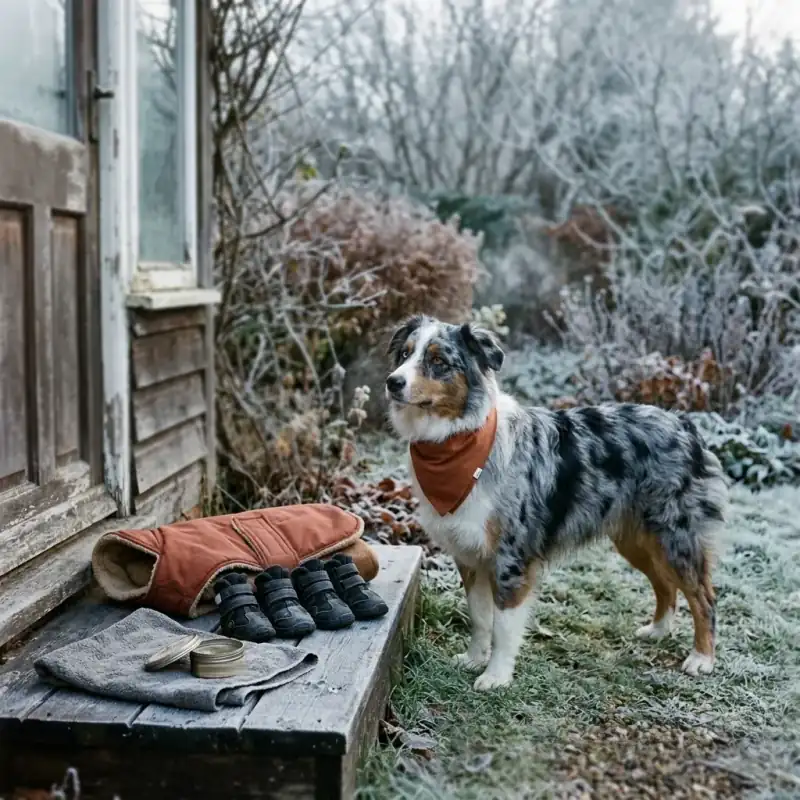
There’s a predictable order in which people buy winter dog gear, and it goes like this: it gets cold, they feel guilty looking at the dog, they buy a coat.
The coat is almost always the wrong first purchase. Not because coats are bad — for the right dog they’re the most valuable item on this page — but because the coat is the item that the largest number of dogs least need, and because buying it doesn’t touch the two problems that will actually shorten your walks in January.
Those are the feet, and the dark.
So here’s the checklist rebuilt around a different sort: cost per problem solved. It starts with the things that cost nothing and works up. Everything is linked to the guide that explains the reasoning in full, because this page is about what to have and when to get it, not about relitigating which coat won.
Do this in October. Two reasons, and the second is the one people learn the hard way. Sizes sell out during the first real cold snap and restock arrives in February. And anything sized to your dog needs measuring, ordering and possibly returning — a three-week process that cannot be compressed into the week you first needed it.
On links: products below link to Amazon and we may earn a commission if you buy through them. Note that the top of this list is free, which is not an accident — the two most effective things you can do for a dog in winter cost nothing at all.
Tier 0: the free things, which are also the best things
Before anything with a price on it.
1. Trim the hair between the pads. This is the single highest-value winter intervention available, it costs nothing, and a veterinary school recommends it first. Long hair between the toes is what turns wet snow into hard ice balls that a dog will stop dead and refuse to walk on. Our winter paw care guide covers why it happens to some dogs and not others, and how to get the ice out when it’s already there.
2. Wash and dry the feet after every walk. Free, and it works against every surface and every chemical — road salt, ice melt, whatever’s been spread on the pavement outside. It is more effective than any product you can buy for the same problem.
3. Know your dog’s actual limits. Not the viral temperature chart — our guide to how cold is too cold takes that chart apart and explains what two veterinary schools actually say, including the one concrete duration figure we could find. Free to read, and it prevents both of the failure modes: the dog that gets cut short unnecessarily and the dog that shouldn’t have been out.
If you do nothing else on this page, do these three.
Tier 1: under $20, used every single day
Disclosure: some links below are affiliate links. If you buy through them we may earn a small commission at no extra cost to you.
Check Dog Safety Lights on Amazon →
4. A light for the collar. The most underrated item in winter dog ownership. From November, most walks in most of the northern hemisphere happen in the dark at one end or both, and a dark dog off-lead on a dim path is invisible to cyclists, drivers and other dog walkers. Costs less than a takeaway, fits every dog, no measuring.
Buy two. The first one gets lost.
Check Dog Drying Towels on Amazon →
5. A dedicated drying towel. Winter’s real daily problem isn’t cold, it’s wet — and damp fur is dramatically worse than dry fur at the same temperature, because water displaces the insulating air a coat depends on. A dog that came through slush has different tolerances for the rest of that walk than the dog that set out. A microfibre drying towel holds several times what a bath towel does and cuts the doorway routine from twenty minutes to five.
Buy two of these as well: one by the door, one in the car.
Check Dog Paw Balm on Amazon →
6. Paw balm. Cornell’s veterinary guidance recommends applying balm before walks and wiping the feet with a lukewarm cloth afterwards. A wax barrier makes snow less likely to stick in the first place and gives the pads some protection from salt. Worth having — and worth knowing that it ranks fourth in our paw guide’s list of what helps, behind two free things and washing the feet. It’s an aid, not a substitute.
Tier 2: $20–60, if your surfaces demand it
Check the Ruffwear Grip Trex on Amazon →
7. Boots — but buy them in October, not January. Boots do a real job on salted pavement, ice and sharp frozen ground, and they come with one condition that is easy to get wrong: a dog has to be conditioned to them before the weather makes them necessary. There is peer-reviewed work behind that, and winter paw care sets out what the study found and how to do the introduction.
The other half is fit, which decides whether they stay on far more than price does — our boot guide covers the measuring problem behind most boot failures, and tells you whether the pair you already own is the right kind for ice.
8. Something for traction at the door, for the humans. Not dog gear exactly, but a boot tray and a mat inside the door is the difference between a manageable winter and five months of hallway. Cheap, and it’s the item that makes the post-walk foot wash actually happen rather than get skipped.
Tier 3: the coat — for the dogs that need one
Now the coat, which is where most people started.
Who needs one: thin- and short-coated breeds, small dogs, puppies, senior dogs, and any dog that’s unwell or underweight. Small dogs lose heat faster because they carry more surface area relative to volume, and thin-coated dogs have none of the insulation a double coat provides.
Who doesn’t: healthy double-coated northern breeds. If you have a Siberian Husky or an Alaskan Malamute, the coat budget is better spent on paw care — those dogs’ feet collect snow more readily because of the fur between the pads, and that’s the part of them that genuinely struggles.
Our winter coat guide opens by asking whether the dog needs one at all, and then answers “which one” using measured heat-loss testing from two independent teams. Two things from it worth carrying into a checklist:
Check the Hurtta Extreme Warmer on Amazon →
Check the Ruffwear Powder Hound on Amazon →
Measure before you order, and check which measurement the brand wants. Ruffwear sizes by girth, around the widest part of the ribcage. Hurtta sizes by back length, neck to tail base. These are different numbers and the charts are not interchangeable — measuring for one and ordering against the other is the most reliable way to buy a coat that doesn’t fit.
Belly coverage is what separates a coat that works from one that looks warm, particularly for short-legged dogs walking through snow.
One honest note on price: the independent testing does not flatter the budget end of this category, and the Amazon best-seller doesn’t appear in either test team’s results. If you’re going to buy one item on this page properly, it’s this one — and if the budget doesn’t stretch, a thin-coated dog is better served by shorter walks than by a cheap coat that doesn’t insulate.
Tier 4: the car, which everyone forgets until December
Winter driving with a dog has its own kit, and it lives in the boot permanently.
Check Dog Car Seat Covers on Amazon →
9. A seat cover, for the obvious reason. Worth being straight about what it is and isn’t: it protects upholstery and stops a dog sliding into the footwell on corners. It is not a restraint and none have been crash tested to act as one.
Check the Sleepypod Clickit on Amazon →
10. A tested restraint, which is the part that matters and matters more in winter than in summer, because winter is when the roads are worse. Our car harness guide covers what independent crash testing actually shows and how wide the gap is between products that have been tested and products that merely look sturdy.
Check Dog First-Aid Kits on Amazon →
11. A first-aid kit, a spare leash, a spare towel, and water. Water freezes, which is the winter-specific thing about this — keep it inside the cabin rather than the boot on very cold days.
If you’re driving any distance over the holidays, the dog road trip checklist is the longer version of this section.
What not to buy
A coat for a double-coated dog. Covered above, and it’s the most common misspend of the season.
Boots you plan to introduce in the moment. The peer-reviewed caveat is the whole point. Boots bought in December and used in December are boots your dog will fight.
“Pet-safe” ice melt, on the assumption that the label means something. It isn’t a regulated term. Our paw care guide has a section on what’s actually in these products and what they do — worth five minutes before you buy a bag on the strength of the packaging.
Heated anything, before the basics. Heated beds, heated jackets, heated bowls. There are situations where these earn their keep, but not one of them is ahead of a towel, a light and a pad trim.
A bigger coat “to grow into.” A coat that doesn’t fit doesn’t insulate. It vents.
The dogs that need the most of this
Winter risk isn’t evenly distributed, and the checklist should scale with it.
Most gear: small dogs, puppies, seniors, and short- or thin-coated breeds. Texas A&M adds a point owners rarely consider — older dogs may be on medications that alter temperature regulation and blood flow, which makes them more vulnerable independently of their coat.
Least gear, but not none: the northern breeds. They need the paw routine and the light. They don’t need the coat. Our guide to the best cold-weather dog breeds covers what that adaptation actually consists of, and where its limits are.
Everyone, in wet cold. Damp is the variable that overrides breed. A wet dog at 4°C is in more trouble than a dry dog at −4°C.
The bottom line
Do the free things first. The pad trim and the post-walk foot wash outperform anything you can buy.
Then buy the cheap things that get used daily. A light, a towel, balm. Under $60 for all three, used two hundred times a season.
Then boots, in October, introduced slowly. The research is specific about this and it’s the caveat every other list leaves out.
Then the coat — if your dog is one of the dogs that needs one. Measure first, check whether the brand wants girth or back length, and don’t buy a cheap one for a dog that genuinely needs insulation.
And do it before the first freeze, because the size you want disappears in the first cold week and comes back in the spring.
If you’re timing this around the sales, our guide to dog gear on Black Friday covers which of these categories genuinely discount in November and which never do — coats and boots are in season and worth watching; the cheap daily items are not worth waiting for.
Sources
- Cornell University College of Veterinary Medicine — Keeping your furry friends safe during winter weather — pad trimming, paw balm before walks, wiping afterwards
- Washington State University Veterinary Teaching Hospital — When is it too cold for your pet?
- Texas A&M College of Veterinary Medicine — Dashing Through the Snow: Signs of Hypothermia — medication effects on temperature regulation in geriatric dogs
- Changes in Ground Reaction Forces and Center of Pressure Parameters of Paws When Wearing Dog Boots in Dogs — peer-reviewed; boots protect, but sudden unconditioned use can cause gait changes or distress
- Treeline Review — Best Cold Weather Coats and Jackets for Dogs (Tested) — measured heat-loss testing behind the coat ordering
- ASPCA — Cold Weather Safety Tips
- Product specifications read from live amazon.com listings; the full reasoning for each pick lives in the guides linked inline
Frequently asked questions
What does a dog actually need for winter?
Less equipment and more routine than most lists suggest. The genuine essentials are a light for dark walks, a way to dry and wash the feet after every outing, and a plan for ice and salt underfoot. Beyond that it depends heavily on the individual dog: a thin-coated, small, old or young dog needs insulation, and a healthy double-coated northern breed usually needs nothing worn at all. The two most effective winter interventions — trimming the hair between the pads and washing the feet afterwards — cost nothing.
In what order should I buy winter dog gear?
Cheapest-per-problem-solved first, which is almost the reverse of how it is usually done. Free things first (the pad trim, the post-walk foot wash), then the sub-$20 items that get used every day (a collar light, a proper drying towel, paw balm), then traction and boots if the surfaces demand it — introduced slowly at home, never produced for the first time at a trailhead — and only then a coat, and only for a dog that needs one. Buying the coat first is the most common sequencing mistake in winter dog gear.
When is the best time to buy winter dog gear?
October, for two unrelated reasons. Sizes sell out during the first genuine cold snap and the restock arrives when you no longer need it, so waiting for the weather to make the decision costs you the size you wanted. And anything sized to the dog needs measuring, ordering and possibly returning — a process that takes weeks and cannot be compressed into the week you first needed the thing.
What winter gear should I keep in the car?
A towel, a spare leash, a collapsible bowl with water, and a first-aid kit. The towel is the one that matters most in practice — a wet dog in a cold car stays wet, and damp fur loses insulation badly. If you are driving in winter conditions with a dog, a tested restraint matters more in bad weather than in good, and a blanket in the boot is worth having for the same reason it is worth having for you.
What winter gear does a northern breed actually need?
Paw care, mostly. A double-coated northern breed is genuinely built for cold in a way a thin-coated dog is not, and putting a coat on one is usually pointless. What is not optional is the feet: heavily furred paws collect snow between the pads more readily, not less, so a husky or a malamute needs the hair trimmed between the toes as much as any dog — arguably more. Spend the coat budget on paw protection and a good drying towel instead.
Is expensive winter dog gear worth it?
It splits sharply by category. For anything doing an insulation job the price differences are real and measurable, and independent testing does not flatter the budget end. For towels, lights, bowls and balm the cheap version is essentially the same product. And for boots, the expensive ones are not more likely to stay on — fit is what determines that, and fit is free to get right.
Comments
Got a question, a tip, or a correction? Leave a comment — no account, no sign-in. Just your name and your thoughts.
Loading comments…