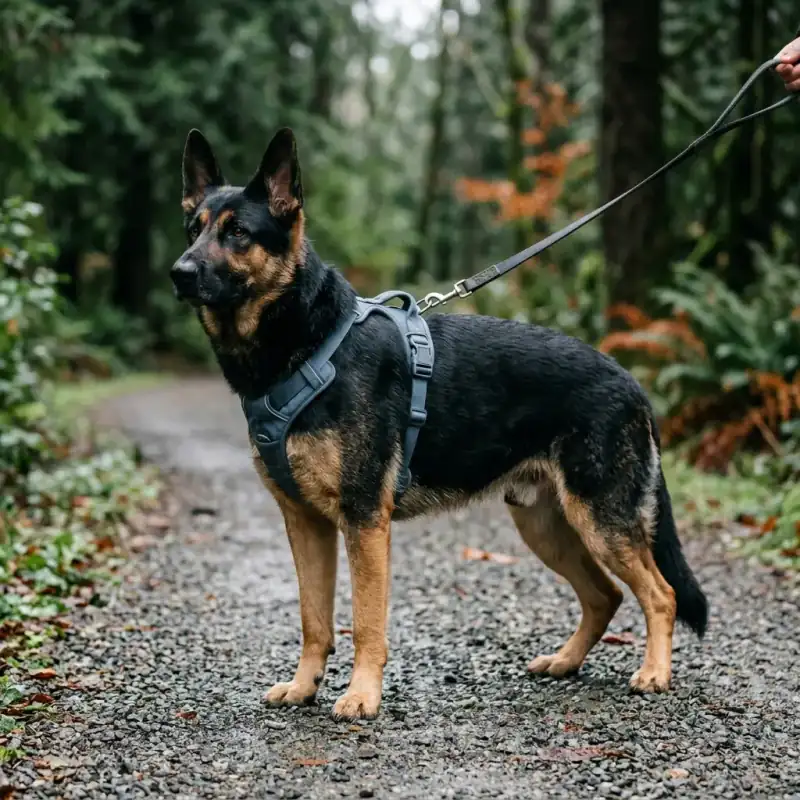
Read five harness guides and you will come away with the same three rules, stated with total confidence. Y-shaped harnesses are safe for shoulders. Chest-strap harnesses restrict movement. Front-clip stops pulling.
In 2025, a review in the journal Animals pulled together what has actually been measured about collars, harnesses and head collars. Some of the consensus survived. A good chunk of it did not.
For a German Shepherd — 65–90 lb of dog that the AKC itself says should not be trusted off leash — the difference between repeating the consensus and reading the measurements is worth a few minutes.
Start with why a harness at all
The case against a collar for a pulling dog is stronger than most people realise, and it comes from ophthalmology.
Pauli and colleagues measured intraocular pressure across 51 eyes in 26 dogs while force was applied through either a collar or a harness. Pressure rose significantly with the collar and did not rise with the harness. The mechanism is straightforward: a collar compresses the jugular veins, pressure backs up through the veins of the head including the episcleral veins of the eye, and intraocular pressure climbs.
A 2025 study in Veterinary Medicine and Science repeated the question on 20 dogs — ten brachycephalic, ten long-nosed. Collar plus exercise raised intraocular pressure in both groups. Harness plus exercise raised it in neither. In flat-faced dogs the collar raised pressure even standing still. The authors’ conclusion, verbatim: “Data suggest that collars may elevate IOP during exercise for all dogs and also during stationary conditions for brachycephalic breeds.”
And the 2025 review adds the raw numbers: measured collar pressures ranged from 83 kPa to 832 kPa, while the threshold associated with tissue damage in humans is around 4.3 kPa. As the authors put it, even the lowest measured value was far above the levels linked to raised intraocular pressure and tissue damage.
None of this means a collar is dangerous on a dog walking politely on a loose lead. It means that a 75 lb Shepherd leaning into a flat collar is doing something measurable to their own head, and there is a straightforward alternative.
What the 2025 review actually found
Here is where it gets more interesting than the standard advice.
Front-clip harnesses do reduce pulling best — and cost the most movement. The review found front-clip designs the most effective at reducing pulling, while also reporting that “use of front-clip harnesses was related to the largest impact on joint flexion and extension.” That is not a contradiction. Redirecting a pulling dog works by altering how they can move.
The Y-shape rule did not hold up cleanly. The finding that should make every gear blog uncomfortable: “the Y-shaped harness (which was considered non-restrictive) limited shoulder extension more than the chest-strap (‘restrictive’) harness.” The exact opposite of the received wisdom.
Everything alters gait a bit. The authors state that “all harnesses had the potential to alter canine gait” and conclude that “no harness appears to be superior for all dogs.”
Anatomy decides more than design. One detail worth carrying into a fitting room: “the distance from the floor to the elbow appeared to be a key factor in determining whether a harness restricted stride length.” Your dog’s proportions matter more than the marketing diagram on the box.
So the honest framework isn’t “buy the anatomically correct harness.” It is:
Pick the harness for the job — everyday walking, no-pull training, working and lift support — get the fit genuinely right, and watch how your own dog moves in it.
Sizing a German Shepherd
The number that matters is girth: the circumference of the chest measured just behind the front legs, at the widest point of the ribcage. Take it with the dog standing, snug but not compressed.
Most adult German Shepherds fall somewhere around 28–36 inches, and that range unhelpfully straddles a size boundary on several brands.
| Harness | Sizing that fits a GSD | Notes | Price |
|---|---|---|---|
| Ruffwear Front Range | Medium 27–32″ · Large/X-Large 32–42″ | Girth-based; a 31″ dog and a 33″ dog buy different sizes | Check price → |
| Ruffwear Web Master | Medium 27–32″ · Large/X-Large 32–42″ | Same bands as Front Range | Check price → |
| 2 Hounds Freedom | Large, 1″ webbing | Sized by girth plus webbing width | Check price → |
| Julius-K9 IDC | Size 2 — chest 28–37.5″, dog 61.5–88 lb | One size covers most of the breed | Check price → |
If you measure right at a boundary, size up and use the adjusters. Every harness here has four points of adjustment; a harness at the top of its range with no adjustment left is a harness you will replace in six months.
The four that are worth your money
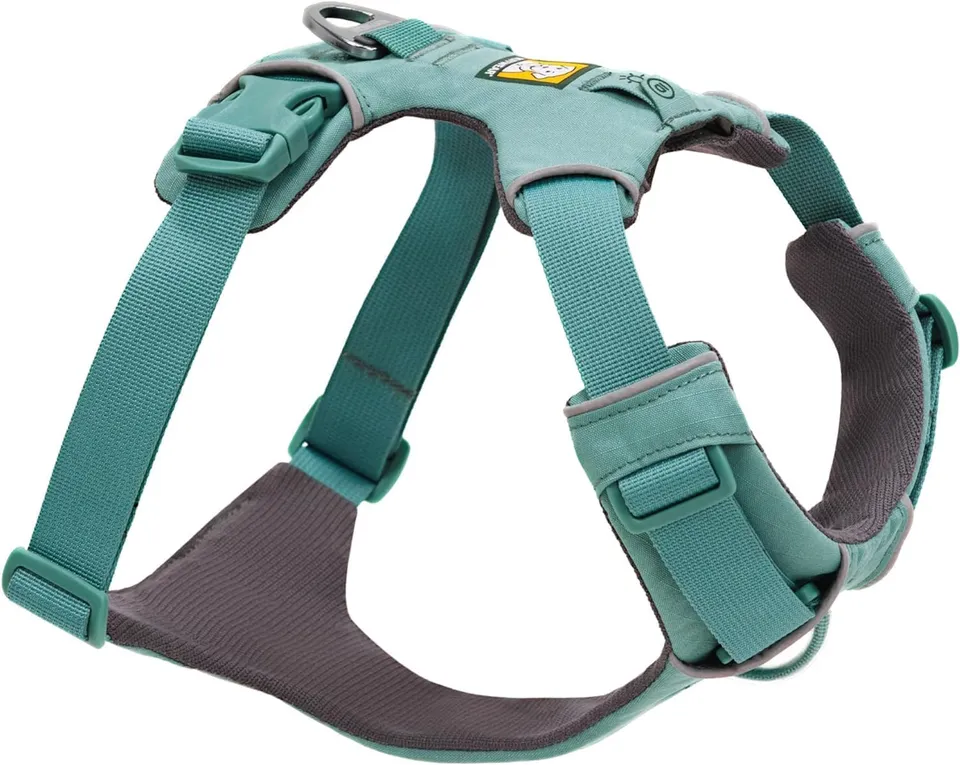
Ruffwear Front Range — the everyday default
The one to buy if you’re buying one. Foam-padded chest and belly panels, four points of adjustment, an aluminium V-ring on the back for normal walking and a reinforced front clip at the chest for redirecting a dog that pulls, reflective trim, and an ID pocket that stops tags jingling.
For a Shepherd, the two attachment points are the practical feature. Back clip for the walk your dog has already earned; front clip for the adolescent stage where the pulling is a daily negotiation.
Disclosure: some links below are affiliate links. If you buy through them we may earn a small commission at no extra cost to you.
Check the Front Range (L/XL) on Amazon →
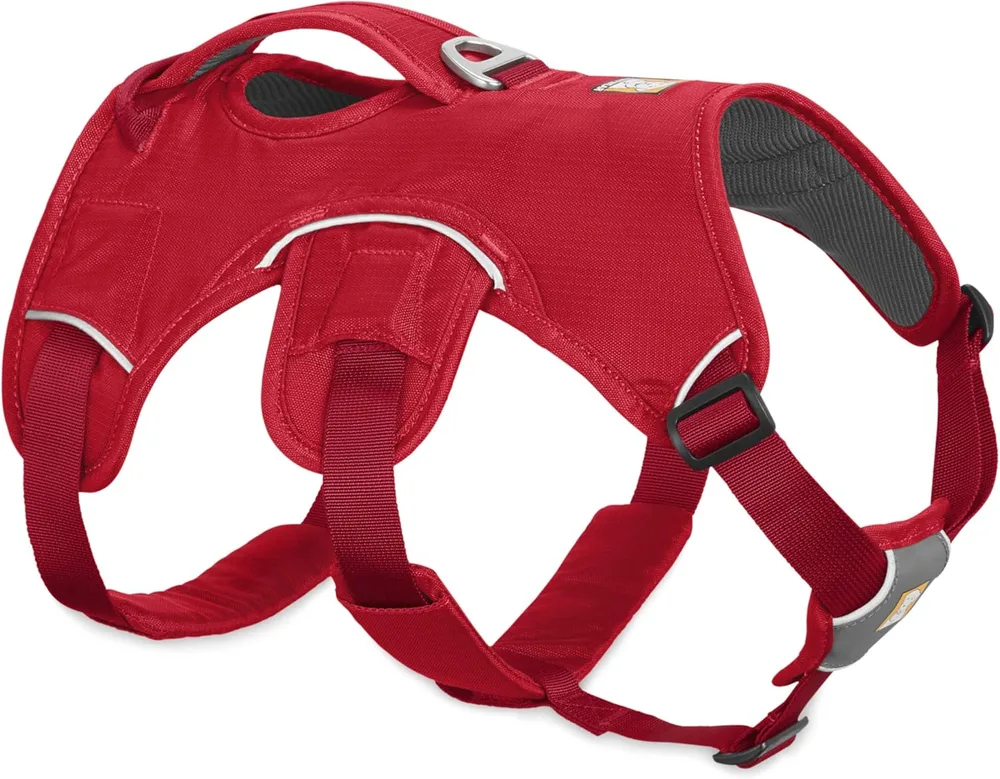
Ruffwear Web Master — the working and support harness
The Web Master is Ruffwear’s oldest harness and the one with a genuinely different job. It adds a reinforced lift handle built into the frame for balanced support, a perforated foam back panel, a neck buckle so it doesn’t have to go over the head, front and back attachment points, and four points of adjustment for an escape-resistant fit on deep-chested dogs. Ruffwear notes it has been the harness of choice for avalanche rescue teams and service dog handlers for two decades.
For a German Shepherd this is worth thinking about early, for a reason specific to the breed. Degenerative myelopathy is a well-documented condition in Shepherds — a progressive, painless spinal cord disease causing hind-limb weakness and incoordination, linked to the SOD1 mutation, with a DNA test available. A supportive harness with a proper lift handle is not a luxury accessory for a dog in that situation. It is how the dog gets up the back steps.
Buy it for scrambling and car lifts now. It may end up doing something else.
Check the Ruffwear Web Master on Amazon →
2 Hounds Design Freedom No-Pull — the training tool
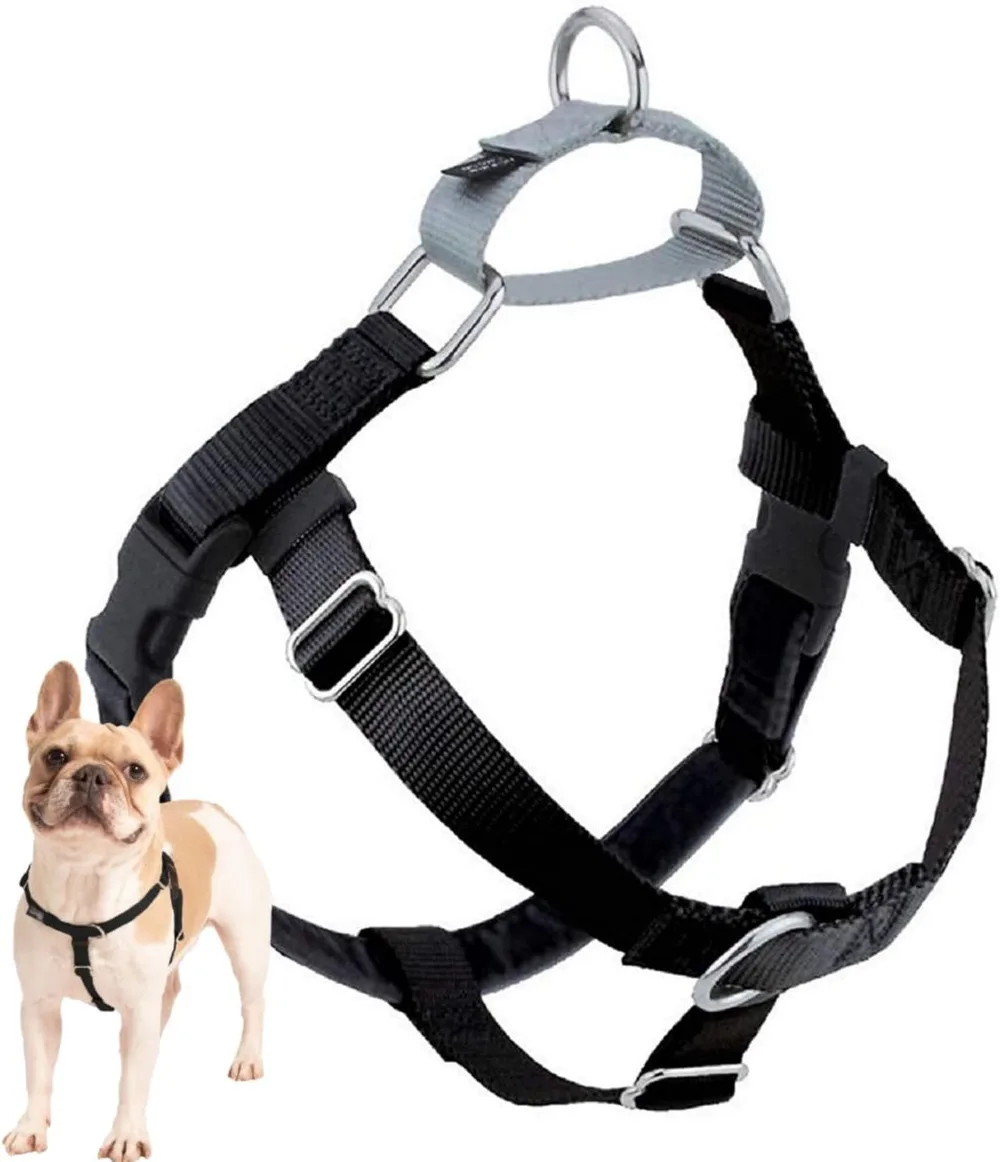
This is the specialist. A martingale loop on the back that gently tightens across the chest when the dog pulls, plus a front O-ring for steering — used together with a double-ended lead, it is one of the more effective management setups for a strong dog that hasn’t yet learned loose-lead walking.
The build is unusually good for the price: stainless steel hardware, a Swiss velvet lining where the straps sit, four points of adjustment, made in the USA, and a replacement warranty covering chewed straps.
Two honest points. It is a chest-strap style, so it sits in the design category the internet warns about — and per the 2025 review, that category did not perform worse than the Y-shaped one on shoulder extension. And it is a training aid: the review’s finding that front-clip harnesses have the largest effect on joint flexion is a reason to use it for the training phase rather than as a permanent walking setup.
Check the Freedom No-Pull on Amazon →
Julius-K9 IDC Powerharness — the European working standard
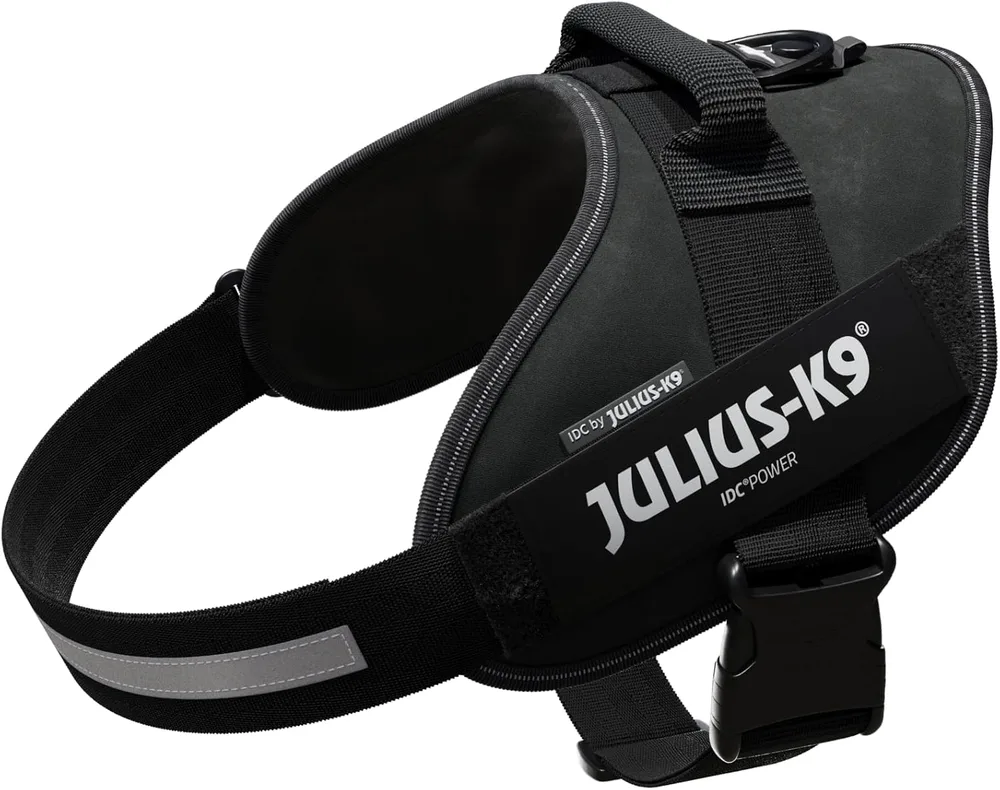
The harness you see on working dogs across Europe, and the easiest of the four to size for this breed: Size 2 covers a 28–37.5 inch chest and dogs 61.5–88 lb, which is the German Shepherd standard almost exactly.
Made in Europe, water-repellent outer, breathable inner liner, reflective edges and chest strap, heavy-duty buckles, and the interchangeable hook-and-loop patches that make it recognisable. The wide, stiff chest plate makes it fast to put on and gives a solid handhold at the back.
The trade-off is inherent to the design: it is a chest-strap harness, and the plate sits across the front of the shoulders. On the evidence above that is not the disqualification it is often presented as — but if your Shepherd does distance work, watch the front-end gait, and keep an eye on heat under a broad panel in summer.
Check the Julius-K9 IDC on Amazon →
Getting the fit right
The research is clear that fit matters at least as much as design. Five checks, all of which take under a minute:
Two fingers, everywhere. You should be able to slide two fingers flat under every strap. Tighter causes rubbing; looser lets the harness rotate — and a rotated harness puts webbing exactly where you didn’t want it.
Nothing across the point of the shoulder. Find the shoulder joint with your fingers and make sure the chest strap sits below it, on the sternum. This is the one piece of the standard advice the evidence still supports.
Watch the elbows. The review flagged floor-to-elbow distance as a key factor in whether a harness restricts stride. Walk your dog fifty metres and watch the front legs from the side. Short, choppy front steps mean something is in the way.
Check the skin weekly. A dense double coat hides friction. Run your hands under the straps, especially behind the front legs, and look for matting or pink skin.
Take it off at home. All-day wear is how you get matting and trapped heat. It goes on for the walk and comes off after.
Two things a harness will not do
It will not train your dog. A no-pull harness makes pulling less rewarding; it does not teach walking on a loose lead. The evidence on how to teach that is also reasonably settled — a study of 92 companion dogs found those trained with aversive or mixed methods showed more stress behaviours, more panting and greater post-training cortisol rises than dogs trained with rewards. For a breed with this much drive, reward-based training isn’t a soft option, it’s the one with the data behind it.
It will not restrain your dog in a car. Walking harnesses are not crash-tested and are not designed to be. That is a separate product category — our guide to the safest dog car harnesses covers what has actually been through a crash test.
And a related point the AKC makes about this breed directly: “do not let the dog off leash, as even the best-trained dog can become distracted.” If you want your Shepherd to have real freedom of movement while staying attached to you, a long-line leash is the tool for that, not a better harness.
The bottom line
If you buy one harness for a German Shepherd, buy the Ruffwear Front Range in Large/X-Large. It covers everyday walking, gives you a front clip for the pulling phase, and it fits.
Add the Web Master if your dog scrambles, works, needs lifting into a car, or is heading into older age. Use the Freedom No-Pull as a training-phase tool if pulling is the daily problem. Take the Julius-K9 IDC if you want the European working build and a single size that fits the breed.
And hold the whole category a little more loosely than the internet does. The most useful sentence in the current research is the least satisfying one: no harness appears to be superior for all dogs. Measure your dog, fit it properly, watch how they move — and be willing to be wrong about it.
For the full picture on the breed — exercise load, training, health screening, the off-leash question — see our complete German Shepherd guide, and how to start hiking with your dog if the harness is going on the trail. If you are still deciding between the two great working shepherds, our German Shepherd vs Belgian Malinois comparison covers where they actually differ — including the sizing point that matters here, since the two breeds share a height range but not a build.
Sources
- Cavalli C. & Protopopova A., Review of Collars, Harnesses, and Head Collars for Walking Dogs, Animals (2025): https://pmc.ncbi.nlm.nih.gov/articles/PMC12345489/
- Pauli A.M., Bentley E., Diehl K.A., Miller P.E., Effects of the Application of Neck Pressure by a Collar or Harness on Intraocular Pressure in Dogs, Journal of the American Animal Hospital Association 42(3):207–211 (2006), PMID 16717175: https://pubmed.ncbi.nlm.nih.gov/16717175/
- Bailey M.E., Packer M.J., Wills A.P., Effect of a Collar and Harness on Intraocular Pressure and Respiration Rate of Brachycephalic and Dolichocephalic Dogs, Veterinary Medicine and Science (2025): https://pmc.ncbi.nlm.nih.gov/articles/PMC12036695/
- Vieira de Castro A.C. et al., Does training method matter? Evidence for the negative impact of aversive-based methods on companion dog welfare, PLOS ONE (2020): https://journals.plos.org/plosone/article?id=10.1371%2Fjournal.pone.0225023
- Degenerative myelopathy and the SOD1 mutation in German Shepherd Dogs: https://www.ncbi.nlm.nih.gov/pmc/articles/PMC4579386/
- American Kennel Club — German Shepherd Dog breed standard, size and off-leash guidance: https://www.akc.org/dog-breeds/german-shepherd-dog/
- Ruffwear official sizing and product specifications: https://ruffwear.com/products/front-range-harness · https://ruffwear.com/products/web-master-harness
- Manufacturer specifications for 2 Hounds Design Freedom No-Pull and Julius-K9 IDC Powerharness — read from current Amazon listings, August 2026.
Frequently asked questions
What size harness does a German Shepherd need?
Measure the girth — the circumference of the chest just behind the front legs — because that is the number every manufacturer sizes on. Most adult German Shepherds land between roughly 28 and 36 inches, which straddles a size boundary on some brands: Ruffwear's Medium covers 27–32 inches and Large/X-Large covers 32–42 inches, so a 31-inch dog and a 33-inch dog buy different harnesses. Julius-K9's Size 2 covers a 28–37.5 inch chest and dogs 61.5–88 lb, which fits most of the breed in one size.
Is a harness better than a collar for a German Shepherd?
For a dog that pulls, the evidence points that way. Two independent studies found that force applied through a collar raises intraocular pressure while a harness does not — Pauli and colleagues measured this across 51 eyes in 26 dogs, and a 2025 study of 20 dogs found collar-plus-exercise raised pressure in both flat-faced and long-nosed dogs while harness-plus-exercise raised it in neither. A 2025 review also reported measured collar pressures of 83–832 kPa, against a 4.3 kPa threshold associated with tissue damage in humans.
Do no-pull harnesses actually work?
Front-clip harnesses do reduce pulling more effectively than back-clip designs — but the same 2025 review found that front-clip use 'was related to the largest impact on joint flexion and extension.' They redirect a pulling dog by changing how the dog can move, which is exactly why they work and exactly why they are not a permanent solution. Use one as a management tool while you train loose-lead walking, not instead of it.
Is a Y-shaped harness always better for a dog's shoulders?
That is the internet consensus, and the measurements are less tidy. A 2025 review in Animals reported that in testing, 'the Y-shaped harness (which was considered non-restrictive) limited shoulder extension more than the chest-strap (restrictive) harness,' and concluded that all harnesses had the potential to alter canine gait and that no harness appears to be superior for all dogs. Y-shaped is a reasonable default. It is not a guarantee.
Why does a German Shepherd harness need a handle?
Two reasons, one immediate and one you hope never arrives. Immediately: a handle gives you control over a large, powerful dog at a trailhead, in a vet waiting room, or getting in and out of a car. Longer term: degenerative myelopathy is a well-documented condition in the breed, causing progressive hind-limb weakness, and a supportive harness with a reinforced lift handle becomes genuine mobility assistance rather than a convenience feature.
Can a German Shepherd wear a harness all day?
Better not to. Any harness sits on a dense double coat, and constant wear plus friction is how you get matting, rubbing at the armpits and trapped heat in summer. Put it on for walks, training and the car, and take it off at home. Check the skin underneath weekly, especially where the girth strap sits behind the elbows.
What is the best harness for a German Shepherd?
There isn't a single answer, and that is the honest finding rather than a dodge. The 2025 review of harness measurements found no design that came out best for every dog, so the right harness for a German Shepherd is the one that fits your Shepherd's chest and shoulders. Work from the measurement rather than the model name: a deep-chested working line and a blockier show line take different sizes at the same bodyweight. Beyond fit, the features that earn their place on this breed are a padded chest panel, a handle for control on rough ground, and hardware rated for a dog that can genuinely pull.
Comments
Got a question, a tip, or a correction? Leave a comment — no account, no sign-in. Just your name and your thoughts.
Loading comments…