
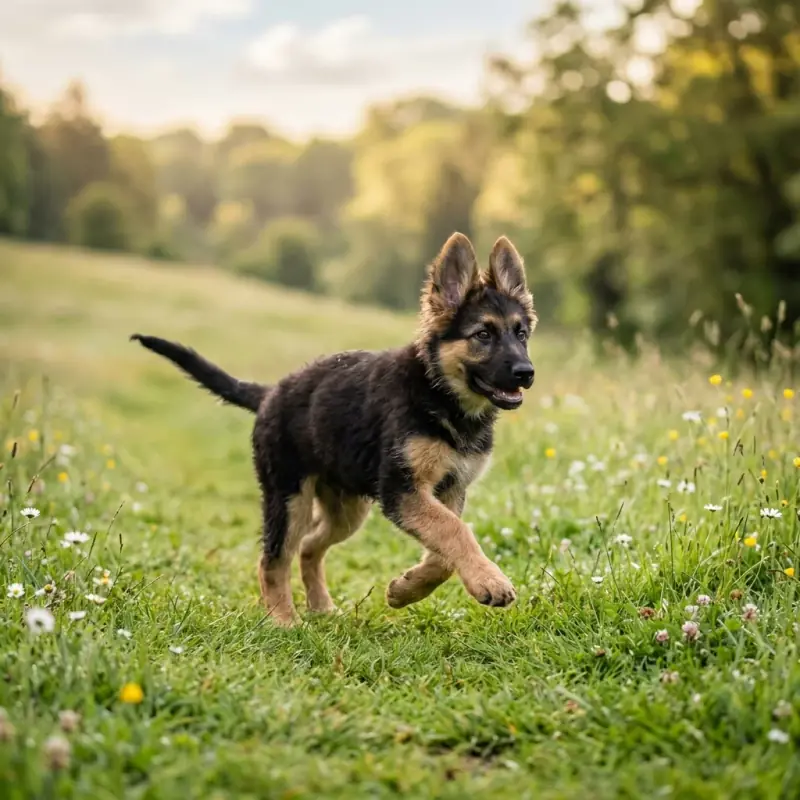
There is a rule about puppy exercise that everyone knows. Five minutes per month of age, once or twice a day. Three-month-old puppy, fifteen minutes. Six-month-old, half an hour. It is on breeder handouts, in puppy packs, on forums, in vet waiting rooms, and it has probably been recited to you by three different people since you brought the dog home.
It is also on the American Kennel Club’s website, where it is attributed to “veterinary researchers.”
We went looking for those researchers. We could not find them.
What we found instead was a veterinary journal listing the rule as a misconception, a body of actual research pointing at a completely different variable, and — two paragraphs below the rule on the AKC’s own page — the statement that “the best exercise for puppies is safely free running,” which is not really compatible with a stopwatch.
None of this means you should go and exhaust your puppy. It means the question has a better answer than the one in circulation, and the better answer is more useful.
Where the rule stands
Let’s be precise about the state of the guidance, because “there’s no evidence” is a claim that needs showing rather than asserting.
The AKC publishes it. Its puppy exercise article states that “veterinary researchers recommend that puppies can go for walks for about five minutes multiplied by every month of their age, once or twice a day.” No study is named, and no researcher is named.
The Veterinary Ireland Journal rejects it. Its article Guidelines for exercising pups: separating myths from science lists “five minutes of exercise per month of life” among the misconceptions owners are given, alongside no supporting research. Its own suggested figures are considerably more generous — 15–30 minute sessions at 2–4 months and 45–60 minutes at 4–6 months — with the emphasis on letting puppies set their own pace.
The AKC’s own page undercuts it. The same article that prints the formula goes on to say the best puppy exercise is free running, and recommends tugging, hide-and-seek, flirt poles, tag, scatter-feeding and puzzle work — none of which come with a five-minute allowance.
So we have a widely repeated number with no traceable source, contradicted by a veterinary journal and quietly contradicted again by the organisation most often cited as publishing it.
That is worth knowing not because the number is dangerous — fifteen minutes of walking for a three-month-old is perfectly reasonable — but because people follow it anxiously, and some of them restrict a puppy’s world in ways that cost more than they save.
What the research actually found
Here is where the topic gets genuinely interesting, and where the popular rule turns out to be measuring the wrong thing entirely.
The most relevant work is a prospective cohort study of large-breed puppies in Norway, published in the American Journal of Veterinary Research in 2012 by Krontveit and colleagues. It followed Newfoundlands, Labrador Retrievers, Leonbergers and Irish Wolfhounds and looked at which housing and exercise factors were associated with radiographically confirmed hip dysplasia.
Two findings matter, and they run in opposite directions:
- Puppies that used stairs before three months of age had an increased risk of hip dysplasia.
- Puppies given daily off-leash exercise in park-like, undulating terrain had a decreased risk — as did puppies born in a rural environment.
Read those together and the conclusion is not “less exercise.” It’s that the protective factor was a different kind of exercise: free, varied, self-paced movement on natural ground, rather than restriction.
Other work reported in the veterinary reviews of this literature points the same way at specific hazards rather than at duration. Slippery flooring was associated with more hip dysplasia in Boxer puppies. Young Labradors with a history of chasing balls and sticks thrown by their owners showed more hip and elbow problems. Osteochondrosis showed up more in dogs playing with other dogs. At the far extreme, cartilage softening has been demonstrated in dogs running about 40 km a day — a workload no pet puppy will ever see. And in the other direction, lifelong moderate exercise has been found safe for cartilage.
A note on sourcing: the Krontveit findings above come from the primary paper. The Sallander, van Hagen, Slater, Newton and Arokoski results are as reported in the veterinary evidence reviews we’ve cited, not read from the original papers — so treat them as the profession’s summary of the literature rather than as figures we’ve verified line by line.
The picture that emerges is coherent. What appears to harm growing joints is repetition, impact, hard or slippery surfaces, and activity the puppy can’t opt out of. What appears to be fine — or beneficial — is varied, self-paced movement on forgiving ground.
A five-minute cap doesn’t distinguish between those at all. Five minutes of forced trotting on pavement and five minutes of pottering in a field are the same number and not the same event.
The one hard number that is properly attributable
There is a specific figure worth taking seriously, and unlike the five-minute rule it comes from a named veterinarian at a named organisation.
Dr. Jerry Klein, Chief Veterinary Officer of the American Kennel Club, states: “it is never recommended to do road work or jogging on a dog less than 14 to 18 months of age, especially large and giant breeds, until the growth plates have fully fused.” He also notes that “excessive, prolonged activity, like jogging, can be extremely detrimental on the bones and joints of growing puppies.”
That is a much narrower claim than the five-minute rule, and a much better supported one. It is about regimented running on hard surfaces, not about how long a puppy may be awake and moving.
VCA’s veterinary guidance draws the same line, listing the activities to postpone until maturity as long jogs or hikes, jumping hurdles, and competitive agility courses — all repetitive, all high-impact, all things the dog can’t pace itself out of.
The AKC applies it at breed level too. Its Australian Shepherd page describes the breed as a great running companion once the skeletal system is fully formed, and its Vizsla page states that young dogs should not run long distances until maturity at 18–24 months.
If your plan for this puppy involves running or real trail miles — and on a site like this, it probably does — that’s the guidance to build around. Our guides to how much exercise a dog needs and starting hiking with your dog both assume a skeletally mature animal.
Growth plates, and why nobody agrees on the date
Growth plates are soft, still-forming zones near the ends of a young dog’s long bones. While they’re open, the bone is still lengthening and the plate itself is more vulnerable to injury than mature bone. When they finish and calcify, they’re said to have “closed.”
Everyone agrees this is the thing that matters. Nobody agrees on when it happens.
| Source | Small | Medium | Large | Giant |
|---|---|---|---|---|
| VCA Hospitals | ~6 mo | — | — | ~18 mo |
| Walkerville Vet (evidence review) | 9 mo | 10–11 mo | 12–14 mo | 18–24 mo |
| Veterinary Ireland Journal | 7 mo | — | 10–14 mo | — |
| AKC | 6–9 mo (toy) | — | 16–18 mo | 18–24 mo |
That spread isn’t sloppiness. Closure is a gradual biological process that varies by individual, by breed, by which bone you’re looking at, and by whether the dog has been neutered — and different sources are summarising different underlying literature.
The neutering effect is real and under-discussed. The classic study, Salmeri and colleagues in JAVMA in 1991, found growth plate closure was delayed in all neutered dogs compared with intact ones, and delayed longer in dogs neutered at 7 weeks than at 7 months — with the longer growth period producing greater final bone length. It’s an important finding, and it’s worth knowing it rests on a sample of 32 mixed-breed dogs from 1991. We’re citing it as the classic reference, not as settled modern consensus, and it is emphatically not a reason for you to change your neutering plan based on a blog post.
What all of this means for you is simple and slightly unsatisfying: there is no calendar date. The bigger your dog, the later it finishes. If you want a real answer for your specific puppy, your vet can assess it — and if you’re planning a serious running or hiking career for the dog, that’s a conversation worth actually having rather than guessing at.
What to do instead of counting minutes
Here’s the practical version, built from what the sources agree on rather than from the formula.
Let the puppy set the pace. This is the single most consistent recommendation across every source we read. A puppy that lies down, lags, or wants to be carried is done — and that signal is better information than any number. VCA’s phrasing is to let the puppy “self-regulate their activity.”
Prefer soft, varied ground. Grass, dirt, forest floor, gently uneven terrain. This is the exposure that was associated with lower hip dysplasia risk in the Norwegian cohort. Pavement and concrete are the surfaces to limit.
Avoid the specific hazards, not exercise in general. Stairs in early puppyhood. Slippery floors — rugs and runners are a cheap fix. Repetitive fetch with a thrown ball for a young large-breed dog. Jumping. Regimented road running. These are narrow, identifiable things, and avoiding them is much easier than policing a stopwatch.
Don’t over-restrict. VCA is unusually direct about this: “you don’t want you to stress so much about exercise that you’re impacting your puppy’s social and behavioral skills.” A puppy that misses out on the world during its socialisation window pays a behavioural price that lasts a lot longer than a sore joint. There is a real cost on both sides of this decision.
Count sleep as part of the plan. An eight-week-old puppy might play hard for 30–60 minutes and then need one to two hours of sleep, plus around eight hours overnight. Overtired puppies get frantic and bitey, which owners routinely misread as needing more exercise.
Use the brain. Scent games, scatter feeding, puzzle toys, short training sessions and simple novelty tire a puppy out in a way that costs joints nothing. For a working-breed puppy this isn’t a substitute for physical exercise so much as the other half of the job — and it’s the half most owners skip.
Build recall now, while it’s easy. The single most valuable thing you can teach a puppy that will one day run trails is a reliable return. Puppies are naturally inclined to follow you at this age, which makes it dramatically easier than it will be at ten months. Our recall training guide covers the method, and long-line leashes are the standard tool for practising it safely before you trust an off-leash environment.
This is educational information, not veterinary advice. It doesn’t establish a veterinarian-client-patient relationship and it can’t account for your individual puppy’s breed, size, development or health. Growth-plate maturity in particular varies enough that it should be assessed rather than assumed — talk to your vet before starting any running or long-distance programme, and if your puppy is lame, reluctant to move or sore after activity, that’s a consultation, not something to work out from an article.
The short answer
If you want a number to start from, the Veterinary Ireland Journal’s is better sourced than the one in circulation: 15–30 minutes per session at 2–4 months, 45–60 minutes at 4–6 months, split across the day, with the puppy setting the pace and sleep protected.
But the number is the least important part. The five-minute rule survives because it’s easy to remember, not because it’s true, and it quietly answers the wrong question. The evidence isn’t really about how long. It’s about what kind — free and self-paced on soft ground, rather than repetitive and forced on hard ground — and about one specific thing to wait for, which is skeletal maturity before you start running the dog.
Get those right and the minutes largely take care of themselves.
When your puppy does grow up, the fun starts: our guides to the best dog breeds for runners and starting hiking with your dog pick up exactly where this one leaves off. And if you’re still choosing a breed, Australian Shepherd vs Border Collie and Labrador vs Golden Retriever both cover how long each breed needs before it’s ready for real mileage.
Sources
- American Kennel Club — How Much Exercise Does a Puppy Need? (the page that publishes the five-minute rule)
- American Kennel Club — Puppy Growth Chart: When Does My Puppy Finish Growing? (Dr. Jerry Klein, Chief Veterinary Officer, on road work and growth plates)
- Veterinary Ireland Journal — Guidelines for exercising pups: separating myths from science
- Krontveit RI et al. Housing- and exercise-related risk factors associated with the development of hip dysplasia as determined by radiographic evaluation in a prospective cohort of Newfoundlands, Labrador Retrievers, Leonbergers, and Irish Wolfhounds in Norway. American Journal of Veterinary Research 73(6):838–846 (2012) — PMID 22620698
- Krontveit RI et al. Risk factors for hip-related clinical signs in a prospective cohort study of four large dog breeds in Norway. Preventive Veterinary Medicine 103(2–3):219–227 (2012) — PMID 21982689
- VCA Hospitals — Puppy exercise and growth plates
- Andrew Spanner BVSc(Hons) MVetStud — When It’s Safe To Run A Puppy: The Evidence (veterinary evidence review; source for the Sallander, van Hagen, Slater, Newton and Arokoski summaries)
- Salmeri KR et al. Gonadectomy in immature dogs: effects on skeletal, physical, and behavioral development. JAVMA (1991) — PMID 2045340
Frequently asked questions
What is the 5-minute rule for puppy exercise?
It's the widely repeated guideline that a puppy should get about five minutes of exercise per month of age, once or twice a day — so 15 minutes twice daily for a three-month-old. It appears on the AKC's own site, attributed only to unnamed “veterinary researchers.” We could not find a study behind it, and the Veterinary Ireland Journal lists it explicitly as a misconception rather than a guideline. Treat it as a rough conversation-starter, not a rule.
Is the 5-minute rule actually true?
There is no published research supporting it. What the research does support is a distinction the rule misses entirely: the type of exercise matters more than the number of minutes. A prospective study of over 500 large-breed puppies found that using stairs before three months of age increased the risk of hip dysplasia, while daily off-leash exercise in park-like, undulating terrain decreased it. Free, self-paced movement on soft ground looks protective; forced, repetitive, hard-surface work does not.
When can I start running or jogging with my puppy?
Dr. Jerry Klein, the AKC's Chief Veterinary Officer, puts it plainly: “it is never recommended to do road work or jogging on a dog less than 14 to 18 months of age, especially large and giant breeds, until the growth plates have fully fused.” Growth plates close later in bigger dogs, so a small breed may be ready well before a giant one. Ask your own vet about your individual puppy before you start — breed, size and development all move the date.
When do a puppy's growth plates close?
It depends on size, and veterinary sources genuinely disagree on the numbers. VCA gives a little over 6 months for small dogs and closer to 18 months for giant breeds. One veterinary evidence review gives 9 months for small, 10–11 for medium, 12–14 for large and 18–24 for giant. The AKC cites 6–9 months for toy breeds and 16–18 months for large and giant ones. The useful takeaway is the pattern, not a single number: the bigger the dog, the later it finishes, and there is no calendar date that applies to every puppy.
Can a puppy get too much exercise?
Yes, but probably not in the way the popular rule implies. The risk factors identified in the research are specific: stairs in very early puppyhood, slippery flooring, repetitive chasing of thrown balls and sticks in young large-breed dogs, and sustained road work on hard surfaces before the growth plates close. Ordinary free play where the puppy sets its own pace and stops when tired is not the same thing — and VCA warns that being so anxious about exercise that you restrict a puppy's social experience carries its own cost.
How long should I walk a 3-month-old puppy?
The Veterinary Ireland Journal suggests sessions of 15–30 minutes for puppies aged 2–4 months and 45–60 minutes at 4–6 months, with the strong caveat that puppies should set their own pace and that sleep matters as much as activity — an eight-week-old may play for 30–60 minutes and then nap for one to two hours. That's guidance, not a prescription. A puppy that lies down, lags behind or wants to be carried is telling you the session is over, and that signal is better data than any formula.
Comments
Got a question, a tip, or a correction? Leave a comment — no account, no sign-in. Just your name and your thoughts.
Loading comments…