
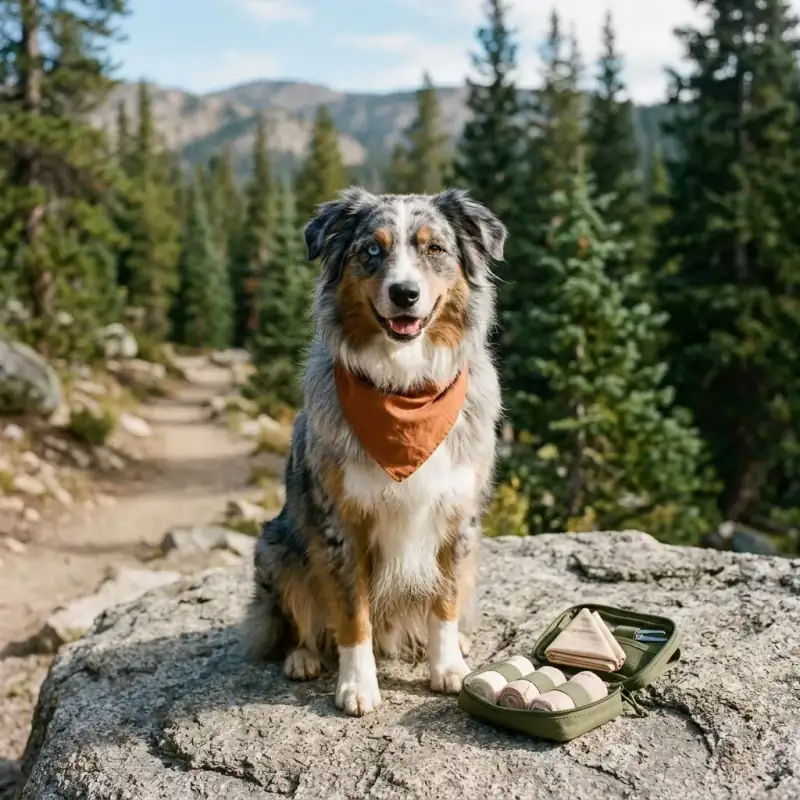
Search for what to put in a dog first-aid kit and you will find much the same list on page after page: gauze, tape, scissors, tweezers, antibiotic ointment, Benadryl, hydrogen peroxide. Some of it is fine. All of it was written before August 2026.
That month, the RECOVER Initiative — the veterinary group behind the standard CPR guidelines for dogs and cats — published the first evidence-graded first-aid guidelines for dogs and cats. Its authors state plainly that before this there were none. The guidelines are not a kit list. But they answer the questions a kit list quietly assumes, and for two of the items almost every list carries, they change the advice.
So this page is the kit rebuilt around them, and around the veterinary references that cover what they don’t. Each item is here because it does a job someone without veterinary training can actually do on a trail, and each item that is missing is missing for a reason you can check.
What changed in 2026, and how much weight it can bear
The RECOVER First Aid Guidelines were published in three open-access papers in the Journal of Veterinary Emergency and Critical Care in August 2026. They were built the way human first-aid guidelines are: a defined list of questions, systematic literature searches, every study graded for quality, recommendations drafted, then four weeks of comment from veterinary professionals internationally before anything was finalised.
They are also honest about the evidence underneath them, and so should we be. Of 38 general recommendations, 15 rest on low or very low quality evidence and 18 on expert opinion. Much of what they draw on is human first-aid research applied to dogs, because canine studies are scarce. That is not a reason to ignore them. It is a reason to read “the guidelines say” as “the best available judgement, written down by the people best placed to make it”, rather than as settled science.
One rule runs underneath all of it, and it is the first thing worth taking from them: the guidelines recommend against giving first aid at all if the risk to you is high. They name pain and fear as the reasons an animal turns on the person helping it, and an emergency specialist quoted by the American Kennel Club puts it more plainly: even docile, friendly dogs can snap when they are handled in severe pain. The kit starts with the thing that makes it safe to use the rest.
The kit, item by item
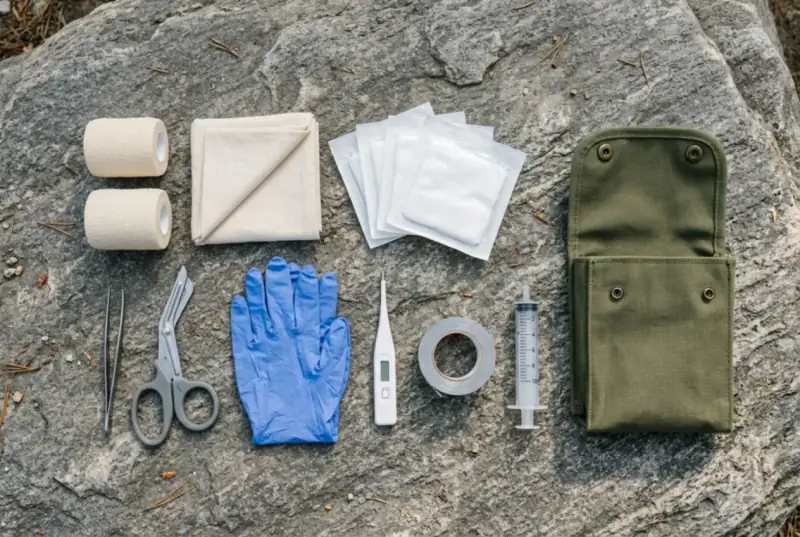
This is the trail kit, the one that rides in your pack. Everything in it is light, and nothing in it needs a prescription.
| Item | What it is for | Why it is on the list |
|---|---|---|
| Triangular bandage (a large cotton one) | A muzzle; and, folded into a band at least 2 in wide, an improvised tourniquet | The guidelines' tourniquet is improvised and at least 2 inches wide. One piece of cloth covers both jobs |
| Gauze pads and non-stick pads, plus a roll of gauze | Direct pressure on bleeding, then covering the wound | Pressure is the first step for any bleeding |
| Self-adhesive wrap ("vet wrap"), 2 in | The outer layer of a paw or leg bandage | It sticks to itself rather than to fur |
| A roll of cloth adhesive tape | The "stirrups" that stop a paw bandage sliding off | Part of the Red Cross paw-bandage method — see below |
| A short length of duct tape, wrapped round a pencil or bottle | Securing a tourniquet, or the outside of a bandage for the walk out | Named for both jobs — by the guidelines for the tourniquet, by Merck for the bandage |
| Fine-tipped tweezers or a tick-removal tool | Ticks, splinters, a visible seed head | Either is acceptable — see the tick section |
| Blunt-tip shears | Cutting tape and dressings, trimming fur from a wound | Blunt tips are safe next to the skin of a dog that moves |
| Disposable gloves | Keeping your hands out of the wound, and the wound off your hands | — |
| Styptic powder, or a twist of cornstarch | A torn or broken nail that keeps bleeding | Merck's owner guidance names styptic powder, cornstarch or flour |
| Digital thermometer and a sachet of lubricant | Knowing when a hot dog has been cooled enough | The 2026 guidelines give a temperature at which to stop cooling; you cannot follow that without one |
| Antihistamine tablets, one active ingredient, in a labelled bag | A skin-only allergic reaction to a sting or a plant | Recommended for that reaction, and specifically not for anaphylaxis — see below |
| Your dog's own daily medicines, plus a spare day | A trip that runs long | On Merck's list, with a note to ask your vet before giving them during an emergency |
| A 10–20 ml syringe (no needle) | Flushing a wound or an eye with the water you are carrying | Drinking water is a reasonable wound wash — see below |
| A card with three numbers | Your vet; the nearest 24-hour emergency vet to the trailhead; animal poison control | Most of what the guidelines recommend ends with "and go to a vet". Know which one before you lose signal |
Worth adding for some trips:
- An instant cold pack where bees and wasps are busy. Merck’s advice for a sting is a cold pack on the spot to bring down swelling and itching.
- A multi-tool with wire cutters if your trail ends at a fishing lake. The fish-hook section below explains why.
- A dry towel or a space blanket in the cold months, for a dog that ends up wet and cold. Drying the dog is the first step Merck gives.
And four things that are on the usual lists and are not on this one:
- Hydrogen peroxide as a wound cleaner — it damages healthy tissue. As a way to make a dog vomit, it is a decision for a vet or poison control, not a default. The next section is about it, because it is the item the lists most consistently get wrong.
- Activated charcoal or milk of magnesia. AKC’s list includes them to “absorb and counteract poisons”, and the Merck pet-owner list “for some poisonings”. In the 2026 guidelines, activated charcoal appears only as part of hospital treatment, and nothing we could find supports an owner dosing it on a trail.
- Human painkillers. The FDA’s warning is specific: an anti-inflammatory painkiller made for people — aspirin, ibuprofen, naproxen — may last longer, be absorbed faster and reach higher blood levels in a dog. Its advice before reaching for any human painkiller, acetaminophen included, is to stop and call your vet. If you share a kit, the human medicines stay in the human bag.
- Loperamide, the anti-diarrhoea tablet in most human kits, is one of the drugs to avoid in a dog carrying the MDR1 mutation, which is common in several herding breeds. Our Australian Shepherd guide covers who carries it.
Hydrogen peroxide: the item the lists keep and the evidence doesn’t
It turns up on almost every list, for one of two reasons, and both of them fail.
As a wound cleaner. The American Kennel Club’s kit list includes it as an antiseptic “to help prevent infection”. The Merck Veterinary Manual’s chapter on wound management says the opposite in one sentence: although an effective antiseptic, hydrogen peroxide is toxic to healthy tissue and should not be used for lavage of wounds.
As a way to make a dog vomit. This is the reason the kits carry it — the Adventure Medical Kits Trail Dog kit lists its 1 oz of peroxide as “to induce vomiting”. It does work. In ASPCA Animal Poison Control Center case data, 3% peroxide produced vomiting in 76 of 84 dogs (90%) and brought up an estimated 48% of what had been swallowed.
The cost of that turned up when someone looked. In a 2017 study, six healthy dogs were given 3% peroxide and examined with an endoscope at intervals afterwards. All six had lesions in the stomach lining at four hours, and they were worse at 24 hours. One dog had grade III inflammation of the oesophagus a week later. Most of the damage had healed by two weeks. The single dog given a veterinary emetic instead had normal tissue samples throughout.
That is the background to the most consequential recommendation in the new guidelines for a hiker:
RECOVER recommends against routinely making a dog vomit before reaching a vet after it swallows something toxic.
The reasoning is partly that human studies have consistently found early vomiting does not improve survival or recovery after poisoning, and partly that it can delay getting the animal to a clinic, where better decontamination is available.
But the guidelines are written for real situations, and they carve out exactly the one a hiker worries about. Their own example is a dog that eats a large quantity of raisins while camping. If a vet or animal poison control center tells you to make the dog vomit because you cannot get to a clinic in time, the guidelines suggest you follow that advice. The order matters: you phone, they decide. ASPCA Animal Poison Control is (888) 426-4435 in the US, around the clock; a consultation fee may apply.
If your dog eats everything and you hike far from roads, there is a conversation worth having before the trip. The guidelines suggest vets consider prescribing ropinirole eye drops for exactly that dog. Be aware of the tension here: the FDA approved ropinirole for dogs in 2020 as a prescription drug, and its approval notice says it should only be administered by veterinary personnel. Whether your vet will send you out with it is their call, and the question is worth asking either way. The answer tells you what they would want you to do on the day.
Antihistamines: right for one reaction, wrong for another
“Pack Benadryl for bee stings” is on most lists, and it is half right. The 2026 guidelines include a separate paper on allergy and anaphylaxis, and it divides the problem cleanly:
| What you see | What it is | What the guidelines say |
|---|---|---|
| Hives, a swollen face or muzzle, itching — with at most one mild bout of vomiting or diarrhoea | An uncomplicated allergic reaction | Give an oral antihistamine before reaching a vet (strong recommendation). The aim is to stop it progressing |
| Any of: laboured or noisy breathing, wheezing, repeated vomiting or diarrhoea, pale gums, collapse | Anaphylaxis | No oral antihistamine — it delays the vet and the drug that works. Epinephrine is the treatment. Go now |
For the sting itself, Merck’s owner guidance is practical: a cold pack on the spot to bring down swelling and itching, and if the stinger is still in, scrape it out with something flat, such as a card, rather than squeezing it with tweezers. Major swelling around the head or neck that could block breathing, or a sting on the tongue or the roof of the mouth, is an emergency.
Two details make the antihistamine in your kit a better one.
Get the dose from your vet before the trip, and write it on the bag. Veterinary references give a weight-based range, but the right number depends on your dog and its health, and a trailhead is the wrong place to work it out. While you are asking, it is worth knowing that a small 2019 study of six dogs found that on average only 7.8% of an oral dose of diphenhydramine reached the bloodstream, with large differences between dogs. A 2018 study of eight Beagles found that oral cetirizine suppressed the skin’s histamine reaction completely. Both are small, experimental studies, not trials in allergic dogs — but they are why some vets prefer one antihistamine over the other, and why the choice is theirs.
Carry plain tablets with one active ingredient. Allergy products are often combined with a decongestant or a painkiller, and a Merck Veterinary Manual chapter written by an ASPCA Animal Poison Control Center veterinarian notes that combinations with pseudoephedrine can cause more serious signs. Check the inactive ingredients too: the FDA lists cough syrup and over-the-counter medicines among the products that may contain xylitol, which is dangerous to dogs.
If your dog has had anaphylaxis before, there is one more question for your vet. The guidelines suggest that vets consider giving owners of those dogs prefilled epinephrine syringes, dosed to the dog’s weight, with instructions — the same idea as a person carrying an autoinjector.
Before you treat anything: the muzzle, and when not to use one
The Merck Veterinary Manual’s owner guidance recommends muzzling an injured dog when it is safe to, and its professional chapter notes that most dogs can be muzzled with a long strip of fabric — the triangular bandage’s second job. Merck is specific about when it is not safe:
- Never muzzle a dog with a chest injury, a facial injury, or difficulty breathing.
- Never muzzle a flat-faced breed — the pug and the bulldog are the examples given.
- Never leave a muzzled dog alone.
The emergency specialist quoted by the AKC adds the point that matters most on a hot trail: a muzzled dog cannot pant, and panting is the main way a dog sheds heat. The muzzle goes on for the handling and comes off when the dog is resting.
Two things help before the muzzle does. Merck notes that a light cloth over the dog’s head can lessen the stimuli that set off a frightened, defensive reaction. And tying a cloth muzzle quickly is a skill rather than an item. It is on the short list of things the same specialist tells owners to learn, and the place to learn it is at home, on a calm dog.
If you cannot muzzle the dog and it is trying to bite, the guidelines’ own rule applies. The risk to you is high, so you stop, keep yourself safe and get help.
Bleeding: pressure first, and for a leg, a tourniquet
The order is simple, and the Merck Veterinary Manual’s owner guidance gives it: press firmly on the wound with a pad or your hand, then put on a firm — not overly tight — bandage. If blood soaks through, don’t take the bandage off. Put more material on top and keep pressing. Duct or packing tape around the outside holds it for the journey.
What changed in 2026 is the next step, for bleeding from a leg or the tail that pressure does not control, and here the older references disagree with each other. One Merck chapter, last updated in 2024, says to use a pressure wrap instead of a tourniquet, because narrow tourniquets can damage nerves and blood vessels. Another, updated in December 2025, allows a tourniquet once compression has failed, but tells owners to loosen it every 5–10 minutes.
RECOVER now suggests a tourniquet for a conscious dog with severe limb bleeding that pressure isn’t stopping, recommends one if the dog has lost consciousness, and says to leave it in place for the whole journey and let the vet remove it. In human medicine, tourniquets placed before hospital save lives and cause few complications. Nobody has studied them in dogs, and the guidelines say so.
How they describe it:
- Improvised, not a commercial human tourniquet. Those are designed for human limbs and are unlikely to fit a dog’s. In people, improvised cloth tourniquets have been shown to help when they are applied properly.
- At least 2 inches (5 cm) wide. A narrow band needs more pressure to stop bleeding and does more damage — the same concern behind the older advice. This is why a triangular bandage folded into a band belongs in the kit.
- Above the wound, looped into a simple knot, and pulled tight just until the bleeding slows appreciably. If it slides down the leg, loosen it, move it higher and tighten again. It is easiest on the forearm, shin or tail; above the elbow or knee, the shape of the leg makes it slip.
- Secure it with more knots or a strip of duct tape. It may need tightening again on the way.
- Leave it on. The vet takes it off.
- Limbs and tail only — never the head, neck or body. For bleeding there, keep pressing and go.
One trail-specific warning sits directly against this section. A tourniquet is not snakebite first aid. The snakebite advice further down is the opposite.
If something is still in the wound — a stick, say — and it has gone into the chest, belly or skull, leave it there. Both Merck chapters say the same thing: don’t pull out a penetrating object; keep it from moving and get the dog to a vet.
Hemostatic gauze — the clotting-agent dressings many owners add to their kits — was not among the questions the guidelines evaluated, and the canine evidence is thin. There is a 2024 report of four dogs in which veterinarians used QuikClot Combat Gauze, whose authors note there is minimal information on these dressings in veterinary medicine. There is also a small 2015 experiment with a chitosan dressing on artery puncture sites in anaesthetised dogs. Neither tells you how one performs in an owner’s hands on a trail. Pressure, then a tourniquet on a limb, is the sequence that has been written down.
Paws: cleaning and wrapping the injury you will most likely meet
The most common injuries in the one field dataset that exists for working dogs were the ordinary ones. In a study of 25 search dogs deployed for more than 2,000 working hours after the 2014 Oso landslide in Washington, wounds — scrapes, worn and split paw pads, cuts — were the most common injury, and dehydration the most common illness. Those were working dogs on disaster rubble, not pets on a trail. But they are the best evidence there is, and they point at a kit weighted towards paws and water.
Cleaning. For a dirty wound, Merck names saline as the gentlest flushing fluid for healing tissue, and the Red Cross gives a recipe if you want to mix your own: one teaspoon of salt in a quart of warm water. On a trail, what you will actually have is drinking water, and in people a Cochrane review of 13 trials found no evidence that saline prevents infection better than tap water. Flush with steady pressure rather than force — Merck warns that too much pressure drives debris deeper into healthy tissue — until the visible dirt is gone.
Wrapping. A paw is the hardest place on a dog to keep a dressing, and the Red Cross method solves it with tape stirrups. The Red Cross’s pet first-aid pages are provided by Dr. Deborah Mandell, the University of Pennsylvania emergency specialist who also co-chaired the first-aid section of the RECOVER guidelines:
- Dry the foot after flushing.
- Make the stirrups. Stick a strip of adhesive tape down each side of the foot, directly on the fur, starting several inches above the wound and running several inches past the bottom of the foot.
- Pad the wound with a non-stick pad or a gauze square.
- Wrap a roll of gauze from the toes to just above the wrist or ankle.
- Fold the stirrups up over the gauze, twisting them so the sticky side grips the bandage.
- Finish with the self-adhesive wrap, again working from the toes upwards.
- Check it isn’t too tight. Look for swelling in the toes, and feel the leg just above the bandage for coolness, swelling or pain. If you find any of them, loosen it.
Then head for a vet. The bandage buys you the walk out; it doesn’t finish the job.
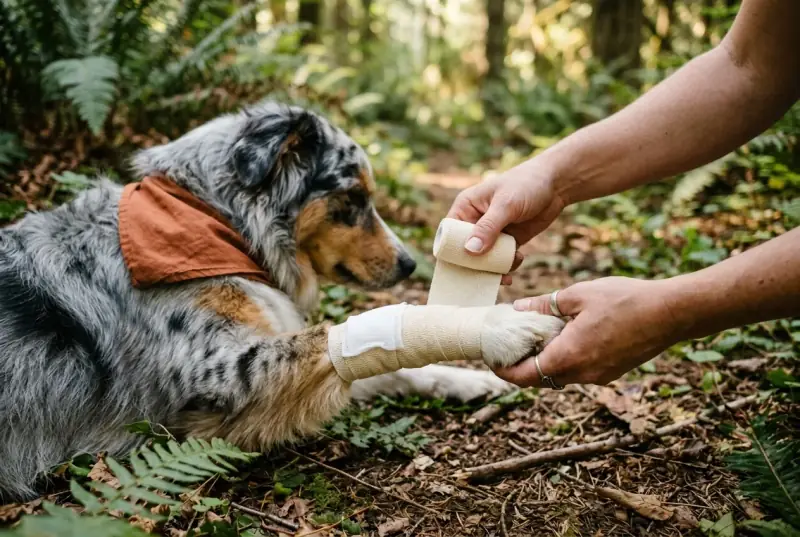
A torn nail is the other paw injury a kit should expect. Merck’s guidance is to press on the nail, or pack it with styptic powder, cornstarch or flour, to help it clot. Broken nails are painful, so muzzle the dog if you need to handle the foot. Try to remove a loose broken piece gently, and if it won’t come away, leave it for the vet.
Ticks, quills, hooks and snakes: what the kit can and cannot do
Ticks. The International Liaison Committee on Resuscitation’s first-aid review recommends against chemicals, heat or ice. It suggests either pulling with tweezers or using a commercial device according to the maker’s instructions — the evidence for both is weak, and neither clearly beats the other. With plain tweezers, the CDC’s technique for people applies: grip the tick as close to the skin as you can and pull with steady, even pressure, without twisting or jerking. With a twist-style tool, use it the way it is designed to be used. Why autumn is a peak rather than the end of tick season is in our guide to autumn trail hazards.
Porcupine quills. Merck’s owner guidance is unambiguous: don’t try to pull them out yourself. Quills are barbed, and a vet removes them with the dog sedated. The evidence on timing backs that up. In a study of 296 dogs with quill injuries, the number of quills was not associated with complications — the time before reaching a vet was. Dogs seen after more than 24 hours needed watching for three weeks. On a trail, the job is getting to a vet the same day.
Fish hooks. If your hike ends at a fishing lake, Merck covers these too. Leave a hook in the eye, mouth or ear for a vet, because getting it out there needs anaesthesia. If a hook in the mouth is still on its line, tie the line to the collar so the dog can’t swallow the hook, and if you can, cut the line, leaving a few inches attached so the vet can find it. If the barb has gone through the skin somewhere else, push the hook on through, clip off the barb with wire cutters, back it out the way it came, then clean and bandage it and see your vet. And never pull on fishing line a dog has swallowed — it can be caught in the intestines.
Rattlesnakes. The Merck Veterinary Manual is direct: keep the dog quiet and limit its movement, and spend no time on anything else. Ice and cold packs, cutting and suction, tourniquets, electric shock, hot packs and waiting to see how bad it gets are all ineffective and potentially harmful. The Red Cross adds two practical points: carry the dog if you can, and don’t try to kill the snake to identify it, because the fangs of a severed head are still venomous. Note what it looked like from a safe distance instead.
In a study of 272 bitten dogs in Arizona, eight died, and in dogs older than ten, a longer delay before reaching the vet was associated with dying. The same study found no evidence that diphenhydramine or the rattlesnake vaccine reduced illness or death. The antihistamine stays in the bag.
Grass awns. Tweezers will take out a seed head you can see. The ones that matter are the ones you cannot, and our guide to paw licking covers how they travel and where they hide.
Three emergencies where the kit is mostly your hands
Overheating. This is where the thermometer earns its place. The 2026 guidelines recommend active cooling for a dog showing signs of heat stroke, and they give a temperature at which to stop cooling. Without a thermometer you are guessing. Our guide to how hot is too hot to walk your dog sets out how to cool a dog, when to stop, and why “tepid water only” was never supported by evidence.
A wet, cold dog. How to recognise hypothermia — including why a dog that has stopped shivering has not necessarily warmed up — is in our guide to how cold is too cold to walk your dog. The first aid is short, and Merck gives it: dry the dog first, then wrap warm — not hot — water bottles around its body. Don’t rub it. If you suspect frostbite, thaw the area slowly, and never with snow or very hot water.
Choking on a stick or a ball. AKC’s first-aid guide, updated in April 2026, still lists the Heimlich manoeuvre as the choking skill to learn. Four months later the guidelines put something else first. They recommend up to five firm back blows, delivered over the back of the ribcage beside the spine rather than on it. If those fail, try something else — tipping the dog head-down, then chest or abdominal thrusts — and go back to back blows. Don’t reach into the mouth of a conscious dog. If the dog loses consciousness, start chest compressions. Look in the mouth after 30 and take out only what you can see — no blind sweeping with a finger. Any dog that needed help to clear its airway should see a vet even if it seems fine.
Getting a dog that cannot walk back to the car
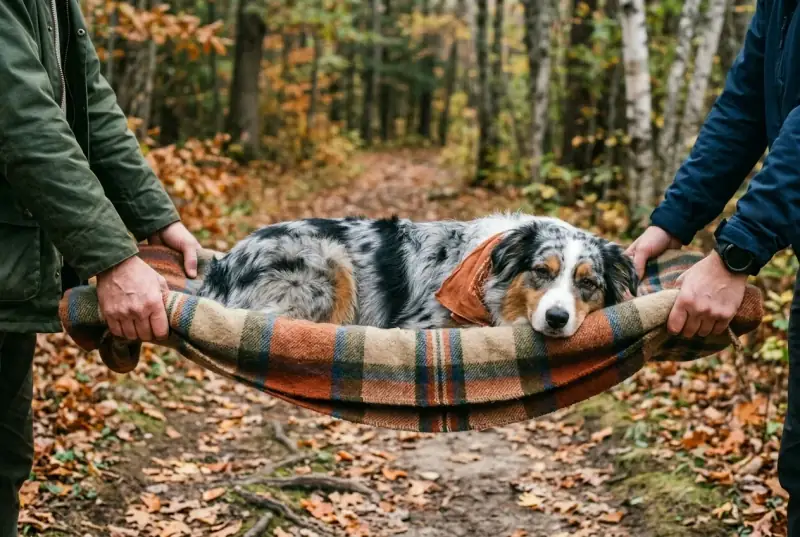
This is the part of trail first aid that no kit solves. Merck’s guidance for moving an injured dog is to keep movement of its head, neck and spine to a minimum and support it on something flat and firm — a board, thick cardboard or a folded blanket — without jerky movements or anything pressing on the neck. If the dog seems confused after a fall or a knock, keep its head level with its body or slightly raised. On a trail, that usually means a blanket, a jacket or a sleeping mat, and two people.
If a leg looks broken below the elbow or knee, Merck’s professional guidance allows a support splint for the journey, once the dog is safely restrained. Its example is a rolled newspaper or magazine, held in place with strips of fabric or duct tape. Above the elbow or knee, a break is hard to immobilise; support the dog and move it as little as possible.
For a small dog, all this is a carry. For a large one it is a plan you should make before you need it. The most likely day you need it isn’t a dramatic one: the dog simply cannot go on. Our guide to hiking with a senior dog is built around that problem.
A trail kit, a car kit, and the trip that runs long
The kit above is for the pack. The AKC’s first-aid guide suggests keeping one kit at home and another in the car, and the car is where the bulky things that help on the way to a vet belong:
- More of everything that runs out — dressings, wrap and tape.
- A blanket, which is also your stretcher.
- A spare leash. The AKC’s kit list makes the point that in an accident a collar can come off or a leash can snap.
- A copy of your dog’s medical records, which the emergency specialist quoted by the AKC recommends keeping up to date — especially when you travel.
- More water than you plan to drink. It is also your wound wash.
For an overnight or multi-day trip, the trail kit stays the same size, but the conversation with your vet below matters more, because the nearest clinic may be a day away rather than an hour.
And check the kit itself. Merck’s advice is to check expiry dates on medicines at least once a year and replace what you use. Keep liquids in their own sealed bag: one REI reviewer found that their kit’s peroxide packet had leaked through everything else.
If you would rather buy a kit
Building the kit yourself lets you match it to your dog. The review REI ranks as the most helpful critical one of the obvious pre-made kit argues for doing exactly that. But if you want one in the pack this weekend, the obvious candidate is the Adventure Medical Kits Trail Dog, which is designed for hiking. It is about 11–12 oz, packed in a waterproof inner bag, and built around the right core: gauze and non-stick dressings, a 2-inch self-adhesive wrap, a triangular bandage, saline, an irrigation syringe, triple antibiotic ointment and a splinter and tick forceps.
Read its contents against this page, though, as they were listed on Amazon and on the manufacturer’s site on 1 October 2026:
- It includes a 1 oz bottle of 3% hydrogen peroxide, listed as “to induce vomiting”. Everything in the hydrogen peroxide section above applies. One REI reviewer also reported that the peroxide packet in their kit leaked and ruined everything else inside, so where you keep it matters even if you keep it.
- It includes two 25 mg diphenhydramine tablets. Fine — once your vet has told you whether that is the right drug and how many tablets your dog gets.
- It has no thermometer, cloth tape or styptic powder. Add them.
- Its triangular bandage is the most useful thing in it. It is your muzzle and, folded wide, your tourniquet.
- The contents vary between production runs. The two listings we checked did not match exactly, so open yours and check.
That most helpful critical review on REI comes from a reviewer who describes themselves as a veterinary and first-aid professional. Their view, summarised: a kit you build to your own needs is the better route and costs a fraction as much, and the included guide is not up to current veterinary standards. That is fair. The kit is a sound base and a poor manual, and the guidelines described on this page replace the manual.
Disclosure: the link below is an affiliate link. If you buy through it we may earn a small commission at no extra cost to you.
Check the AMK Trail Dog Kit on Amazon →
Before the hike: three numbers and one conversation
The guidelines end almost every recommendation the same way: then go to a vet. So the most useful preparation weighs nothing.
Three numbers on a card in the kit and saved in your phone: your own vet; the nearest 24-hour emergency vet to the trailhead, not to your house; and animal poison control. If you hike in rattlesnake country, ring the emergency vet once in advance and ask whether they stock antivenom. Our printable emergency card has fields for your vet, a 24-hour clinic and your dog’s medications, which is also where the antihistamine dose belongs. Add the poison control number by hand.
One conversation with your vet, ideally at the next routine visit:
- Which antihistamine, and how much for my dog? (Write it on the bag.)
- Has my dog ever had a reaction serious enough to justify carrying epinephrine?
- If my dog eats something toxic two hours from a road, what do you want me to have with me — and what do you want me to do?
- Is there anything in a standard kit you would take out for this dog — a breed with MDR1, a dog with kidney disease, a flat face?
If you want to practise the hands-on part, the American Red Cross runs a 35-minute online cat and dog first-aid course and a free Pet First Aid app. RECOVER itself offers a one-hour online CPR course for pet owners, built with Cornell’s veterinary college. Bear spray, if you carry it, adds its own problem when the dog is on a short leash beside you; our bear country guide covers that one.
The bottom line
A good trail kit for a dog is mostly the boring part of a human kit, plus a triangular bandage, a self-adhesive wrap, tape for a paw and a thermometer. The two medicine items that appear on almost every list are the two that need rethinking. Hydrogen peroxide is not a wound cleaner, and making a dog vomit is now a decision you make on the phone with a vet or poison control, not one you make alone. An antihistamine belongs in the kit for a reaction confined to the skin, with a dose your vet gave you, and stays in the bag for anything that affects breathing or circulation.
Then the parts no kit contains: knowing which emergency vet is nearest the trailhead, and knowing how you would get your dog there if it could not walk.
Frequently asked questions
Can I give my dog Benadryl for a bee sting on a hike?
For a reaction that stays in the skin — hives, a swollen face or muzzle, itching, perhaps one episode of vomiting — yes: the 2026 RECOVER first-aid guidelines recommend giving an oral antihistamine before you reach a vet, with the aim of stopping the reaction from progressing. If breathing is affected, the dog collapses, its gums go pale, or the vomiting or diarrhoea keeps coming, the same guidelines suggest against oral antihistamines: that is anaphylaxis, the treatment is epinephrine, and the right move is the car. Use plain tablets with diphenhydramine as the only active ingredient, and get your dog's dose from your vet before the trip rather than estimating it on the trail.
Should I carry hydrogen peroxide in my dog’s first-aid kit?
Not as a wound cleaner — the Merck Veterinary Manual states that it is toxic to healthy tissue and should not be used to flush wounds. As a way to make a dog vomit it does work, but in a 2017 study every one of six healthy dogs given it had stomach lesions four hours later, and the 2026 RECOVER guidelines recommend against routinely making a dog vomit before reaching a vet. Their one exception is a dog far from any clinic when a vet or poison control tells you to do it. If you hike that far out, ask your vet in advance what they would want you to carry.
Can I use my own first-aid kit on my dog?
The dressings, bandages, tape, gloves, tweezers and shears, yes — they are the same materials. The medicines are where it goes wrong. The FDA warns that anti-inflammatory painkillers made for people, such as aspirin, ibuprofen and naproxen, may last longer, be absorbed faster and reach higher blood levels in dogs, and its advice before giving any human painkiller, acetaminophen included, is to call your vet. Loperamide is a problem for dogs carrying the MDR1 mutation, and allergy tablets are often combined with a decongestant. Keep the dog's medicines in their own labelled bag with the vet's dose written on it.
Can you put a tourniquet on a dog?
On a leg or the tail, yes, and since 2026 it is in the guidelines. RECOVER suggests one for severe bleeding from a limb that direct pressure does not control, and recommends one if the dog has lost consciousness. Commercial human tourniquets are made for human limbs, so the guidelines describe an improvised one at least 2 inches wide, tied above the wound and tightened just until the bleeding slows appreciably. Some older references tell owners to loosen a tourniquet every few minutes; the 2026 guidelines say to leave it in place for the journey and let the vet remove it. Never on the head, neck or body — and never for a snakebite.
What should I do if a rattlesnake bites my dog on the trail?
Keep the dog as calm and still as you can, carry it if you can, and go straight to the nearest emergency vet — ideally one you already know stocks antivenom. Don't try to kill the snake to identify it; note what it looked like from a safe distance. The Merck Veterinary Manual lists ice, cold packs, cutting and suction, tourniquets and waiting to see how bad it gets as ineffective and potentially harmful. A study of 272 bitten dogs found no evidence that diphenhydramine or the rattlesnake vaccine reduced illness or death, and in dogs over ten a longer delay before reaching the vet was associated with dying.
What should I do if my dog tears a nail on a hike?
Press on the nail, or pack it with styptic powder, cornstarch or flour, to help it clot — that is the Merck Veterinary Manual's owner guidance. A broken nail is painful, so muzzle the dog if you need to handle the foot. Try to remove a loose broken piece gently; if it won't come away, leave it for your vet.
Sources
Every figure in this piece traces to one of these. Dates are when we read the source — certified lists, prices and park rules all move.
- RECOVER Guidelines: First Aid for Dogs and Cats. Clinical GuidelinesMandell DC, Thawley VJ, Burkitt-Creedon JM, Fletcher DJ, Boller M, Fausak E — Journal of Veterinary Emergency and Critical Care 36(S1):S36–S62 (2026)The spine of this page. That no evidence-based first-aid guidelines for dogs and cats existed before; the rule against first aid when the risk to you is high; the recommendation against routine emesis and its remote-access exception; ropinirole for remote dogs; the tourniquet recommendations, the 2-inch minimum width, placement, duct tape, and leaving it in place for the vet; back blows for choking; and the stop temperature for cooling.Read 1 October 2026
- RECOVER Guidelines: First Aid in Dogs and Cats. Evidence and Knowledge Gap Analysis With Treatment RecommendationsThawley VJ, Mandell DC, Burkitt-Creedon JM, Fletcher DJ, Boller M, et al. — Journal of Veterinary Emergency and Critical Care 36(S1):S3–S35 (2026)The method (GRADE, an international comment period) and the honest count: of 38 recommendations, 15 rest on low or very low quality evidence and 18 on expert opinion.Read 1 October 2026
- RECOVER Guidelines: First Aid. Acute Allergy and Anaphylaxis in Dogs and CatsBurkitt-Creedon JM, Mandell DC, Thawley VJ, et al. — Journal of Veterinary Emergency and Critical Care 36(S1):S63–S89 (2026)The grading of allergic reactions into uncomplicated and anaphylaxis; an oral antihistamine for a skin-only reaction and not when breathing is affected; prehospital epinephrine, and prefilled syringes for dogs with a previous anaphylactic reaction.Read 1 October 2026
- First Aid for Dogs: Everything You Need to KnowGibeault S, with Dr. Ann Marie Zollo, DVM, DACVECC — American Kennel Club (updated 1 April 2026)That even docile, friendly dogs can snap when handled in severe pain; that a muzzled dog cannot pant and the muzzle should come off once handling is done; a kit at home and one in the car, checked regularly; a copy of the medical records and the nearest 24-hour clinic; learning to muzzle a dog; and the Heimlich manoeuvre listed as the choking skill.Read 1 October 2026
- Dog First-Aid Kit EssentialsArford K — American Kennel Club (updated 26 March 2024)Lists hydrogen peroxide as an antiseptic "to help prevent infection", and milk of magnesia and charcoal "to absorb and counteract poisons"; a spare leash because a collar can come off or a leash snap in an emergency.Read 1 October 2026
- First Aid Kit for a PetTextor J — Merck Veterinary Manual, pet owner version (December 2025)A standard reference list, including 3% hydrogen peroxide and "activated charcoal or milk of magnesia (for some poisonings)"; a supply of daily medicines, with the note to ask your vet before giving them in an emergency; checking expiry dates at least once a year.Read 1 October 2026
- What to Do in a Dog or Cat EmergencyTextor J — Merck Veterinary Manual, pet owner version (December 2025)When to muzzle and when never to; pressing on bleeding, adding material rather than removing a soaked bandage, and duct tape over the bandage for transport; leaving penetrating objects in place; drying and warming a cold dog; moving an injured dog on flat, firm support.Read 1 October 2026
- Minor Injuries and AccidentsTextor J — Merck Veterinary Manual, pet owner version (December 2025)Broken nails (pressure, styptic powder, cornstarch or flour); stings (a cold pack, and scraping out the stinger rather than squeezing it); porcupine quills left for a vet; fish hooks and swallowed fishing line.Read 1 October 2026
- First Aid and Transport of Small AnimalsLinklater A, Hanson KR — Merck Veterinary Manual (updated December 2025)A muzzle from a long strip of fabric, but not with facial injuries or difficulty breathing; a light cloth over the head; tourniquets only after compression fails, loosened every 5–10 minutes (advice RECOVER does not repeat); sticks left in place; a rolled support splint below the elbow or knee.Read 1 October 2026
- Initial Wound Management in Small AnimalsWinkler KP — Merck Veterinary Manual (updated September 2024)Hydrogen peroxide is toxic to healthy tissue and should not be used to flush wounds; saline is the least toxic to healing tissue; excessive flushing pressure drives debris deeper; a pressure wrap instead of a tourniquet, because narrow tourniquets risk nerve and vessel damage.Read 1 October 2026
- Effectiveness and adverse effects of the use of apomorphine and 3% hydrogen peroxide solution to induce emesis in dogsKhan SA, McLean MK, Slater M, Hansen S, Zawistowski S — Journal of the American Veterinary Medical Association 241(9):1179–1184 (2012)ASPCA Animal Poison Control Center case data: 3% peroxide caused vomiting in 76 of 84 dogs (90%) and recovered an estimated 48% of what had been swallowed.Read 1 October 2026
- Effects of oral 3% hydrogen peroxide used as an emetic on the gastroduodenal mucosa of healthy dogsNiedzwecki AH, Book BP, Lewis KM, Estep JS, Hagan J — Journal of Veterinary Emergency and Critical Care 27(2):178–184 (2017)Six healthy dogs scoped after 3% peroxide: stomach lesions in all six at four hours, worse at 24 hours, mostly resolved by two weeks; normal tissue in the apomorphine control.Read 1 October 2026
- FDA Approves Clevor (Ropinirole Ophthalmic Solution) to Induce Vomiting in DogsUS Food and Drug Administration, Center for Veterinary Medicine (16 June 2020)Prescription only; the FDA says it should only be administered by veterinary personnel; 95% of dogs in the field study vomited within 30 minutes.Read 1 October 2026
- ASPCA Poison ControlAmerican Society for the Prevention of Cruelty to AnimalsThe (888) 426-4435 number, staffed 24 hours a day; a consultation fee may apply.Read 1 October 2026
- Diphenhydramine pharmacokinetics after oral and intravenous administration of diphenhydramine and oral administration of dimenhydrinate to healthy dogsEhling S, Bäumer W, Papich MG — Veterinary Dermatology 30(2):91–e24 (2019)A six-dog pilot study: on average 7.8% of an oral dose of diphenhydramine reached the bloodstream, with great variation between dogs.Read 1 October 2026
- Cetirizine per os: exposure and antihistamine effect in the dogEkstrand C, Ingvast-Larsson C, Bondesson U, Hedeland M, Olsén L — Acta Veterinaria Scandinavica 60:77 (2018)Eight Beagles: oral cetirizine suppressed the histamine skin reaction completely, with no sedation seen.Read 1 October 2026
- Toxicoses in Animals From Human Cold and Allergy MedicationsHayes C (ASPCA Animal Poison Control Center) — Merck Veterinary Manual (updated June 2025)Antihistamines are often combined with decongestants, painkillers or NSAIDs in over-the-counter products, and combinations with pseudoephedrine can cause more serious signs.Read 1 October 2026
- Paws Off Xylitol; It’s Dangerous for DogsUS Food and Drug AdministrationCough syrup and over-the-counter medicines are among the products that may contain xylitol.Read 1 October 2026
- Get the Facts about Pain Relievers for PetsUS Food and Drug Administration, Center for Veterinary MedicineAn NSAID meant for people may last longer, be absorbed faster and reach higher blood levels in a dog; call your vet before reaching for any human painkiller.Read 1 October 2026
- The use of a kaolin-based hemostatic dressing to attenuate bleeding in dogs: A series of 4 casesHuther A, Edwards TH, Jaramillo EL, et al. — Journal of Veterinary Emergency and Critical Care 34(2):166–172 (2024)Veterinarians used QuikClot Combat Gauze in four dogs; the authors note there is minimal information on these dressings in veterinary medicine.Read 1 October 2026
- Chitosan hemostatic dressing for control of hemorrhage from femoral arterial puncture site in dogsSzatmári V — Journal of Veterinary Science 16(4):517–523 (2015)An experiment in ten anaesthetised dogs: the dressing controlled bleeding from 12 artery puncture sites and failed on two.Read 1 October 2026
- Injuries and illnesses among Federal Emergency Management Agency–certified search-and-recovery and search-and-rescue dogs deployed to Oso, WashingtonGordon LE — Journal of the American Veterinary Medical Association 247(8):901–908 (2015)Twenty-five search dogs over 2,015 working hours: wounds, including paw-pad splits, were the commonest injury and dehydration the commonest illness.Read 1 October 2026
- Water for wound cleansingFernandez R, Green HL, Griffiths R, Atkinson RA, Ellwood LJ — Cochrane Database of Systematic Reviews CD003861 (2022)Thirteen trials in 2,504 people: no evidence that saline beats tap water for preventing wound infection (very low certainty).Read 1 October 2026
- What to do if your dog has a pad woundAmerican Red Cross, with Deborah C. Mandell, VMD (University of Pennsylvania)The paw bandage with tape stirrups, step by step, and the check for a bandage that is too tight; saline made from one teaspoon of salt in a quart of warm water; the 35-minute online course.Read 1 October 2026
- Methods of Tick Removal: First Aid Systematic Review (Consensus on Science with Treatment Recommendations)International Liaison Committee on Resuscitation, First Aid Task Force (2021)Against chemicals, heat or ice; pull with tweezers or use a commercial device according to its instructions; all evidence very low certainty.Read 1 October 2026
- Tick RemovalUS Centers for Disease Control and PreventionThe tweezer technique, written for people: grasp close to the skin, pull with steady, even pressure, don’t twist or jerk.Read 1 October 2026
- Porcupine quill injuries in dogs: a retrospective of 296 cases (1998–2002)Johnson MD, Magnusson KD, Shmon CL, Waldner C — Canadian Veterinary Journal 47(7):677–682 (2006)The number of quills was not associated with complications; a longer interval before the vet was.Read 1 October 2026
- Snakebites in AnimalsGwaltney-Brant SM — Merck Veterinary Manual (updated September 2024)Keep the animal quiet; ice, cold packs, incision and suction, tourniquets, electric shock, hot packs and delaying treatment are ineffective and potentially harmful.Read 1 October 2026
- How to Recognize a Snake Bite on a DogAmerican Red CrossIdentify the snake without going close and don’t try to kill it, because the fangs of a severed head are still venomous; carry the dog if possible; don’t cut the bite or suck out venom.Read 1 October 2026
- 272 cases of rattlesnake envenomation in dogs: Demographics and treatment including safety of F(ab′)2 antivenom use in 236 patientsWitsil AJ, Wells RJ, Woods C, Rao S — Toxicon 105:19–26 (2015)Eight of 272 dogs died; in dogs over ten, a longer delay to the vet was associated with death; no evidence that diphenhydramine, steroids, antibiotics or vaccination reduced illness or death.Read 1 October 2026
- Pet First Aid Awareness Month — Keep Your Pets Safe with Red Cross App, Online ClassAmerican Red Cross (2 April 2026)The free Pet First Aid app, covering more than 25 first-aid and emergency situations.Read 1 October 2026
- CPR Course for Pet Owners and Pet ProfessionalsRECOVER Initiative, with Cornell University College of Veterinary MedicineA one-hour, self-paced online CPR course for pet owners from the group that wrote the guidelines.Read 1 October 2026
- Adventure Medical Kits Trail Dog Medical Kit — product listingAmazon.com (ASIN B00T72ST1Y) and adventuremedicalkits.comThe contents list, including 1 oz of 3% hydrogen peroxide listed "to induce vomiting" and two 25 mg diphenhydramine tablets; no thermometer.Read 1 October 2026
- Adventure Medical Kits ADS Trail Dog First Aid Kit — customer reviewsREI Co-opOwner reports summarised in our own words: a peroxide packet that leaked through the kit, and a reviewer describing themselves as a veterinary professional who judged the included guide out of date.Read 1 October 2026
Comments
Got a question, a tip, or a correction? Leave a comment — no account, no sign-in. Just your name and your thoughts.
Loading comments…