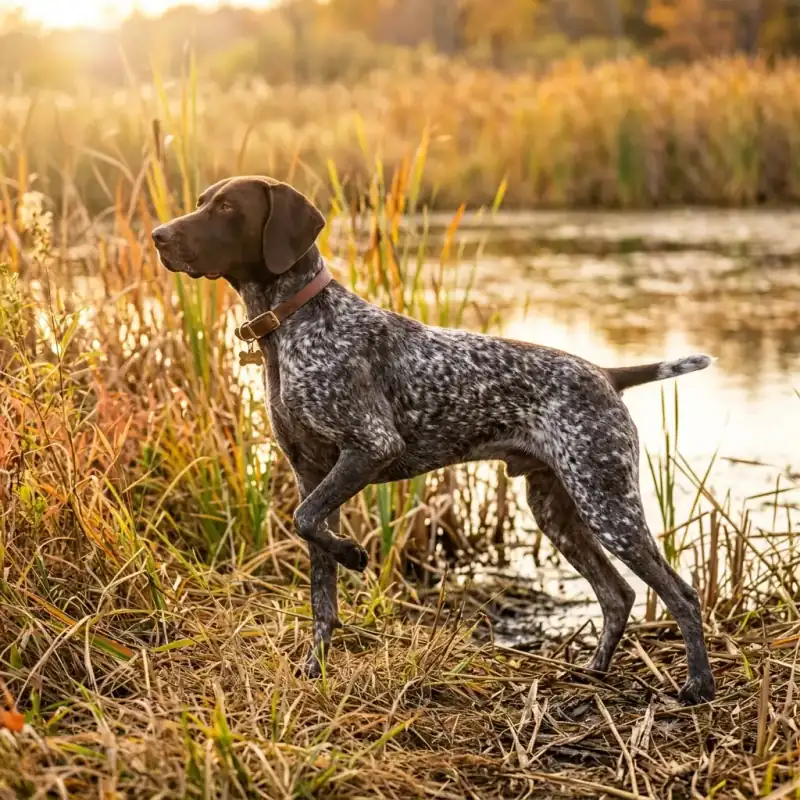
If you designed a dog to do everything outdoors, you might well end up with a German Shorthaired Pointer. It points and retrieves; it works on land and in water; it hunts fur and feather; it hikes, runs and swims tirelessly; it is clever, handsome and devoted. Hunters sometimes call the breed the “iron dog” for its all-round toughness and versatility, and on capability alone it is one of the finest adventure companions there is.
But versatility on that scale is powered by an engine, and the engine has requirements that the breed’s sleek, easy-going looks completely disguise. Two of them catch owners off guard again and again, and both are the heart of this guide: the surprisingly intense separation anxiety hiding behind that friendly face, and the deep-chested bloat risk that every GSP owner must be able to spot in the dark. Get those right, alongside the exercise, and the GSP is very hard to beat. Get them wrong and this is a lot of dog to have unravel.
German Shorthaired Pointer at a glance
| Height | 23–25 in (males), 21–23 in (females) |
| Weight | 55–70 lb (males), 45–60 lb (females) |
| Life expectancy | 10–12 years |
| Coat | Short, dense, water-resistant |
| Shedding | Moderate — more than the short coat suggests |
| Energy | Very high; an all-day hunting athlete |
| Adventure verdict | Arguably the most versatile adventure dog alive — for an active owner who is genuinely around |
Heights, weights, life expectancy and health flags come from the official AKC breed standard. Our verdict: for a home that is active and rarely leaves the dog alone all day, the GSP is close to the perfect do-everything adventure dog: fast, hardy, biddable, equally at home on a mountain trail or in a lake. The two conditions in that sentence, active and around, are the whole story. Fail either and this brilliant breed becomes a very unhappy one.
The dog behind the reputation
The GSP was developed in 19th-century Germany as a versatile hunting dog: one animal that could track, point, and retrieve across every kind of terrain and quarry, replacing the specialists that came before. That “do it all” brief shaped a dog of remarkable athletic completeness: power, speed and endurance in a medium-large, streamlined frame, with a weather-resistant coat and webbed feet for the water.
It also shaped a particular temperament. Versatile hunting dogs had to work in constant, close partnership with their handler all day, and the modern GSP inherits that intense human orientation. This is an affectionate, enthusiastic, deeply people-focused dog, “cooperative” and “friendly” in the breed’s reputation, that wants to be with its person and involved in whatever is happening. That devotion is a huge part of the appeal, and, as we will see, it is also the root of the breed’s biggest behavioural challenge.
Exercise needs: “ample activity, twice a day”
The AKC’s guidance for the GSP is unusually specific: it needs “ample physical activity twice a day.” Read that as the real requirement it is. This is an all-day working athlete, and it needs one to two hours of genuine daily exercise (running, hiking, swimming, retrieving, fieldwork), split across the day, not a single token walk.
The formats that suit the breed play to its build and drive:
- Running and trail hiking, where the endurance and pace shine; GSPs make superb, tireless running partners for a fit owner — see how the breed compares in our best dog breeds for runners guide.
- Swimming and water retrieves, thanks to the water-resistant coat and webbed feet.
- Fieldwork, scent games and retrieving drills, which exercise the hunting brain as well as the body.
And here is the trap: the GSP’s high intelligence and intense attachment mean physical exercise alone is not enough. A GSP that is run hard but left mentally idle and, worse, left alone, does not settle; it stews. The combination of a high-octane body, a busy mind and a need for company is exactly what turns into trouble when any one of the three goes unmet. If you are working out sensible loads for your dog’s age and fitness, our guide to how much exercise a dog really needs breaks it down; and if trail days are new, start with the beginner’s guide to hiking with your dog.
Disclosure: some links below are affiliate links. If you buy through them we may earn a small commission at no extra cost to you.
Check Ruffwear Approach Pack on Amazon →
The thing that face hides: separation anxiety
That relaxed, easy expression hides something owners rarely see coming: the GSP is one of the more separation-anxiety-prone breeds you can own. It is a leading reason the breed turns up in rescue, and it tends to blindside people who did their homework on the exercise needs but never on the temperament.
The cause is the flip side of everything lovable about the breed. A GSP is a “Velcro dog”: it bonds hard to its people and genuinely wants to be with them, a trait bred into a hunting dog that worked at its handler’s side all day. Take that dog and leave it alone for long, regular stretches, and many GSPs deteriorate: pacing, howling, chewing, house-soiling, and destruction that is not naughtiness but distress. Well-adjusted adults, conditioned to alone-time from puppyhood and properly exercised, can typically manage a normal working-day absence of a few hours; but consistently leaving a GSP alone for eight-hour-plus stretches is asking for problems, and a home where the dog would be alone all day is simply the wrong home for the breed.
The honest implications are practical:
- Condition alone-time early and gradually, from puppyhood, so being alone is normal and boring rather than frightening.
- Meet the exercise need first. A GSP that has run is far better equipped to rest calmly than one bursting with unspent energy.
- Be realistic about your lifestyle. If your household is out from morning to night with no provision for the dog, choose a more independent breed. This is not a failing you can train away entirely; it is part of the package.
None of this is a reason to avoid the GSP; it is a reason to be honest about whether your life has room for a dog that wants to share almost all of it.
Bloat: the emergency every GSP owner must know
The second thing the breed’s athletic build hides is a serious medical risk. Like other deep-chested breeds, the GSP is susceptible to gastric dilatation-volvulus (GDV), commonly called bloat: a sudden, life-threatening emergency in which the stomach fills with gas and can then rotate on itself, cutting off blood supply. Without rapid veterinary treatment it is frequently fatal, and it can progress terrifyingly fast.
Every GSP owner should be able to recognise it. The warning signs include:
- A swollen, distended abdomen.
- Unproductive retching — trying to vomit but bringing nothing up.
- Sudden restlessness or pacing, an inability to get comfortable.
- Excessive drooling and obvious signs of pain or distress.
If you see these signs, this is a drive-to-the-emergency-vet-now situation, not a wait-and-see one. Minutes matter.
Sensible risk-reduction steps, widely advised for deep-chested breeds, include feeding two or three smaller meals rather than one large one, discouraging gulping of food and large volumes of water, and avoiding hard exercise in the window right around meals. There are also preventive surgical options (gastropexy) worth discussing with your vet, particularly for a high-risk, hard-working dog. As with everything medical here: your vet sets the plan for your individual dog; your job is to know the signs and act fast.
Trainability: eager and able
After the Husky, the GSP feels like a gift to train. This is an intelligent, biddable, people-pleasing breed that genuinely wants to work with you, and it takes well to obedience, fieldwork and dog sports. The usual caveats apply: channel the energy or it will find its own outlet, keep sessions engaging for a quick mind, and start early.
For an adventure dog, prioritise:
- Reliable recall. The hunting drive is strong, and a GSP locked onto a scent or a flushing bird can tune you out. Build recall on a long-line before trusting it off-leash near wildlife or roads.
Check Long-Line Leashes on Amazon →
- Calm settling and alone-time, which for this breed is as much training as it is management; see the separation-anxiety section.
- Impulse control for a bouncy, powerful dog that can bowl people over in its enthusiasm.
Toys, play and gear that fit a GSP
GSPs love to retrieve and to use their noses, so fetch, water retrieves, flirt poles and scent games are all excellent outlets. As with any athletic breed, mind a young dog’s joints with high-impact, hard-stopping ball games until it matures.
On gear, the GSP’s medium-large, athletic build is easy to outfit, but two breed-specific notes matter:
- A harness for real activity. A padded harness gives better control and no throat pressure for running and hiking; the Ruffwear Front Range suits the build.
Check Ruffwear Front Range on Amazon →
- A cold-weather coat, yes, really. The GSP’s short coat and lean, low-fat body give it little insulation, so unlike a Husky it genuinely feels the cold. For winter hikes and cold-water work, a well-fitted dog coat and sensible limits are kind, not soft.
A note for gift-buyers. The deep chest and tucked waist that make a GSP such an athlete also make it one of the harder shapes to fit, and the range above runs 45 to 70 lb across the sexes. Girth-sized gear needs the actual girth. Our gift guide for adventure dog owners sorts the category by that constraint.
Health and lifespan
GSPs live around 10 to 12 years, and beyond bloat (covered above, and the most urgent thing to know), responsible breeders screen for:
- Hip dysplasia — the standard large-breed orthopaedic screen; ask for parents’ scores.
- Progressive retinal atrophy (PRA) and other eye conditions — a good breeder health-tests eyes.
- Cardiac conditions — included in responsible breeders’ screening.
- Bloat/GDV — not something a breeder tests for, but the risk every owner must manage; see above.
None of this is a diagnosis. It is the honest health picture of the breed — screen through a good breeder and manage your individual dog with your vet.
Grooming and shedding
The short, dense coat is genuinely low-maintenance: a weekly once-over with a rubber grooming mitt or bristle brush keeps it healthy and removes loose hair, and the coat’s slight water resistance means the breed cleans up quickly after muddy trail days. Do not be fooled, though: GSPs shed more than their short coat suggests, and those fine hairs weave themselves into fabric. The trade-off is fair: minimal grooming effort, in exchange for accepting some shedding and remembering that this coat offers almost no protection from the cold.
Is a German Shorthaired Pointer right for you?
Run through four honest questions first:
- Are you genuinely active? One to two hours of real exercise daily, indefinitely. A GSP without it is a destructive, unhappy dog.
- Are you actually around? This is the breed’s defining question. A GSP left alone all day is a recipe for separation anxiety. If your home is empty from morning to night, choose another breed.
- Can you recognise and act on bloat? Know the signs, feed sensibly, and treat any episode as the emergency it is.
- Can you handle a few years of exuberant adolescence? The mature GSP is a superb, devoted athlete; the teenager is a lot of bouncy, powerful dog.
Clear all four and the GSP gives back as much as any breed in this series: a hike-run-swim-anything athlete that asks for little beyond being included in your day. Miss on the exercise or the company, though, and you will let this brilliant dog down without ever meaning to. Its needs are unusually easy to get wrong.
The GSP’s closest cousins on most shortlists are the Vizsla, leaner, even more velcro, and every bit as devoted, and the Weimaraner, bigger and harder to tire, while the Labrador offers similar versatility with a more forgiving, less clingy temperament. For the whole field against the veterinary data, see our hub guide, The Best Adventure Dog Breeds for Hiking & Camping.
Sources
- American Kennel Club — German Shorthaired Pointer breed profile
- American College of Veterinary Surgeons — Gastric Dilatation-Volvulus (bloat)
- Orvis — German Shorthaired Pointer breed overview
Frequently asked questions
How much exercise does a German Shorthaired Pointer need?
A great deal. The AKC specifies 'ample physical activity twice a day', and it means genuine activity, not a stroll. GSPs were bred as all-day hunting athletes with power, speed and endurance, and they need one to two hours of hard exercise daily: running, hiking, swimming, retrieving or fieldwork. Crucially, a physically tired GSP is not the whole goal; they also need mental work and, above all, company. This is not a breed you can satisfy with a quick walk and a garden.
Do German Shorthaired Pointers have separation anxiety?
Very commonly, yes. GSPs are classic 'Velcro dogs' that bond intensely to their people and struggle to be left alone. Without careful conditioning to alone-time from puppyhood, and without their considerable exercise needs met, many become anxious and destructive when left for long stretches. They are a poor fit for a household where the dog would be alone all day. Meeting their exercise needs, crate-training thoughtfully, and building up alone-time gradually all help, but the underlying need for companionship is part of the breed.
Are German Shorthaired Pointers at risk of bloat?
Yes: like other deep-chested breeds, the GSP is at risk of gastric dilatation-volvulus (GDV), or bloat, a sudden and life-threatening emergency in which the stomach fills with gas and can twist. Every owner should learn the signs (a swollen abdomen, unproductive retching, restlessness, drooling and pain) and treat them as a dash-to-the-vet emergency. Sensible precautions include feeding smaller meals rather than one large one and avoiding hard exercise right around mealtimes. Discuss the risk, and any preventive options, with your vet.
Do German Shorthaired Pointers get cold?
Yes, more than people expect. That sleek short coat and lean, low-fat build give a GSP very little insulation, so they feel the cold and can struggle in winter or cold water despite being tough, hardy athletes. A well-fitted dog coat for cold-weather outings, sensible limits on time in cold water, and a warm, dry place to recover are all reasonable. The same short coat that makes them low-maintenance to groom is the reason they need a bit of help with the cold.
Are German Shorthaired Pointers good family dogs?
They can be excellent, affectionate, playful and devoted, in an active family that can meet their needs. The caveats are energy and exuberance: a young GSP is bouncy and powerful enough to knock over small children by accident, and a bored, under-exercised one is a handful. In a household that hikes, runs and includes the dog in daily life, the GSP is a loving and loyal family member. In a sedentary one, it will be miserable and so will everyone else.
Is a German Shorthaired Pointer a good first dog?
Only for an active, committed first-time owner who has done their homework. GSPs are trainable and people-loving, which helps, but the combination of high exercise needs, separation anxiety and sheer adolescent energy overwhelms unprepared owners. If your first dog is going to be a GSP, be honest that you are signing up for one to two hours of daily exercise, a dog that wants to be with you almost constantly, and a couple of boisterous years before the athlete matures.
Comments
Got a question, a tip, or a correction? Leave a comment — no account, no sign-in. Just your name and your thoughts.
Loading comments…