Most lists of running breeds are ranked by energy. Which dog has the most, essentially, and therefore which will keep up.
That is the wrong axis, and there is a large study that shows why.
Researchers examining 905,543 dogs under primary veterinary care identified 1,259 heat-related illness events and traced what triggered them. The result reorders the whole subject:
| Trigger | Share of heat-related illness events |
|---|---|
| Exertion | 74.2% |
| Environmental (hot weather) | 12.9% |
| Vehicular confinement | 5.2% |
Hot cars — the thing every summer campaign is about — accounted for one in twenty. Exercise accounted for three in four.
So the limiting factor for a running dog is almost never stamina. It is heat dumping, skeletal maturity, and whether the dog can be trusted next to a road. Rank breeds on those and the list looks quite different from the usual one.
The four filters
1. Can it dump heat? Dogs cool primarily by panting, and that system is easily outrun. Muzzle length, coat, and body mass all decide how well. Relative to a Labrador, the odds of heat-related illness were 13.95× for Bulldogs, 6.49× for French Bulldogs, 3.24× for Pugs and 2.65× for Golden Retrievers; brachycephalic skull shape alone carried 2.10× and bodyweight over 50 kg carried 3.42×.
2. Is it skeletally mature? Running is repetitive, high-impact loading on a fixed surface. The AKC flags this breed by breed, in its own words — collected below.
3. Can it be contained? A dog that breaks away on a road run is a different category of problem from a dog that breaks away in a field. For some breeds the AKC’s own advice is explicit: never off leash.
4. Is it built for a sustained trot? Most running dogs are not sprinting; they are trotting for 40 minutes. Breeds selected for quartering ground all day are built for exactly that. Breeds selected for explosive sprints are not, whatever they look like.
Tier 1 — built for the distance
Vizsla
The purpose-built running dog. AKC: 22–24 inches, 55–60 lb, 12–14 years, needing a minimum of 30 minutes of active daily exercise plus regular hard off-leash running. Light, short-coated, athletic, and among the most willing partners you will find.
Two honest caveats. The AKC states that “young dogs should not run long distances until maturity at 18–24 months” — this is the breed runners most often injure young, because the puppy is so obviously capable. And the Vizsla is the archetypal velcro dog, bred to work within arm’s reach of one person; a dog left alone all day and run for 40 minutes is a dog with an unmet need, not a met one.
→ Full guide: Vizsla
German Shorthaired Pointer
AKC: 23–25 inches, 55–70 lb, 10–12 years, described as requiring “ample physical activity twice a day,” with power, speed and endurance. If the Vizsla is the road runner, the GSP is the all-terrain version — slightly more substantial, equally tireless.
Watch two things: a deep chest means bloat/GDV risk, so no hard running around meals, and the same separation-anxiety tendency as the Vizsla. The short coat also means it feels the cold on winter mornings more than its energy level suggests.
→ Full guide: German Shorthaired Pointer
Weimaraner
AKC: 25–27 inches and 70–90 lb (male), 23–25 inches and 55–75 lb (female), 10–13 years. The AKC’s exercise note is unusually direct — Weimaraners “have high exercise requirements… They love a good run,” and while walking is acceptable, getting “up a full head of steam” is far better.
The breed’s most serious health issue, per the AKC, is gastric torsion — the same deep-chested bloat risk as the GSP, and the same rule about meals and hard exercise. The AKC also passes on a breeder’s line that any Weimaraner owner will recognise: “the good news is that Weimaraners are smart; the bad news is that Weimaraners are smart.” Our Weimaraner guide goes through what that costs day to day, and the juvenile bone disease that hits the breed harder than most.
Dalmatian
The historical answer to this question. AKC: 19–24 inches, 45–70 lb, 11–13 years — and the breed is also known as the English Coach Dog and Carriage Dog, developed to run alongside horse-drawn carriages. The AKC’s exercise section still lists running alongside a biking or jogging owner as ordinary exercise for the breed.
Two breed-specific facts a prospective Dalmatian runner needs. First, the AKC’s maturity warning is the clearest of any breed page: “since a puppy’s bones and joints aren’t at their mature strength until two years of age, be wary of strenuously exercising the dog before then.”
Second, the urinary one. A 2008 study in PLOS Genetics found the SLC2A9 mutation causing hyperuricosuria was homozygous in all 247 Dalmatians tested, and absent in 378 dogs from 58 other breeds. In plain terms: every Dalmatian carries the trait that predisposes them to urate stones. That makes water intake and diet a standing veterinary conversation for this breed — and running dogs lose water fast. Ask your vet before you add mileage, not after.
Deafness is also present in the breed; responsible breeders test entire litters.
Tier 2 — excellent, with conditions attached
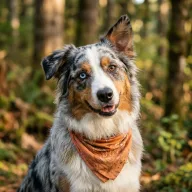
Australian Shepherd
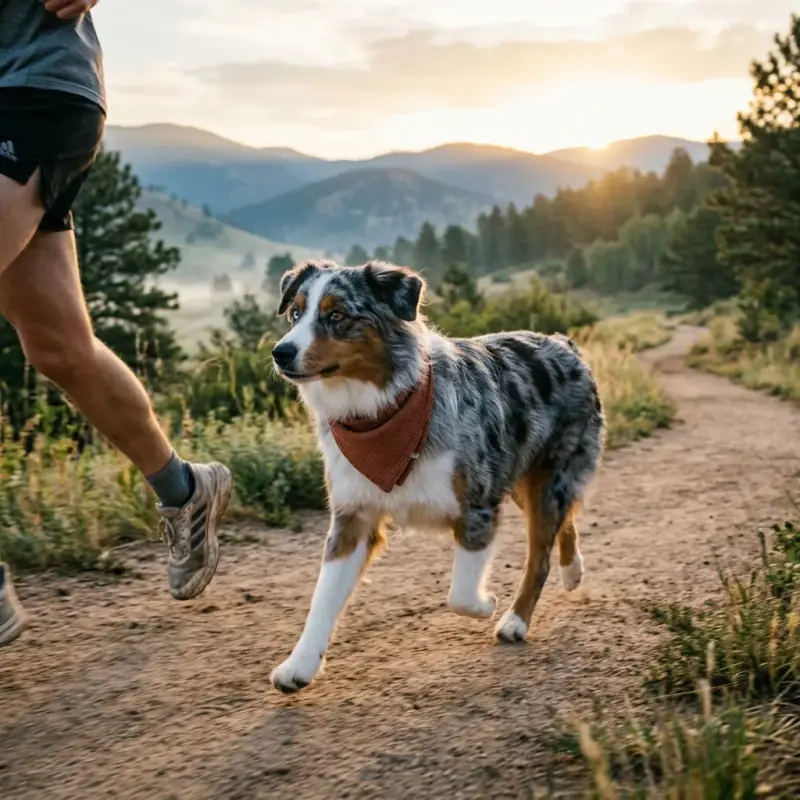
AKC: 20–23 inches, 50–65 lb, 12–15 years, needing “a great deal of exercise daily” — one to two hours. The AKC describes the Aussie as a great running companion “once the skeletal system is fully formed.”
The breed-specific catch is pharmacological rather than athletic: roughly half of Australian Shepherds carry the MDR1/ABCB1 mutation affecting drug sensitivity. Not a running issue directly, but something your vet needs to know before any procedure.
→ Full guide: Australian Shepherd
Border Collie
AKC: 19–22 inches, 30–55 lb, 12–15 years, needing vigorous exercise every day. Tireless, light, and mentally engaged with the job — a genuinely good running partner for someone who runs most days.
The specific caution here is Border Collie Collapse, a documented syndrome studied at the University of Minnesota. Episodes begin 5–15 minutes after strenuous activity, particularly in warm weather — disorientation, staggering, a choppy gait — with dogs typically normal again after 30 minutes of rest. It is genetically distinct from the exercise-induced collapse seen in Labradors. If you ever see that pattern, stop and call your vet.
→ Full guides: Border Collie · Are Border Collies easy to train?
Labrador Retriever
AKC: 22.5–24.5 inches, 65–80 lb, 11–13 years. Willing, biddable, and happy to run — with two genuine limits.
Exercise-induced collapse (EIC) is a screened condition in the breed with a DNA test available; affected dogs are normal at rest and collapse after intense, excited exercise. And the breed’s appetite problem is real and genetic — a deletion in the POMC gene, at roughly 12% allele frequency, is associated with higher body weight and greater food motivation. An overweight Lab is a poor running partner and a joint problem waiting to happen.
→ Full guide: Labrador Retriever
Australian Cattle Dog
AKC: 18–20 inches, 35–50 lb, 12–16 years — one of the longest-lived working breeds, and the toughest engine per pound on this list. The AKC notes the breed “needs more than just a quick walk” and wants daily runs.
The caveat is social, not physical: this is a heeler, bred to move cattle by nipping at heels. That instinct finds joggers, cyclists and running children irresistible. Fine on a lead beside you; a management project everywhere else.
→ Full guide: Australian Cattle Dog
Tier 3 — capable, complicated
Siberian Husky
The engine is genuinely extraordinary. Research on ultra-endurance sled dogs found they shift to fat metabolism within roughly 24–48 hours of sustained running and return to near-resting metabolic values while running around 100 miles a day — they do not hit the wall the way humans do.
Two problems for a road runner. The AKC’s containment guidance is unambiguous: it is “vital to keep the dog on a leash, in harness, or in a fenced yard at all times.” And an Arctic double coat is the wrong equipment for summer. A Husky is a superb winter partner and a liability in July.
→ Full guide: Siberian Husky
German Shepherd
AKC: 24–26 inches, 65–90 lb, 12–14 years, needing plenty of exercise — and the AKC’s own note that you should “not let the dog off leash, as even the best-trained dog can become distracted.” Perfectly capable of running with you on a secure attachment.
The reasons for Tier 3 are structural: hip and elbow dysplasia are the breed’s signature screened conditions, degenerative myelopathy is a documented later-life risk, and at 65–90 lb the dog is carrying more mass through each stride than the Tier 1 breeds.
→ Full guide: German Shepherd
Golden Retriever
Willing, and the least suited of the popular retrievers to hot-weather running. Golden Retrievers carried 2.65× a Labrador’s odds of heat-related illness in the 905,543-dog study, and the AKC itself advises that “consultation with a vet is recommended before starting strenuous or high-impact activities.”
That is not a no. It is a cool-mornings-only, ask-your-vet-first yes.
→ Full guides: Golden Retriever · Belgian Malinois
The ones that look like runners and aren’t
Whippets and Greyhounds. The AKC is blunt: “Whippets are sprinters by nature,” with adequate exercise taking the form of vigorous retrieving sessions, walks, or play in a safely fenced area — and always on lead when not fenced. At 25–40 lb with minimal coat and body fat, they are built for explosive speed over short distances, not sustained miles.
Flat-faced breeds. Research on brachycephalic obstructive airway syndrome found these dogs are more susceptible to heat illness even at relatively low temperatures and relatively low activity levels. Bulldogs’ HRI odds were 13.95× a Labrador’s. This is not a conditioning problem you can train around. The moderately flat-faced athletic breeds are the awkward case — the Boxer is fit enough to want the miles and built wrong for doing them in summer.
Giant breeds. Bodyweight over 50 kg carried 3.42× the odds of heat-related illness, on top of the joint loading. The Great Pyrenees, per the AKC, is “not a highly active breed” and conserves energy deliberately. Long walks, not road miles.
Any dog under skeletal maturity. See below — this is the most common and most avoidable mistake in the whole subject.
The growth plate rule, in the AKC’s own words
There is no single closure age across all dogs, and anyone quoting one number is smoothing over real variation. What we can do is quote the breed pages directly:
- Dalmatian: “since a puppy’s bones and joints aren’t at their mature strength until two years of age, be wary of strenuously exercising the dog before then.”
- Vizsla: “young dogs should not run long distances until maturity at 18–24 months.”
- Australian Shepherd: a great running companion “once the skeletal system is fully formed.”
- Golden Retriever: “consultation with a vet is recommended before starting strenuous or high-impact activities.”
Secondary sources commonly give 12 months for small and medium dogs and 18–20 months for large and giant breeds. Treat any of those as approximate. Your vet can assess your actual dog; a blog cannot.
Walking, off-lead pottering and play on soft ground are all fine in the meantime. It is repetitive road work at your pace that a young skeleton isn’t ready for.
Running with a dog, safely
Run on the temperature, not the schedule. Given that 74.2% figure, the single most protective habit is moving your run to the cool part of the day. Our guide to how hot is too hot to walk your dog has the thresholds, and the pavement temperature tool estimates surface heat for today.
Check the ground before the air. Asphalt runs far hotter than air temperature and paw burns happen in seconds. Where you can’t avoid hot or abrasive surfaces, dog boots are the direct answer — conditioned in advance, not first used at the start of a run.
Build up like an athlete. Gradual increases, on varied surfaces, with rest days. Dogs will follow you past their own limit out of sheer willingness; the restraint has to come from you. Our step-by-step guide to starting running with your dog sets out a full build-up — and explains why the limiter is heat and skeletal maturity rather than the distance target most plans are built around.
Attach properly. A well-fitted harness spreads load across the chest instead of the throat, and gives you a controllable dog beside a road. Our German Shepherd harness guide covers the research on fit and design for large dogs.
A padded everyday harness with front and back attachment points is the sensible default for road running.
Cool the dog, not just the schedule. If you run in genuine heat with a heat-vulnerable breed, a cooling vest is one of the few pieces of dog gear with a peer-reviewed test behind it — though what that study found, and did not find, is worth reading before you buy.
Carry water for the dog, not just yourself. And offer it before they ask.
A squeeze bottle with a built-in bowl is easier to use one-handed mid-run than a collapsible bowl.
Know the warning signs. Frantic panting that won’t settle, brick-red or very pale gums, wobbliness, vomiting — stop, cool the dog, get to a vet. And know that a fit dog showing these signs is the normal presentation, not the surprising one.
The bottom line
If you run most days and want a dog built for it, look at the pointing breeds — Vizsla, German Shorthaired Pointer, Weimaraner — or the Dalmatian, the breed that was literally developed to run beside a moving vehicle. Give any of them until 18–24 months before real distance.
If you already have an Aussie, Border Collie, Lab or Cattle Dog, you have a fine running partner with one specific thing to watch. If you have a Husky, run in winter. If you have a flat-faced dog, walk — earlier, shorter, shadier — and enjoy the walk.
And whichever dog is beside you, remember the number this whole article turns on: three quarters of heat-related illness in dogs is triggered by exercise. The most dangerous thing on a dog’s run is usually the run.
For the wider picture on which breeds handle the outdoors well, our best adventure dog breeds guide covers hiking and camping, and how much exercise a dog actually needs sets the daily baseline before you add miles.
Sources
- Hall E.J., Carter A.J., O’Neill D.G., Dogs Don’t Die Just in Hot Cars — Exertional Heat-Related Illness (Heatstroke) Is a Greater Threat to UK Dogs, Animals 10(8):1324 (2020): https://www.mdpi.com/2076-2615/10/8/1324
- Hall E.J., Carter A.J., O’Neill D.G., Incidence and risk factors for heat-related illness (heatstroke) in UK dogs under primary veterinary care in 2016, Scientific Reports 10:9128 (2020) — breed odds ratios: https://pmc.ncbi.nlm.nih.gov/articles/PMC7303136/
- Bannasch D. et al., Mutations in the SLC2A9 Gene Cause Hyperuricosuria and Hyperuricemia in the Dog, PLOS Genetics 4(11):e1000246 (2008): https://journals.plos.org/plosgenetics/article?id=10.1371/journal.pgen.1000246
- University of Minnesota Canine Genetics Lab — Border Collie Collapse: https://canine-genetics.umn.edu/canine-genetic-research/border-collie-collapse
- Raffan E. et al., A Deletion in the Canine POMC Gene Is Associated with Weight and Appetite in Obesity-Prone Labrador Retriever Dogs, Cell Metabolism (2016): https://pmc.ncbi.nlm.nih.gov/articles/PMC4873617/
- Glucocentric Metabolism in Ultra-Endurance Sled Dogs, Integrative and Comparative Biology 61(1):103 (2021): https://academic.oup.com/icb/article/61/1/103/6237898
- American Kennel Club breed pages — Vizsla, German Shorthaired Pointer, Weimaraner, Dalmatian, Whippet, Australian Shepherd, Border Collie, Labrador Retriever, Australian Cattle Dog, Siberian Husky, German Shepherd, Golden Retriever, Great Pyrenees: https://www.akc.org/dog-breeds/
Frequently asked questions
What is the best dog breed for a runner?
For steady distance on most terrain, the pointing breeds are hard to beat — the Vizsla, German Shorthaired Pointer and Weimaraner were all built to quarter ground for hours at a working trot. The Dalmatian deserves its old reputation too: it was developed as a coach dog running alongside carriages, and the AKC still describes running beside a biking or jogging owner as normal exercise for the breed. The catch with all four is that they are ready for distance later than people expect.
Does the right starting age depend on the breed?
Yes — it tracks the breed's own maturity rather than a universal number, and it is later than most owners assume. The AKC's Vizsla page states that young dogs should not run long distances until maturity at 18–24 months; the Dalmatian page warns that a puppy's bones and joints are not at mature strength until two years of age; the Australian Shepherd page describes the breed as a great running companion once the skeletal system is fully formed. Ask your own vet before starting road work — they can see your dog's growth plates and you cannot.
Which dogs should not be running partners?
Flat-faced breeds first. Research on brachycephalic obstructive airway syndrome found these dogs are more susceptible to heat illness even at relatively low temperatures and relatively low activity levels, and in a study of 905,543 dogs, Bulldogs carried nearly 14 times a Labrador's odds of heat-related illness. Very large dogs are also at structural risk — bodyweight over 50 kg carried 3.42 times the odds. Add any dog under skeletal maturity, and any dog your vet hasn't cleared.
Are Huskies good running dogs?
Their engine is extraordinary and their containment is the problem. Racing sled dogs shift to fat metabolism within roughly 24–48 hours of sustained running and return to near-resting metabolic values while covering around 100 miles a day. But the AKC's own guidance is that it is vital to keep a Siberian Husky on a leash, in harness or in a fenced yard at all times — so road running with one means a secure attachment, not trust. And a double-coated Arctic dog is the wrong dog for a summer afternoon.
How far can a dog run?
Further than most owners, and that is exactly the danger — a fit dog will keep going past the point where it should stop. There is no published mileage limit by breed, so the honest guidance is conditioning rather than a number: build distance by roughly 10% a week, run on cool mornings, turn around based on time rather than how the dog looks, and stop at the first sign of heavy laboured panting, lagging or wobbliness. Heat, not distance, is what puts dogs in emergency clinics.
Are Whippets or Greyhounds good running partners?
Not for distance, despite looking the part. The AKC states plainly that 'Whippets are sprinters by nature' and suggests vigorous retrieving sessions, walks and safely fenced play rather than sustained miles. They are built for explosive speed over short distances, they have almost no insulating coat or body fat, and the AKC adds that a Whippet should always be on lead when not in a fenced area. Lovely dogs; wrong tool for a 10K.
Comments
Got a question, a tip, or a correction? Leave a comment — no account, no sign-in. Just your name and your thoughts.
Loading comments…