
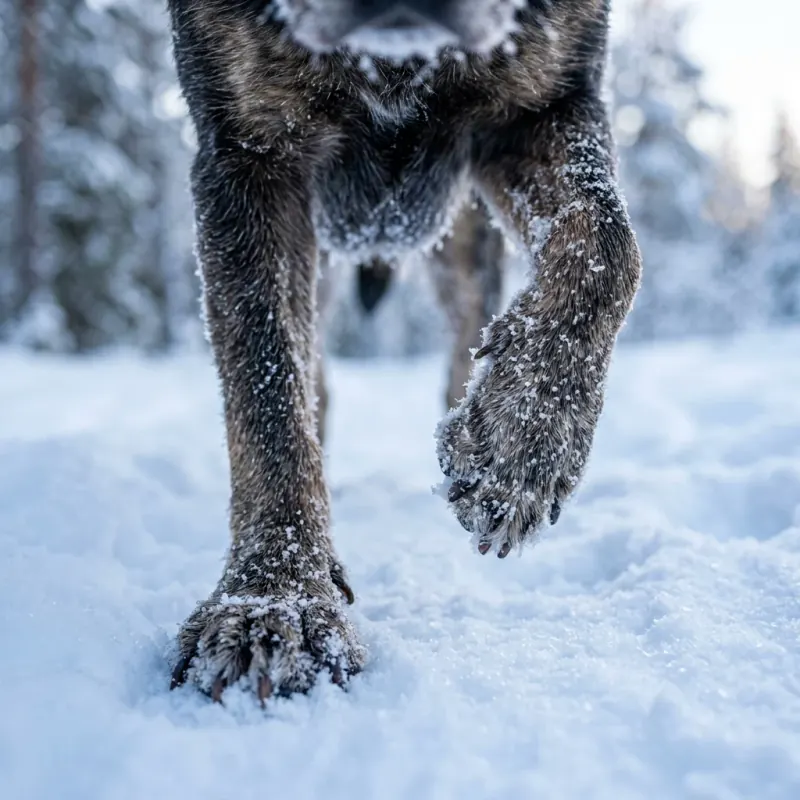
Search for winter paw care and you’ll get the same article every time: road salt burns paws, buy this balm, wipe the feet, done.
Salt matters. But if you actually walk a dog through winter, you’ll notice the thing that ends walks isn’t a chemical burn developing quietly over weeks. It’s the dog stopping dead a kilometre from home, lifting one back foot, and refusing to put it down.
That’s ice balling, and the interesting part is that the dog causes it. Loose snow works its way into the fur between the pads. The dog’s own body heat melts it. It refreezes into hard clumps that force the toes apart and pull on the hair every time the foot lands.
It’s painful, it’s fast, and it happens to dogs whose paws are otherwise in perfect condition. It’s also almost entirely preventable — with grooming rather than a product.
So this guide is organised the way winter actually goes: the thing that stops your walk today, the thing that damages paws over a season, and the thing that’s an emergency.
Ice balling: the walk-stopper
Why it happens to some dogs and not others
The variable is hair. Dogs with long or feathered fur between and around the pads collect snow readily; short-coated feet shed it. Which is why the spaniel and the golden come home with hooves of ice while the pointer doesn’t.
Wet, sticky snow around freezing point is worst. Dry powder in deep cold packs less.
Worth knowing, because it explains why some dogs cope so well: northern breeds are built for this. As the AKC describes it, they benefit from counter-current heat exchange in the paws — heat moving from warm arterial blood into the cooler veins alongside, keeping the core warm while the feet keep working — plus broad paws that spread weight on snow and extra footpad fat, which freezes more slowly than other tissue. Our guide to cold-weather dog breeds covers which dogs genuinely have that equipment and where “built for cold” stops being true.
The fix is a haircut
Cornell University College of Veterinary Medicine’s winter guidance puts the primary prevention first, and it isn’t a purchase: trim the fur between the paw pads.
Keep it level with the pads rather than scalped — you’re removing the scaffolding the snow builds on, not the insulation. If your dog is nervous about having its feet handled, a groomer will do it in a few minutes, and it’s worth adding to the routine from November onward.
Cornell’s second recommendation is to check long-haired dogs’ feet while you’re still out, not only when you get home. Ice balls are trivial to clear at thirty seconds old and a real problem at twenty minutes.
How to get them out
Don’t pull. The ice is frozen onto the hair; pulling tears both.
Soak the foot in warm — not hot — water and massage gently until the clumps loosen and melt. Cornell recommends wiping paws with a lukewarm cloth after winter walks, which does the same job for smaller build-ups. Then dry the foot thoroughly, because damp fur in cold conditions is worse than no protection at all.
Salt and ice melt: the slower problem
Now the thing every other article leads with — correctly, just not first.
What’s actually in it
The ASPCA’s Animal Poison Control Center classes all ice-melting products as chemical irritants. The usual ingredients are sodium chloride (rock salt), potassium chloride, calcium chloride and magnesium chloride; products marketed as pet-friendly typically use urea or magnesium chloride instead. The seasonal poison calendar opens well before the first frost, though — antifreeze and rodenticide move indoors in autumn, weeks before anyone salts a path.
Two exposure routes matter, and the second one gets forgotten: licking their feet after walking on a treated surface, and eating treated snow.
What it does
Per the APCC, the most common effect is stomach upset — vomiting and diarrhoea, with dehydration a concern in more severe cases. Beyond that:
- Ingesting too much can raise blood sodium levels enough to cause tremors and seizures.
- Calcium chloride can cause ulceration in the mouth.
- Topically, all of them can irritate pads and skin — cracking, redness, and licking that makes it worse.
Ingredient by ingredient
The APCC treats ice melt as one hazard. Pet Poison Helpline’s guidance breaks it down by ingredient, and the differences are large enough to matter when you are the one choosing the bag:
| Ingredient | What stands out | If swallowed |
|---|---|---|
| Sodium chloride (rock salt) | The one salt toxicosis comes from | Vomiting and diarrhoea after small amounts; a large amount can cause sodium toxicosis |
| Potassium chloride | Called a “severe irritant” | Gut irritation; vomiting or diarrhoea can be bloody |
| Magnesium chloride | Common in blends sold as pet-friendly | Gut upset |
| Calcium salts — calcium chloride, calcium magnesium acetate | The most severe irritants of any ice-melt ingredient | Severe gut signs; calcium chloride can ulcerate the mouth |
| Urea | Usually what a “pet safe” label contains | Drooling and mild gut irritation; very large amounts can cause weakness and tremors |
Licking a treated paw is far more likely to irritate than to poison: the dose that causes salt toxicosis is measured in grams per kilogram of body weight, as our guide to electrolytes on the trail works through. A dog that eats from the bag, or from a pile of treated snow, is a different case — the National Capital Poison Center notes that pets can swallow enough sodium or calcium to poison themselves.
On the pads themselves, the Poison Center’s summary covers every ingredient: dryness and irritation. Calcium chloride goes further. In a 1987 veterinary report, a dog whose skin was accidentally exposed to a landscaping product that was 77–80% calcium chloride developed ulcerated skin lesions within a day, and the researchers reproduced the same lesions in five healthy dogs with small amounts — the compound had passed through the skin and left calcium deposits in it, a condition called calcinosis cutis. That was a landscaping product rather than an ice melt, but it is the same compound, and it is the clearest reason on record not to leave treated grit sitting in the fur between the toes.
Cornell’s Brian Collins, DVM, Section Chief of the Community Practice Service at the Cornell University Hospital for Animals, puts it simply: “salt and most deicers can be toxic.”
If your dog has ingested ice melt or is showing symptoms, contact your vet or the ASPCA Animal Poison Control Center on (888) 426-4435 — a consultation fee applies. That’s a call to make promptly, not after a wait-and-see hour.
”Pet safe” is not a regulated term
This is the part worth internalising before you spend money.
There is no standard, certification or regulated definition behind the phrase “pet safe” on a bag of ice melt. It’s marketing language. A urea-based product genuinely is less aggressive than rock salt, and the ASPCA recommends using pet-friendly melts where you can — but the label itself guarantees nothing, and it does precisely nothing about the pavement your neighbour salted, which is where your dog actually walks.
The step that works on every surface, from the ASPCA’s own winter guidance: “After each walk, make sure to wash and dry your pet’s feet and stomach to remove ice, salt and chemicals.” The APCC suggests wiping paws as soon as you’re inside with a damp cloth or baby wipes.
It costs nothing, it works regardless of what was on the ground, and it is the single highest-value habit in this article.
Two more from the same ASPCA guidance, both easy to get wrong: bathe your dog as little as possible during cold spells, and keep ice-melt packaging somewhere the dog can’t reach it.
What actually helps, in order of value
On links: the product category below links to Amazon, and we may earn a commission if you buy through it. It doesn’t change what we recommend — and you’ll notice the two most effective steps in this article are a haircut and a towel.
1. Trim the hair between the pads. Free, prevents the most common problem, recommended first by a veterinary school.
2. Wash and dry the feet after every walk. Free, works on every surface and every chemical.
3. Check the feet mid-walk on long-haired dogs. Free, catches ice balls while they’re still nothing.
4. Paw balm before you go out. Cornell recommends applying paw balm before walks and wiping with a lukewarm cloth afterward. A wax barrier reduces how readily snow sticks to the fur in the first place and gives pads some protection from salt. It’s a genuine aid, but it is fourth on this list rather than first, and it doesn’t replace washing the feet afterward.
5. Boots, if — and only if — you condition them first. This one has a peer-reviewed caveat attached. A study measuring ground reaction forces and centre-of-pressure while dogs wore boots found they can serve a real protective function against paw injuries, but that sudden use without prior practice can cause gait changes or distress.
So boots are not something you produce at the trailhead in January. Introduce them at home across several short, cheerful sessions until the dog moves normally in them. Cornell’s guidance points to boots particularly for small and short-haired dogs spending extended time outside. Fit is where most boots fail, and our guide to choosing dog boots covers the measuring problem that causes it.
Which dogs need the most of this
Winter paw care isn’t evenly distributed. The veterinary sources agree on who carries the most risk in cold weather generally, and it maps directly onto how much of the routine above you actually need.
Highest risk: small dogs, puppies, senior dogs, and short- or thin-coated breeds. Small dogs lose heat faster simply because they have more surface area relative to their volume, and thin-coated dogs have none of the insulation a double coat provides. Texas A&M adds a point owners rarely think about — geriatric dogs may be on medications that alter their ability to regulate temperature and blood flow, which makes them more vulnerable independently of their coat.
Lowest risk, but not zero: the northern breeds with the paw equipment described earlier. A Siberian Husky is genuinely built for this in a way a whippet is not — but “built for cold” isn’t “immune to ice balling,” and heavily furred feet actually collect snow more readily. A husky needs the haircut between the pads as much as any dog; what it doesn’t need is the coat.
Everyone, in wet cold: damp fur is dramatically worse than dry fur at the same temperature, because water strips out the insulating layer of air a coat depends on. A dog that has been through slush has different tolerances for the rest of that walk than the dog that set out.
Washington State University puts a concrete limit on it: for a thin-coated dog, roughly 10–15 minutes below freezing before they need somewhere warmer. Treat that as a starting point and adjust down for wet, wind or a smaller dog — how cold is too cold to walk your dog covers what moves the number, and why a second veterinary school declines to give one at all.
If winter is shortening your walks, the exercise still has to go somewhere — our guide to how much exercise a dog needs covers the indoor and short-session options that keep a high-energy dog sane through a bad January.
Frostbite: what it looks like on a paw
Pads are one of the first places frostbite shows, so recognition belongs here. Treatment does not.
Washington State University notes that affected dogs may “appear to prance when walking” and that tissue “may turn gray as it freezes and dies.” Texas A&M describes affected areas as red and swollen, or pale and white. Damp paws are more vulnerable than dry ones, which is the practical link back to everything above: a dog whose feet you dried is a dog at lower risk.
This is educational information, not veterinary advice. It doesn’t establish a veterinarian-client-patient relationship and can’t account for your individual dog. Frostbite is an emergency — get the dog somewhere warm and contact your veterinary practice or an emergency clinic rather than attempting to treat it yourself. The same applies to any ice-melt ingestion or a paw injury that isn’t obviously minor.
Frostbite rarely arrives on its own. The temperature question underneath it — hypothermia and how it is staged, whether wind chill applies to a dog at all, and why two veterinary schools give opposite answers about a threshold — is covered in how cold is too cold to walk your dog, along with the winter hazards that have nothing to do with paws. Antifreeze is the one worth reading that page for. And if your dog is one of the ones that genuinely needs an extra layer, winter coats for dogs covers which dogs those are and which coats have actually been measured.
The winter routine, condensed
Before the walk: hair between the pads trimmed short. Wax on the pads if you use it. Boots only if the dog is already comfortable in them.
During: on a long-haired dog, check the feet. Watch for the sudden stop-and-lift — that’s ice, and it’s easiest to deal with immediately.
After, every single time: wash and dry the feet and belly. Warm water on any ice that’s formed, never pulling. Dry properly.
Through the season: watch for cracking, redness or persistent licking, which is your cue for a vet visit rather than more balm. Keep ice melt packaging out of reach. Bathe less than you would in summer.
None of that is expensive and most of it isn’t a purchase at all. The gap between a dog that loves winter and a dog that starts refusing to go out is usually thirty seconds with a towel by the door.
For the things that are purchases — and the order to buy them in — the winter dog gear checklist runs from the free interventions above through to the coat, and is fairly blunt about the fact that most people buy that last item first.
Sources
- Cornell University College of Veterinary Medicine — Keeping your furry friends safe during winter weather (Brian Collins, DVM, Community Practice Service; Dr. Lauri-Jo Gamble, Sports Medicine & Rehabilitation)
- ASPCA — Keeping Pets Safe during Winter: The Dangers of Ice Melts
- ASPCA — Cold Weather Safety Tips
- National Capital Poison Center — Ice melt products harmful to pets and kids
- Pet Poison Helpline — Ice Melts Safe For Dogs (ingredient-by-ingredient effects; read 26 September 2026)
- Schick MP, Schick RO, Richardson JA. Calcinosis cutis secondary to percutaneous penetration of calcium chloride in dogs. JAVMA 191(2):207–211 (1987)
- ASPCA — Getting the Facts on the Dangers of Antifreeze and Your Pets
- Washington State University Veterinary Teaching Hospital — When is it too cold for your pet?
- Texas A&M College of Veterinary Medicine — Dashing Through the Snow: Signs of Hypothermia
- American Kennel Club — Reasons Why Northern Breeds Rock Cold Weather
- Changes in Ground Reaction Forces and Center of Pressure Parameters of Paws When Wearing Dog Boots in Dogs — peer-reviewed; boots must be conditioned before real use
Frequently asked questions
Why does snow build up between my dog's toes?
It's called ice balling, and it's caused by your dog rather than by the weather. Loose snow packs into the fur between the pads, the dog's own body heat melts it, and it refreezes into hard clumps. Those clumps force the toes apart and pull on the hair, which is genuinely painful — it's the most common reason a dog suddenly stops and lifts a foot on a snowy walk. Dogs with long or feathered fur between the pads are worst affected.
How do I get ice balls out of my dog's paws?
Never pull them out — the ice is frozen onto the hair, and pulling tears skin and fur. Soak the paw with warm or lukewarm water and massage gently until the ice loosens and melts away. Cornell's veterinary guidance is to wipe paws with a lukewarm cloth after winter walks. Then dry the foot properly, because damp fur in cold weather is worse than dry fur.
Is pet-safe ice melt actually safe for dogs?
Treat it as less irritating, not harmless. “Pet safe” is a marketing phrase with no regulated standard behind it — there is no certification a product must meet to use it. The ASPCA's Animal Poison Control Center classes all ice-melting products as chemical irritants. Products marketed as pet-friendly typically use urea or magnesium chloride rather than rock salt, which is a real improvement, but the reliable step is washing your dog's feet after every winter walk regardless of what was on the ground.
What happens if my dog licks ice melt off its paws?
According to the ASPCA Animal Poison Control Center, the most common result is stomach upset — vomiting and diarrhoea — with dehydration a risk in more severe cases. Ingesting too much ice melt can raise blood sodium levels enough to cause tremors and seizures, and products containing calcium chloride can cause ulceration in the mouth. If your dog has ingested ice melt or is showing symptoms, contact your veterinarian or the APCC on (888) 426-4435 straight away (a consultation fee applies). Don't wait to see how it develops.
Should my dog wear boots in winter?
They help, but only if you introduce them properly first. A peer-reviewed study of ground reaction forces found that boots can serve a real protective function, but that sudden use without prior practice can cause gait changes or distress. So boots are not a thing you put on a dog at the trailhead in January — condition them at home over several short sessions first. Cornell's guidance suggests boots particularly for small and short-haired dogs spending extended time outside.
How do I tell if my dog's paws are frostbitten?
Pads are among the most exposed sites on a dog, along with the nose, ears and tail — the extremities with the least fur coverage. Washington State University notes that affected dogs may appear to prance when walking and that tissue may turn grey as it freezes, while Texas A&M describes affected areas as red and swollen or pale and white. Damp areas are more vulnerable. Frostbite is a veterinary emergency: get the dog inside and contact your vet rather than attempting to treat it yourself.
Comments
Got a question, a tip, or a correction? Leave a comment — no account, no sign-in. Just your name and your thoughts.
Loading comments…