
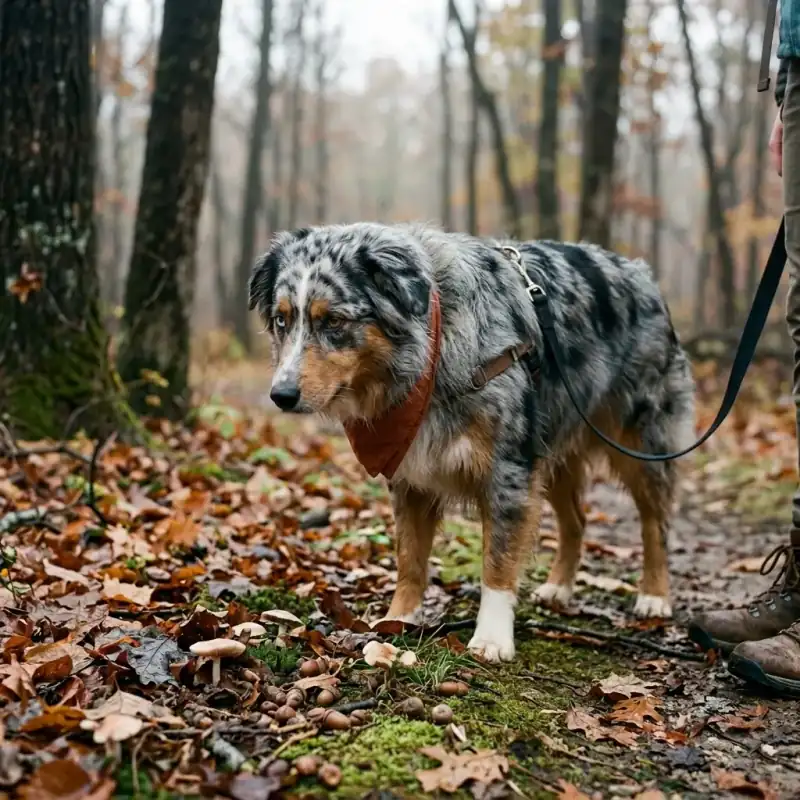
Search for autumn dog safety and you will get the same article fifteen times: a photograph of a golden retriever in leaves, a warning about antifreeze, a warning about chocolate, and a reminder to keep your dog hydrated. Most of it is true and almost none of it is seasonal. Chocolate is not more toxic in October.
The useful version of this list is much shorter. Four things genuinely change when the season does — and one of them is a risk owners actively increase, every September, by stopping something they did all summer.
1. Mushrooms, and the identification problem
This is the hazard that autumn genuinely creates, because autumn is when mushrooms fruit. They appear during wet or rainy periods, can grow almost anywhere, and sometimes come up overnight — so a trail that had none in August can be dotted with them by October. The toxins have not changed. The number of them within range of a dog’s nose has.
The reason this matters more than most trail hazards is that the normal response — work out what it was, then decide — is not available to you. Pet Poison Helpline is unusually direct about it: identifying a poisonous mushroom from a non-poisonous one is “difficult and beyond the scope of the great majority of pet owners and most veterinarians.” Accurate identification is a job for a mycologist, and there are more than 100 toxic species in North America.
The ASPCA frames the odds more gently — while 99% of mushrooms have little or no toxicity, the 1% that are highly toxic can cause life-threatening problems in pets — and both framings point to the same behaviour, because you cannot tell which 1% you are looking at. The majority of confirmed fatal mushroom poisonings in pets involve the genera Amanita, Galerina and Lepiota.
What the different toxins do varies by species and can hit the gut, the central nervous system, the liver or the kidneys. That variation is precisely why the advice is not “watch and see”: some of the most dangerous species produce early signs, then an apparent recovery, while organ damage continues underneath.
So the rule is behavioural rather than diagnostic. If your dog eats an unidentified mushroom, treat it as toxic and call your vet or a poison control line immediately. Photograph it if you can do so without delaying the call. On trails where mushrooms are up, this is also one of the few genuine arguments for a shorter lead through the wooded sections — a dog that hoovers is a dog that will eventually hoover a mushroom.
2. Acorns, which are a real risk and an over-told story
Oaks drop in autumn, and a dog with a taste for them can put away a surprising number. Acorns contain tannins, and the Merck Veterinary Manual attributes oak toxicosis to hydrolysable tannins — gallotannins are hydrolysed to gallic acid and then metabolised to pyrogallol.
Here is where we part company with most autumn lists, which escalate straight to kidney failure. The honest picture is more graded:
- The common outcome is gastrointestinal. Tannins irritate the digestive tract, so vomiting, diarrhoea and abdominal discomfort are the usual presentation after a one-off.
- Organ failure is possible but rare in dogs. Blue Cross notes acorns can lead to liver and kidney failure and be fatal, while describing that as rare. Merck is clearer on why: the severe kidney damage documented in grazing animals such as cattle and horses is uncommon in dogs and cats, largely because they do not generally eat enough.
- The mechanical risk is the underrated one. A quantity of acorns can obstruct the intestines, and that risk scales down with the dog — it is a much bigger deal for a small dog than a Labrador.
None of which makes acorns fine. It makes them worth interrupting rather than panicking about, and worth taking seriously if your dog is small, or if the eating was enthusiastic rather than incidental. Signs of an obstruction — repeated vomiting, refusing food, a hunched or painful abdomen, straining without producing anything — are a same-day veterinary problem regardless of what caused them.
3. Ticks, which peak in autumn rather than ending
This is the one that owners get backwards, and it is the only hazard on this list made worse by a decision you make rather than by the weather.
Tick prevention feels like a summer product. It gets bought in May and quietly abandoned in September when the season ends. But according to the CDC, adult blacklegged ticks are most active in early spring and fall — and they can be active and bite any time winter temperatures are above freezing.
So the moment prevention typically lapses is roughly the moment adult tick activity climbs. Meanwhile autumn hiking pushes dogs through exactly the habitat that concentrates them: leaf litter, long grass at trail edges, brush.
The practical version:
- Keep prevention running into winter, on your vet’s advice for your region rather than on the calendar.
- Check after every autumn walk. Ears, armpits, groin, between the toes, and under the collar. Leaf litter makes ticks harder to see and gives them more cover on the approach.
- Do not relax because it is cold. Freezing weather suppresses activity; a mild autumn week does not.
If you want a routine that folds this in, the post-walk check in our winter dog paw care guide is the same habit at the same point in the day. And if a foot is still being licked that evening, our guide to paw licking shows where to look between the toes, and which signs should not wait.
4. The poisons that move indoors
Autumn does not add toxins to the world so much as relocate them. As temperatures drop, rodents move indoors — and the ASPCA notes that rodenticide use rises accordingly, with rodenticides highly toxic to pets and potentially fatal if ingested. Anticoagulant rodenticides, the most frequent cause of poisoning in pets, interfere with blood clotting and can cause internal bleeding that only becomes obvious days after the dose.
That delay is the danger. A dog that ate bait on Saturday can look entirely normal on Sunday. There is no useful wait-and-see window here either.
Antifreeze belongs to the same seasonal shift, arriving with the first cold snaps: the ASPCA notes that ethylene glycol-based coolants are highly toxic and spills should be cleaned up immediately. We cover the timing of ethylene glycol poisoning — signs within one to six hours, and a narrow treatment window — in how cold is too cold to walk your dog, because that is where owners usually meet it.
Two practical notes. Rodenticide labels require a bait station where children or pets are present, which is worth knowing when a neighbour or a rental cabin has put bait down. And secondary poisoning is real — a dog that eats a poisoned rodent can be poisoned by it, which is a specifically rural and trailhead-adjacent risk in autumn.
This is educational information, not veterinary advice. It does not establish a veterinarian-client-patient relationship and cannot account for your individual dog. If you think your dog has eaten a mushroom, rodenticide, antifreeze or a quantity of acorns, contact your veterinary practice, an emergency clinic, or the ASPCA Animal Poison Control Center on (888) 426-4435 immediately — a consultation fee applies. Do not wait for signs to appear.
What is on every autumn list but isn’t actually seasonal
Three hazards that deserve your attention year-round, and get filed under autumn because the photography is better:
Blue-green algae. Harmful algal blooms are commonly framed as a summer problem, but they can persist into autumn, and the decisive fact is not seasonal at all: there is no way to tell by eye whether a given bloom is toxic. We cover cyanobacteria properly, with Cornell’s guidance on onset and prognosis, in how to start hiking with your dog. Treat any discoloured, scummy, foamy or foul-smelling water as off limits in October exactly as you would in July.
Cold water. Not a toxin, and not autumn-specific in principle, but autumn is when the gap between air and water temperature catches people out. A lake integrates weeks of cooling; the air integrates this afternoon’s sun. So a mild October day can sit on top of water that has been getting colder since August, and a mild afternoon does not imply a mild swim. The dog also comes out wet for the remainder of the walk, and wet fur insulates far worse than dry fur at the same temperature.
Hunting season. Genuinely seasonal, genuinely important on shared-use land, and too big for a bullet point — dates, blaze orange, and how to read local regulations deserve their own guide, which is on our list.
Bears, which belong on this list for the opposite reason. Autumn is when bears feed hardest before denning, and the state wildlife agencies are direct that a bear in that state will accept risks it would refuse in July. That is genuinely seasonal, and it changes what an off-leash dog costs you — hiking with dogs in bear country has the evidence and the leash rules that actually apply on forest land.
The autumn version of the trail kit
Nothing here needs new equipment. Two things already in most packs do more work in autumn than they do in July:
- A trail first-aid kit — the same one you carry all year, with your vet’s number and a poison control number written inside the lid where you will find them without signal.
- A clip-on collar light — because the other thing autumn changes is that you will finish more walks in the dark than you planned to. The winter dog gear checklist covers the rest of that shift, in order of cost per problem solved.
The short version
Autumn adds mushrooms and acorns to the ground, moves rodenticide and antifreeze into the places dogs go, and coincides with the second annual peak in adult tick activity — right when most owners stop prevention. Everything else on the standard autumn list is a year-round hazard wearing a seasonal photograph. If your dog eats something you cannot identify, the correct move is a phone call, not a wait.
For the walk itself, how to start hiking with your dog covers the fundamentals this article assumes, and the dog camping checklist is the overnight version.
Sources
- Pet Poison Helpline — Wild Mushrooms and Dogs and Mushrooms — identification difficulty, toxic genera, treat unidentified ingestion as toxic
- ASPCA — The Fungus Among Us: Mushroom Toxicosis
- Merck Veterinary Manual — Quercus (oak/acorn) Poisoning in Animals — hydrolysable tannins, gallic acid, pyrogallol; species differences
- Blue Cross — Are acorns poisonous to dogs? — clinical picture and obstruction risk
- CDC — Preventing Lyme Disease and Blacklegged Tick Surveillance — adult activity in early spring and fall, activity above freezing
- ASPCA — Autumn Safety Tips — seasonal rodenticide use, ethylene glycol coolants
- AVMA — Protect your family, pets and livestock from rodents and rodenticides — bait stations, secondary poisoning
- Merck Veterinary Manual — Anticoagulant Rodenticide Poisoning in Animals — delayed onset of bleeding
Frequently asked questions
Are wild mushrooms dangerous for dogs?
Some are, and the practical problem is that you cannot tell which. Pet Poison Helpline is blunt about it: identifying a poisonous mushroom from a non-poisonous one is difficult and beyond the scope of the great majority of pet owners and most veterinarians. There are over 100 toxic species in North America, and the majority of confirmed fatal mushroom poisonings in pets involve the genera Amanita, Galerina and Lepiota. Because identification is not realistically available to you in the moment, the standing advice is to treat any unidentified mushroom your dog eats as toxic and call your vet rather than waiting to see what happens.
Why do mushrooms matter more in autumn?
Because that is when they fruit. Mushrooms appear during wet or rainy periods and can grow almost anywhere, sometimes overnight, which is why a trail that had none in August is dotted with them in October. Nothing about the toxins changes seasonally — what changes is how many are within reach of a dog's nose on any given walk.
Are acorns poisonous to dogs?
They are best treated as a genuine but usually moderate risk. Acorns contain tannins, and the Merck Veterinary Manual attributes oak toxicosis to hydrolysable tannins, with gallotannins broken down to gallic acid and then to pyrogallol. In practice, the common outcome in dogs is gastrointestinal — vomiting, diarrhoea, abdominal discomfort — and Blue Cross notes that liver and kidney failure, while possible, is rare. Merck adds that the serious kidney damage documented in grazing animals such as cattle and horses is uncommon in dogs and cats, because they do not usually eat enough. The under-discussed risk is mechanical: in a small dog, a quantity of acorns can obstruct the gut.
Do I still need tick prevention in autumn?
Yes, and autumn is one of the two peaks rather than the end of the season. The CDC states that adult blacklegged ticks are most active in early spring and fall, and that they can be active and bite any time winter temperatures are above freezing. Stopping prevention in September because the summer is over lines up almost exactly with the point at which adult ticks become most active, which makes it the one seasonal hazard on this list that owners create for themselves.
What should I do if my dog eats something on an autumn walk?
Call, do not wait. For unidentified mushrooms in particular, the advice from Pet Poison Helpline is to treat the ingestion as toxic rather than delay for identification — some of the most dangerous species cause a deceptive lull between the first signs and organ damage. Contact your veterinary practice, an emergency clinic, or the ASPCA Animal Poison Control Center on (888) 426-4435, where a consultation fee applies. If you can safely photograph or bag what was eaten, do — but do not spend time on that at the expense of making the call.
Is autumn water safe for dogs to swim in?
Two separate questions live in that one. Harmful algal blooms are not confined to summer and can persist into autumn, and there is no way to judge a bloom's toxicity by eye — we cover cyanobacteria properly in our guide to hiking with your dog. The other issue is temperature: water cools faster than the air above it, so an October swim in weather that feels mild is a colder swim than it looks, and the dog comes out wet for the rest of the walk. Wet fur is dramatically worse at insulating than dry fur at the same temperature.
Comments
Got a question, a tip, or a correction? Leave a comment — no account, no sign-in. Just your name and your thoughts.
Loading comments…