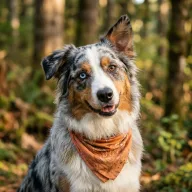
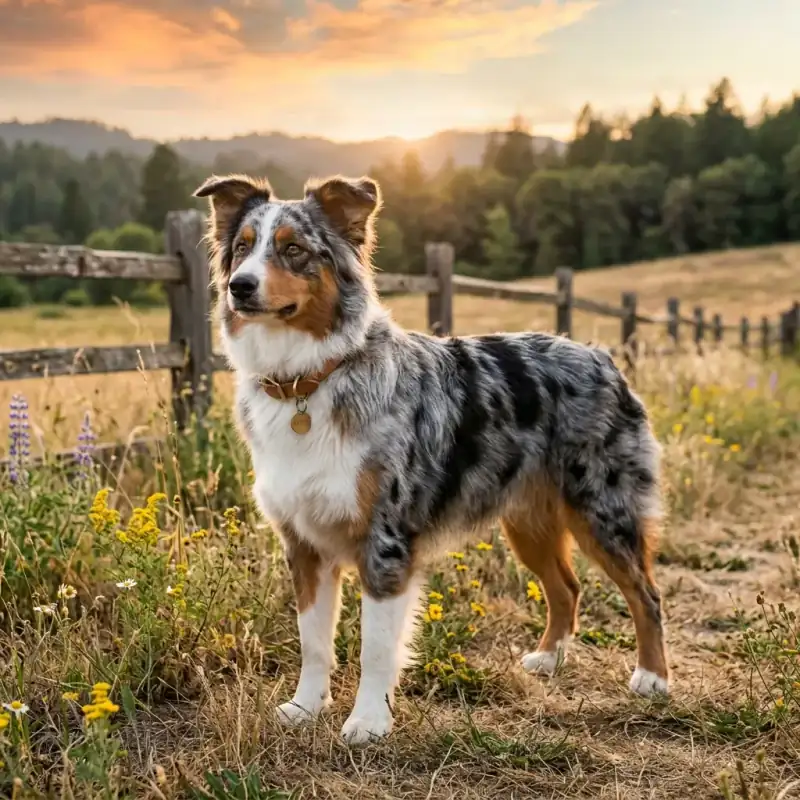
Start with the name, because it is a lie. The Australian Shepherd is not Australian. It was built in the American West, refined by ranchers, shepherds and rodeo riders across California and the Rocky Mountains, and it is about as home-grown American as a dog can be. The Australian label stuck for tangled reasons involving imported sheep, and it has been misleading people ever since.
That mislabelling is oddly fitting, because the Aussie is a breed people get wrong in bigger ways too. They see the striking merle coat and the odd blue eye and think pretty. They see the frisbee-catching agility star and think fun. Both are true, and both miss the animal underneath: a serious, tireless, intensely intelligent stock dog that needs a job the way other dogs need dinner.
This guide covers what makes the Aussie a genuinely superb adventure and ranch companion, plus the two things most breed pages skate over: a genetic quirk that half the breed carries and that can turn a routine trip to the vet into an emergency, and the honest reality behind the cheerful phrase “needs a job.”
Australian Shepherd at a glance
| Height | 20–23 in (males), 18–21 in (females) |
| Weight | 50–65 lb (males), 40–55 lb (females) |
| Life expectancy | 12–15 years |
| Coat | Medium-length weather-resistant double coat |
| Shedding | Moderate to heavy — year-round, plus seasonal blows |
| Energy | Very high; a working stock dog that needs a job |
| Adventure verdict | One of the best trail and ranch partners alive — for an owner who can match its body and its brain |
Heights, weights, life expectancy and health flags come from the official AKC breed standard. The verdict is ours: for the right person, the Aussie is close to the perfect medium-sized adventure dog: agile, hardy, up for anything, and glued to your side. For the wrong person, someone who wants a handsome dog that mostly relaxes, it is a fast route to a frustrated animal and a chewed sofa. The whole breed lives or dies on that match.
The dog behind the reputation
The AKC calls the Australian Shepherd “smart, work-oriented, and exuberant,” and every word earns its place. This is a dog bred for one demanding purpose: to spend long days moving livestock across rough country, thinking on its feet, reading a handler’s intent, and never running out of drive before the work does. That heritage is not decorative. It is the operating system your Aussie runs on, whether the nearest sheep is five miles or five hundred away.
Two traits define living with one. The first is intelligence: quick, problem-solving, occasionally too clever for its own good. An Aussie learns fast, which cuts both ways: it picks up the commands you teach and the habits you did not mean to. The second is attachment. Aussies are classic “velcro dogs,” happiest underfoot and shadowing their person from room to room. That devotion is a huge part of the appeal, and it is also why an Aussie left alone and idle tends to unravel. Separation and boredom hit this breed hard.
There is a guardian streak, too. Many Aussies are reserved with strangers and naturally watchful, which makes early, generous socialisation non-negotiable. Raised well, that wariness matures into a discerning, steady dog. Raised in isolation, it can curdle into suspicion or noise reactivity. The raw material is superb; it just has to be shaped on purpose.
Exercise needs: body and brain
The AKC says the Aussie needs “a great deal of exercise daily,” and puts the figure at one to two hours. That is accurate but incomplete, because it measures only half the problem. The single most important thing to understand about exercising this breed is that physical exercise alone does not tire an Aussie out. It just builds a fitter dog with the same restless mind.
An Aussie you run for an hour and then leave with nothing to think about will find its own project: herding the children, patrolling the fence, disassembling the garden, or spinning obsessively. The fix is to spend the body and the brain together:
- Physical: running, trail hiking, long fetch sessions, swimming, bikejoring. Aussies are agile, sure-footed and built for a full day out.
- Mental: obedience and trick training, puzzle and food-dispensing toys, scent games, and best of all a real job. Agility, herding, flyball, dock diving and canicross exist partly because breeds like this needed somewhere to put the drive.
Get both and you have a calm, satisfied dog at the end of the day. Get only the first and you have an athlete with nothing to do, which is worse than an unfit dog with the same problem.
One firm rule for puppies: an Aussie is a “great running companion once the skeletal system is fully formed,” in the AKC’s careful wording. Not before. Growing joints and open growth plates do not tolerate hard distance work or repeated jumping. Keep young dogs to short, flat, self-paced outings until roughly 18 to 24 months, then build up. If you are unsure how much is right for your dog’s age, our guide to how much exercise a dog really needs breaks it down by life stage.
New to trail days with a dog? The Aussie will happily out-hike you, so start with the fundamentals in our beginner’s guide to hiking with your dog before the first big outing.
The thing every Aussie owner must know: the MDR1 gene
The most important fact in this guide is one that most breed pages bury or skip entirely: roughly half of all Australian Shepherds carry a genetic mutation called MDR1 (also written ABCB1), and it can turn ordinary, everyday medications dangerous, occasionally fatally so.
The science, in plain terms. The MDR1 gene codes for a protein called P-glycoprotein that acts like a bouncer at the blood-brain barrier, pumping certain drugs back out before they can build up in the brain. A dog with the mutation makes a broken version of that bouncer. Give an affected dog a normal dose of the wrong medication and it can accumulate in the brain to toxic levels, causing severe neurological reactions. Washington State University, the lab that discovered the mutation and runs the test, reports that about 50% of Australian Shepherds carry it (in Collies the figure is closer to 70%).
The medications this affects are not exotic. They include:
- High-dose ivermectin and milbemycin — ingredients in some parasite and heartworm treatments.
- Loperamide — the active ingredient in the anti-diarrhoeal Imodium.
- Acepromazine and butorphanol — common sedatives and pre-anaesthetic drugs.
- Certain chemotherapy agents — vincristine, vinblastine and doxorubicin.
Read that list again and notice how ordinary it is. A sedative before a dental. A de-wormer. Something for an upset stomach. These are routine, and in an untested Aussie any of them is a gamble.
The good news is that this is one of the most manageable “honest angles” of any breed, because there is a simple, cheap fix: a DNA test. A cheek swab or blood sample, sent to WSU’s veterinary pharmacology lab, tells you whether your dog is clear, a carrier, or affected, and that single result, handed to your vet, lets them dose safely for life.
Disclosure: some links below are affiliate links. If you buy through them we may earn a small commission at no extra cost to you.
Check Dog First-Aid Kits on Amazon →
So the practical instruction is unusually clear-cut: test your Australian Shepherd for MDR1, and make sure the result is in its file before any sedation, anaesthesia, or new medication. This is not a diagnosis and it is not a reason to panic. Plenty of Aussies are clear, and affected dogs live completely normal lives once their owners and vets simply know. It is the single most valuable thing you can do for the breed, and it costs less than a bag of food.
Trainability: brilliant, on the breed’s terms
Few breeds learn faster than an Australian Shepherd, and the breed’s dominance in agility, obedience and herding trials is no accident. But “trainable” and “easy” are not the same word, and Aussie owners learn the difference quickly. This is a dog that needs its intelligence directed, or it directs itself.
For an adventure dog, prioritise three things:
- Rock-solid recall. Aussies are biddable and want to work with you, which helps, but the herding drive is strong, and a dog that locks onto livestock, wildlife or a distant jogger can go temporarily deaf. Build recall properly on a long-line before you trust it off-leash near stock or roads.
Check Long-Line Leashes on Amazon →
- Impulse control around motion. The instinct that makes an Aussie herd sheep also makes it want to chase bikes, cars, joggers and running children, often nipping at heels to “turn” them. Teach an off-switch for the chase early. It is not aggression, but it lands the dog in trouble all the same.
- A genuine outlet for the drive. Training is not just about manners for this breed; it is exercise for the part of the brain that will otherwise cause problems. Ten minutes of focused work can settle an Aussie more than an hour of aimless running.
Toys and play: the thinking dog’s dog
Aussies play hard and they play smart. Frisbees and flying discs are a natural fit for their agility and jump (mind the joints on a young dog — save the big aerial catches until the skeleton is mature). Fetch is bottomless. But the toys that earn their keep with this breed are the ones that make the dog think: puzzle feeders, treat-dispensing balls, snuffle mats and “find it” games that turn dinner into a job. A tired body and an occupied mind is the whole formula, and the right toys do half the work.
Gear that fits an Australian Shepherd
The Aussie’s medium, athletic, agile build is easy to kit out: nothing is too big or too small, and the breed’s stamina rewards good gear. The essentials:
- A well-fitted harness. For running, hiking and any real control work, a padded harness beats a collar: no pressure on the throat, better steering, and a handle for helping your dog over obstacles. The Ruffwear Front Range is the sensible default for a dog this size.
Check Ruffwear Front Range on Amazon →
- A GPS tracker — worth it for a driven herder. An Aussie that spots stock or bolts after wildlife can cover ground fast. A live GPS tracker turns a heart-stopping disappearance into a map on your phone; our GPS tracker guide compares the options.
Check Tractive GPS on Amazon →
- Heat management. That double coat is built for mountain work, not scorching afternoons. On hot days, mind the pavement and the pace — our guide to how hot is too hot to walk your dog has the thresholds, and a cooling vest earns its place on summer trails.
If this is a gift rather than your own dog, the coat is the trap. An Aussie carries enough of it to read a size larger than the 40–65 lb frame underneath, and gear is fitted to the dog rather than the silhouette. Our gift guide for adventure dog owners is organised around precisely that failure.
Health and lifespan
Aussies are a fairly hardy, long-lived breed, living 12 to 15 years, but there are specific conditions to know about, and one buyer’s decision that matters more than any of them.
- Hip dysplasia — the classic herding-breed orthopaedic concern. Ask to see both parents’ hip scores.
- Epilepsy — inherited seizure disorders occur in the breed; a topic to discuss with a breeder about their lines.
- Eye conditions — cataracts and Collie eye anomaly (CEA) both appear in Aussies; responsible breeders screen eyes, and DNA tests exist for some conditions.
- MDR1 / drug sensitivity — covered in full above. Test for it; it is the most actionable health item on this list.
And the buyer’s decision: avoid double merle puppies entirely. Merle is the marbled coat pattern, and breeding two merle dogs together produces, on average, about 25% “double merle” pups — typically mostly white and at high risk of being born deaf, blind, or both. This is completely avoidable, and a responsible breeder simply never mates merle to merle. When you are choosing a puppy, ask the colour of both parents, and walk away from any litter where both are merle. It is the clearest single test of whether you are dealing with an ethical breeder.
None of this is a diagnosis. It is the honest health picture of the breed — screen through a good breeder, test for MDR1, and manage your individual dog with your vet.
Grooming and shedding
The Aussie wears a medium-length, weather-resistant double coat, and it sheds accordingly: steadily year-round, with heavier seasonal “blows” when the undercoat comes out in earnest. It is not a low-maintenance coat, but it is not a demanding one either. A thorough weekly brush keeps it under control most of the year, stepped up to several times a week during the moult to get ahead of the loose undercoat. Pay attention to the feathering on the legs and behind the ears, where mats form, and after muddy trail days check between the toes and under the belly. This is a working coat doing its job, so resist the urge to shave it: it insulates against heat as well as cold.
Is an Australian Shepherd right for you?
Four questions, answered honestly, tell you most of what you need to know:
- Can you give it a job, not just a walk? This is the breed’s defining requirement. If you cannot commit to daily mental work on top of physical exercise, an Aussie will make its boredom your problem.
- Are you an active, experienced-enough owner? The Aussie rewards people who train and hike and do things with their dog. It overwhelms people looking for a low-effort companion. Be honest about which you are.
- Will you test for MDR1 and buy from an ethical breeder? Both are simple, and both are non-negotiable for this breed: the drug-sensitivity test and the merle-to-merle rule protect your dog from entirely preventable harm.
- Can you handle the herding drive? The nipping, the chasing, the need to move things — it is charming in a working context and a genuine problem without an outlet. Plan for it.
Answer yes to those and the Aussie is about as rewarding as dogs get: a tireless, brilliant partner that trains up beautifully and will out-hike almost anything on four legs. Answer no to even one and you have a working animal with no work, and few breeds make you regret that faster.
The Aussie’s closest rival on most shortlists is the Border Collie, even smarter, even more intense, and if anything less forgiving of an under-committed owner — we’ve put the two head to head in Australian Shepherd vs Border Collie, where the difference that actually matters turns out to be a drug-sensitivity gene rather than temperament. For a different flavour of demanding working dog, the German Shepherd trades some of the Aussie’s agility for size and guarding instinct. And for the full field, our hub guide, The Best Adventure Dog Breeds for Hiking & Camping, ranks them all against the veterinary data.
Sources
- American Kennel Club — Australian Shepherd breed profile
- Washington State University — Dog breeds commonly affected by the MDR1 mutation
- Washington State University — Program in Individualized Medicine (PRiME), MDR1 testing
- Australian Shepherd Health & Genetics Institute — Double Merle
Frequently asked questions
Are Australian Shepherds actually from Australia?
No. Despite the name, the Australian Shepherd was developed in the American West. The breed's ancestors were herding dogs that arrived with sheep from various places, but the dog we call an Aussie was refined by ranchers and shepherds in California and the Rocky Mountain states, then popularised by rodeo and Western culture after the Second World War. It is one of the most thoroughly American breeds there is, wearing a misleading passport.
What is the MDR1 mutation and does my Australian Shepherd have it?
MDR1 (also called ABCB1) is a genetic mutation that stops affected dogs from properly pumping certain drugs out of the brain, so ordinary doses can become toxic. Washington State University, which discovered it, reports that roughly half of all Australian Shepherds carry it. There is a simple cheek-swab DNA test. Every Aussie should be tested before any sedation, anaesthesia or de-worming, because the affected drugs include some very common ones, and knowing your dog's status is genuinely lifesaving information to hand your vet.
How much exercise does an Australian Shepherd need?
A great deal: one to two hours of real activity every day, and crucially it cannot all be physical. The AKC describes the breed as needing a job, and that is the honest truth: an Aussie exercised in body but not in mind will invent work, usually destructive or neurotic. Combine physical exercise (running, hiking, fetch) with mental work (training, puzzle toys, herding, agility, scent games). Wait until the skeleton is fully formed, around 18 to 24 months, before hard distance running.
Are Australian Shepherds good with children?
They can be excellent family dogs, but the herding instinct needs managing. Aussies were bred to move livestock by circling and nipping at heels, and a running, shrieking child can trigger exactly that behaviour. It is not aggression — it is a working dog doing its job on the wrong species. With early training, plenty of outlet for the drive, and sensible supervision, most Aussies are devoted, gentle family dogs; without those things, the nipping becomes a problem.
What is a double merle Australian Shepherd and why does it matter?
Merle is the marbled coat pattern many Aussies have. When two merle dogs are bred together, about a quarter of the puppies inherit two copies of the gene and are 'double merles', usually mostly white and at high risk of being born deaf, blind, or both. It is entirely avoidable: a responsible breeder never mates merle to merle. If you are buying a puppy, ask the colours of both parents, and walk away from any litter where both are merle.
Do Australian Shepherds make good first dogs?
Honestly, not for most first-time owners. The Aussie is intelligent, energetic and driven in a way that rewards experienced, active handlers and overwhelms unprepared ones. A bored Aussie is not a naughty dog; it is a working animal with no work, and the results (destruction, anxiety, obsessive behaviours, nipping) land squarely on a novice's lap. If your first dog must be an Aussie, commit to serious daily exercise, real training and a genuine outlet for the drive before the puppy comes home.
Comments
Got a question, a tip, or a correction? Leave a comment — no account, no sign-in. Just your name and your thoughts.
Loading comments…