
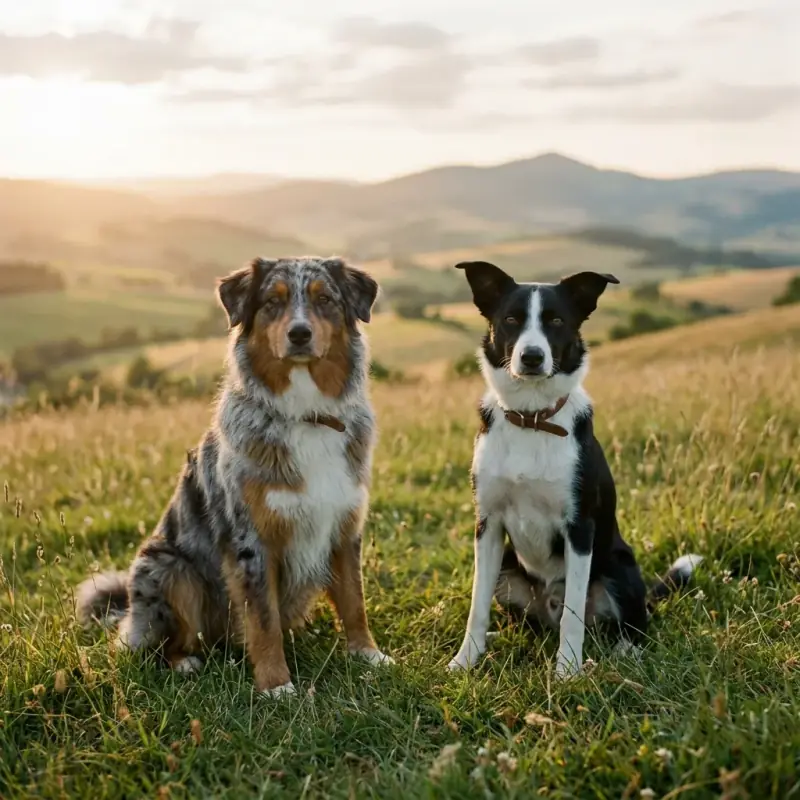
Search either of these breeds against the other and you will get the same article back a dozen times. Aussies have floppy ears; Border Collies often have pricked ones. Aussies are stockier. Border Collies stalk, Aussies bark. One of them is the smartest dog in the world, depending on which list you read.
All of that is broadly true and almost none of it will change a decision.
Here is a difference that will. If you take an Australian Shepherd to a vet for a routine sedation, there is roughly a one-in-two chance it carries a genetic mutation that changes which drugs are safe to give it. Take a Border Collie in for the same procedure and that chance drops below one in twenty — and below one in a hundred in most of the world.
That is a real, testable, consequential difference between these two breeds, and it is missing from essentially every comparison written about them. So we’ll start there, then work through the things that actually separate them day to day: how they fail when you get it wrong, what each one costs you in time, and which household each one belongs in.
The short version
| Australian Shepherd | Border Collie | |
|---|---|---|
| Height (male, AKC) | 20–23” | 19–22” |
| Weight (male, AKC) | 50–65 lb | 30–55 lb |
| Life expectancy (AKC) | 12–15 yr | 12–15 yr |
| Exercise (AKC wording) | “a great deal of exercise daily”, 1–2 hr | vigorous exercise every day; “not for someone who prefers to stay indoors” |
| MDR1 mutation frequency | ~50% | under 5% |
| Signature exercise risk | — | Border Collie Collapse (heritable) |
| Signature breeding risk | double-merle litters | — |
| Working style | upright, driving, more vocal | low, stalking, silent “eye” |
| Coat | double, seasonal blow | double, seasonal blow |
Two dogs of similar size, similar lifespan and similar appetite for work. The differences are in the last four rows.
MDR1: the one difference with a consequence
MDR1 — properly ABCB1 — is a gene that builds a protein called P-glycoprotein. Among other jobs, it acts as a gatekeeper at the blood-brain barrier, pumping certain substances back out before they reach the brain.
Dogs that inherit the mutated version build a defective gatekeeper. Drugs that should stay out get in, and a dose that is entirely routine for another dog can produce a serious neurological reaction.
The mutation was discovered at Washington State University, and WSU’s own frequency table is where the numbers below come from:
| Breed | Approximate frequency |
|---|---|
| Collie | 70% |
| Australian Shepherd (standard and mini) | 50% |
| Shetland Sheepdog | 15% |
| German Shepherd | 10% |
| Mixed breed | 5% |
| Border Collie | under 5% |
WSU’s table doesn’t spell out whether those percentages mean carriers or affected dogs, so we cross-checked against a peer-reviewed study that reports the genotypes separately. In a sample of 145 Australian Shepherds, 44.8% were heterozygous and 9.0% homozygous — about 54% carrying at least one copy, which lines up with WSU’s 50%. In 261 Border Collies, the same study found an allele frequency of 4.8%. The paper’s international comparison is starker still: Border Collie frequencies sit below 1% across most of the world, against 25–33% for Australian Shepherds in the US, Europe and Japan, and around 45% in the UK and Australia.
So the headline is fair: roughly half of Australian Shepherds are affected, and Border Collies almost never are.
What it actually changes
The drugs WSU flags include high-dose ivermectin and milbemycin (found in some parasite treatments), the anti-diarrhoeal loperamide — sold over the counter as Imodium — the sedatives acepromazine and butorphanol, and several chemotherapy agents including vincristine, vinblastine and doxorubicin.
Two things follow from that list, and they are the practical payoff of this whole section.
First, the sedatives. Acepromazine and butorphanol are routine pre-anaesthetic drugs. This is why the test matters most before a procedure, not after a problem — a cheek swab weeks in advance is a very different situation from a reaction on the table.
Second, loperamide is in a lot of human medicine cabinets, and giving a dog something from the cabinet is exactly the kind of well-meant shortcut that goes wrong in an Aussie.
This is educational information, not veterinary advice. We are naming a gene and a test, not telling you which drugs your dog can have — that decision belongs to your veterinarian, who will weigh the test result against the specific medication and dose. If your Australian Shepherd has not been tested, raise it at your next appointment, and mention the breed before any sedation or anaesthesia.
None of this makes the Aussie a fragile breed. A tested dog with a known result is straightforwardly manageable for the rest of its life. But it is a genuine, breed-linked difference between these two, and “Aussies have floppier ears” is not.
How they work, and why it shows up in your living room
Both breeds were built to move livestock, and both bring the job home whether or not you have livestock. The style of the job is where they diverge, and it predicts a surprising amount of ordinary household behaviour.
The Border Collie works with “the eye” — a low, crouched, stalking approach and a fixed, unblinking stare that moves stock through pressure rather than noise. It is a quiet, intense, highly focused way of working.
Point that at a suburb and you get a dog that locks onto moving things: cars, bikes, joggers, skateboards, the neighbour’s cat. In an under-stimulated dog, the same circuitry latches onto things that aren’t there to be herded at all — shadows, torchlight, reflections on a wall. Shadow and light chasing in this breed can tip past a quirk into genuine compulsive behaviour.
The Australian Shepherd is generally more upright and more vocal, driving stock forward rather than stalking it, and is typically the more socially oriented of the two toward its own family — the AKC describes the breed as “smart, work-oriented, and exuberant.” That sociability is why Aussies more often get described as good family dogs. It’s also why an ignored Aussie tends to become loud and destructive rather than quietly obsessive.
Neither pattern is better. They are two different failure modes, and knowing which one you’re signing up for is more useful than knowing which dog is smarter.
On which one is smarter
Border Collies place first in psychologist Stanley Coren’s much-quoted 1994 ranking of working and obedience intelligence, and the breed has the single most impressive documented case in the literature: Chaser, a Border Collie who learned the proper-noun names of 1,022 objects over three years of daily training, published by Pilley and Reid in Behavioural Processes in 2011.
Australian Shepherds also rank very high. But past a certain point the comparison stops being useful, because both breeds are smarter than the average home can keep busy. The dog that learns fastest also learns the things you didn’t mean to teach it, notices every pattern in your day, and gets bored faster. We’ve written about that trade-off at length in our guide to whether Border Collies are actually easy to train — the short answer being that trainability and easiness are not the same property.
Exercise: similar totals, different consequences
The AKC asks for one to two hours daily for the Australian Shepherd, and says of the Border Collie that it needs vigorous exercise every day and is “not for someone who prefers to stay indoors.”
In practice, planning for both breeds looks much the same: a substantial daily physical outlet, plus real mental work — training, scent games, herding, agility, puzzle feeding. Physical exercise alone produces a fitter dog with exactly the same restless brain, which is the single most common mistake owners of either breed make. Our guide to how much exercise a dog actually needs covers how to structure that when your week doesn’t cooperate.
Both make excellent trail and running partners. The AKC’s note on the Aussie is worth repeating precisely: a great running companion once the skeletal system is fully formed — which is a different and later date than most owners assume. If you’re bringing home a puppy of either breed with plans to run it, read how much exercise a puppy needs first, because the popular rule on that is not supported by evidence.
For off-leash work, both breeds bring a complication: the herding drive that makes them brilliant on a trail is the same drive that sends them after a deer, a cyclist or a car. Solid recall isn’t optional here, and it’s worth building deliberately — our recall training guide covers the method, and a long line is the standard bridge between a fenced yard and genuine off-leash freedom. Both breeds appear in our roundups of the best adventure dog breeds and the best breeds for runners for good reason.
Health: what’s shared, and what isn’t
Both breeds share a similar screening list — hip dysplasia, epilepsy and Collie eye anomaly, with deafness also flagged in the Border Collie and cataracts in the Australian Shepherd. Any breeder worth buying from will have screened for these and will show you the results without being asked twice.
Beyond MDR1, each breed has one risk the other doesn’t carry in the same way.
Border Collie: exercise-induced collapse
Border Collie Collapse (BCC) is well documented and, for a site about hard-working dogs, unusually relevant. Episodes begin 5 to 15 minutes into strenuous, high-excitement activity, often in warm weather: the dog becomes disoriented and dull, staggers, develops a choppy gait, and may fall. Most dogs are back to normal within about 30 minutes of rest. Onset ranges from 4 months to 7 years, with a median around 2 years.
Two details matter. It is genetically distinct from the exercise-induced collapse seen in Labradors — the DNM1 mutation behind Labrador EIC was not identified in a large population of Border Collies. And it is moderately to highly heritable, with SNP-based heritability estimated between 49% and 61% depending on assumed prevalence.
The scenario BCC describes — a fit dog, a hot day, twenty minutes of hard ball-chasing — is precisely the situation Border Collie owners create most often. If you see it, stop, cool the dog, and speak to your vet.
Australian Shepherd: the double-merle problem
The Aussie’s extra risk isn’t in the dog you own — it’s in the litter you buy from.
Merle is a coat pattern, and breeding merle to merle produces, on average, about 25% “double merle” puppies: predominantly white dogs with high rates of deafness and serious eye defects, including microphthalmia. This is entirely avoidable and entirely the breeder’s responsibility.
The practical instruction is short. Ask the colour of both parents. A responsible breeder will never have paired two merles, and will tell you so without hesitation. If you get a vague answer, walk away.
One number we’re not going to give you
A large 2024 study of 584,734 UK dogs put the Border Collie’s median life expectancy at 13.1 years, against 12.5 years for all dogs. We looked for the equivalent figure for the Australian Shepherd in the same paper and could not confirm it, so we’re not printing one. The AKC gives both breeds a range of 12–15 years, and on current evidence there is no reason to think one meaningfully outlives the other.
While we’re here: the Australian Shepherd isn’t Australian
It was developed in the American West as a ranch and stock dog, refined in California and the Rockies, and popularised through rodeo and post-war Western culture. The name is a historical accident. The Border Collie, by contrast, really does come from the border country between Scotland and England.
It changes nothing about owning one. It is simply the most reliable way to be the most annoying person at the dog park.
So which one should you get?
Neither, if the honest answer to “who is going to work this dog every day for the next thirteen-plus years?” is “we’ll figure it out.” That is the filter that matters, and it disqualifies far more homes than either breed’s quirks do.
If you’re past it:
Choose the Australian Shepherd if you want a dog that is deeply woven into family life, you have children or a busy household, you’d rather manage a loud dog than an obsessive one, and you’re prepared to do the MDR1 test early and buy from a breeder who can tell you both parents’ coat colours.
Choose the Border Collie if your household is built around activity rather than the dog fitting into it, you actively want the most trainable dog available and will use that, you can provide structured mental work daily and not just walks, and you’ll respect the collapse risk on hot days instead of throwing the ball one more time.
Choose either if you want a genuine trail, running or backcountry partner — both are outstanding at it, and the deciding factor will be temperament fit with your home, not capability.
The breed pillars go much deeper on each: the Australian Shepherd and the Border Collie, including feeding, gear, crate sizing and what each one is like to live with year to year.
Sources
- American Kennel Club — Australian Shepherd and Border Collie breed pages (size, life expectancy, exercise and health flags)
- Washington State University, Program in Individualized Medicine — Dog breeds commonly affected by the MDR1 mutation — the lab that discovered the mutation
- Frequency of canine nt230(del4) MDR1 mutation in prone pure breeds, their crosses and mongrels in Israel — peer-reviewed genotype breakdown and international comparison
- Pilley JW, Reid AK. Border collie comprehends object names as verbal referents. Behavioural Processes 86(2):184–195 (2011)
- University of Minnesota Canine Genetics Lab — Border Collie Collapse
- Heritability of Border Collie Collapse — peer-reviewed heritability estimates
- Australian Shepherd Health & Genetics Institute — Merle and double merle
- McMillan KM et al. Longevity of companion dog breeds: those at risk from early death. Scientific Reports 14:531 (2024)
Frequently asked questions
What is the main difference between an Australian Shepherd and a Border Collie?
Behaviourally, the Border Collie is the more intense and more single-minded of the two: it works with a low, stalking posture and a fixed stare, and it tends to struggle more when it has nothing to work on. The Australian Shepherd is generally more upright, more vocal at work, and more socially oriented toward its family. Medically, the difference that matters most is MDR1: Washington State University puts the drug-sensitivity mutation at roughly 50% in Australian Shepherds and under 5% in Border Collies. That one changes which medications are safe for your dog.
Which breed is smarter, the Aussie or the Border Collie?
Border Collies place first in Stanley Coren's widely cited ranking of working and obedience intelligence, and a Border Collie named Chaser was documented in a peer-reviewed 2011 study learning the names of 1,022 individual objects. Australian Shepherds also rank very highly. But this is close to the wrong question — both breeds are far smarter than the average household can keep occupied, and the practical issue is not which learns faster, it's which one you can give a job to every day for the next 13 to 15 years.
Is a Border Collie or an Australian Shepherd better for a family?
Neither is a low-effort family dog, and both were bred to move livestock, which can show up as heel-nipping and circling around running children. Between the two, the Aussie's more social, family-oriented temperament often makes it the easier fit in a busy household, while the Border Collie's intensity and lower tolerance for chaos suits a home built around activity. The honest filter is not the breed — it's whether anyone in the house genuinely wants to work a dog daily.
What is MDR1 and why does it matter for these breeds?
MDR1 (also called ABCB1) is a gene that produces a protein acting as a gatekeeper at the blood-brain barrier. Dogs with the mutation cannot keep certain drugs out of the brain, and normal doses of some common medications can cause serious neurological reactions. Washington State University — the lab that discovered the mutation — estimates about 50% of Australian Shepherds are affected versus under 5% of Border Collies. A cheek-swab DNA test identifies it, and the result matters most before any sedation, anaesthesia or chemotherapy. Discuss the test and any medication decisions with your veterinarian.
Do Australian Shepherds and Border Collies need the same amount of exercise?
Both need a great deal, and both need it mentally as well as physically. The AKC asks for one to two hours of daily activity for the Australian Shepherd and says plainly that the Border Collie is “not for someone who prefers to stay indoors.” The practical difference is in what happens when you fall short: an under-worked Aussie usually becomes destructive and noisy, while an under-worked Border Collie is more prone to tipping into genuinely compulsive behaviour like shadow and light chasing.
Do Australian Shepherds get Border Collie Collapse?
No — it is not documented as an Australian Shepherd condition, which is worth knowing before you assume two similar herding breeds carry the same risks. BCC is an exercise-induced condition in which a healthy dog becomes disoriented and unsteady 5 to 15 minutes into strenuous, high-excitement activity, often in warm weather, then usually returns to normal within about 30 minutes of rest. Research at the University of Minnesota has shown it is moderately to highly heritable and genetically distinct from the exercise-induced collapse seen in Labradors. If you ever see these signs in either breed, stop the activity, cool the dog and contact your vet.
Comments
Got a question, a tip, or a correction? Leave a comment — no account, no sign-in. Just your name and your thoughts.
Loading comments…