
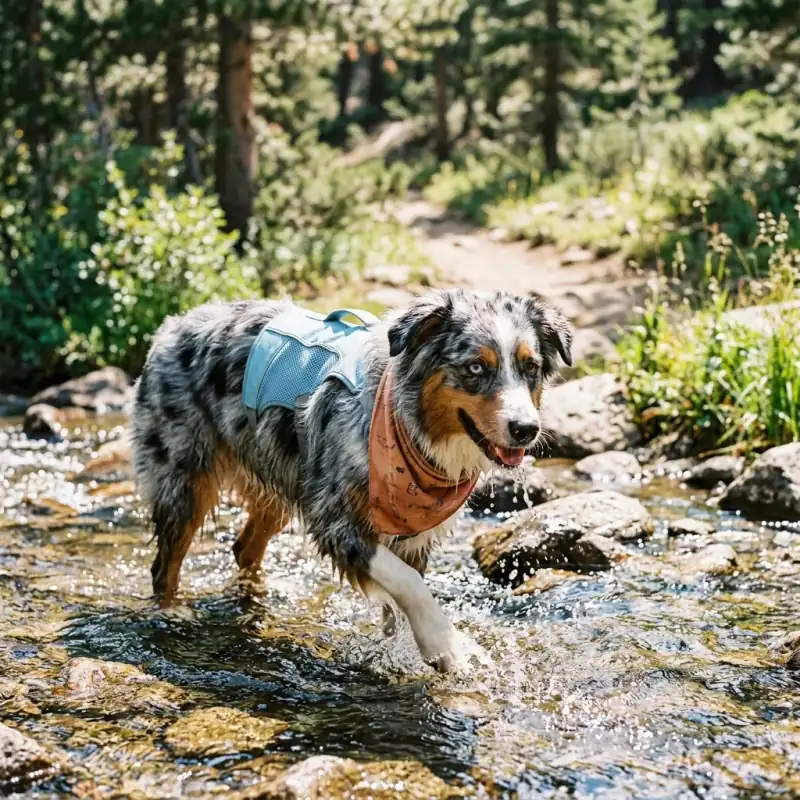
Dogs are far worse at shedding heat than we are. They can’t sweat through their skin — they cool mainly by panting — so on a hot trail a dog can go from fine to a genuine emergency faster than most owners expect. Heatstroke in dogs is common in summer, and it can be fatal.
The good news: it’s almost entirely preventable with a few disciplined habits. This guide covers the vet-backed rules for hot-weather hiking — when to go, how to protect paws, what gear actually helps, and the warning signs you cannot afford to miss. It’s general safety information, not a substitute for your own vet’s advice.
Hike the cool hours — this rule does the most work
The single biggest thing you can do is change your timing. Hike at dawn or in the evening and skip the middle of the day entirely. The AVMA and AKC both put this first: exercise dogs during the cooler parts of the day, take frequent breaks, and rest in shade.
Caution rises steeply with temperature. Above roughly 85°F you should be actively careful, and above 90°F the overheating risk is serious for most dogs. But air temperature is only part of it — humidity matters just as much, because panting stops working when the air is already saturated. On a humid day, a “mild” 82°F can be dangerous.
Know your dog’s real limits
There is no universal safe temperature, because it depends heavily on the dog:
- Flat-faced (brachycephalic) breeds — Bulldogs, Pugs, Boxers — overheat dramatically faster; their airways can’t move enough air to cool efficiently.
- Thick, double-coated breeds — Huskies, Malamutes, many shepherds — hold heat.
- Overweight, very young, senior, or unwell dogs all have lower limits.
How much these differences matter is measurable rather than anecdotal, and the gap between the most and least vulnerable breeds is wide enough to change what you plan. Our guide to the best adventure dog breeds ranks the whole field on that data rather than on energy level, and the best breeds for runners does the same for pace; how hot is too hot to walk your dog has the study the rankings are built on.
Match the hike to the dog in front of you, not to what you’d like to do.
Paws on hot ground
Hard, sun-exposed ground is the danger owners forget — the car park, the access road, bare rock and sand all run far hotter than the air, and they hold that heat long after the afternoon stops feeling hot to you. Shaded natural trail is a different surface entirely, which is why route choice does most of the work here.
The thresholds, the surface test and how fast a burn actually happens are all in how hot is too hot to walk your dog. Our pavement temperature tool estimates ground temperature from today’s forecast.
For the hike itself: pick shaded, water-adjacent routes, go in the cool hours, and check the surface before you set off rather than once your dog is already standing on it. A paw balm earns its place on rough or abrasive ground — it toughens and shields the pads — but treat it as protection against terrain, not against heat.
Disclosure: some links below are affiliate links. If you buy through them we may earn a small commission at no extra cost to you.
Check Dog Paw Balm on Amazon →
Water: bring more than you think, offer it constantly
Dehydration and overheating go hand in hand. Carry plenty of water for your dog — more than you expect — and offer small drinks frequently rather than one big one. Don’t rely on trailside streams: beyond giardia, warm stagnant water can harbour toxic blue-green algae — and this is the one to take seriously. Cornell’s Riney Canine Health Center notes dogs are poisoned by swimming in it as well as drinking it, that signs can develop rapidly or over several hours, and that many affected dogs do not survive to reach a veterinary hospital. Critically, there is no way to tell by eye whether a bloom is toxic, so any discoloured, scummy or foul-smelling water is off limits. We cover it properly in how to start hiking with your dog.
A portable dog water bottle or a collapsible bowl makes frequent stops effortless, which means you’ll actually do it.
Plain water is also almost certainly all your dog needs. If you have wondered whether to add a supplement to it, do dogs need electrolytes on the trail goes through what the research on working and sled dogs actually measured — and flags the one thing in your own pack that can genuinely harm a dog.
Cooling gear that genuinely helps
Gear won’t override bad timing, but it buys margin on warm days:
- A cooling vest. Soak it, wring it, and evaporation pulls heat off your dog’s core as they move. Genuinely effective on dry-heat hikes — and unusually for dog gear, there is a peer-reviewed study measuring what it does to core body temperature, which is worth reading before you spend.
- A cooling mat for the car and camp, giving your dog a cool surface to offload heat during breaks.
Check Dog Cooling Vests on Amazon →
Wetting your dog’s belly, groin and paws at water crossings is a free, effective cool-down too — those areas shed heat fastest.
Learn the warning signs — and act fast
Know the escalation, because heatstroke moves quickly.
Early heat stress (stop and cool down now):
- Heavy, frantic panting and drooling
- Slowing down, lagging, seeking shade
- Restlessness, then reluctance to move
Heatstroke — a medical emergency:
- Gums turning bright red, or blue/purple
- Thick, ropey drool; vomiting or diarrhoea
- Confusion, stumbling, weakness
- Collapse, loss of consciousness, or seizures
A dog’s normal temperature is about 99–102.5°F. Above 104°F is heat stress; above 106°F is heatstroke that requires emergency veterinary care.
If your dog is overheating
Move to shade or airflow immediately and start cooling before you set off for the vet — the Royal Veterinary College’s phrase is “cool first, transport second.” Then get to a vet right away, even if they seem to recover: heatstroke can cause internal damage that shows up hours later. Call ahead so the clinic is ready.
The method matters here, and the version most owners have read is the wrong one — how hot is too hot to walk your dog sets out what the RVC actually recommends and why the “tepid, not cold water” advice survived without evidence behind it.
Plan the hot-weather hike
- Check the forecast — temperature and humidity.
- Go at dawn or dusk; pick shaded, water-adjacent trails.
- Pack extra water and offer it often.
- Check the ground temperature before you set off, not after.
- Take frequent shade breaks and turn back early if your dog is flagging.
- Never, ever leave a dog in a parked car — interior temperatures become lethal within minutes.
The bottom line
Heat is the trail danger that hurts the most dogs and gets underestimated the most. Hike the cool hours, respect your dog’s breed limits, protect the paws, carry more water than you need, and know the warning signs cold. Do that and summer stays the best hiking season of the year — for both of you.
Sources
-
Cornell Riney Canine Health Center — Blue-Green Algae Poisoning (Cyanobacteria Toxicosis)
-
Cornell University College of Veterinary Medicine — Summer Heat Safety Tips for Dogs
Frequently asked questions
Does humidity matter as much as temperature?
Close to it, and it is the half of the forecast most owners skip. Dogs cool mainly by panting, which works by evaporation — so when the air is already saturated, the mechanism they depend on stops doing its job. That is why a humid 82°F day can be more dangerous than a dry day several degrees warmer, and why evaporative cooling gear also loses much of its effect in humid air. Check humidity alongside temperature and let the pair of them decide the hike.
Do I need paw protection for summer trails?
On shaded natural surfaces — dirt, grass, forest floor — usually not. The problem is the hard, sun-exposed stretches: the car park, the access road, bare rock and sand, which run far hotter than the air and hold that heat for hours. Route choice does most of the work, so pick shaded, water-adjacent trails and hike the cool hours. A paw balm helps on rough or abrasive ground, but treat it as protection against terrain, not against heat. Our guide to how hot is too hot to walk your dog has the surface thresholds and the test that goes with them.
How do I cool down an overheating dog?
Start cooling before you travel, not after — the Royal Veterinary College's guidance is "cool first, transport second." Move the dog into shade or airflow, begin cooling straight away, offer small sips of water but never force it, and then get to a vet. One thing worth knowing: the familiar advice to use only "tepid, not cold" water is not supported by substantial evidence, so follow the current recommendation rather than the one you have probably read — our guide to how hot is too hot to walk your dog sets it out in full.
Do cooling vests actually work for hiking dogs?
Yes, modestly, and only as prevention. In a study of 13 military working dogs exercising in 28–31°C heat, dogs wearing an evaporative cooling vest finished 0.62°C cooler than those wearing nothing. That's a real margin, not a transformation — and the researchers were explicit that vests are not a treatment for heat stroke. They also work much less well in humid air, because evaporation is what does the cooling. Useful kit; not permission to hike in conditions you otherwise wouldn't.
What are the signs a dog is overheating?
Early signs include heavy or frantic panting, drooling, slowing down, seeking shade and reluctance to move. Warning signs of true heatstroke — a medical emergency — include bright red, blue or purple gums, thick drool, confusion, vomiting, collapse or seizures. If you see those, cool your dog and get to a vet immediately; this is life-threatening.
Comments
Got a question, a tip, or a correction? Leave a comment — no account, no sign-in. Just your name and your thoughts.
Loading comments…