
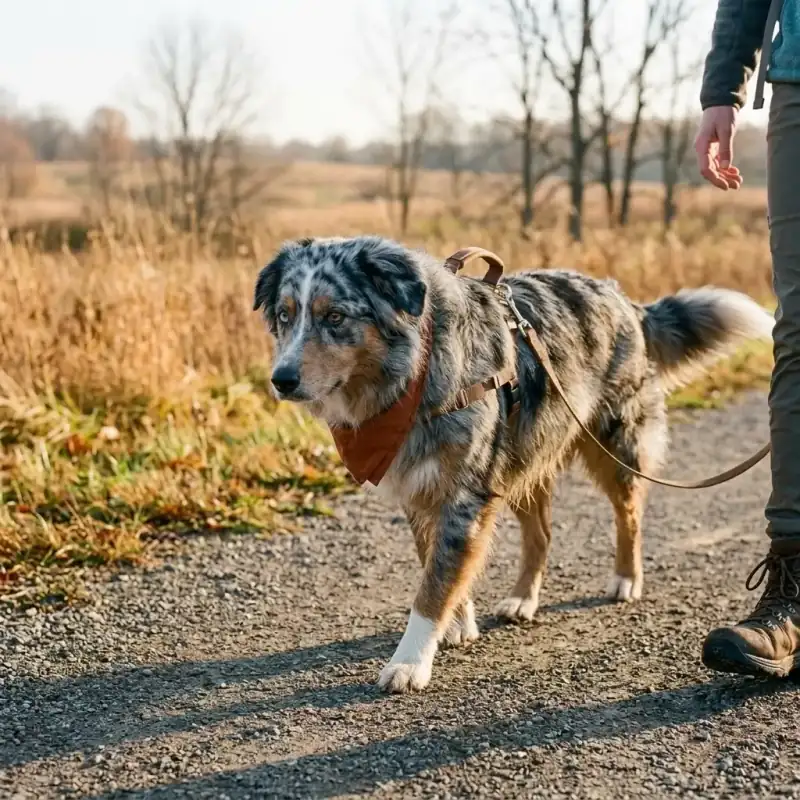
There is a walk most owners of an ageing dog remember. Not a dramatic one — the dog just stops at a junction it has always taken, looks up the hill, and waits to see whether you meant it.
The instinct that follows is protective and almost universal: do less. Shorter routes, flatter ground, more rest days, and eventually the trail becomes something the dog used to do.
Half of that instinct is right. The other half is the single most common mistake made with an ageing dog’s joints, and the veterinary guidance on it is not subtle.
”Senior” is not an age, which is why the timing catches people out
The AAHA Canine Life Stage Guidelines decline to give a number. Because ageing varies so much with breed and size, senior is defined as the last 25% of a dog’s estimated lifespan through end of life — a proportion, not a birthday.
That definition does real work. It means a giant breed can be senior at six while a small terrier is still middle-aged at ten, and it means the honest first question is not “how old is my dog” but “how long is this dog likely to live.” Our guide to how long dogs live covers what the two large lifespan studies actually agree and disagree about, and why size is the dominant variable.
It also means the label arrives later than the body changes do — which brings us to the number that should genuinely change how you read your own dog.
The gap between diagnosed and present
Two studies, both in Scientific Reports, approach canine joint disease from opposite ends and produce a gap worth understanding.
Anderson and colleagues (2018) looked at 455,557 dogs under primary veterinary care in the UK and found an annual period prevalence of appendicular osteoarthritis of 2.5%, with a median age at diagnosis of 10.5 years. That is the disease as the clinical record sees it: uncommon, and a problem of old dogs.
Enomoto and colleagues (2024) went looking instead, in dogs nobody had flagged. They radiographed and examined 123 dogs across 40 breeds, aged 8 months to 4 years — young adults. In that group, 39.8% had radiographic osteoarthritis in at least one joint, and depending on the pain threshold used, between 16.3% and 23.6% had clinical osteoarthritis — radiographic changes accompanied by joint pain on examination.
The finding that matters most for anyone reading their dog on a trail is what the owners knew. Only around 30% of owners had noticed signs in dogs with detectable joint pain, and in the whole cohort just two dogs were receiving any pain management.
Some caution is owed here: 123 dogs is a small study, dogs were examined in a research setting, and radiographic change is not the same thing as a dog in trouble. It does not tell you that four in ten dogs are suffering. What it does tell you, fairly robustly, is that the gap between “diagnosed” and “present” is enormous, and that owner observation is a weak detector. The 2.5% figure describes how often a vet writes it down. It is not an estimate of how many dogs have it.
For hiking, the practical conclusion is not alarming, just earlier: the adjustments in this article are not a thing you start when the muzzle greys. They are a way of walking that suits any dog past its first few years, and they cost a young dog nothing.
The part of the instinct that is wrong: stopping
Here is where the protective response backfires. VCA’s guidance on exercising dogs with osteoarthritis puts controlled, regular physical exercise among the core treatments, alongside weight control, rehabilitation and pain management. The mechanism is specific: exercise increases circulation to the muscles and joints, decreases stiffness in the joint capsule and soft tissues, reduces pain, maintains strength, and benefits the cardiovascular system.
The framing VCA uses is that dogs with osteoarthritis need to “use it or lose it.” A dog that stops moving loses the muscle that supports the joint, gains weight that loads it, and stiffens in the intervals — three effects that compound.
There is also a published starting point, which is more useful than the vague advice this topic usually attracts. For a dog not already in a regular exercise programme, VCA suggests 10 minutes of walking, three times a day, chosen deliberately to reduce the rest time between walks during which joints stiffen — and increasing weekly if the dog shows no increase in stiffness.
Read that as a design principle rather than a prescription, and the trail version follows: frequency over distance, consistency over intensity. Three short outings in a day are better for an ageing dog than one long one. A daily hour beats a five-hour Saturday after five sedentary days — that pattern is the one to engineer out, because it combines the least conditioning with the highest single load.
Your vet is the right source for how far, how long, on what surfaces, and which strengthening exercises suit your dog. That is not a disclaimer for its own sake — VCA specifically lists those as things a veterinarian should be guiding.
What actually changes on the trail
Distance is the last thing to cut
Reduce elevation, technicality and pace first. A flat five kilometres is usually kinder than a steep two, and an older dog that is allowed to set the pace will often cover more ground than one being managed.
Terrain: the problem is the vertical
Steady climbing is generally well tolerated. What is not is impact and unpredictable footing — jumping down off rock steps, scrambling, awkward landings, loose scree. Descents load joints harder than ascents. If a route has one bad section, the useful skill is spotting where you can help the dog down rather than watching it choose.
Warm up, and treat the first ten minutes as data
Stiffness that eases over the first ten minutes of a walk and returns the next morning is one of the most common early patterns owners describe. Build a slow flat start into every route, and pay attention to what the beginning of the walk is telling you.
Weather counts for more than it used to
Cold stiffens arthritic joints, and older dogs thermoregulate less well than healthy adults — a point how cold is too cold to walk your dog covers, including the specific note that geriatric dogs may be on medications that alter their ability to regulate temperature and blood flow. Heat is the more dangerous direction: an older dog with reduced cardiovascular reserve has less margin, and how hot is too hot to walk your dog explains why the ground, not the air, sets the limit.
The car is part of the hike
Jumping down out of a car boot or a tailgate is frequently the highest-impact movement of the entire day, repeated twice per outing, on hard ground, cold, at the end. A ramp, a step, or a lift with a hand under the chest and one under the rump removes it. If your dog travels in a crash-tested restraint — and it should; see the safest dog car harnesses — factor in that getting in and out of it is now part of the exercise.
Turn around earlier than feels necessary
An older dog will often keep going past the point where it should stop, especially with company and a familiar route. The return leg is where trouble appears, and it is the half you cannot shorten.
Gear that genuinely helps
Three items, and only three. Two are changes to kit the dog already wears; the third is probably already in your pack.
- A harness with a padded handle. The handle is the whole point: it lets you steady a dog on an awkward step, assist it up a rock or into a car, and take weight briefly without pulling on a collar or hoisting under the belly. The Ruffwear Web Master is the pattern most often used for this, with the handle sitting over the shoulders rather than at the back; the size linked here is the large/XL.
- Boots, for traction rather than warmth. Wet rock, boardwalk and hard-frozen ground are where a dog with less hind-limb confidence slips. Grip Trex boots have a rubber outsole made for it. Fit is what decides whether boots stay on, and our guide to dog boots covers that properly — introduce them at home, never for the first time at a trailhead.
- A first-aid kit you actually carry. A trail first-aid kit matters more with an older dog for an unglamorous reason: the most likely incident is not dramatic, it is a dog that becomes unable to continue, and the planning that helps is knowing in advance how you would get a 30 kg dog back to the car.
What we would not buy: joint supplements on the strength of an article. There is a genuine literature here and it is not uniform, and this is exactly the decision your vet should make with your dog’s history in front of them.
The signs that mean stop, and what they are not
These are reasons to end the walk and book an appointment. None of them is a diagnosis, and several have causes that have nothing to do with joints:
- Lagging behind on ground the dog used to lead on
- Sitting or lying down at stops it used to stand through
- Hesitating at obstacles it used to take without thinking
- Stiffness at the start of a walk, or the next morning
- Reluctance to jump into the car at the end
- Any lameness, or a change in gait, however slight
The Enomoto finding is worth keeping in mind here: owner observation missed joint pain in roughly 70% of the dogs that had it. Waiting for an unmistakable limp is waiting for a late signal.
This is educational information, not veterinary advice. It does not establish a veterinarian-client-patient relationship and cannot account for your individual dog. Before increasing an older dog’s exercise, and before acting on anything above, talk to your veterinary practice — an exercise plan for a dog with joint disease, heart disease or reduced vision is a clinical decision, not a reading decision.
The short version
Senior is a proportion of a lifespan, not an age, so a big dog gets there years earlier than a small one. Joint disease is far more common than diagnosis rates suggest and far less visible than owners assume, which means the adaptations here are worth adopting before you think you need them. And the instinct to retire an ageing dog from the trail gets the direction wrong: controlled, regular, low-impact exercise is treatment, not risk. Shorten the outing, flatten the ground, drop the pace, repeat it more often — and keep going.
If you are rebuilding an older dog’s routine from a low base, how much exercise does a dog need has the framework, and how to start hiking with your dog covers the conditioning progression this article assumes.
Sources
- AAHA Canine Life Stage Guidelines — senior defined as the last 25% of estimated lifespan through end of life; no fixed age
- Anderson KL, O’Neill DG, Brodbelt DC, Church DB, Meeson RL, Sargan D, Summers JF, Zulch H, Collins LM. Prevalence, duration and risk factors for appendicular osteoarthritis in a UK dog population under primary veterinary care. Scientific Reports 2018;8:5641 — 455,557 dogs; 2.5% annual period prevalence; median age at diagnosis 10.5 years
- Enomoto M, et al. Prevalence of radiographic appendicular osteoarthritis and associated clinical signs in young dogs. Scientific Reports 2024;14:2827 — 123 dogs aged 8 months to 4 years; 39.8% radiographic OA in ≥1 joint; 16.3–23.6% clinical OA; owner detection around 30%
- VCA Animal Hospitals — Exercising Dogs with Osteoarthritis — controlled regular exercise as core treatment; the 10 minutes three times daily starting protocol
- VCA Animal Hospitals — Helping Your Dog with Osteoarthritis
Frequently asked questions
At what age is a dog considered senior?
There is no fixed age, and the AAHA Canine Life Stage Guidelines say so directly — because of variability in ageing between breeds and sizes, senior is defined as the last 25% of a dog's estimated lifespan through end of life rather than a birthday. In practice that makes a giant breed senior years earlier than a small one: the same calendar age can put one dog in late middle age and another well into its final quarter. Estimating your own dog's lifespan is the awkward first step, and breed and size are the two biggest inputs.
Should I stop hiking with my senior dog?
Usually the opposite. VCA describes controlled, regular exercise as one of the core treatments for canine osteoarthritis, alongside weight control, rehabilitation and pain management — it increases circulation to muscles and joints, decreases stiffness in the joint capsule and soft tissues, reduces pain and maintains strength. The phrase used is 'use it or lose it.' What should change is the shape of the exercise, not its existence: more frequent, shorter, lower-impact outings rather than the same distance done occasionally.
How far can an old dog walk?
No article can answer that for your dog, but there is a published starting protocol worth knowing. For a dog not currently in a regular exercise programme, VCA suggests beginning with roughly 10 minutes of walking three times a day — frequent short sessions, specifically to reduce the rest periods in which joints stiffen — and increasing weekly if the dog does not show increased stiffness. Your vet can advise on distance, surfaces and targeted strengthening for your individual dog. The trail translation is that three short outings beat one long one.
How do I know if my dog is in pain on a hike?
Mostly by changes in behaviour rather than by an obvious limp. A study of young dogs found that owners noticed signs in only around 30% of dogs that had joint pain detectable on veterinary examination, so the absence of visible lameness is weak evidence. On the trail, the things worth reading are lagging behind on ground the dog used to lead on, sitting or lying down at stops it used to stand through, hesitating at obstacles it used to take, stiffness at the start of a walk that eases, and stiffness the following morning. Any of those is a conversation with your vet, not a reason to push on.
Is my dog too old to start hiking?
Age alone is not a disqualification, but a dog starting late needs a slower build than a young one and a veterinary check before the build begins — both for joints and for the heart and lungs doing the work. The conditioning principle is the same one that applies to any unconditioned dog: increase one variable at a time, and let recovery the next day set the pace. The mistake specific to older dogs is the weekend pattern — five sedentary days followed by a hard Saturday is the version of exercise that does the most harm.
What gear helps an older dog on the trail?
Three things earn their place. A harness with a padded handle over the shoulders lets you assist over an obstacle or into a car without pulling on a collar or lifting from under the belly. Boots help on wet rock and hard-frozen ground where a dog with reduced hind-limb confidence is most likely to slip. And a car ramp or a lift routine matters more than either, because jumping down out of a car boot is often the single highest-impact movement of the whole day.
Comments
Got a question, a tip, or a correction? Leave a comment — no account, no sign-in. Just your name and your thoughts.
Loading comments…