
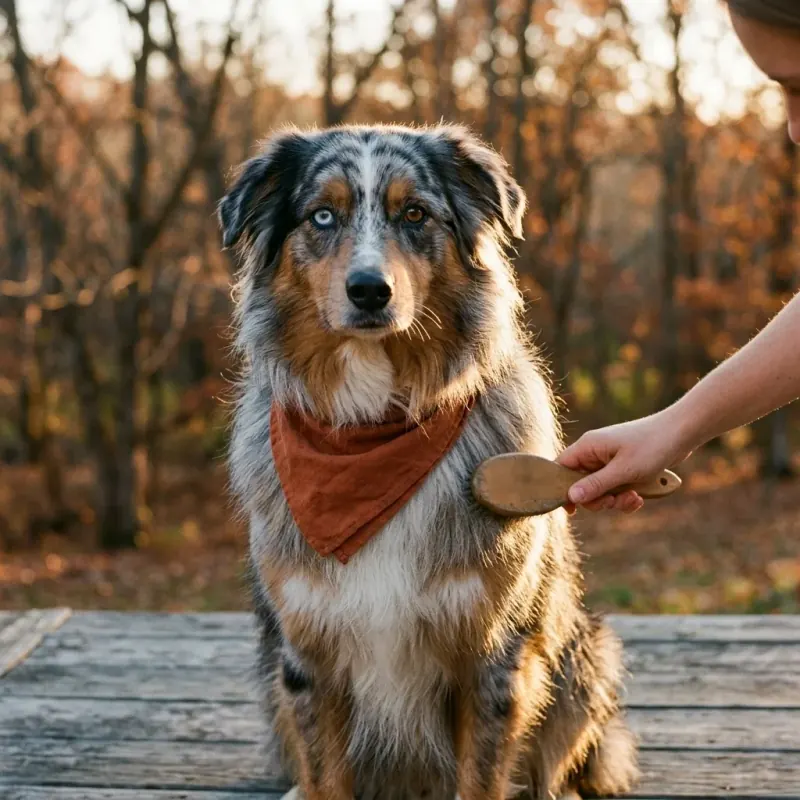
Every year, at roughly the moment the evenings start closing in, the hair begins. Handfuls of it. It comes off the dog in soft grey clouds that drift under the sofa and reassemble themselves into something that looks alarmingly like a second dog.
And the timing feels wrong. Winter is coming, and your dog appears to be disposing of the coat that handles it.
That reading is backwards. It is worth correcting, because the most common response to autumn shedding — reaching for the clippers — only makes sense if the backwards version is true.
The autumn shed is an arrival, not a departure
A double coat is two layers doing two jobs: a dense, woolly undercoat that traps warm air against the skin, and a longer layer of coarser guard hairs over the top that sheds water and blocks UV. The undercoat is the part that changes with the seasons. The guard hairs largely stay put.
VCA Animal Hospitals describes heavy-coated breeds as going through two heavy seasonal shedding cycles yearly — late spring and late fall — during which much of the undercoat falls out in clumps. The spring one is intuitive: the dog is dumping winter insulation before summer. The autumn one is the same mechanism running the other way, and the AKC gives the direction explicitly — in fall, dogs shed lighter hair to make way for thicker insulation.
So the hair on your floor in October is the summer undercoat. What replaces it is denser. Your dog is not losing its winter coat; it is in the middle of building one, and the old one has to come out first because there is no room for both.
This is also why the autumn shed feels heavier than it is. The incoming winter undercoat is thicker than the summer coat going out, so for a few weeks your dog is simultaneously growing more hair than usual and dropping more hair than usual.
The trigger is mostly light, which is why it starts before the cold does
The AKC’s position is that shedding is primarily triggered by changes in daylight and temperature, with hormonal responses to those changes signalling the coat to transition between seasons. Both cues are in there, and we are not going to pretend the temperature half does not exist.
But daylight is the one that explains the pattern you actually see. The autumn shed typically starts in late August or early September in the northern hemisphere — weeks before anything gets cold, and often during a warm spell. Day length has been falling since June. The dog is responding to that, not to the forecast.
Two practical consequences follow:
- A mild autumn will not delay it. If you are waiting for cold weather to tell you the heavy shedding season has started, you will be surprised every year. It has usually started already.
- Indoor life blurs it. The AKC notes that some indoor dogs shed continuously because of consistent exposure to artificial lighting and temperature, though many still have heavier seasonal periods. A dog that spends most of its day under electric light in a climate-controlled house gets a weaker seasonal signal, and spreads the same hair across the whole year instead of concentrating it.
That second point is worth sitting with if you have ever wondered why your dog “doesn’t have a shedding season” and yet you vacuum constantly. It does. The season has just been smeared across twelve months.
Which dogs do this, and which ones genuinely don’t
The dramatic version belongs to the double-coated working and northern breeds — the ones that arrived with a coat built for a climate:
- Northern breeds like the Siberian Husky, Alaskan Malamute and Samoyed, where a coat blow is a multi-week household event.
- Herding breeds like the Australian Shepherd, Border Collie and Australian Cattle Dog.
- Heavy-coated working breeds, including the Bernese Mountain Dog and the German Shepherd, which has earned its nickname.
Each of those breed guides has a grooming section with the specifics for that coat. If you want the version organised by climate rather than by breed, our roundup of the best cold-weather dog breeds covers what a coat like this is actually for.
Single-coated dogs — greyhounds, boxers, most of the short-haired sporting breeds — have no woolly undercoat to blow, so they shed at a steadier rate year-round without the seasonal spike. They still shed. They just do it without a season attached.
The intervention that backfires: clipping the coat
This is the one that matters, and it is the direct consequence of reading the autumn shed backwards. If you think the dog is losing its coat anyway, taking the rest off looks harmless. It is not.
AKC chief veterinary officer Dr. Jerry Klein is direct about the mechanism: the coat “actually acts as an insulator,” and removing it “eliminates that insulating layer of fur, makes the dog susceptible to heat stroke.” Insulation works in both directions — the same trapped air that holds warmth in during winter keeps heat out during summer, which is why the shaved dog is at more risk in July, not less. Klein adds that the coat also protects against sunburn and decreases the risk of developing skin cancer.
Then there is the regrowth problem, which owners are rarely warned about. When a double coat is shaved to the skin, the undercoat grows back faster than the guard hairs and can crowd them out — changing the coat’s texture and colour and leaving it patchy and, in the AKC’s phrasing, unattractive. That is a cosmetic outcome, but it is not always a temporary one.
The more serious version is post-clipping alopecia, an uncommon complication reported particularly in plush-coated breeds such as huskies and Pomeranians, in which regrowth is delayed for many months. It is uncommon enough that it should not be the main reason you decide against clipping — the insulation argument above is. It is also entirely avoidable, since the procedure that causes it had no medical benefit in the first place.
None of this applies to a coat that genuinely needs clipping for a medical reason, or to breeds whose coats are meant to be cut. It applies to shaving a healthy double coat to reduce shedding or to cool the dog down — two goals it does not achieve.
What actually reduces the hair in your house
The honest answer is unglamorous: get the hair out on your terms, before it comes out on the carpet’s.
- Brush more often, for shorter sessions. During a coat blow, most of the breed guides above move from a weekly brush to daily. The hair is coming out either way — brushing decides where.
- Use a tool that reaches the undercoat. A slicker brush or an undercoat rake gets into the layer that is actually shedding. A bristle brush mostly tidies the guard hairs sitting on top of the problem.
- Bathe at the right point in the cycle. VCA suggests dogs with heavy undercoats benefit from bathing in spring and fall, when they are undergoing seasonal shedding — a bath and a thorough dry loosens a surprising amount of dead undercoat in one go.
- Do it outside if you can. Twenty minutes of raking in the garden in September removes hair that would otherwise spend October in your house.
What we are deliberately not doing is recommending a supplement to stop it. Coat and skin health are genuinely affected by diet, but “stops seasonal shedding” is a much larger claim, and we did not find evidence behind it that we would be comfortable passing on. A healthy dog on a complete diet sheds seasonally because that is what the coat is for.
When it is not just the season
A seasonal shed thins the coat more or less evenly and leaves normal skin behind. The signs that you are looking at something else, per the AKC, are bald patches, inflamed skin, or a sudden increase in hair loss — any of which can indicate an underlying health problem and should be evaluated by a veterinarian.
The practical test is to look at the skin rather than the hair. Redness, scabbing, odour, a greasy or flaky texture, hair loss that is symmetrical on both flanks, or a dog that is scratching and chewing at itself are all pointing somewhere other than the calendar.
This is educational information, not veterinary advice. It does not establish a veterinarian-client-patient relationship and cannot account for your individual dog. If your dog’s coat or skin changes in a way that concerns you, contact your veterinary practice rather than working from an article.
The short version
The hair arriving in September is the summer coat leaving to make room for the winter one. It is triggered largely by falling daylight, which is why it starts before the cold does and why a house dog under electric light sheds all year instead. Brushing changes where the hair lands; clipping the coat does not reduce shedding and removes insulation the dog needs in both directions. And skin that looks wrong is a different problem from a coat that is simply busy.
If the reason you are thinking about your dog’s coat is that the season is turning, two guides are worth reading next: best dog winter coats, which starts with the question of whether your particular dog needs one at all, and the winter dog gear checklist — ordered by cost per problem solved, and best worked through in October rather than during the first freeze.
Sources
- VCA Animal Hospitals — Coat and Skin Appearance in the Healthy Dog — two heavy seasonal shedding cycles yearly, late spring and late fall; bathing during seasonal sheds
- American Kennel Club — Dog Shedding: When Dogs Shed Most and How to Manage It — daylight and temperature as triggers, indoor dogs shedding year-round, when shedding warrants a vet
- American Kennel Club — Should You Shave Your Dog in the Summer? (Dr. Jerry Klein, AKC chief veterinary officer) — insulation, heat stroke, sunburn and skin cancer risk, guard-hair crowding
- American Kennel Club — What Is a Double Coat, and What Dog Breeds Are Double-Coated? — coat structure, post-clipping alopecia in plush-coated breeds
- VCA Animal Hospitals — Grooming and Coat Care for Your Dog
Frequently asked questions
Why is my dog shedding so much in the fall?
Because the winter coat is coming in, and the summer undercoat has to leave first. VCA describes heavy-coated breeds as going through two heavy seasonal shedding cycles a year — late spring and late fall — during which much of the undercoat falls out in clumps. The autumn one is the less intuitive of the two: it looks like your dog is losing insulation at exactly the wrong moment, when in fact it is making room for a denser coat. The shed usually starts before the weather turns cold, which is the clue to what is really driving it.
Does cold weather cause dogs to shed?
Temperature is part of it, but it is not the whole story. The AKC states that shedding is primarily triggered by changes in daylight and temperature, with hormonal responses to those changes signalling the coat to transition. Daylight is the cue that explains the timing you actually observe: the autumn shed tends to begin in late summer or early September, weeks before it gets cold, because day length has already started dropping. A warm October does not postpone it.
Why does my indoor dog shed all year round?
Consistent artificial light and indoor heating blunt the seasonal signal. The AKC notes that some indoor dogs shed continuously because of steady exposure to artificial lighting and temperature, though many still show heavier seasonal peaks. Practically, this means a house dog's shed is often spread thin across twelve months rather than concentrated into two bursts — the same total hair, distributed more evenly and therefore more noticeably.
Should I shave my double-coated dog to stop the shedding?
No, and it does not stop the shedding anyway — it removes hair that has already grown rather than changing what the follicles do next. AKC chief veterinary officer Dr. Jerry Klein puts the case plainly: the coat acts as an insulator, and removing it eliminates that insulating layer and makes the dog susceptible to heat stroke, while also removing protection from sunburn and reducing the associated skin cancer risk. There is also a regrowth problem — clipped undercoat grows back faster than the guard hairs and can crowd them out, changing the coat's texture and colour and leaving it patchy.
When is shedding a sign of something wrong?
When the skin underneath stops looking normal. The AKC flags bald patches, inflamed skin or a sudden increase in hair loss as signs that warrant veterinary attention, because these can indicate an underlying health problem. A useful distinction: a seasonal shed thins the coat evenly and leaves healthy skin behind. Hair loss that is patchy, one-sided, or comes with redness, scabs, odour or scratching is a different process and belongs in front of a vet rather than a brush.
Comments
Got a question, a tip, or a correction? Leave a comment — no account, no sign-in. Just your name and your thoughts.
Loading comments…