
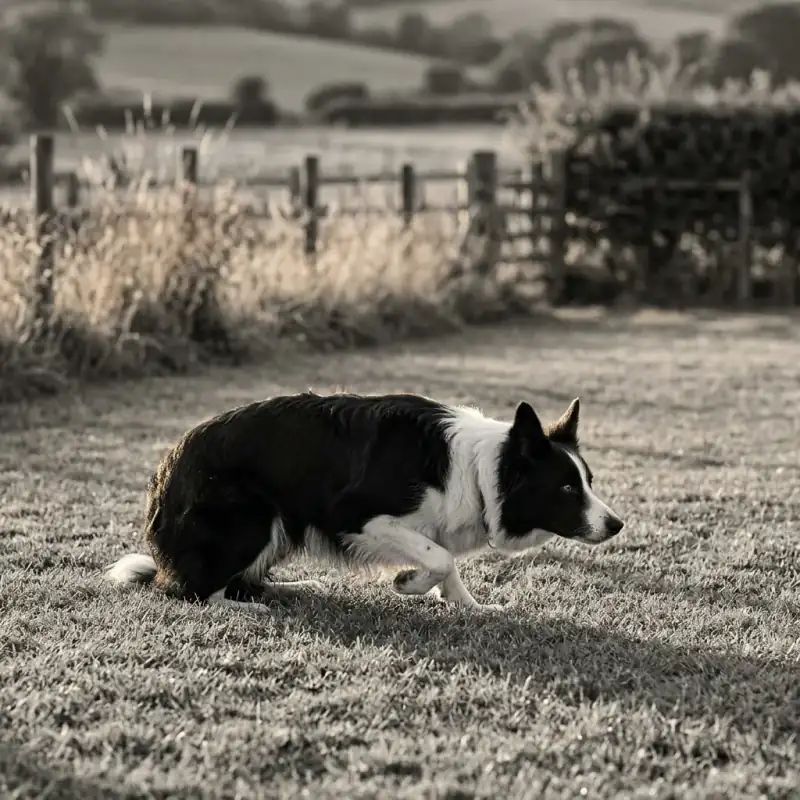
“Are Border Collies easy to train?” is almost always a stand-in for a different question. What people actually want to know is: if I get one, will this go well?
Those two questions have opposite answers, and the research is unusually good at showing why.
The case for “yes, remarkably”
Start with the evidence people quote.
The ranking. Stanley Coren’s 1994 The Intelligence of Dogs placed the Border Collie first, based on surveys of obedience judges. Worth knowing what it measured: how quickly a breed learns new obedience commands and how reliably it obeys a first command. That is trainability, not intelligence in the broad sense.
Chaser. The stronger evidence is a single dog. Chaser, a Border Collie trained by psychologist John Pilley, learned the proper-noun names of 1,022 objects over three years of daily training — published in Behavioural Processes in 2011. Chaser could also retrieve by category and infer the name of a novel object by exclusion. That is a genuinely remarkable result, and it took daily structured work for years to produce.
The measured cognition. The most useful modern data comes from a 2022 study of 1,002 dogs across 13 breeds using the smartDOG test battery in Finland. Its findings on this breed:
- Border Collies excelled at inhibitory control — the cylinder test, where a dog has to suppress the obvious direct approach to reach food.
- Border Collies and Malinois were fastest at spatial problem-solving (the V-detour task).
- Malinois and German Shepherds, by contrast, scored notably low on inhibitory control.
- And a finding that should temper the whole conversation: there were no breed differences at all in logical reasoning or short-term memory.
That last point matters. Breeds differ in specific, selected abilities — not on a single intelligence ladder. What the Border Collie brings to a training session is focus and impulse control, which is exactly the combination that makes teaching feel effortless.
So: yes. If “easy to train” means “acquires new behaviours quickly,” few breeds are easier.
The case for “you have misunderstood the question”
Now the same trait list, viewed from the sofa on a wet Tuesday.
The largest survey of canine anxiety traits — 13,715 Finnish dogs across 264 breeds — found that Border Collies showed a very high prevalence of compulsive staring and fly-snapping, and that light chasing and staring were most often observed in this breed. The authors made the connection explicit: Border Collies were bred to herd livestock by staring.
The same study found inattention was rarely reported in Border Collies — the breed pays attention almost by default.
Read those two findings together and you have the whole problem in one sentence: the trait that makes a Border Collie brilliant to train is the same trait that, unemployed, turns into a compulsion. The intense visual focus that locks onto your hand signal in a training session locks onto a shadow on the wall when there is no session. It isn’t a different behaviour. It’s the same behaviour with nowhere to go.
This is why “easy to train” and “easy to own” come apart so sharply here. A Labrador with an unmet need gets into the bin. A Border Collie with an unmet need invents a job, and the job it invents is often one you can’t switch off.
Four ways “easy” breaks down
1. Acquisition is fast. So is the wrong acquisition.
A dog that learns in three repetitions learns your accidents in three repetitions. Barking at the door that got answered once. The lead that came out after they spun in the hallway. Most Border Collie “training problems” are not slow learning — they are things you taught by accident and now have to untrain, against a dog with excellent recall of what worked before.
Practical consequence: be deliberate about what gets rehearsed, not just about what gets rewarded.
2. They generalise less than you think.
Fast learning within a context doesn’t mean automatic transfer between contexts. A dog with a perfect kitchen recall may have no recall at all in a field with sheep in it — not from disobedience, but because a field with sheep is, to that dog, a completely different situation. Train the behaviour again in each place that matters.
3. Motion sensitivity is not a training bug.
The eye, the stalk, the chase — these are the breed’s working machinery. Aimed at bicycles, cars, joggers and running children, they read as a behaviour problem. They aren’t. They’re an occupation with the wrong client.
You cannot delete this, and trying tends to go badly. What works is redirection: give the drive a legitimate target (a flirt pole, a herding ball, a structured fetch-with-rules game) and train an interrupt cue that pays better than the chase. That is a months-long project, not a weekend one.
4. There is no off switch included.
The AKC’s own summary of the breed is that it needs vigorous exercise every day and is “not for someone who prefers to stay indoors.” True, and incomplete — because relaxation is itself a trained skill in this breed. Dogs that get only stimulation learn only stimulation. Settling on a mat while you work, in short daily sessions, is a genuine exercise and belongs in the training plan alongside recall.
What actually works
Reward-based methods, and this one has data.
A study of 92 companion dogs compared training schools using reward-based, mixed and aversive-based methods. Dogs from the aversive and mixed groups displayed more stress-related behaviours such as crouching and yelping, spent more time in tense states, panted more during training, and showed greater cortisol increases after training than dogs trained with rewards. The authors concluded that aversive-based methods compromise welfare both inside and outside the training context.
For a breed this quick to form associations, that isn’t an ethical footnote — it’s a practical one. A sensitive dog that learns in three repetitions learns “this person is unpredictable” in three repetitions too.
Short sessions, high rate of reinforcement. Five minutes, many repetitions, finish while the dog still wants more. Long sessions with a dog this intense produce arousal, not learning.
Feed the brain, not just the legs. Puzzle feeding, scentwork, shaping games and trick chains do more for a Border Collie’s evening than an extra mile. A treat-dispensing toy is a reasonable way to make a meal into twenty minutes of work — the same picks apply here as for retrievers.
A slow-feeding puzzle toy is one of the cheapest ways to turn a two-minute dinner into a job.
Train recall on a long line, not on hope. Given the AKC’s own warning about the breed’s chase drive, the honest version of off-leash freedom for an adolescent Border Collie is a 15–30 foot line while the recall is being built. Our guide to long-line leashes covers what to look for and how to use one without wrapping it round a tree.
A biothane long line is the practical middle ground between a six-foot lead and a genuinely reliable recall.
The first six months, in priority order
Most Border Collie training plans front-load tricks, because tricks are where the breed makes you look good. That is the wrong order. Here is what actually pays back.
1. A settle cue, from week one. Mat work — dog goes to a mat, lies down, gets paid for staying there while nothing happens. Two minutes, three times a day. This is the single skill that determines whether you live with a companion or a motor. It is also the one people skip because it feels like doing nothing.
2. An interrupt cue, before you need it. Not “no.” A specific, heavily-paid sound that means whatever you are looking at, look at me instead. Build it in a boring kitchen with a bit of chicken, long before there is a cyclist involved. A cue trained only in emergencies has only ever been paid in emergencies.
3. Recall, in every location separately. Because generalisation is weak, the kitchen recall and the field recall are two different behaviours. Train it fresh in each new place, on a long line, until the dog has been right a hundred times in that context.
4. An outlet for the eye. Ten minutes a day of a game with rules — flirt pole with a clear start and stop, a herding ball, structured fetch where the dog waits before being released. The point is not exercise. The point is that the stalking behaviour has a legal address.
5. Tricks and sports, last. They are wonderful, and this breed will devour them. They are also the part that works itself out once the four above are in place.
The physical limit nobody mentions
There is a specific reason not to answer every Border Collie problem with more exercise.
Border Collie Collapse (BCC) is a documented, breed-specific syndrome studied by the University of Minnesota’s Canine Genetics Lab. Episodes begin 5–15 minutes after strenuous activity, particularly in warm weather: disorientation, dull mentation, staggering or falling, a choppy gait. Affected dogs are typically normal again within 30 minutes of rest. Onset ranges from 4 months to 7 years, with a median around 2 years. It is moderately-to-highly heritable and polygenic, and — importantly — it is genetically distinct from the exercise-induced collapse seen in Labradors; the DNM1 mutation behind Lab EIC was not found in a large population of Border Collies.
The scenario that triggers it is exactly the one an enthusiastic owner builds: repetitive, high-arousal ball work on a warm afternoon.
That sits alongside the general heat picture. In a study of 905,543 dogs, 74.2% of heat-related illness events were triggered by exertion — not hot cars. The dog most at risk is a fit, willing dog whose owner hasn’t checked the temperature. Our guide on how hot is too hot to walk your dog has the thresholds.
If you ever see the BCC pattern, stop, cool the dog, and talk to your vet. Never diagnose it from a blog — including this one.
The honesty valve
Everything above describes populations, and it is worth being clear about how much that predicts your individual dog.
A 2022 study in Science surveyed owners of 18,385 dogs and genotyped 2,155 of them. Most behavioural traits were heritable — above 25% — but breed explained only about 9% of the behavioural variation between individual dogs.
Nine percent. Breed shifts the odds; it does not write the dog.
Which means two things. Your Border Collie may be calmer, or considerably more difficult, than everything in this article. And “it’s a Border Collie” is a starting hypothesis about a dog, not an explanation for its behaviour.
So — should you get one?
A short, honest filter.
Reasonable fit if: you enjoy training as a hobby rather than a chore; you want a dog for a sport (agility, obedience, flyball, herding, canicross); you’re outdoors most days regardless of weather; and you accept that the first two years are a project.
Poor fit if: you want a dog that comes home from a walk and switches off; the dog will be alone most of the working day; you have young children plus a garden full of running and squealing (the herding instinct finds that irresistible); or you chose the breed because it is smart, without a plan for what the smart will be doing.
The most useful reframe we can offer: a Border Collie is not a difficult dog. It is a working dog with no work, which looks identical from the outside and has a completely different solution.
For everything else — exercise load, health screening, feeding, whether the breed suits your life — see our complete Border Collie guide, and if you’re comparing options, our adventure dog breeds roundup puts the breed next to its realistic alternatives.
The bottom line
Border Collies are among the easiest dogs in the world to teach and among the hardest to satisfy. They excel at inhibitory control, solve spatial problems fast, and learn at a rate that flatters any owner — while carrying an unusually high tendency toward compulsive staring and chasing when the drive has no outlet.
Train with rewards, in short sessions, several times a day. Give the herding behaviour a legal target rather than trying to delete it. Teach settling as deliberately as you teach recall. Don’t answer behaviour problems with more mileage, especially in the heat.
Do that, and “easy to train” turns out to be true. Skip it, and you will have taught a very quick dog a set of habits neither of you chose.
Still deciding between this breed and the other obvious herding choice? Australian Shepherd vs Border Collie compares them on the things that actually differ — including a drug-sensitivity gene that roughly half of Aussies carry and Border Collies almost never do.
Sources
- Junttila S., Valros A., Mäki K., Väätäjä H., Reunanen E., Tiira K., Breed differences in social cognition, inhibitory control, and spatial problem-solving ability in the domestic dog, Scientific Reports (2022): https://www.helsinki.fi/en/news/dogs/dog-breeds-differ-each-other-their-cognitive-traits
- Salonen M. et al., Prevalence, comorbidity, and breed differences in canine anxiety in 13,700 Finnish pet dogs, Scientific Reports 10:2962 (2020): https://pmc.ncbi.nlm.nih.gov/articles/PMC7058607/
- Morrill K. et al., Ancestry-inclusive dog genomics challenges popular breed stereotypes, Science (2022): https://www.science.org/doi/10.1126/science.abk0639
- Pilley J.W. & Reid A.K., Border collie comprehends object names as verbal referents, Behavioural Processes 86(2):184–195 (2011): https://www.sciencedirect.com/science/article/abs/pii/S0376635710002925
- Vieira de Castro A.C. et al., Does training method matter? Evidence for the negative impact of aversive-based methods on companion dog welfare, PLOS ONE 15(12):e0225023 (2020): https://journals.plos.org/plosone/article?id=10.1371%2Fjournal.pone.0225023
- University of Minnesota Canine Genetics Lab — Border Collie Collapse: https://canine-genetics.umn.edu/canine-genetic-research/border-collie-collapse
- Hall E.J., Carter A.J., O’Neill D.G., Dogs Don’t Die Just in Hot Cars — Exertional Heat-Related Illness Is a Greater Threat to UK Dogs, Animals (2020): https://www.mdpi.com/2076-2615/10/8/1324
- American Kennel Club — Border Collie breed standard, exercise and health: https://www.akc.org/dog-breeds/border-collie/
Frequently asked questions
Are Border Collies easy to train?
They are exceptionally easy to teach and frequently hard to live with, and those are different questions. In a study of 1,002 dogs across 13 breeds, Border Collies excelled at inhibitory control and were among the fastest at spatial problem-solving. The same qualities mean they learn your accidental patterns as fast as your deliberate ones, and the Finnish anxiety survey of 13,715 dogs found the breed had a very high prevalence of compulsive staring and fly-snapping. Fast learner, high maintenance.
Are Border Collies really the smartest dog breed?
They top Stanley Coren's 1994 ranking, which measured obedience command learning rather than intelligence in general. The stronger single piece of evidence is Chaser, a Border Collie who learned the proper-noun names of 1,022 objects over three years of daily training, published in Behavioural Processes in 2011. But a 2022 standardised test battery found no breed differences at all in logical reasoning or short-term memory — breeds differ in specific abilities, not in some general intelligence score.
Why does my Border Collie stare at shadows and snap at nothing?
It is the herding behaviour running without livestock. In a survey of 13,715 Finnish dogs across 264 breeds, Border Collies showed a very high prevalence of compulsive staring and fly-snapping, and light chasing was most often reported in this breed. The researchers connected it directly to function: Border Collies were bred to herd by staring. If it is escalating or hard to interrupt, that is a veterinary behaviour conversation, not a training-harder one.
Do Border Collies need a job, or is exercise enough?
Exercise alone tends to make the problem worse, because you end up with a fitter dog with the same unmet need. The AKC's own line on the breed is that it is 'not for someone who prefers to stay indoors,' but physical work is only half of it. Training sessions, scentwork, trick chains, herding-style games with a toy — anything with a rule structure — does more for a Border Collie's settle than another mile.
What training method works best for a Border Collie?
Reward-based, and there is evidence behind that rather than just preference. A study of 92 companion dogs found that those trained with aversive or mixed methods showed more stress-related behaviours such as crouching and yelping, panted more, spent more time in tense states, and had greater cortisol increases after training than dogs trained with rewards. For a breed this sensitive and this quick to form associations, punishment-based methods tend to create avoidance faster than obedience.
Is a Border Collie a good first dog?
For most first-time owners, no — though breed is a weaker predictor than people assume. A 2022 study in Science of 18,385 dogs found breed explains only about 9% of behavioural variation between individual dogs. The honest version: the average Border Collie needs more structured work than a first-time owner expects, and if you get an easy one, that is luck rather than something you can shop for.
Comments
Got a question, a tip, or a correction? Leave a comment — no account, no sign-in. Just your name and your thoughts.
Loading comments…