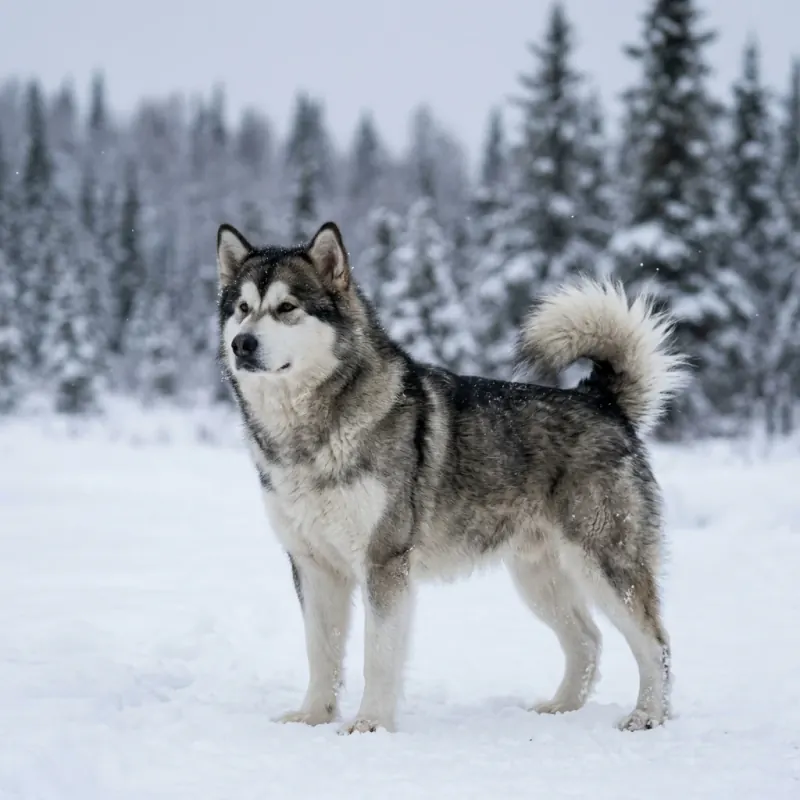
Most people meet the Alaskan Malamute through a photograph and file it mentally as “the big Husky.” It is one of the most consequential mistakes in dog ownership, because the two breeds were developed by different peoples, on different continents, for jobs that are close to opposites.
The AKC breed standard doesn’t leave this to interpretation. Its instruction to judges opens: “In judging Malamutes, their function as a sledge dog for heavy freighting in the Arctic must be given consideration above all else.” Not speed. Not distance. Freight.
That one sentence predicts nearly everything a prospective owner needs to know — including the counterintuitive part, which is that this magnificently athletic dog is a mediocre running partner and an outstanding backpacking one.
Alaskan Malamute at a glance
| Height | 25 inches (males), 23 inches (females) — AKC desirable freighting size |
| Weight | 85 lb (males), 75 lb (females) |
| Life expectancy | 10–14 years |
| Group | Working (AKC recognised 1935) |
| Coat | Dense double coat; heavy seasonal shed |
| Built for | Hauling heavy loads over distance at a steady pace |
| Best at | Loaded hiking, carting, skijoring, snow travel |
| Worst at | Road running, hot climates, off-leash freedom |
The job it was actually bred for
The breed comes from the Mahlemut people of the Kotzebue Sound region of Alaska, who needed dogs that could move serious weight across serious distance and survive doing it. The selection pressure was for strength, endurance and a steady temperament — a dog that could work in a team, day after day, in conditions that kill.
Speed was never the point. A freighting team moves at a working pace with a heavy sled behind it; a racing team moves fast behind a light one. Both are sled dogs in the way that a tractor and a motorcycle are both vehicles.
The Siberian Husky, which people constantly conflate with this breed, came from the Chukchi and was selected for the opposite trade-off: lighter build, less pulling power, more speed over distance. Our Siberian Husky guide covers that side in detail, and our direct comparison of the two takes the question people usually arrive with — which one handles cold better — and shows why it is the wrong one. If you’re choosing between them, you’re choosing between power and pace, not between two sizes of the same dog.
What that means on the trail
Here’s the practical translation, and it’s the reason this breed sits oddly in most adventure-dog content.
A Malamute is exceptional under load. This is a dog whose entire evolutionary brief was moving weight. Hiking with a pack, hauling a cart, pulling a pulk, skijoring — the Malamute doesn’t merely tolerate these, it settles into them. Working the dog is also the only reliable way to satisfy one. The AKC itself lists backpacking, sledding and skijoring as the breed’s sports.
A Malamute is a poor road-running partner. Three things stack against it: it’s built for power rather than speed, it’s heavy enough that sustained pavement work loads the joints hard, and it’s wearing an Arctic coat. If running is the activity you’re buying a dog for, our guide to dog breeds for runners has far better answers — and none of them are this one.
That inversion is worth sitting with. Most large working breeds are decent at both. This one is genuinely brilliant at one and genuinely weak at the other, and buying it for the wrong one is how people end up disappointed in a superb dog.
If loaded hiking is where you’re headed, pack fit on a deep-chested, heavy-coated dog is its own problem — our dog hiking backpack roundup covers what actually stays put on a broad-framed dog.
Heat is the real limit
The coat that makes a Malamute indifferent to a blizzard makes it vulnerable in the summer, and this is the failure mode that puts dogs in emergency clinics.
Dogs don’t cool the way we do. As the AKC puts it plainly, “sweating contributes very little to temperature regulation in dogs. Instead, panting does most of the work.” The sweat glands that exist are merocrine glands in the paw pads; everything else runs on panting and on blood-vessel dilation in the ears and face. Wrap that system in a dense double coat, on a large dark-coated dog, and the margin narrows fast.
Two rules that experienced owners treat as non-negotiable:
- Move activity to the cool end of the day in summer. Our guide on how hot is too hot to walk your dog covers the thresholds and the pavement test.
- Never shave the coat. It insulates in both directions. Shaving removes heat protection and can permanently damage regrowth.
The flip side is that this breed is superb in the cold, and if you live somewhere with real winters, the cold-weather breeds guide puts the Malamute in context alongside the other genuinely Arctic-equipped dogs.
Containment, prey drive and digging
Malamutes were bred to make decisions in harness, ahead of a human, in bad conditions. That independence is a feature of the working dog and a challenge in the suburban one.
Expect three things:
Prey drive. Widely described as strong across the breed community, and the practical consensus is that it’s managed rather than trained away. Small fast animals are the issue, and so are other people’s cats. Note this is owner-reported rather than a measured breed trait — but it’s consistent enough, and the consequences are serious enough, that planning around it is the sensible default.
Escape ability. This is a strong, clever, motivated dog with an interest in what’s on the other side of the fence. Fencing needs to be tall and dug in, because —
Digging. Malamutes dig. It’s a normal breed behaviour, not a defect, and the practical answer is usually to give the dog a place where digging is allowed rather than to try to extinguish it.
For open ground, a long line is the honest middle path between a lead and unearned freedom — the same tool our recall training guide builds on, and long-line leashes covers the hardware. A GPS tracker is worth having on a breed with this escape reputation, though it’s a recovery tool, not a containment strategy.
Trainability: capable, not compliant
Malamutes are intelligent and entirely trainable, but they are not biddable in the way a retriever is biddable. A gundog is bred to want your instruction. A freighting sled dog is bred to keep working when you’re not there to give it.
What that means practically: reward-based training works well, repetition-heavy drilling does not, and a Malamute that sees no reason to comply is very good at conveying that. Early, consistent handling matters more here than in a softer breed, and this is a large, powerful dog — an untrained 85-pound Malamute on the end of a lead is a physical problem as well as a behavioural one.
Diet and feeding
Nothing exotic here, and we’re deliberately not going to repeat the widely circulated claim that Malamutes “run on very little food” — the AKC makes that point about the Siberian Husky specifically, and we couldn’t find it stated for this breed by a source worth citing.
What is worth saying is ordinary and important: this is a large dog with a documented hip and elbow dysplasia risk, and every extra kilogram is load on those joints for the dog’s whole life. Body condition — ribs easily felt, waist visible from above — is a better guide than a measuring cup, and keeping a Malamute lean is one of the few genuinely high-impact things an owner controls.
Otherwise, standard large-breed sense: a large-breed puppy formula during growth, meals split across the day rather than one large one, and no hard exercise on a full stomach. If the zinc-responsive skin signs described below appear, that’s a veterinary conversation rather than a supplement you should start on your own — zinc supplementation without guidance can cause its own problems.
Living with one, day to day
The gap between the photograph and the household reality is worth spelling out. What follows is breed-community description rather than published research — we’re flagging that rather than dressing it up, because the honest status of these observations is “widely reported by people who own them,” not “measured.”
They are strong. This one isn’t folklore, it’s arithmetic: an 85-pound dog whose entire breeding history is about moving weight is not something you out-muscle. Lead manners need training early, while the dog is still small enough that training is the easier option than restraint.
They are vocal. Not typically barky — Malamute owners describe woos, grumbles and something close to conversation. Most find it charming. Close neighbours occasionally don’t.
They dig. Consistently reported across the breed community, and the practical response most experienced owners land on is to give the dog a place where digging is permitted rather than trying to extinguish it.
They are sociable with people rather than protective. Malamutes were bred to work in teams, and the AKC describes an affectionate, loyal and playful temperament — this is not a guarding breed. Dog-to-dog dynamics are the more commonly discussed issue, and worth raising with a breeder or rescue about the specific dog rather than the breed.
They shed, then shed properly. See the grooming section below; new owners consistently underestimate this.
They are not a dog you leave alone all day. An under-worked, under-company Malamute is where the destruction stories come from.
One practical note if you are buying kit for a Malamute, your own or somebody else’s: at 75–85 lb of freight-hauling build, this breed sits at or past the top of most manufacturers’ size charts, and the largest listed size is not always large enough. Check the girth against the chart before ordering rather than after. Our gift guide for adventure dog owners covers which categories tolerate that guesswork and which do not.
Health and lifespan
Malamutes are, on the whole, a robust breed with a 10–14 year life expectancy. The conditions worth knowing about are mostly breed-specific and mostly testable, which puts a lot of power in the buyer’s hands.
Alaskan Malamute polyneuropathy (AMPN). A nerve disease caused by a mutation in the NDRG1 gene, inherited recessively. Affected dogs typically show signs before two years of age. The mutation was identified in a 2013 study published in PLOS ONE, and the University of Minnesota’s Canine Genetics Lab offers a DNA test that reports clear, carrier or affected. This is a solved problem for anyone willing to ask for the test result.
Cone degeneration (day blindness). Caused by a deletion of the CNGB3 gene, again recessive. The Alaskan Malamute Club of America describes signs appearing from around seven weeks, with affected dogs becoming almost blind in daylight while keeping normal night vision — the classic picture is a puppy reluctant to come out of the shade. The AMCA calls it “fortunately rare” but notes cases still appear. A DNA test exists.
Chondrodysplasia (ChD). A skeletal condition producing shortened, bowed forelimbs. This is the one with no DNA test. Diagnosis depends on radiography of the distal ulna between four and twelve weeks, and the AMCA’s older test-breeding certification programme has been permanently retired. The club reports the incidence as very low. Because there’s no test, this is a question about the breeder’s lines rather than a certificate you can ask to see.
Zinc-responsive dermatosis. Crusting and scaling around the eyes, muzzle and mucocutaneous junctions, driven by a genetic defect in intestinal zinc absorption that is specifically documented in northern breeds including this one. It’s treatable, and it’s worth recognising early rather than chasing as an allergy for a year.
Screening tests. The AKC publishes the breed club’s recommended panel as a hip evaluation, an ophthalmologist evaluation, and the AMPN DNA test. Separately, the requirement for a CHIC number is described as hips and eyes, with results made public. The two lists don’t match exactly, so treat the AKC panel as the fuller ask — and note what a CHIC number does and doesn’t mean: it records that the tests were done and published, not that the dog passed them. Read the accompanying report, not just the number.
A note on all of the above: these are breed-level risks and testing information, not diagnoses. Nothing here replaces your own vet, and if you’re worried about a specific dog, that conversation belongs in a consulting room.
The buyer’s version of this section is short: ask for the polyneuropathy and cone degeneration DNA results, ask for the hip and eye evaluations, and ask what the breeder does about chondrodysplasia given that no test exists. A good breeder will have all four answers ready.
Grooming and shedding
Heavy. The double coat sheds year-round and blows out seasonally in quantities that genuinely surprise first-time owners. Weekly brushing is the baseline; during a coat blow it becomes a daily job for several weeks. There is no low-shedding version of this breed and no grooming shortcut that changes it.
Paws deserve attention in winter — dense fur between the pads is exactly what collects packed snow, which our guide to winter paw care covers in detail. On gritted pavement the problem changes from packed snow to road salt, and that is where dog boots earn their place.
Is an Alaskan Malamute right for you?
Yes, if: you live somewhere cold, you want a hiking and hauling partner rather than a running one, you have secure fencing, you’re honest about the grooming, and you find an independent-minded dog charming rather than insubordinate.
No, if: you want a jogging companion, you live somewhere hot, you need reliable off-leash freedom, you have a manicured garden you’re attached to, or you’re buying primarily for the way the breed looks. That last one is how most Malamutes end up in rescue.
This is a spectacular dog for the right household and a very difficult one for the wrong household — and unusually, the standard itself tells you which is which before you commit.
Sources
- American Kennel Club — Official Standard of the Alaskan Malamute (the “IMPORTANT” judging note on heavy freighting; desirable freighting size of 25 in / 85 lb males and 23 in / 75 lb females, which the standard itself says should not outweigh type, proportion and movement)
- Alaskan Malamute Club of America — Illustrated Standard (independent reproduction of the same judging note)
- American Kennel Club — Alaskan Malamute breed page and breed history (life expectancy, group, listed sports, Mahlemut origin, AKC recognition 1935)
- American Kennel Club — Working Group health testing requirements (recommended panel: hip evaluation, ophthalmologist evaluation, AMPN DNA test)
- American Kennel Club — “Do Dogs Sweat?” (thermoregulation, merocrine glands, panting)
- Alaskan Malamute Club of America — cone degeneration and chondrodysplasia pages
- Drögemüller M. et al. (2013). “A Gly98Val Mutation in the N-Myc Downstream Regulated Gene 1 (NDRG1) in Alaskan Malamutes with Polyneuropathy.” PLOS ONE 8(1):e54547
- University of Minnesota Canine Genetics Lab — Alaskan Malamute polyneuropathy DNA test
- University of Minnesota, Small and Large Animal Dermatology Handbook, Vol. 2 §3.13 — canine zinc-responsive dermatosis
Frequently asked questions
Is an Alaskan Malamute just a bigger Siberian Husky?
No, and the difference is written into the breed standard. The AKC standard instructs judges that the Malamute's “function as a sledge dog for heavy freighting in the Arctic must be given consideration above all else.” The breed was developed by the Mahlemut people of Kotzebue Sound to move heavy loads at a steady, slow pace. The Siberian Husky was developed separately, by the Chukchi, for lighter loads at speed over distance. They are two different jobs, and it shows in the dog: the Malamute is heavier-boned, stronger and slower. Think of the difference between a draught horse and a distance runner.
Can you run with an Alaskan Malamute?
Less well than almost any other large working breed, and this surprises people. A Malamute is built for power at low speed, carries a coat engineered for Arctic cold, and is heavy enough that sustained road running loads the joints hard. Add the heat problem and pavement running becomes a genuinely poor idea for this breed. Hiking with weight, skijoring, carting and snow work all suit it far better. If you specifically want a running partner, this is the wrong breed and there are much better choices.
How much exercise does an Alaskan Malamute need?
A lot, but the useful measure is work rather than distance. This is a dog bred to pull, and the exercise that actually satisfies it involves resistance and purpose: loaded hiking, carting, skijoring, hauling. An hour or two of daily activity is a realistic floor, and a bored, under-worked Malamute is famously destructive — this is a breed that will excavate a garden down to the subsoil. A gentle lead walk around the block does not touch it.
Do Alaskan Malamutes cope with hot weather?
Badly. The double coat is built for Arctic conditions and the dog is large, heavy and dark-coated, all of which work against it in the heat. Summer activity needs to move to early morning or late evening, with shade and water available throughout, and you should never shave the coat — it insulates against heat as well as cold. Heat management is a year-round responsibility with this breed, not a July afterthought.
What health tests should an Alaskan Malamute breeder have done?
The AKC lists the breed club's recommended panel as a hip evaluation, an ophthalmologist evaluation and the polyneuropathy (AMPN) DNA test — the NDRG1 mutation, tested at the University of Minnesota. Also worth asking about is the DNA test for cone degeneration (CNGB3). There is currently no DNA test for chondrodysplasia, so ask how the breeder manages that in their lines instead; a breeder who can answer that clearly is telling you something useful. One caveat on CHIC numbers generally: a CHIC number records that the tests were done and the results published, not that the dog passed them, so read the report rather than the number.
Can an Alaskan Malamute be trusted off-leash?
Assume not. Malamutes combine a strong prey drive with an independent working temperament and a well-earned reputation as escapers and diggers. Recall in a dog bred to make its own decisions in front of a sled is not the reliable recall you'd get from a biddable gundog. Secure fencing — including underneath it — and a long line for open ground are the realistic tools here, and they're the ones experienced owners use.
Comments
Got a question, a tip, or a correction? Leave a comment — no account, no sign-in. Just your name and your thoughts.
Loading comments…