
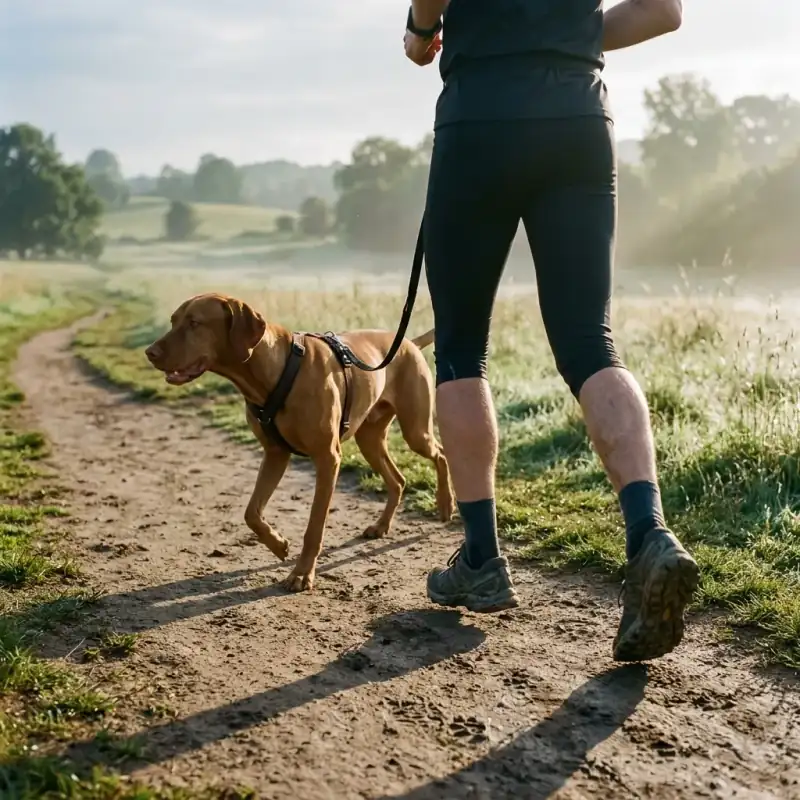
Every “start running with your dog” guide follows the same shape as a couch-to-5k plan: week one, one mile; add ten percent; here’s a leash.
The problem is that a couch-to-5k plan is designed around the thing that limits a human beginner, which is cardiovascular fitness. For a dog, fitness is usually not the limit. Two other things are, and neither of them appears on a training schedule.
The first is skeletal maturity. The second is heat — and the evidence on that one is more alarming than most owners realise.
The number that should reframe this
In 2020, Hall, Carter and O’Neill published a study of 905,543 dogs under primary veterinary care in the UK, looking at what actually triggers heat-related illness. The paper is titled “Dogs Don’t Die Just in Hot Cars” for a reason.
Exertional heat-related illness — heat illness caused by exercise — accounted for 74.2% of all heat-related illness events. Not hot cars. Not dogs left in gardens. Exercise.
The rest of the findings read like a description of exactly the dog most people take running:
| Risk factor | Finding |
|---|---|
| Age | Dogs under two years had the highest odds; dogs over eight had lower odds |
| Sex | Male dogs and neutered females had greater odds than entire females (male-neutered OR 1.83) |
| Bodyweight | Dogs at or above their breed and sex mean weight had higher odds (OR 1.30) |
| Outcome | 7.6% case fatality for exertional heat illness |
A young, keen, slightly heavy male dog is the profile. That is not an unusual dog. That’s the dog jogging beside half the runners in your park.
None of this means don’t run with your dog. It means the run should be planned around heat, not around distance — which is the opposite of how almost every plan is written.
Why your dog won’t tell you to stop
Two facts combine badly.
Dogs cool almost entirely by panting. As the AKC puts it, “sweating contributes very little to temperature regulation in dogs. Instead, panting does most of the work of cooling a dog down.” Dogs do have merocrine sweat glands, but only in the paw pads. Everything else runs on evaporation from the tongue, nasal passages and lungs, plus blood-vessel dilation in the ears and face.
That system has a specific weakness: it needs dry air. Panting cools by evaporating moisture, so when the surrounding air is already carrying a lot of moisture, evaporation slows and panting becomes less effective — the dog pants harder for less cooling. We’re not going to print a humidity threshold, because the specific figures circulating online don’t trace back to a source we can stand behind. The directional point is well established and enough to act on: on a muggy day, treat the conditions as harder than the thermometer suggests.
And the dog will keep going. A dog running alongside its owner is doing the thing it most wants to do, with the person it most wants to do it with. Self-limiting is not reliable in that situation. The dog that “loves running” and never seems to flag is not demonstrating that it’s fine; it’s demonstrating that you are the one who has to make the decision.
Our guide on how hot is too hot to walk your dog covers the temperature thresholds and the pavement test in detail. For running, apply them more conservatively — the same weather is a bigger ask at pace.
Wait until the skeleton is ready
The second limit is developmental, and here there’s a clean, attributable answer.
Dr. Jerry Klein, the AKC’s Chief Veterinary Officer, states that it is never recommended to do road work or jogging with a dog under 14 to 18 months of age, especially large and giant breeds, until the growth plates have fused.
Growth plates are the soft, actively growing zones near the ends of long bones. While they’re open they’re vulnerable, and repetitive high-impact loading is exactly the kind of stress they don’t tolerate well. Closure ages vary — small breeds finish earlier than giant ones, and the published figures disagree with each other enough that we’ve deliberately avoided printing a single number in our puppy exercise guide, which goes through that disagreement properly.
What the evidence does support is that the kind of exercise matters more than the amount. A 2012 study by Krontveit and colleagues found that stair use before three months of age was associated with higher hip dysplasia risk, while off-leash exercise in undulating terrain was associated with lower risk. Free, self-paced movement on varied ground is good for a growing dog. Structured repetitive road running is the thing that waits.
Note how neatly this stacks with the heat data: under-twos have the highest exertional heat illness odds and the least mature skeletons. Both limits say the same thing.
Which dogs shouldn’t do this at all
Be honest about this list rather than diplomatic.
Brachycephalic breeds. Flat-faced dogs — pugs, French and English bulldogs, boxers — have compromised airways, and panting is the cooling system. Running is a poor idea for these breeds in any weather and a dangerous one in warm weather.
Dogs carrying extra weight. Higher heat-illness odds, and more joint loading. Weight loss first, running second — and a vet-guided plan rather than a self-directed one.
Seniors and dogs with joint or cardiac disease. Not automatically excluded, but they need a vet’s input before you start, not after something goes wrong.
Some working breeds you’d assume were ideal. A Siberian Husky is an extraordinary endurance athlete in the cold and a heat casualty waiting to happen in July. An Alaskan Malamute is built for hauling weight slowly, not for pavement running at all. Our roundup of dog breeds for runners sorts this out breed by breed.
Building up, properly
Assuming an adult, healthy, suitably built dog, here’s a structure that respects both limits.
To be clear about what this is: no veterinary body publishes a canine couch-to-5k, and the schedule below is a conservative progression built around the two sourced constraints above, not a clinical guideline. Your vet’s view of your specific dog beats it.
Weeks 1–2: walk, then trot. Fifteen to twenty minutes total, mostly brisk walking with short trotting intervals of a minute or two. You’re teaching a position and a rhythm, not building fitness. Run on soft ground if you have it.
Weeks 3–4: extend the trotting. Build the running intervals until you’re covering perhaps a mile of continuous easy running inside a longer walk. The dog should finish looking like it could have done more — that’s the whole target for this phase.
Weeks 5–8: add distance, not pace. Increase gradually, and keep the pace conversational. Dogs generally adapt faster than people do, which is precisely the trap: the dog’s willingness will outrun its conditioning and its cooling capacity long before it outruns yours.
Here’s the same thing as a table, if you prefer it that way:
| Phase | Session length | Structure | What you’re building |
|---|---|---|---|
| Weeks 1–2 | 15–20 min | Mostly walking, 1–2 min trotting intervals | Position, rhythm, and your own habit of checking the dog |
| Weeks 3–4 | 25–30 min | Up to ~1 mile continuous easy running inside a longer walk | Base conditioning, still finishing fresh |
| Weeks 5–8 | 30–45 min | Gradual distance increase, pace unchanged | Endurance — without adding speed at the same time |
| Ongoing | As conditions allow | Governed by weather, not by the plan | A habit that survives summer |
Throughout:
- Warm up and cool down with walking. Five minutes each end.
- Run at the cool end of the day. Early morning is better than evening, because the ground has had all night to lose heat.
- Carry water and offer it. A collapsible bowl and a bottle are the whole kit.
- Check the feet afterwards. Pads wear gradually and then all at once.
- Skip the run when it’s hot. This is the actual skill.
Teaching the position
Running with a dog that weaves across your feet is unpleasant and eventually injurious for both of you. It’s worth a few sessions.
- Pick a side and stay on it. Consistency does most of the work.
- Reward the position at walking pace first. Treats delivered at your knee on the chosen side teach the dog where “correct” is, long before pace is involved.
- Use a cue for changing pace — a simple “let’s go” for picking up and “easy” for slowing. Dogs learn these fast and it saves a lot of lead tension.
- Stop for road crossings, every time. A dog that expects to stop at kerbs is a safer dog for the rest of its life.
Our recall training guide covers the wider foundation, and it’s worth having before you start running in any area where the dog might come off the lead.
Where this can go next
Once a dog is conditioned and mature, road running is the least interesting option available.
Canicross — running with the dog in a pulling harness attached to a waist belt — is more comfortable for both parties, lets the dog work with its body rather than against a side-lead, and is a genuine sport with events. Bikejoring and skijoring extend the same idea. Trail running with a dog is, for most dogs, better than road running in every respect: softer ground, cooler air, more interest.
If you own one of the northern breeds, note that these harness sports are what the dog was actually built for. Our Alaskan Malamute and Siberian Husky guides both cover why pulling work suits them far better than pavement running does.
Gear, kept short
You need less than the internet suggests.
A harness, not a neck collar. Attaching a running lead to a neck collar puts repeated load on a dog’s throat. A well-fitted harness spreads it. Note that the evidence on harness design is weaker than the marketing implies — the 2025 review we cover in our German Shepherd harness guide found no single harness shape superior for all dogs.
A hands-free or fixed-length lead. Not a retractable one. A retractable lead at running pace is a mechanism for injuries to both ends of it.
Boots only if you’ve conditioned them first. A peer-reviewed study of ground reaction forces found boots can genuinely protect paws, but also that sudden use without prior practice causes gait changes and distress. Boots are a thing you train, over several short sessions at home, not a thing you put on a dog at the trailhead. Our dog boots roundup covers fit.
Something reflective if you run early or late. For both of you.
What good looks like
A dog that finishes a run trotting rather than trudging. That settles and recovers within a few minutes. That’s keen to go next time. That comes back with intact pads and no stiffness the following morning.
If you’re getting all four, the plan is working. If any one of them slips, the answer is almost always to shorten the run or move it to a cooler hour — not to push through it.
Running with a dog is one of the genuinely great things about having one. It just isn’t a couch-to-5k plan with a leash attached, and the two limits that make it different are both worth respecting from the first week.
Sources
- Hall EJ, Carter AJ, O’Neill DG (2020). “Dogs Don’t Die Just in Hot Cars — Exertional Heat-Related Illness (Heatstroke) Is a Greater Threat to UK Dogs.” Animals 10(8):1324. doi:10.3390/ani10081324
- Dr. Jerry Klein, AKC Chief Veterinary Officer — guidance on road work and jogging before 14–18 months
- Krontveit RI et al. (2012). “Housing- and exercise-related risk factors associated with the development of hip dysplasia as determined by radiographic evaluation in a prospective cohort of Newfoundlands, Labrador Retrievers, Leonbergers and Irish Wolfhounds in Norway.” American Journal of Veterinary Research 73(6):838–46. PMID 22620698
- American Kennel Club — “Do Dogs Sweat?” (panting, merocrine glands, vasodilation)
- “Changes in Ground Reaction Forces and Center of Pressure Parameters of Paws When Wearing Dog Boots in Dogs.” PMC9323085
Frequently asked questions
At what age can a dog start running with me?
Later than most people think, and the two reasons stack. On skeletal maturity, Dr. Jerry Klein, the AKC's Chief Veterinary Officer, states that it is never recommended to do road work or jogging with a dog under 14 to 18 months, particularly in large and giant breeds. On heat, the largest study of canine heat-related illness found dogs under two years old had the highest odds of exertional heat illness. Both point the same direction. Free running and play on soft ground are fine and beneficial long before then — it's the structured, repetitive road running that waits.
Should I set a distance target for my dog's runs?
No, and it is the one thing almost every beginner plan gets wrong. Distance is rarely the limiting factor for a healthy adult dog of a suitable breed; heat, humidity, surface and skeletal maturity are. The same dog that handles a long run comfortably in cool weather can be in trouble on a much shorter one in the heat — which is why we won't put a number on it. Build the habit around conditions rather than around a distance target, and let the conditions govern the run.
How do I know if my dog is overheating on a run?
Watch for panting that seems out of proportion to the effort or that doesn't settle, a dog that starts lagging behind or seeking shade, heavy drooling, and any change in gum colour. The difficulty is that dogs are poor at self-limiting when they're running with you — many will keep going past the point they should stop. That is why the run needs a plan rather than a feel. If you suspect heat illness, stop, get the dog somewhere cool and wet, and contact your vet immediately; this is an emergency, not a wait-and-see.
Is my dog fit enough to start running?
Three groups should not start at all, and it's worth being firm about each of them. Brachycephalic (flat-faced) breeds — pugs, bulldogs, boxers and similar — because the airway that makes the face distinctive also compromises the panting they rely on to cool. Dogs under about 14–18 months, on both growth-plate and heat grounds. And dogs carrying extra weight: the same large study found dogs at or above their breed and sex mean bodyweight had higher odds of exertional heat illness. Seniors and dogs with joint or cardiac disease need a vet's input first.
Is running on pavement bad for dogs?
It's harder on joints than trail or grass, and it's much hotter — asphalt absorbs and holds heat long after the air has cooled, and your dog is running on bare skin. Soft, uneven ground is generally kinder, and there's evidence behind that preference: a 2012 study found that off-leash exercise in undulating terrain was associated with lower hip dysplasia risk in puppies, while stair use before three months of age was associated with higher risk. Where you run matters as much as how far.
Do dogs need to warm up before running?
Yes, and it costs you five minutes. Start every run with a brisk walk before you pick up the pace, and finish with a walk rather than stopping dead at your door. Beyond the muscular argument, the walk-first approach gives you a chance to notice a dog that's stiff, reluctant or not right today — information you'll miss if the run starts at running pace. Let the dog toilet before you begin, and don't run immediately after a large meal.
Comments
Got a question, a tip, or a correction? Leave a comment — no account, no sign-in. Just your name and your thoughts.
Loading comments…