
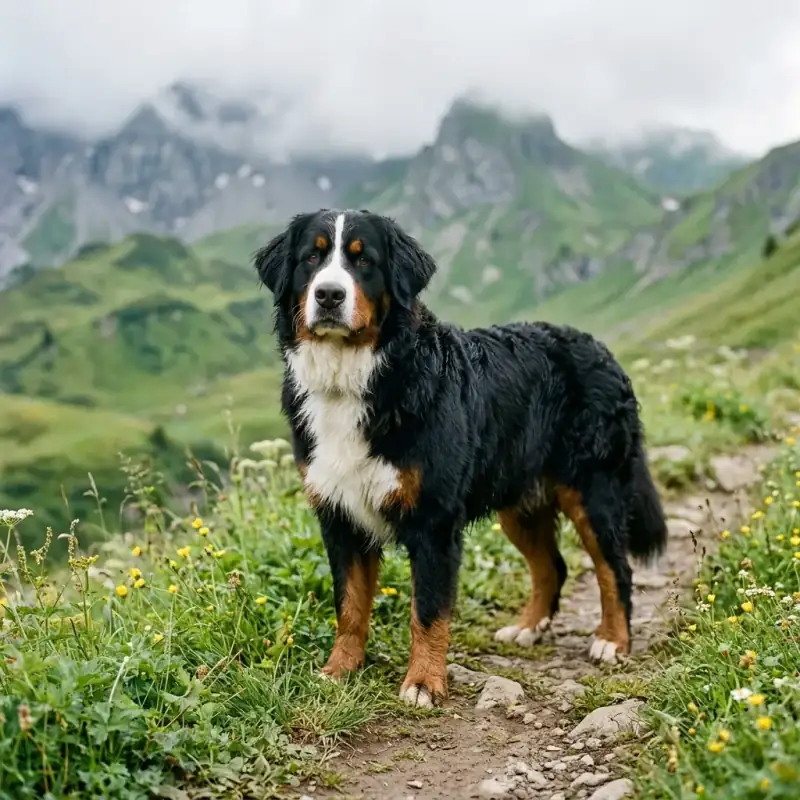
There is no gentle way to write this guide. The Bernese Mountain Dog is one of the most beautiful, most good-natured large breeds a household can own, and where its lifespan has been measured directly the median comes out at eight years — three and a half years below the average for large breeds as a class. Any honest guide has to carry both facts, in that order, because people who love Berners tend to keep owning them anyway, and they deserve to go in knowing what the evidence says rather than finding out at year six.
The AKC’s own breed page recommends the Berner for camping, backpacking and carting. That is not marketing: this is a Swiss farm dog bred to move loads across alpine smallholdings, and the working history is intact. The question this guide answers is how to build eight or nine good years around it.
Bernese Mountain Dog at a glance
| Height | 25–27.5 in (male) · 23–26 in (female) |
| Weight | 80–115 lb (male) · 70–95 lb (female) |
| AKC life expectancy | 7–10 years |
| Measured median lifespan | 8.4 years (Swiss breed-club cohort, n = 389) |
| AKC popularity | 20 of 210 |
| Coat | Thick, silky, moderately long tricolour double coat |
| AKC exercise guidance | ”At least a half-hour of moderate exercise every day” |
| Named activities | Long walks, hikes, camping, backpacking, carting and drafting, agility, herding, obedience, rally, tracking |
| Breed-club health tests | Hip · Elbow · Cardiac · Ophthalmologist · two degenerative myelopathy DNA tests |
| Cold tolerance | Excellent — “a hardy dog who thrives in cold weather” |
| Heat tolerance | Poor |
The dog behind the markings
Berners are one of the four Swiss Sennenhunde — literally “dog of the Senn,” the Alpine herdsmen and dairymen these breeds worked alongside, the others being the Greater Swiss Mountain Dog, the Appenzeller and the Entlebucher. The Berner takes its name from the midland region around Bern, which became a major dairy area, and it did the full range of farm work: helping herd small groups of cattle, guarding, and — the job that shaped the body — pulling carts. The AKC’s own description of that load is worth quoting for scale: heavy carts hauled up and down the Alps carrying bulky cheese rounds and four to six metal milk cans, each weighing 80 pounds when filled.
That is a drafting build. Power at the shoulder, weight to put behind a load, a coat for alpine winters, and a temperament placid enough to walk beside a farmer all day.
Nothing about that history says distance athlete, and it is worth resisting the urge to read the size as stamina. A Berner is built to move weight at a walk, not to cover miles at speed. The AKC’s own exercise guidance — at least half an hour of moderate exercise daily — is startlingly modest for a 100 lb dog, and it is accurate.
What that history does say is that a Berner wants to work alongside you. The breed excels at carting and drafting sports for a reason, and Berner owners who find that outlet tend to have the most contented dogs.
The health picture, stated plainly
This is the part of the guide that matters most, so it comes before the fun.
Lifespan: three sources, one answer
- AKC: 7–10 years.
- Swiss breed-club cohort: researchers followed 389 Bernese born in 2001–2002 and registered with the Swiss Bernese Mountain Dog Club until 381 of them had died. Median life expectancy: 8.4 years (IQR 6.9–9.7). Females lived significantly longer than males — 8.8 years against 7.7.
- UK purebred survey: median age at death 8.0 years across 394 recorded Berner deaths.
Independent countries, independent methods, agreement within half a year. For context, the median across all dogs in the largest UK dataset is 12.5 years, and large breeds as a class sit at 11.9. The Berner is roughly three and a half years below its own size class.
Why: cancer, and more of it than size explains
In the Swiss cohort, the cause of death was unrecorded for 89 of the 381 dogs (23.4%). Every figure below is a share of all 381 deaths, including those unrecorded ones:
| Cause of death | Share of all 381 deaths |
|---|---|
| Neoplasia (cancer) | 58.3% (222 of 381) |
| Degenerative joint disease | 4.2% |
| Spinal disorders | 3.4% |
| Renal injury | 3.1% |
| Gastric or mesenteric volvulus | 1.8% |
Read the other way round, that means cancer accounted for 222 of the 292 deaths where a cause was recorded — just over three-quarters of them.
The comparison that gives the number meaning is in the same paper: cancer accounts for 14.5–16.5% of deaths in the general dog population. Earlier Bernese studies had put the breed’s figure between 28.1% and 55.1%.
A UK survey of purebred deaths gives an independent read. There, cancer accounted for 27% of all purebred deaths across 15,881 dogs — and 45.7% of Bernese deaths (180 of 394), placing the breed fourth of every breed listed, behind only the Irish water spaniel, flat-coated retriever and Hungarian wirehaired vizsla.
Large dogs do get more cancer, and there is a well-understood reason: more cells, more cell divisions, more chances for the handful of driver mutations a tumour needs. So the fair question is whether the Berner is simply paying the giant-breed tax. A 2024 analysis put that to the test across three independent datasets, fitting lifetime cancer mortality against breed size. Of 85 breeds present in more than one dataset, only the flat-coated retriever was significantly elevated above its size expectation — with the Scottish terrier, Bernese Mountain Dog and bullmastiff also notably raised, more than 50% over expected.
So: not just a big-dog effect.
Histiocytic sarcoma
The tumour type most associated with the breed is histiocytic sarcoma, an aggressive cancer of histiocytes — immune cells found throughout the body — which is why it can appear almost anywhere and present in so many different ways.
A study comparing 365 Bernese with 289 flat-coated retrievers, the other breed strongly predisposed to it, found the disease behaves differently in each. In Bernese, the disseminated form (spread across multiple organs) accounted for 60.8% of cases, against 39.4% in flat-coated retrievers; the localised form was the more common presentation in the retrievers. Bernese more often showed leukocytosis and low platelet counts on bloodwork, and hypercalcaemia appeared in 15 Bernese and in none of the retrievers.
The practical implication is not a treatment plan — it is that vague, systemic-seeming illness in a middle-aged Berner deserves a fast, thorough workup rather than a wait-and-see week. Lameness, unexplained weight loss, lethargy and inappetence are all worth an appointment in this breed sooner than they would be in another.
The rest of the list
- Hip and elbow dysplasia — the standard orthopaedic screens; both are on the breed club’s recommended panel, and you should see both parents’ results.
- Degenerative myelopathy — a progressive, painless spinal-cord disease. The Berner is one of very few breeds with two DNA tests on its recommended panel: the common variant and a Bernese-specific variant. Ask about both.
- Cardiac and eye screening — both on the club panel.
- Bloat (gastric dilatation-volvulus) — the deep-chested-breed emergency, and it appears in the Swiss cause-of-death data. Learn the signs before you need them.
This is educational information, not veterinary advice. None of the above is a diagnosis, a prognosis or a screening plan for your dog. What it is: the questions to ask a breeder before you buy, and the reasons to take a vague symptom seriously in this particular breed. Everything else belongs with your vet.
What this means when you buy
For most breeds, “buy from a breeder who health-tests” is generic advice. For the Berner it is the whole game. Ask for hip and elbow scores on both parents, both DM test results, cardiac and eye clearances — and ask, directly, how long the dogs in that line have lived and what they died of. A breeder who tracks longevity in their own lines and will talk about it openly is the single best signal available. Breed-club health foundations exist precisely because the community has been collecting this data for decades.
Temperament: the easy part
Berners are, by consistent description and by the AKC’s own summary, placid, affectionate and eager to please — imposing without being threatening, aloof but dignified with strangers, and particularly gentle with children. They typically get on with the whole family while attaching hardest to one person.
Two practical notes.
They are sensitive. The AKC puts it plainly: their feelings are easily hurt. This is not a breed that shrugs off a harsh correction; it is a breed that shuts down and remembers. Training a Berner is an exercise in patience and reward, and the good news is that eagerness to please makes that easy.
They do not do well left alone. The AKC is explicit about it: “A Berner wants to be with his family, and undesirable behaviors can result if he is regularly left alone for long periods of time.” This is a breed bred to work beside someone all day, and a household that is empty from morning to night is the wrong home for one.
They are big before they are grown. A friendly 90 lb dog that has not learned lead manners is a genuine physical problem. Early socialisation and obedience work matter more in giant breeds than in any other group, not because the temperament is difficult but because the consequences of a gap are heavier.
The breed also has the distinction of being one of the few actually measured at scale: a Finnish behavioural survey of 13,715 dogs across 264 breeds included 209 Bernese among its best-sampled breeds — a rarity, since most breeds never reach a usable sample size in this kind of research.
Exercise: the two ceilings
Heat is the first ceiling
A thick double coat built for alpine winters is a liability in July. The AKC states the cold tolerance as a positive — “a hardy dog who thrives in cold weather” — and the corollary is unavoidable.
Be precise about what the evidence says here, because it is easy to over-claim. The largest UK study of heat-related illness found the odds rising sharply with weight, but its headline 3.42 times figure applies to dogs over 50 kg — and a Berner, at 80–115 lb, is roughly 36–52 kg, so only the heaviest males reach that band. The finding that fits the breed better is the study’s other weight result: dogs at or above their own breed-and-sex average weight carried 1.42 times the odds. In other words, the risk lever you control on a Berner is not its breed but its condition — a heavy Berner is meaningfully worse off than a lean one. Coat depth adds to that; the Royal Veterinary College lists thick-coated dogs among those most susceptible.
Practically, that reshapes the Berner’s year. Summer activity happens at dawn or not at all; a hot afternoon is a rest day without apology. Our guides to how hot is too hot to walk your dog and keeping a dog cool on summer hikes cover the thresholds and the cooling methods that actually work.
Winter, by contrast, is when this breed comes alive. If you want a companion for snowshoe walks and cold-weather camping, few breeds are better equipped — see the best cold-weather dog breeds for where “built for cold” stops being true even for the northern specialists, and winter paw care for the part that actually ends winter walks.
Growth is the second ceiling
Giant breeds mature slowly, and their growth plates close later than smaller dogs’. That makes the first 18 months a period of deliberate restraint: self-directed play on soft ground, yes; repeated jumping, forced distance running and long hikes on hard surfaces, not yet. The rule most often repeated on this subject has no study behind it, which we went through in how much exercise a puppy needs — the honest version is that skeletal maturity is assessed by your vet rather than assumed from a formula, and the cost of getting it wrong is highest in the heaviest breeds.
What a good Berner week looks like
Once mature, and in cool conditions:
- Half an hour to an hour of moderate daily exercise as the baseline — the AKC’s floor, not a ceiling.
- A weekly longer outing: a few miles of trail at a walking pace, ideally with elevation rather than speed.
- A job, if you can find one. Carting and drafting are the breed’s heritage sport and suit the build better than anything else. Obedience, rally and tracking also fit the temperament well.
- Company throughout. This is a dog bred to work beside a person, and it is happiest doing so.
If you want to compare the Berner against the whole field before committing, our hub guide the best adventure dog breeds ranks the options against the veterinary evidence, and the best dog breeds for camping makes the case that camping suitability is about settling rather than stamina — a test the Berner passes easily.
Grooming and shedding
A thick double coat with a longer outer layer and a woolly undercoat, and it sheds — moderately year-round, heavily twice a year. Weekly brushing normally, daily during a coat blow. Tangles come out with a slicker brush or metal comb; keep nails short, because overlong nails on a 100 lb dog cause real structural problems.
None of this is difficult. All of it is non-negotiable, and it adds up over a year.
Is a Bernese Mountain Dog right for you?
Five questions, and the last one is the one people skip:
- Do you live somewhere with real winters — or at least manageable summers? This is the breed’s defining environmental constraint.
- Do you want a companion rather than an athlete? Half an hour of moderate exercise and a place beside you is the actual brief. If you want a trail-running partner, look at the Vizsla or the German Shorthaired Pointer.
- Can you handle a 100 lb dog physically, and afford a 100 lb dog’s veterinary care? Both scale with size, and the second scales further with the breed’s cancer burden.
- Will you buy from a breeder who tests and who will talk about longevity in their lines? For this breed, that conversation is the most important one you will have.
- Can you accept eight years? Not in theory — in advance, with your eyes open. It is the honest price of the breed, and no amount of good care reliably buys the four extra years another large breed would have given you.
If the answer to that last one is yes, the Berner returns something specific for it: a gentle, deeply attached, genuinely capable mountain dog that will walk beside you through every cold morning it gets. That is a real trade, and plenty of people make it twice.
If it is no, that is not squeamishness. It is the correct reading of the evidence, and there are large, gentle, cold-hardy breeds with longer measured lives — the Alaskan Malamute and Samoyed among them. And if the lifespan question is what brought you here in the first place, we went through what actually determines it.
Sources
- American Kennel Club — Bernese Mountain Dog breed profile
- American Kennel Club — What is a Sennenhund, and what are the Sennenhunde breeds?
- American Kennel Club — Bernese Mountain Dog history: where the breed originated
- Klopfenstein M, et al. Life expectancy and causes of death in Bernese mountain dogs in Switzerland. BMC Veterinary Research 12, 153 (2016)
- Dobson JM. Breed-predispositions to cancer in pedigree dogs. ISRN Veterinary Science (2013)
- The effect of body size and inbreeding on cancer mortality in breeds of the domestic dog. Royal Society Open Science (2024)
- Comparison of the Clinical Characteristics of Histiocytic Sarcoma in Bernese Mountain Dogs and Flat-Coated Retrievers. Veterinary Sciences 9(9) (2022)
- McMillan KM, et al. Longevity of companion dog breeds: those at risk from early death. Scientific Reports 14, 531 (2024)
- Hall EJ, Carter AJ, O’Neill DG. Incidence and risk factors for heat-related illness (heatstroke) in UK dogs under primary veterinary care in 2016. Scientific Reports 10, 9128 (2020)
- Salonen M, et al. Prevalence, comorbidity, and breed differences in canine anxiety in 13,700 Finnish pet dogs. Scientific Reports 10, 2962 (2020)
Frequently asked questions
How long do Bernese Mountain Dogs live?
Shorter than almost any other popular breed. The AKC gives 7–10 years. When it was measured directly — 389 Bernese from the Swiss breed club's 2001–2002 birth cohort, followed until 381 of them had died — the median was 8.4 years, with females at 8.8 and males at 7.7. A separate UK purebred survey put the breed's median age at death at 8.0 years. Three sources, one answer: plan for eight.
Why do Bernese Mountain Dogs die so young?
Cancer, overwhelmingly. In the Swiss cohort, neoplasia was recorded as the cause of death for 58.3% of all 381 dogs — and since no cause was recorded at all for another 23.4%, that is just over three-quarters of the deaths where a cause was known. The general dog population sits at 14.5–16.5%. A UK purebred survey put the breed's proportional cancer mortality at 45.7%. And this is not simply a big-dog effect: a 2024 analysis testing cancer mortality against body size across three datasets found the Bernese sitting more than 50% above what its size alone predicts.
Are Bernese Mountain Dogs good hiking dogs?
For moderate distances in cool weather, yes — the AKC names long walks, hikes, camping and backpacking directly, and the breed was built to haul carts over Swiss farmland. The two limits are heat and joints. This is a heavy, thick double-coated dog that overheats readily, and a slow-maturing giant breed whose growth plates need protecting for the first 18 months or more. It is a cool-morning, moderate-mileage companion, not a summer distance dog.
How much exercise does a Bernese Mountain Dog need?
Less than its size suggests. The AKC's guidance is at least half an hour of moderate exercise a day — modest next to the one to two hours a Border Collie or a Vizsla needs. What a Berner does want is to be with you while you do it. The breed is placid indoors and genuinely enjoys drafting and carting work, which suits its build far better than repetitive distance running does.
Do Bernese Mountain Dogs handle cold well?
Very well — the AKC describes the breed as "a hardy dog who thrives in cold weather," and the thick tricolour double coat is the reason. The mirror image is that they cope badly with heat, which is the constraint that shapes the whole exercise year for this breed. Cold is where a Berner is at its best.
Is a Bernese Mountain Dog a good family dog?
The temperament is one of the breed's great strengths: the AKC describes Berners as placid, affectionate and eager to please, gentle with children, often attaching most strongly to one person while getting on with the whole household. They are also sensitive — their feelings are easily hurt, which makes harsh training methods particularly counterproductive. The hard part of Berner ownership is not the dog. It is the shortness of the time.
Comments
Got a question, a tip, or a correction? Leave a comment — no account, no sign-in. Just your name and your thoughts.
Loading comments…