
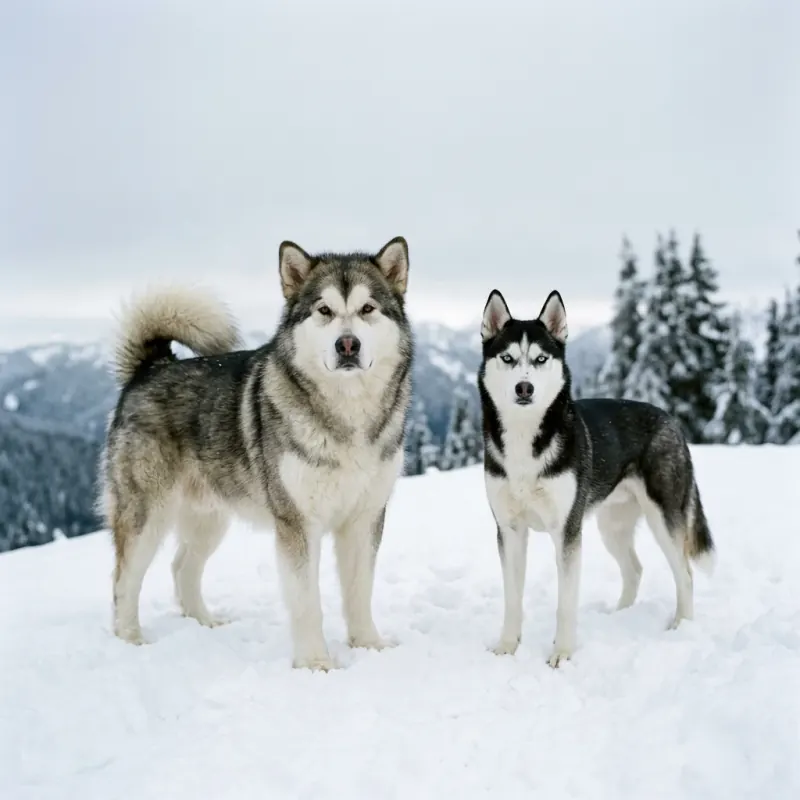
Search for these two breeds together and the question is almost always the same: which one is tougher in the cold? It is a reasonable thing to ask about two dogs that look like they were carved out of the same Arctic winter, and people cross-shop them constantly, usually on the assumption that a Malamute is a Husky scaled up.
The honest answer is not the one the question expects. At the level of the equipment they carry, neither one wins — and once you see why, the decision moves somewhere far more useful.
The short answer
They handle cold about equally well, because they are running the same hardware. The differences that matter are not thermal. They are about what each dog was built to do in the cold, and about how each one fits into a household for the next decade.
That is not a dodge. It is the actual finding, and it reframes the choice: stop asking which dog survives winter better, and start asking what you intend to be doing out there.
The hardware they share
Northern breeds are not simply well-insulated dogs. They carry a set of specific anatomical adaptations, described by the American Kennel Club, and the Husky and the Malamute both have the full set:
- A true double coat — reflective, bristly, water-resistant guard hairs roughly twice the length of the undercoat, sitting over a dense downy layer that traps warm air against the skin.
- Counter-current heat exchange in the paws. This is the one almost nobody knows about. Heat passes from the warm arterial blood into the cooler veins running alongside it, so warmth is returned toward the core instead of being dumped into the snow. The paw keeps working; the dog does not bleed its core temperature away through its feet.
- Broad paws that grip ice and spread weight over soft snow.
- Small, thick, furred ears — less surface area exposed to frostbite.
- A bushy tail that pre-warms inhaled air when curled over the face at rest.
- Extra footpad fat, which freezes more slowly than other tissue.
Our guide to the best cold-weather dog breeds goes through this system in detail, including the point where “built for cold” stops being true — which matters more than owners expect.
Here is the telling detail: even the Tufts weather assessment scale, the tool cruelty investigators use to judge whether conditions are dangerous, does not distinguish between them. It subtracts a single risk point for a northern or heavy double-coated breed. One point, for both.
So if the question is strictly whose body copes with low temperature, the two breeds are, for practical purposes, the same dog.
Where they actually diverge: two peoples, two problems
The split happened thousands of miles apart, and it was never about cold tolerance. It was about the job.
The Siberian Husky came from the Chukchi of north-eastern Asia, who needed a dog that could pull a light load over vast distances, in brutal cold, on relatively little food, working cooperatively in a team. Almost everything distinctive about the breed traces back to that brief.
The Alaskan Malamute came from the Mahlemut people of Kotzebue Sound, whose problem was the opposite one: heavy freight over shorter hauls, in the same cold. The AKC standard still makes the priority explicit — the Malamute is judged as a freight hauler above all else. The Malamute guide follows that inheritance through the rest of the breed.
Speed was never the Malamute’s point, and hauling power was never the Husky’s. They are both sled dogs in roughly the way a motorcycle and a tractor are both vehicles.
What that actually buys you, per breed
The Husky’s advantage: it does not run out
The endurance is not a marketing adjective. Researchers studying racing sled dogs documented a metabolic feat no human athlete can match. A person running a marathon burns through stored muscle glycogen and hits the wall. Sled dogs, covering distances that dwarf a marathon day after day, switch their metabolism within roughly 24 to 48 hours of sustained running — sparing glycogen and drawing energy almost entirely from fat. Dogs running on the order of 100 miles a day returned to near-resting metabolic values while still running, sustaining an estimated 10,000+ calories a day.
Pair that with the second Chukchi legacy — the AKC notes Huskies maintain their weight on less food than similar-size breeds — and you have a dog that is genuinely extraordinary at going a long way in the cold without much fuel.
The everyday version: a Husky is the better winter running, bikejoring and distance companion, and the better choice if the activity is measured in miles.
The Malamute’s advantage: it moves weight
A Malamute’s whole evolutionary brief was hauling. Loaded hiking, carting, pulling a pulk, skijoring — the AKC lists backpacking, sledding and skijoring among the breed’s own sports, and a Malamute does not merely put up with them.
That also cuts the other way, and it is worth being blunt: a Malamute is a poor road-running partner. It is built for power rather than speed, carries too much mass for repeated roadwork, and wears an Arctic coat while doing it. If running is the reason you want a dog, our best dog breeds for runners has better answers, and none of them is this breed.
The everyday version: a Malamute is the better winter hauling partner, and the better choice if the activity is measured in weight rather than distance. If that is your plan, note that a broad-framed, heavy-coated dog is genuinely hard to fit a pack to — our dog hiking backpack guide is the one to read first.
The differences that will decide it for you
Cold tolerance will not choose between these two. These will.
| Siberian Husky | Alaskan Malamute | |
|---|---|---|
| Size (male) | 21–23.5 in, 45–60 lb | 25 in, 85 lb |
| Size (female) | 20–22 in, 35–50 lb | 23 in, 75 lb |
| Bred to | Cover distance at speed, light load | Haul heavy freight, steady pace |
| Best winter activity | Running, bikejoring, distance | Loaded hiking, carting, skijoring |
| Worst at | Being contained | Road running, hot climates |
| Food | Less than similar-size breeds (AKC) | Ordinary large-breed appetite |
| Life expectancy | 12–14 years | 10–14 years |
| Physical management | Manageable by most adults | 85 lb bred to pull — train early |
The size row is the one people underweight. A male Malamute is commonly 25 to 40 lb heavier than a male Husky, and none of that weight is decorative. You do not out-muscle it on the end of a lead, so lead manners are a puppy job rather than an adult one. It also breaks gear sizing: a Malamute sits at or past the top of most manufacturers’ charts, and the largest listed size is not always large enough.
What neither of them is
Both breeds share a set of non-negotiables, and these sink more owners than the cold ever will.
Neither is an off-leash dog. The AKC’s Husky guidance is unusually direct: keep the dog on a leash, in harness, or in a fenced yard at all times. Malamutes bring a widely reported prey drive plus genuine escape talent and a habit of digging, so fencing needs to be tall and dug in. In winter country a loose northern breed covers ground fast and does not come back on request. A long line is the honest compromise for either — our recall training guide covers building the recall, and long lines covers what to clip it to.
Neither copes with heat. The coat that makes a blizzard a non-event is a liability in July, and this is the failure mode that fills emergency clinics. Dogs cool by panting rather than sweating; wrap that system in a dense double coat and the margin narrows fast. Move activity to the cool end of the day, and check the ground before you walk — our how hot is too hot guide has the thresholds.
Never shave either coat. The reason is the same for both breeds and the damage can be permanent; each breed guide sets it out.
Both shed, then shed properly. Year-round, plus a seasonal blow that lasts weeks and genuinely shocks first-time owners. There is no low-shedding version of either breed.
Neither is a guard dog. Both were bred to work in teams with people. Sociability is the norm; suspicion is not.
Living with each one, day to day
Neither breed is biddable in the way a retriever is biddable, and that catches people who have only owned gundogs. But they are independent in slightly different flavours.
The distinction that matters when you are choosing is the failure mode, not the temperament itself. A Malamute that declines is a stationary 85 lb problem — the difficulty is physical, and it is why early handling is not optional with this breed. A Husky that declines is already three streets away; the difficulty is containment. Same independence, two entirely different bad days, and the training approach that works is the same for both.
Both are vocal rather than barky, in the same register. Most owners find it charming and some neighbours do not, which is worth an honest thought if you share walls.
For what living with either actually involves day to day, the breed guides go into it properly: Alaskan Malamute and Siberian Husky.
Neither is a dog to leave alone all day. An under-worked, under-company northern breed is where every destruction story starts, and it is the same story for both.
The winter kit is the same for both
Because the hardware is shared, so is the gear answer, and it is shorter than people expect. Neither breed needs a coat — our dog winter coat guide is explicit that thick double-coated northern breeds risk overheating in one, which is the opposite of the problem you were solving.
What both do need is paw attention, and for the same reason: heavily furred feet, and the ice balling that ends more winter walks than cold ever does. Winter paw care has the free fix, and dog boots covers the gritted-pavement version of the problem.
The third one people should be looking at
If what actually drew you to these breeds was the northern look plus a dog that lives closely with its family, the Samoyed belongs on the shortlist — it is the one of the trio that most needs to be indoors with its people. It also carries a health picture worth reading before you fall for the smile, including an X-linked kidney disease and one of the highest diabetes risks of any breed.
So which should you get?
Choose the Siberian Husky if the winter activity you have in mind is measured in miles — running, bikejoring, long days on trail — and you want a slightly smaller, longer-lived dog that is easier to physically manage and cheaper to feed.
Choose the Alaskan Malamute if the activity is measured in weight — loaded hiking, carting, hauling — you have the fencing and the space, and you want the bigger, more independent dog. Take the breed guide’s health panel to the breeder before you commit — the Malamute’s is the longer of the two.
Choose neither if you want a dog you can let off the lead, you live somewhere hot, or the appeal is mainly how the breed photographs. That last one is how most of both breeds end up in rescue.
Read the full pictures before you commit: our Siberian Husky guide covers the containment reality in practice, and the Alaskan Malamute guide covers the health testing and the honest household version of an 85-pound freight dog. For where both sit against the rest of the field on veterinary data rather than vibes, start at the best adventure dog breeds.
Sources
- American Kennel Club — Official Standard of the Alaskan Malamute (freight-hauler judging note; desirable freighting size of 25 in / 85 lb males, 23 in / 75 lb females)
- American Kennel Club — Official Standard of the Siberian Husky (heights, weights)
- American Kennel Club — Siberian Husky and Alaskan Malamute breed pages (life expectancy, listed sports, Chukchi and Mahlemut origins, containment guidance, feeding note)
- American Kennel Club — how northern breeds tolerate cold (double coat structure, counter-current heat exchange, ear and tail adaptations, footpad fat)
- American Kennel Club — “Do Dogs Sweat?” (thermoregulation by panting; merocrine glands in the paw pads)
- Miller BF, et al. — Metabolic and Molecular Responses in Ultra-Endurance Sled Dogs, Integrative and Comparative Biology (2021) — the glycogen-sparing metabolic switch
- Tufts Animal Care and Condition weather safety scale — risk adjustment for northern and heavy double-coated breeds
Frequently asked questions
Which handles cold better, a Husky or a Malamute?
At the level of anatomy, neither — they carry the same northern-breed equipment. Both have the dense double coat, the counter-current heat exchange in the paws that keeps feet working without bleeding core heat, the broad ice-gripping paws, the small furred ears and the bushy tail that pre-warms inhaled air. The Tufts weather scale used by cruelty investigators does not separate them either; it subtracts the same risk point for any northern double-coated breed. The useful question is not which one survives the cold but what you want to do in it: the Husky is built to cover distance, the Malamute to move weight.
Is a Malamute just a bigger Husky?
No, and this is the most common mistake made about the two. They were developed by different peoples for opposite trade-offs — the Chukchi bred the Siberian Husky to pull a light load fast over vast distances on relatively little food, while the Mahlemut bred the Alaskan Malamute to haul heavy freight at a steady working pace. The AKC standard is explicit that a Malamute is judged as a freight hauler above all else. They are both sled dogs in roughly the way a motorcycle and a tractor are both vehicles.
Which is bigger, a Husky or a Malamute?
The Malamute, by a wide margin. The AKC gives a desirable freighting size of 25 inches and 85 lb for male Malamutes and 23 inches and 75 lb for females. Siberian Huskies run 21–23.5 inches and 45–60 lb for males, 20–22 inches and 35–50 lb for females. So a male Malamute is commonly 25–40 lb heavier than a male Husky, which changes almost everything practical: lead manners, gear sizing, food bills and how much dog you have to physically manage.
Can either one be trusted off-leash in the snow?
Plan on no. The AKC's guidance on the Siberian Husky is unusually blunt — it calls it vital to keep the dog on a leash, in harness, or in a fenced yard at all times. Malamutes carry a widely reported prey drive and a real talent for escaping, and both breeds cover ground fast and do not come back on request. In winter wilderness that combination is genuinely dangerous. A long line is the honest middle path for either breed.
Which one eats less?
The Husky, and this one is documented rather than folklore: the AKC notes that Siberian Huskies maintain their weight on less food than similar-size breeds, a trait that traces directly back to Chukchi selection. It also means they are easy to overfeed. We deliberately do not repeat the same claim for the Malamute — it circulates widely, but we could not find it stated for that breed by a source worth citing, and a Malamute is a substantially larger dog in any case.
Which lives longer?
The Husky, slightly, and it is worth factoring in. The AKC gives 12–14 years for the Siberian Husky and 10–14 years for the Alaskan Malamute. The Malamute also carries a longer list of breed-specific conditions, though most of them are testable, so a good deal of that gap sits in the buyer's hands rather than in the breed itself.
Comments
Got a question, a tip, or a correction? Leave a comment — no account, no sign-in. Just your name and your thoughts.
Loading comments…