
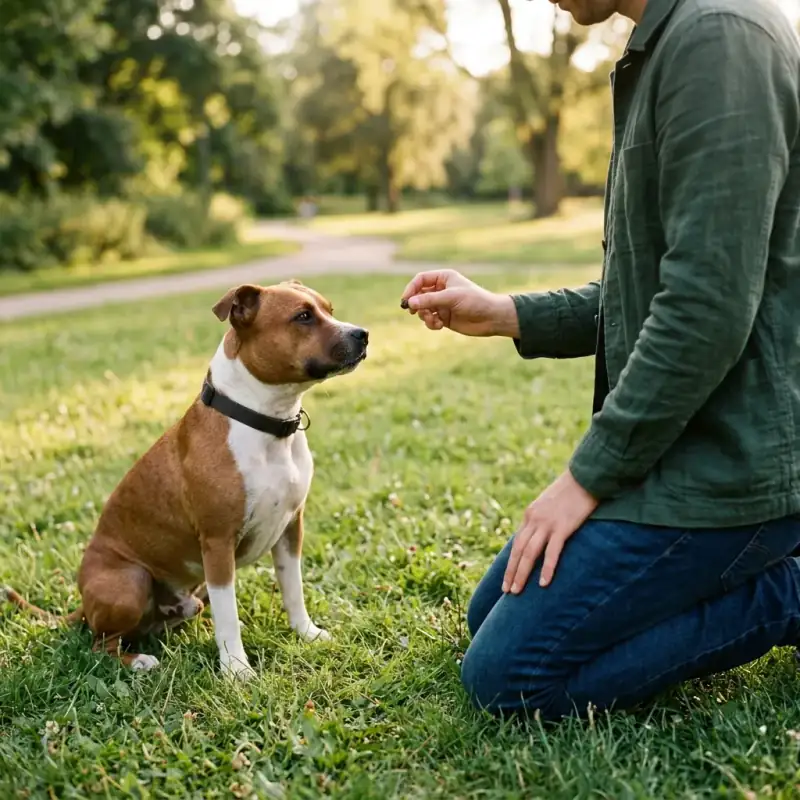
Every list like this ranks breeds by temperament. Calm dog, good beginner dog; intense dog, bad beginner dog.
There’s a problem with that, and it comes from the largest study ever done on the question.
In 2022, Morrill and colleagues published work in Science based on owner surveys of 18,385 dogs and DNA sequencing of 2,155 of them. The finding: breed explains only about 9% of the variation in behaviour between individual dogs. Behavioural traits are heritable — but they differentiate breeds only subtly.
Which means a beginner list ranked on “temperament” is ranking something breed barely controls. Nine percent is not nothing. It is nowhere near enough to carry the weight these lists put on it.
So this list is ranked on something breed genuinely does predict.
What this list actually ranks
Breed is a strong predictor of size, coat, exercise capacity, and the cost of failure. It’s a weak predictor of personality.
For a first-time owner, the useful question isn’t “which breed is nicest.” It’s how much slack does this breed give someone who is going to get things wrong? Because you will. Recall will be inconsistent for months. Training will be patchy in week six. You will misjudge how much exercise a wet week needs.
So each breed here is rated on three things:
- Recovery from handler error — how quickly the dog bounces back from inconsistent training
- Cost of a containment failure — what happens if the recall doesn’t hold in open country
- Honest exercise floor — what the dog needs on your worst week, not your best
That framing also lets us rank breeds we admire enormously near the bottom without pretending they’re bad dogs.
The thing that matters more than any of this
Before the list, the finding that should genuinely change what you do.
Patronek and colleagues studied the risk factors for dogs being relinquished to shelters. The modifiable predictors — the ones an owner controls — were: not attending an obedience class after acquiring the dog, lack of veterinary care, keeping the dog sexually intact, frequent inappropriate elimination, and inappropriate expectations about care.
Breed is not on that list.
Two other datasets point the same way. Salman and colleagues, surveying 12 US shelters and 1,984 canine relinquishments, found 40% of relinquished dogs had at least one behavioural reason cited. And a systematic analysis of 2,836 shelter records from 2018–2023 (Kisley et al., Animals, 2024) found that for dogs specifically, the most frequent reasons given were behaviour issues (35%), unable to care (19%) and housing or moving (15%).
Read those together and the conclusion is uncomfortable for an article like this one: which breed you choose matters less than whether you book a training class. Do that first. Then pick a breed.
Tier 1 — the forgiving ones
These give a beginner the most room to make mistakes.
Labrador Retriever
The default recommendation, and it earns it. Biddable, food-motivated, and genuinely forgiving of inconsistent handling — a Labrador that’s been trained badly for three months is usually still a pleasant dog to live with, which is not true of every breed here.
Trail-capable, water-loving, sociable with people and dogs. The honest caveats: they’re strong and energetic, and the breed carries a documented obesity predisposition that makes portion discipline a real ongoing job. Full detail in our Labrador Retriever guide.
Exercise floor: an hour a day, minimum, every day.
Golden Retriever
Everything said about the Labrador, with more coat and a slightly softer edge. Exceptionally people-oriented and among the easiest breeds to train for a beginner.
Two honest notes. The breed carries a heavy cancer burden, which we cover properly in the Golden Retriever guide — it’s the single most important thing to understand before choosing one. And the AKC’s own advice on the breed is that “consultation with a vet is recommended before starting strenuous or high-impact activities.”
Exercise floor: an hour a day, plus grooming time you’ll underestimate.
Brittany
Less famous than it should be for this list. Smaller than the retrievers, genuinely athletic, and notably eager to work with people rather than independently of them — which is exactly the trait that makes a first dog easier.
The trade-off is energy: this is a working gundog, not a low-key companion, and a bored Brittany is a busy Brittany.
Exercise floor: an hour of real activity, ideally including off-lead running in safe ground.
Tier 2 — good, with a condition attached
Excellent dogs where one specific factor needs your attention.
German Shorthaired Pointer
Superb trail and running dog, affectionate, trainable. The condition is that GSPs are intensely people-bonded and prone to separation anxiety — this is not a breed to leave alone for a full working day. If someone’s home most of the time, it’s a wonderful first adventure dog. Detail in our GSP guide.
Australian Shepherd
Trainable, versatile and a brilliant hiking companion. The condition is that Aussies need a job. Without one, that intelligence turns inward and produces exactly the behaviours that get dogs surrendered.
A first-time owner who’s genuinely enthusiastic — training classes, dog sports, real hikes — will do well. One who wants a dog to fit around an existing life will struggle. See the Australian Shepherd guide, and our Aussie versus Border Collie comparison if you’re weighing the two.
Standard Poodle
Underrated as an adventure dog because of the haircuts. Highly trainable, athletic, and a genuine retriever underneath — the AKC puts the Standard at over 15 inches and 40–70 lb, so this is a full-size dog.
The condition is grooming, and it’s the one people underestimate. A Poodle coat doesn’t shed out; it keeps growing and mats if left, which makes regular professional grooming a permanent standing cost rather than an occasional treat. Get a specific schedule and price from a local groomer before you commit, because it varies and it doesn’t stop.
Nova Scotia Duck Tolling Retriever
The smallest of the retrievers and a genuinely good option for someone who wants retriever biddability in a dog that fits a smaller house and car. Trail-capable and water-mad.
The condition is that Tollers are more sensitive and more intense than their bigger cousins — they’re a working retriever in a compact frame, not a scaled-down Labrador temperament. They suit an active, attentive owner rather than a relaxed one.
English Springer Spaniel
Cheerful, sturdy, endlessly willing, and one of the better hiking companions in a mid-size package. The condition is exercise volume and the coat’s talent for collecting every burr on the trail. A Springer that gets enough work is an easy dog; one that doesn’t is a busy, vocal, bouncing problem. Our English Springer Spaniel guide covers the elbow and enzyme questions worth asking a breeder.
Tier 3 — wait until your second dog
Not lesser dogs. Harder ones — and the honesty here is the point.
Border Collie
The AKC’s own line is the fair warning: “not for someone who prefers to stay indoors.” Extraordinary dogs, and extraordinarily unforgiving of a handler who can’t keep up mentally. Our Border Collie guide and are Border Collies easy to train? cover why “highly trainable” and “easy” are not the same claim.
Siberian Husky
The containment cost is what disqualifies this one for beginners. The AKC states it’s “vital to keep the dog on a leash, in harness, or in a fenced yard at all times.” A recall failure with a Husky in open country isn’t a training setback, it’s a search. Add heavy shedding and real heat sensitivity. See the Siberian Husky guide.
German Shepherd
Capable of almost anything, which is the problem — a GSD amplifies whatever handling it gets. The AKC advises “do not let the dog off leash, as even the best-trained dog can become distracted.” Powerful, needs structure, and needs it early. German Shepherd guide.
Belgian Malinois
We wrote the Belgian Malinois guide largely to talk people out of the breed, and that stands. It is not a first dog. It is arguably not a tenth dog for most people.
Alaskan Malamute
Strong, independent, an escape artist and a serious grooming commitment — and, as our Alaskan Malamute guide explains, built for hauling rather than for the running most beginners imagine. A second or third dog, in a cold climate, for someone who wants to do sled sports.
Puppy or adult?
Most first-time owners assume puppy, and it’s worth actually deciding rather than defaulting.
A puppy gives you the whole history, which matters if you want to do dog sports or need a particular temperament shaped from the start. It costs you four months of broken sleep, house-training, and a period where you cannot exercise the dog properly — a point our puppy exercise guide covers, because the restrictions are real and the popular advice about them is wrong.
An adult — from a breed rescue or a general shelter — gives you a dog whose personality you can see. Given the 9% figure, that’s not a small advantage; it’s arguably the single best information source available to a first-time owner. You inherit whatever the dog learned before you, good and bad, and a good rescue will be honest about which.
For a first dog, an adult in the two-to-five-year range from a rescue that assesses its dogs properly is an underrated option — and it skips the phase where most first-time owners feel out of their depth.
Your first ninety days
Whatever you choose, this is where the outcome is decided.
- Book the training class before the dog arrives. This is the one with actual evidence behind it. A class also gives you a person to ask when something odd happens in week three.
- Register with a vet in the first week, before you need one urgently.
- Decide the house rules with everyone who lives there, and write them down. Inconsistency between people is harder on a dog than any single rule.
- Start recall immediately and don’t rush it. Our recall guide treats it as a months-long project, which is what it is. A long line buys the dog freedom while the recall is still unreliable.
- Be conservative with exercise if it’s a puppy, and be honest about the daily hour if it’s an adult.
- Expect a patch where you doubt the whole thing. We’re not going to attach a timeline to it, because we haven’t found one that’s actually been measured — but it’s near-universally described by new owners, and Patronek’s finding that inappropriate care expectations predict surrender suggests the doubt itself is a normal part of the process rather than a signal you chose wrong.
The choice that isn’t on this list
Consider an adult rescue dog.
Given that breed explains around 9% of behavioural variation, the personality of the specific dog in front of you is far better information than any breed profile — and with an adult, that personality is already visible rather than forecast. A good rescue will have assessed the dog and will tell you honestly what it needs.
For a first-time owner, “this individual dog is calm with strangers and walks nicely” beats “this breed is described as calm” by a wide margin.
What about mixed breeds and doodles?
Two honest notes, and the research above bears directly on both.
Mixed-breed dogs. If breed explains around 9% of behavioural variation, a mix is not the behavioural lottery people fear — it’s roughly the same modest signal, blended. And the label itself is shakier than it looks: Voith and colleagues found that visual breed identifications by adoption agencies matched the predominant breed found by DNA analysis only about 25% of the time, dropping to 16% for mixed-breed dogs. A later study of shelter dogs found staff named a breed that DNA couldn’t detect at all — even at the great-grandparent level — for roughly a third of dogs. So a mixed-breed label is frequently a guess. Meet the dog; that’s better data than the label either way. On the health side of the same question — whether mixed breeds are genuinely healthier, which is the reason many first-time owners choose one — the evidence is more mixed than the slogan: we went through it here.
Doodles. Poodle crosses are enormously popular with first-time owners and are usually sold on two claims: hypoallergenic, and the best of both parents.
On the first, we can be firm, because it doesn’t depend on the cross at all: no dog is hypoallergenic. Allergic reactions are to dander, saliva and urine rather than to hair, which is why the Samoyed’s own parent club has to keep publicly correcting the same claim about a completely different coat type.
On the second, we’re going to be honest about the state of the evidence rather than pretend: the claim that doodle coat type varies unpredictably between littermates is repeated constantly, including by doodle breeders themselves, but we couldn’t find it established by a source meeting the bar we hold everything else here to. Treat it as a widely-reported caution rather than a fact — and note that if it is true, it argues against the hypoallergenic promise rather than for it.
None of this makes them bad dogs. It means at least one of the two things they’re most often sold on doesn’t hold, which is a slightly odd foundation for a first-dog decision.
The short version
Book the training class. Be honest about the wet-Tuesday exercise number rather than the sunny-Saturday one. Then choose from Tier 1 or 2, or meet an adult rescue dog and pick the individual.
The breed is the part of this decision everyone obsesses over and the part the evidence says matters least. That’s genuinely good news: it means a first-time owner who prepares well can succeed with most of this list, and one who doesn’t will struggle with any of it.
If you’re ready to start planning trips, our adventure dog breeds hub covers the wider field, how to start hiking with your dog covers the first outings, and how much exercise does a dog need sets a realistic baseline.
Sources
- Morrill K. et al. (2022). “Ancestry-inclusive dog genomics challenges popular breed stereotypes.” Science 376:eabk0639
- Patronek GJ et al. (1996). “Risk factors for relinquishment of dogs to an animal shelter.” Journal of the American Veterinary Medical Association 209(3):572 (PMID 8755975)
- Salman MD et al. (2000). “Behavioral reasons for relinquishment of dogs and cats to 12 shelters.” Journal of Applied Animal Welfare Science 3(2) — 1,984 canine relinquishments, 40% with at least one behavioural reason
- Kisley MA, Chung EJ, Levitt H (2024). “Investigating the Reasons behind Companion Animal Relinquishment: A Systematic Content Analysis of Shelter Records for Cats and Dogs, 2018–2023.” Animals 14(17):2606 — dog-specific figures used above
- Voith VL et al. — comparison of adoption-agency breed identification with DNA breed identification; and “A canine identity crisis: genetic breed heritage testing of shelter dogs,” PLOS ONE (2018)
- American Kennel Club — official breed pages for each breed listed (exercise descriptions, containment guidance and life expectancy)
Frequently asked questions
How much should a first-time owner trust breed recommendations?
Much less than the listicles assume. The largest study on this — Morrill and colleagues, published in Science in 2022, surveying owners of 18,385 dogs and sequencing 2,155 — found that breed explains only about 9% of the variation in behaviour between individual dogs. Behavioural traits are heritable, but they differentiate breeds only subtly. Breed reliably predicts size, coat and exercise capacity. It is a weak predictor of the individual dog's personality, which is why choosing purely from a temperament ranking disappoints so many first-time owners.
What actually makes a dog work out for a first-time owner?
Preparation, mostly. Patronek and colleagues, studying the risk factors for dogs being surrendered to shelters, found the modifiable predictors were things like not attending an obedience class after getting the dog, lack of veterinary care, keeping the dog sexually intact, and — tellingly — inappropriate expectations about care. None of the modifiable factors was breed. The single most useful thing a first-time owner can do is book a training class before the dog arrives.
Is a Labrador really the best first dog?
It is a genuinely good default, and for defensible reasons: a Labrador is biddable, forgiving of handler error, motivated by food, and comfortable with the level of inconsistency a beginner will inevitably produce. The honest caveats are that Labs are strong, energetic dogs that need real exercise, and that the breed carries a documented obesity predisposition, so 'easy' does not mean 'low effort.' It means the dog recovers well when you get things wrong.
Should a first-time owner avoid Border Collies and Malinois?
For most, yes — and not because they're bad dogs. They're the opposite: they're extremely capable dogs that convert handler mistakes into problems fast. The AKC says of the Border Collie that it is “not for someone who prefers to stay indoors,” and the Belgian Malinois has a well-documented rescue-surrender problem driven almost entirely by people buying more dog than their life can absorb. If you have the time, the experience and a sport to point them at, they're superb. As a first dog with a full-time job, they're a hard road.
Is a rescue dog a bad idea for a first-time owner?
Not at all, and there's a specific advantage: an adult rescue dog's personality is already visible, whereas a puppy's is a forecast. Given that breed explains only about 9% of behavioural variation, meeting the actual dog is better information than reading the breed profile. Good rescues assess their dogs and will match you honestly. The caveat is the same as for a puppy — be realistic about exercise and training commitment rather than about breed labels, which for mixed-breed dogs are often guesses anyway.
How much exercise should a first-time owner plan for?
Plan for the top of the breed's range on your worst week, not the middle of it on your best. Every breed here needs daily activity, and the gap between 'we'll take it hiking at weekends' and what the dog needs on a wet Tuesday in February is where most beginner difficulty lives. If the honest answer is under an hour a day, choose from the calmer end of this list rather than hoping the dog adapts.
Comments
Got a question, a tip, or a correction? Leave a comment — no account, no sign-in. Just your name and your thoughts.
Loading comments…