
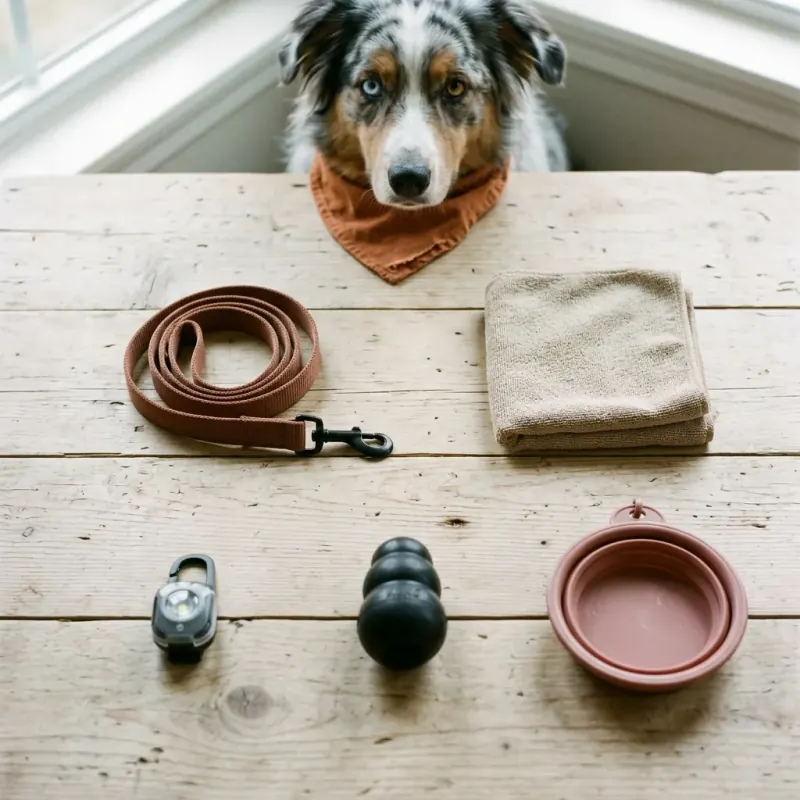
Most price-capped gift lists have an apologetic quality to them. Here’s what you can get for fifty dollars — the implication being that the good stuff is further up the page, and this is the consolation section.
For dog gear, that’s backwards, and there’s a structural reason why.
Almost everything above $50 in a dog catalogue is sized to an individual dog. Harnesses, coats, boots, packs, life jackets — the expensive categories are the fitted ones, sized off chest girth or back length or paw width, with charts that aren’t interchangeable between brands. Which makes them exactly the things you cannot buy for someone else’s dog without a tape measure and an awkward conversation.
Run those two facts together and something useful falls out: the under-$50 band and the safe-to-gift band are very nearly the same set. The price cap isn’t costing you the good options. It’s filtering out the ones that were going to be returned.
So this isn’t a consolation list. It’s most of the list.
On links: products below link to Amazon and we may earn a commission if you buy through them. Everything here is drawn from a guide we’ve already written. Prices move constantly and vary by size — the bands below are typical rather than promised, and the large size of a few items will push past the top of its band. Check before you buy.
Under $15: the ones that get used the same day
This band is where the hit rate is highest, because everything in it solves a problem the owner already has and hasn’t got round to.
Disclosure: some links below are affiliate links. If you buy through them we may earn a small commission at no extra cost to you.
Check Dog Safety Lights on Amazon →
A clip-on collar light. From November, most dog walks in most of the northern hemisphere happen in the dark at one end or both. A light costs less than a sandwich, fits any dog, needs no measurements, and is used every single evening for five months. If you buy one thing from this page, buy this.
Check Collapsible Dog Bowls on Amazon →
A collapsible travel bowl. The item every owner intends to buy and never does, because it’s never quite urgent. Lives in a coat pocket or a glovebox permanently.
Check Dog Paw Balm on Amazon →
Paw balm. Seasonally right and genuinely evidence-backed as part of a winter routine — Cornell’s veterinary guidance recommends applying it before walks and wiping the feet afterwards. Our winter paw care guide is honest about where it ranks, though: it’s fourth on the list of things that help, behind a haircut between the pads and washing the feet, both of which are free. Good gift, modest miracle.
Check Dog Waste Bags on Amazon →
Waste bags, in bulk. Genuinely unromantic and genuinely welcome. Nobody has ever regretted having too many. Best used as the filler in a bundle rather than as the gift itself.
$15–30: the workhorses
Check the KONG Extreme on Amazon →
The black KONG. The tough-rubber version, and the default for a reason: stuffable, freezable, and it outlasts dogs that destroy everything else. It sizes by dog size, but sizing up is harmless — which makes it one of the very few rubber toys you can buy without knowing anything about the recipient.
Check the West Paw Toppl on Amazon →
The West Paw Toppl. Wider opening, much easier to stuff and clean. The better first food toy of the two if you don’t know how experienced the dog is with them.
Check Dog Drying Towels on Amazon →
A microfibre drying towel. The wet-dog problem is universal, twenty minutes long, and solved almost entirely by owning one towel designed for it instead of a bath towel that wasn’t. We have never seen this on a gift list and we don’t understand why.
Check the KONG Wobbler on Amazon →
A food-dispensing feeder. Turns a thirty-second meal into a fifteen-minute job. Particularly good for a dog whose exercise is about to be cut short by five months of bad weather — our guide to how much exercise a dog needs covers why mental work substitutes for physical work better than most owners expect.
Check the Chuckit Ultra Ball on Amazon →
A proper fetch ball. Bouncier and far more durable than a tennis ball, and without the abrasive felt that grinds down teeth over years of hard fetching. Cheap enough to buy several, which you will.
$30–50: the ones that feel like a real present
Check Dog First-Aid Kits on Amazon →
A canine first-aid kit. The best gift in this band, and the clearest example of the category’s whole logic: it’s a thing every owner agrees they should own and almost nobody buys, because buying it means sitting with the reason you’d need it. You do the thinking, they get the kit. It appears on our camping checklist and our road trip checklist for the same reason.
Check BioThane Long Lines on Amazon →
A BioThane long line. For anyone with a young dog, a rescue, or a breed with opinions about coming back. BioThane doesn’t soak, doesn’t hold mud and doesn’t burn hands the way wet nylon does — the difference is much larger in practice than it sounds, as our long line guide gets into. Pair it with our recall training guide and it becomes a gift that says you noticed what they’re working on.
Check the Goughnuts MaXX ring on Amazon →
The Goughnuts ring, for the dog that has already destroyed everything else. It has a red inner layer that becomes visible once the outer layer is chewed through — an actual wear indicator, which in a category built on unfalsifiable “indestructible” claims is close to unique.
Check Puzzle Feeders on Amazon →
A proper puzzle feeder. More involved than a stuffed toy and better suited to a dog that solves the easy ones in thirty seconds. The failure mode to know about: some dogs solve these by chewing the puzzle, which is the ingestion problem our Labrador toy guide treats as the real risk in this category — not durability.
What $50 does not buy — and why you should not buy the cheap version
This is the section that saves you the most, and it’s the reason a price-capped list needs a ceiling as well as a floor.
Four categories sit above this band, and in all four the discount version is not a smaller version of the good thing. It’s a different thing that looks similar in a photograph.
A crash-tested car restraint. The gap between a harness that has been through independent crash testing and one that merely has thick webbing and metal-look hardware is invisible until the moment it matters. Our car harness guide covers what the testing actually shows. This is the one category on the whole site where we would rather you spent full price than found a bargain.
A GPS tracker. Not because the hardware costs more than $50 — some doesn’t — but because most trackers are subscription devices, and a plan at $120/year is roughly $360 in fees over three years. The tracker guide works through that arithmetic. A cheap tracker with an expensive plan is the most expensive item on this page.
A serious winter coat. The coat guide is built on measured heat-loss testing from two independent teams, and the results do not flatter the budget end. It’s also sized to the individual dog, which puts it out of gift range regardless of price.
A load-bearing hiking pack. A dog pack carries weight against a moving spine. Our pack guide covers why fit and load distribution matter more here than in any other soft goods category, and cheap packs fail on exactly those.
The rule underneath all four: when failure means “buy another one,” cheap is fine. When failure means an injury, cheap is the worst available option. Under $50 covers everything in the first group and almost nothing in the second, which is a coincidence worth respecting rather than working around.
Three things not to buy at any price
Anything sold as “indestructible.” It’s an unfalsifiable claim and it’s usually attached to a toy with no way of telling when it’s failing. The Goughnuts ring’s red inner layer is the honest version of this idea, and it’s rare.
Retractable leads. They teach a dog that pulling produces more line, which is the exact lesson you don’t want, and the thin cord is a genuine injury risk to hands and legs.
Novelty. The mug, the doormat, the bandana with the joke on it. It’s not that they’re bad, it’s that they’re a substitute for the twenty minutes it takes to think of something that gets used.
How to make $50 feel like more
The single biggest improvement available here costs nothing: bundle by problem, not by price.
Three items that together solve one thing read as a considered present. The same money spread across three unrelated objects reads as a raid on a shelf. Four bundles that work:
- The dark-walk kit — collar light, reflective lead, and a head torch for the human. Right for the season, and the human item is what makes it a gift for the owner rather than the dog.
- The wet-dog kit — microfibre drying towel, paw balm, and a boot tray or mat for the door.
- The recall kit — a BioThane long line, a decent treat pouch and a bag of high-value treats. For anyone with a dog under two.
- The car kit — collapsible bowl, a towel and a first-aid kit for the boot. Pairs with the road trip checklist if they’re driving over the holidays.
Each of these lands under or near $50 and each solves something the owner is currently solving badly.
The bottom line
The cap isn’t the constraint you think it is. Above $50, dog gear is mostly fitted gear, and fitted gear isn’t giftable. You aren’t missing much.
Buy the boring things. A light, a towel, a bowl, a first-aid kit. Used constantly, never bought for oneself, sized to fit every dog that has ever lived.
Don’t buy the cheap version of a safety item. Car restraints, life jackets, load-bearing packs. If the budget is $50 and the need is a crash-tested harness, the right move is to give something else and say so.
Bundle by problem. It’s free and it’s the difference between a present and a parcel.
If you want the fuller argument about which gifts fail and why, the gift guide for adventure dog owners sorts the whole category on fit, and Christmas gifts for dog owners sorts it on who the present is actually for — which is the question most lists never ask.
Sources
- Product reasoning throughout is drawn from our own gear guides, linked inline; specifications read from live amazon.com listings
- Cornell University College of Veterinary Medicine — Keeping your furry friends safe during winter weather — paw balm before walks, wiping afterwards
- Price bands reflect typical listing ranges at the time of writing and vary by size; Amazon pricing moves daily and should be checked before purchase
Frequently asked questions
What is a good cheap gift for a dog?
A durable rubber food toy is the most reliable inexpensive gift there is, because durability is a property of the toy rather than of the dog — you don't need to know anything about the animal for it to work. A clip-on collar light is the runner-up and arguably the more useful of the two from November onward, when most walks happen in the dark at one end or the other. Both sit well under $25 and both get used within a day.
What can you get a dog owner for under $25?
More than you would expect, because the useful end of dog gear is cheap and the expensive end is mostly things sized to a specific dog. Under $25 covers a collar light, a collapsible travel bowl, paw balm, a decent microfibre drying towel, a tin of good treats, waste-bag holders and most single rubber toys. The trick is to buy two or three that solve the same problem rather than three unrelated things — a bundle reads as considered, three loose items read as a raid on a shelf.
Is cheap dog gear worth buying?
It depends entirely on the failure mode. For a toy, a bowl or a towel, failure means you buy another one — cheap is fine, and often the expensive version is no better. For anything doing a safety job, failure means an injury, and the cheap version is the worst purchase in the category. Car restraints are the clearest case: the gap between a crash-tested harness and one that merely looks sturdy is not visible in a photograph, and it is not a gap a low price should talk you across.
What should you avoid buying as a cheap dog gift?
Three things. Anything advertised as "indestructible," which is an unfalsifiable claim and usually attached to a toy with no wear indicator. Retractable leads, which teach a dog to pull by rewarding it with more line and are disliked by most trainers. And the budget version of any safety item — car restraints, life jackets, anything load-bearing — where a low price is buying you the appearance of the thing rather than the thing.
How do you make a small dog gift feel more generous?
Bundle by problem rather than by price. Three items that together solve one thing — a light, a reflective lead and a head torch for winter walks, say — read as a thought-out present. The same money spread across three unrelated objects reads as filler. It costs nothing extra and it is the single biggest difference between a gift that lands and one that gets a polite thank-you.
Comments
Got a question, a tip, or a correction? Leave a comment — no account, no sign-in. Just your name and your thoughts.
Loading comments…