
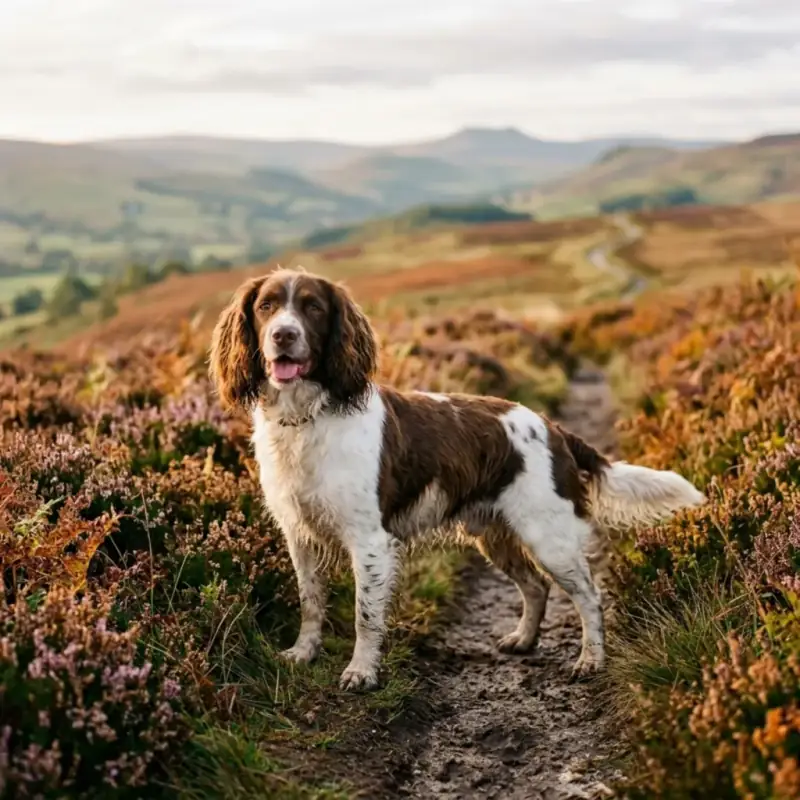
The name is the job description. Before guns, spaniels were used to “spring” game — to drive birds and ground game out of cover towards nets, hawks and coursing hounds. The breed’s parent club records that the smaller puppies in a litter were used on woodcock and called “cockers,” while their bigger littermates did the flushing and were called “Springers.” The breed standard still describes that bigger dog: one that “looks the part of a dog that can go, and keep going, under difficult hunting conditions,” in a coat it calls “substantially waterproof, weatherproof and thorn proof.”
Read as a hiker, that sounds like the ideal trail partner, and in most ways it is. But the breed’s research record points somewhere the usual breed guide never goes. The pages you will find list hips, ears and eyes. The studies point to the elbow, where Springers are over-represented in adult joint disease and in puppy fractures; to an inherited enzyme defect whose crises are set off by hard exercise and heavy panting; and to the eye DNA test every responsible breeder runs, whose “affected” result, it turns out, rarely means a blind dog.
This guide covers all three, plus the split that makes “English Springer Spaniel” two quite different dogs, and the honest test of whether your life suits one.
English Springer Spaniel at a glance
| Height | 20 in (males), 19 in (females) — the standard’s ideal |
| Weight | About 50 lb (males), about 40 lb (females) |
| Life expectancy | 12–14 years (AKC); a measured median of 13.5 years in UK data from 2024 |
| Coat | Medium-length outer coat over a dense undercoat, feathered on the ears, chest, legs and belly |
| Colours | Black or liver with white, blue or liver roan, or tricolour |
| AKC scores | Energy 4 of 5 · mental stimulation 4 of 5 · trainability 5 of 5 |
| Adventure verdict | A tireless, biddable all-day hiking and swimming companion — if you can give it real work every day, and will ask the breeder about elbows and enzymes first |
The standard, approved in 2023, supplies the size, coat and colours, and the AKC supplies the life expectancy and the scores; the 13.5-year median is explained under Lifespan, further down. The verdict is ours. Stamina on this scale usually comes with an independent streak, and the Springer’s standard asks for the reverse: a dog that is “friendly, eager to please, quick to learn and willing to obey.”
Two dogs under one name: field and show
Ask a Springer owner which kind they have, and they will know what you mean. The parent club’s own history explains the split. In the breed’s early American years, “dogs might emerge from a day of heavy field work to be presented in conformation competition the next day.” That did not last. “Dual type” Springers — dogs that could win in both the show ring and field trials — “became a part of history by the early 1940’s, when the last dual championship was earned.” Since then, field-trial breeders have selected for performance, and show breeders for the written standard. The club’s summary is diplomatic: competitive field Springers are “the ultimate in athleticism and performance,” and show Springers “breathtaking examples of breed type, soundness, and symmetry.”
The two lines share a name and a registry, and the research keeps finding differences between them:
- Eyes. In the largest study of the breed’s commonest eye-disease gene, the variant turned up in both types, but “less frequently in the field-bred” dogs.
- Temperament. A national US survey of 1,053 Springers found owner-directed aggression associated with show or bench lines, among several other factors (more below).
- Metabolism. The enzyme disorder covered later in this guide was described in 2001 as “commonly observed in field trial (working)” Springers, though it had also turned up in US show lines.
None of this makes one line better. It makes “Which line, and what do the parents do?” the first question to ask a breeder, because the answer changes which health and temperament questions come next.
Exercise: what “keep going” means on a trail
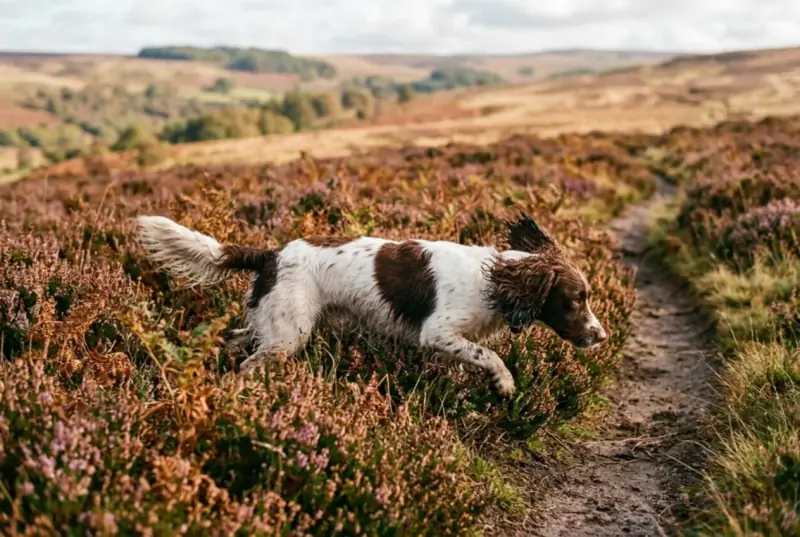
The AKC describes a dog “built for long days in the field” that makes a great companion “on long walks or hikes,” scores its energy 4 out of 5 and its need for mental stimulation 4, and recommends daily exercise in the form of long walks and play. The Royal Kennel Club in the UK, where the Springer is “the most popular of the spaniels for working in the field,” is more specific: more than two hours a day.
Neither figure is a measurement — no study has timed what a Springer needs — but the job explains the scale. A flushing spaniel’s work is to search the cover in front of its handler with its nose, and the AKC’s spaniel hunting tests score it on “range, pattern, gun response and response to commands.” On a hiking trail, expect a dog that covers far more ground than you walk and works its nose the whole time. The AKC suggests obedience, tracking, agility and rally for the mind; scent games at home do the same job on days without a trail.
The breed lasts, too. In a UK owner survey of 665 working gundogs, Springers stopped working at a median age of 11, and across all the breeds, lameness was the most common reason a dog retired — worth remembering when you read the elbow section below. The one thing a Springer handles badly is being left out. The AKC puts it plainly: “undesirable behaviors can result if he is regularly left alone for long periods of time.” A Springer is a dog for people who take the dog with them.
Off leash: a dog bred to come back
A Springer’s job does not end at the flush. The AKC defines the flushing spaniel’s purpose as to “hunt, find, flush and return birds to hand as quickly as possible in a pleasing and obedient manner.” Unlike a hound bred to work alone at a distance, a Springer is bred to work in front of a person and come back to them, which makes it one of the more realistic candidates for reliable off-leash hiking.
Realistic is not automatic. “Response to commands” is the trained half of that description; the nose and the flush are the instinctive half, and on a trail full of birds the instinct gets a lot of practice. Build the recall deliberately with our recall training guide, use a long line while it is still a work in progress, and follow leash rules wherever they apply — a Springer flushing a nesting bird is doing exactly what it was bred to do, in exactly the wrong place.
Heat, water and that coat
The trail card above holds the number that surprises people: in the largest UK study of heat-related illness, Springers had significantly higher odds than Labradors, despite being medium-sized dogs with normal muzzles. The study cannot say why. What the same research does show, as our running guide sets out, is that most canine heat illness is brought on by exercise, not by a hot day alone — and a Springer searching cover flat-out on a warm morning is that case exactly. Hike the long days in cool weather, start early in summer, and treat water stops as part of the route rather than a break from it.
Water is where the breed shines. The AKC lists swimming among the Springer’s favourite pastimes, and the standard’s coat is built for it. The usual warning that follows is about ears: the parent club calls ear infections “common” in Springers because the long ear flap “decreases air circulation within the ear canal.” That reasoning is sound, but the largest study of the question did not find a breed effect. In UK primary-care records for 22,333 dogs, the Springer’s odds of otitis externa were not significantly higher than those of crossbred dogs (odds ratio 1.24, with a confidence interval running from 0.88 to 1.76), although dogs with pendulous ears as a group did have higher odds. The study authors’ advice is a sensible middle path for a swimming dog: dry the ear flap with a paper cloth, use ear cleaners judiciously, and avoid overzealous cleaning.
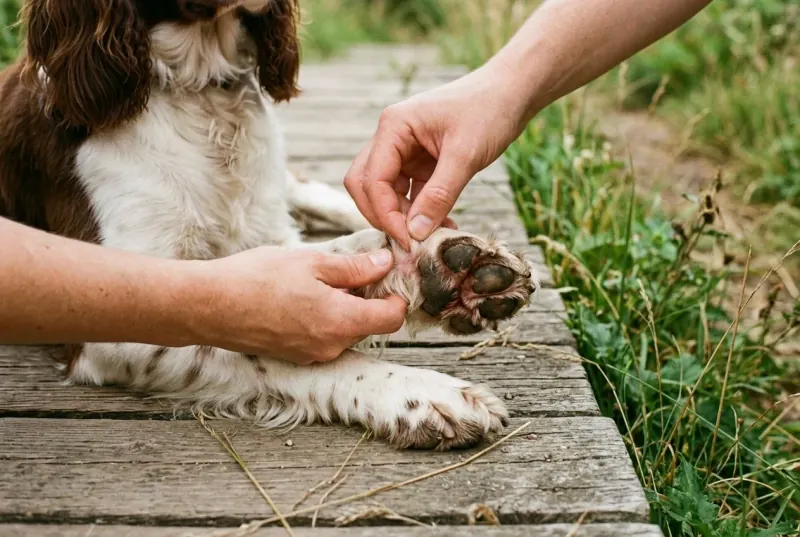
The feathering needs the most attention on a trail. The standard asks for feet “well-feathered between the toes,” and feathered feet and ears are exactly where grass seeds lodge; Springers turned up more often than their numbers would predict in a veterinary case series of grass awns, as our guide to why dogs lick their paws explains. The standard itself says it is “legitimate to trim about the head, ears, neck and feet,” and the AKC recommends exactly that alongside weekly brushing. A tidy foot is a practical choice for a hiking Springer, not a cosmetic one. Check between the toes and inside the ear flaps after every walk through long grass.
One more trail hazard is the tail. The current standard, approved in 2023, gives docked and undocked tails “equal consideration,” and an undocked tail swinging through thorny cover takes knocks. In UK primary-care records, Springers had 2.46 times the odds of a tail injury of crossbred dogs. Injuries are uncommon overall, but a Springer that suddenly guards its tail after a day in brambles deserves a look.
The elbow, not the hip
Hips get the attention on every breed page, and the parent club requires hip X-rays in breeding stock. But the research on Springers keeps returning to the front leg.
- Adult elbow disease. In UK primary-care records covering 455,069 dogs, Springers had twice the odds of elbow joint disease of crossbred dogs — one of only five breeds with a significant excess, alongside the Rottweiler, Labrador, German Shepherd and Golden Retriever. The authors suggested the Springer’s excess may come from a condition spaniels are known for.
- The hidden fissure. That condition is a crack in the humeral condyle, the knuckle of bone at the bottom of the upper arm that forms the elbow, where the two halves fail to fuse completely. When a UK team CT-scanned 50 Springers with no history of lameness, 7 of them (14%) had one. Half the dogs also had abnormalities of the medial coronoid process, another part of the elbow.
- Puppy fractures. In three UK referral hospitals, Springers made up 15% of 115 puppies under a year old treated for a fractured humeral condyle — 5.66 times the odds of mixed-breed dogs. The median age at fracture was 4 months.
Why does a 4-month-old puppy break an elbow? That study did not report causes, but older work on spaniels found condylar fractures “of unknown cause or occurring with normal activity” — which is precisely what led surgeons to look for, and find, a weakness in the bone. The practical lesson is not to wrap a puppy in cotton wool, which our guide to how much exercise a puppy needs argues against anyway. It is to take sudden front-leg lameness seriously. A Springer puppy that will not put weight on a front leg after a tumble needs a vet the same day, and an adult whose front-leg lameness comes and goes with exercise deserves an elbow work-up from a vet who knows the breed. The research studies used CT scanning, and it is reasonable to ask whether referral for it makes sense.
There is good news at the end of that work-up. A fissure that is causing lameness can be treated: in a 2025 study of 39 spaniels fitted with a screw across the condyle, the long-term outcome ranged from acceptable to full function in all of them, though 30% had a major complication, mostly infection.
When a Springer stops on the trail
Every dog can overheat. Springers carry two further, rarer explanations for a dog that suddenly flags on a hard day, and an owner who knows about them can give a vet a head start.
Phosphofructokinase (PFK) deficiency. PFK is an enzyme that red blood cells and muscle need to turn sugar into energy. Springers that inherit two faulty copies of the gene have red cells that break down under stress. In the 1987 description of seven affected Springers, the episodes were “commonly … related to exercise or other stressful situations that caused panting or barking,” with discoloured, dark urine, weakness, lethargy and loss of appetite, and sometimes fever. A Danish family reported in 2001 showed the same discoloured urine after a day’s hunting. Two details make it worth knowing about:
- The trigger is the hiker’s day out. In the original research, the red-cell breakdown was set off by heavy breathing itself — hard exercise, excitement, a dog barking its head off at the trailhead.
- It can be mistaken for something else. The 2001 authors warned that its signs “may be confused with those of recurrent immune-mediated haemolytic anaemia,” a far more serious autoimmune disease.
The parent club says careful breeding has “largely eliminated” PFK deficiency, and it lists the test as optional but recommended rather than required. Carriers, with one copy, are healthy. A DNA test settles the question, so ask a breeder for the parents’ results — or test your own dog if you plan to hike it hard.
Exercise-induced hyperthermia. In 2017, Australian vets described four related young male Springers, aged 23 to 32 months, that began breathing fast and overheating and then weakened or collapsed “soon after a period of mild-to-moderate exercise.” One died. In the dog that had extra genetic testing, the gene behind exercise-induced collapse in Labradors and a gene variant linked to malignant hyperthermia both came back normal. This is a four-dog case series, not a measure of risk, and there is no test for it. It belongs here because it shows a Springer that collapses after modest exercise is not automatically just “too hot.”
What to do on the trail. Stop, get the dog into shade, cool it using the method in our heat guide, and get to a vet. The 2026 first-aid guidelines give a temperature at which to stop cooling, which is why a thermometer belongs in the trail first-aid kit. Note the colour of the dog’s urine and tell the vet the breed and, if you know it, the dog’s PFK status. That one sentence can steer the first blood test.
Health: the tests worth asking for, and what the results mean
The parent club calls the Springer “a generally healthy breed” with “a relatively low incident of serious disease,” and the lifespan data back that up. What follows is what a careful buyer asks about.
The breeder’s checklist
The parent club’s 2024 health statement sets the minimum screening for breeding dogs:
- a DNA test for cord1 progressive retinal atrophy
- an eye examination by a board-certified veterinary ophthalmologist, ideally every year
- hip and elbow X-rays evaluated by the Orthopedic Foundation for Animals (OFA) at 24 months or older, with PennHIP accepted for hips
It lists five more tests as “optional but recommended”: fucosidosis, PFK deficiency, degenerative myelopathy, autoimmune thyroiditis and a cardiac evaluation. The club asks breeders to submit results to the OFA, whose database is public, so a breeder’s claims can be checked by the dogs’ names.
The same statement contains a sentence most breed pages leave out: “While a genetic test may be positive for a disease trait, the trait may not express itself clinically. Therefore, genetic tests should be considered indicators of risk.” The breed’s eye test is the clearest example of what that means.
cord1 PRA: the “affected” result that rarely means blind
Progressive retinal atrophy is a family of inherited diseases in which the retina degenerates. In Springers, the form tested for is cord1, caused by a variant in a gene called RPGRIP1 that a recent University of Pennsylvania study called “highly prevalent” in the breed. That study enrolled 494 Springers over four years, 123 of them genetically “affected,” with two copies of the variant. Among the 96 affected dogs whose owners reported on their vision, deficits were reported only in dogs 12 or older, and many affected dogs reached old age with normal sight. An earlier US study found clinical signs in only 4 of 6 affected dogs. A second gene, MAP9, appears to modify how severe the disease becomes.
This does not make the disease imaginary: specialist tests in the Penn study showed affected dogs’ cone function declining with age, and a minority developed complications such as cataracts, lens luxation and glaucoma. But it changes what an “affected” result means for a pet owner — a raised risk of late-onset vision loss, not a puppy that will go blind. It also corrects a common claim. PetMD’s breed page, citing the parent club, says onset “usually occurs between 2–6 years of age” and that the disease will eventually cause blindness; the club’s current health page gives no such range, and for the cord1 form Springers are tested for, the Penn data put owner-noticed vision loss years later than that.
The first sign, when there is one, is relevant to anyone who hikes at dusk. The disease typically starts with night vision, and owners in the Penn study reported hesitation in dim light as early as 5 years of age. A Springer that becomes reluctant on dark paths but is fine in daylight is worth an eye examination. The study’s authors still recommend DNA testing, but they advise breeders against abruptly eliminating every affected dog or carrier: the variant is so common that doing so would cost the breed too much genetic diversity.
Fucosidosis: a question about bloodlines
Fucosidosis is an inherited storage disease that damages the nervous system in adolescent and adult dogs. Its early signs are behavioural, and the first report in American-bred Springers warned that late onset “may result in misdiagnosis as a primary behavior problem.” The mutation was identified in British and Australian Springers, and a 1999 screening study found carriers among English-bred dogs but none among 60 American-bred ones. The test is on the parent club’s optional list. If a puppy has British lines in its pedigree, it is a reasonable question to ask.
Chronic hepatitis
In a 2012 study of UK pathology records, Springers had between 5.3 and 9.4 times the odds of chronic hepatitis, depending on which control population was used, with a median age at diagnosis of 5 years and three-quarters of cases in females. The signs are vague. In an earlier group of 68 Springers, every dog had raised liver enzymes and five had no outward signs at all, so a routine blood test can find the disease before the dog looks ill. In that group, almost none of the dogs received steroids, and median survival after diagnosis was only 189 days. In a 2020 study of 12 Springers treated with prednisolone, every dog that had signs improved at first, and most were still clinically well years later. It is worth asking your vet whether routine blood work makes sense for your Springer from early adulthood.
Mammary tumours and the spaying question
Female Springers stand out for mammary tumours. In a study of more than 80,000 insured female dogs in Sweden, where few bitches are spayed, Springers had the highest incidence of any breed: 319 per 10,000 dog-years, against 111 overall. A 2023 study of UK primary-care records also found Springers among the breeds with raised odds, and found neutering associated with lower odds.
The timing question pulls the other way. A UC Davis group that analysed hospital records for 212 Springers found no clear rise in joint disorders or cancers with neutering in either sex. But 13% of females spayed at 6–11 months had urinary incontinence, a figure the authors noted might reach significance in a larger sample, and the group’s breed-by-breed guidelines suggest waiting until at least 12 months for females and 6 months for males. That is one research group’s analysis of one hospital’s records, not a rule. Talk it through with your vet with both risks on the table.
Also on the parent club’s list
The parent club also flags immune-mediated haemolytic anaemia, retinal dysplasia, entropion and seizures, which it says usually begin before the age of five; the English Springer Foundation adds epilepsy, cancer, bloat and autoimmune disease to the concerns owners and breeders report. In a Norwegian study of 279 Springers, 25.5% had an abnormality of the eye’s drainage angle that was associated with glaucoma, which is one more reason for regular eye examinations.
Lifespan
The AKC gives 12 to 14 years, and here the measurement backs the range. A 2024 study of UK dogs put the Springer’s median survival at 13.5 years, from 6,221 recorded deaths, against 12.0 years for the crossbreds it was compared with. Other UK studies, using different methods, give lower figures for most breeds; our guide to how long dogs live explains why the studies disagree.
Temperament: the “Springer rage” question
The standard is clear about what a Springer should be: “friendly, eager to please, quick to learn and willing to obey,” and it calls aggression toward people or other dogs “not acceptable.” The phrase “Springer rage” gets attached to almost any Springer that falls short of that, which is not useful. The best data on the breed are less dramatic, and more useful to a buyer.
A 2005 national survey of 1,053 adult AKC-registered Springers found that 48.4% had growled at, or done worse to, their owners at some point, and 26.3% had bitten a person — most often someone familiar. Aggression was associated with being male, being neutered, coming from show or bench lines, being over four, and having one particular kennel’s popular sire in the pedigree. The authors’ advice was that buyers “might seek a female, hunting-type English Springer Spaniel from an experienced breeder,” while warning that behaviour cannot be fully predicted from any of these factors.
Two caveats keep that in proportion. The survey is from 2005, and it relies on owners’ own reports, so it shows associations rather than causes. The practical advice is the same as for any breed, with more weight on it: meet both parents if you can, ask the breeder directly about temperament problems in the pedigree, and start training and socialisation early. The AKC adds that “the owner should be sure to be in control at all times, because the Springer is an active and forward explorer of his environment.”
Is a Springer right for you?
A Springer suits you if:
- you hike, swim or work a dog most days, and can give it more than two hours of real activity, much of it with its nose
- you want a dog that stays close and comes back, and you will put in the recall training to make that reliable
- you are happy to brush weekly, trim feet and check ears and toes after every walk
- you will ask a breeder about the line, the parents’ OFA results, and the PFK status, and wait for the right answers
Think twice if:
- the dog will often be home alone all day
- most of your hiking happens in summer heat
- you want a low-maintenance coat
- you want the decision about elbows and eyes to be someone else’s problem
For a first-time owner, the Springer is one of the more forgiving high-energy breeds — it sits in the “good, with a condition attached” tier of our guide to adventure breeds for first-time owners. The condition is the one every source on this breed returns to, from the standard’s “keep going” to the AKC’s warning about long hours alone: this dog was made to work beside a person, and it is at its best when it gets to.
Frequently asked questions
Are English Springer Spaniels good hiking dogs?
Among the best, with two caveats. The breed standard describes a dog built 'to cover rough ground with agility and reasonable speed' that can 'go, and keep going, under difficult hunting conditions', and the AKC calls Springers great companions on long walks or hikes. The caveats are heat — in the largest UK study of heat-related illness, Springers had significantly higher odds than Labradors — and the elbow, where the breed carries a documented predisposition. Plan hard days for cool weather, and ask a breeder about elbows before you buy.
How much exercise does an English Springer Spaniel need?
A lot, and not all of it walking. The Royal Kennel Club in the UK recommends more than two hours a day; the AKC scores energy 4 out of 5 and mental stimulation needs 4, and suggests long walks, play and sports such as tracking, agility and rally. No study has measured the exact requirement. The practical test is behaviour: the AKC warns that undesirable behaviours can follow when a Springer is regularly left alone for long periods, and a dog that cannot settle in the evening has not done enough with its nose and its body that day.
What is the difference between field-bred and show-bred Springers?
Breeding goals, for more than eighty years. The breed's parent club dates the last dual champion — a dog that won in both the show ring and field trials — to the early 1940s; since then, field breeders have selected for hunting performance and show breeders for the written standard. Research has since found differences between the two lines in the frequency of the commonest eye-disease gene and in owner-directed aggression. Neither line is better. Ask which line a puppy comes from, and what its parents actually do.
What health tests should an English Springer Spaniel breeder do?
The parent club's 2024 health statement sets the minimum: a DNA test for cord1 progressive retinal atrophy, an eye examination by a board-certified veterinary ophthalmologist, and hip and elbow X-rays evaluated by the Orthopedic Foundation for Animals at 24 months or older. It lists five more tests as optional but recommended, including phosphofructokinase (PFK) deficiency and fucosidosis. For a dog that will hike hard, the PFK result is worth asking for specifically, because the disorder's crises are triggered by heavy exercise and panting.
Is 'Springer rage' real?
The phrase gets attached to almost any aggressive Springer, which is not useful. The best data come from a 2005 US survey of 1,053 adult Springers, in which 48.4% had growled at or threatened their owners and 26.3% had bitten someone at some point. Aggression was associated with being male, being neutered, show lines, age over four and one particular kennel's bloodline. The authors' advice to buyers was to consider a female from hunting lines and an experienced breeder — and to remember that behaviour can never be fully predicted from pedigree.
How long do English Springer Spaniels live?
The AKC gives 12 to 14 years, and the best measurement agrees. A 2024 study of UK dogs measured a median of 13.5 years across 6,221 recorded deaths — more than the 12.0 years of the crossbred dogs it was compared with. Working Springers last well too: in a UK survey of gundogs, Springers stopped working at a median age of 11.
Sources
Every figure in this piece traces to one of these. Dates are when we read the source — certified lists, prices and park rules all move.
- English Springer Spaniel — breed pageAmerican Kennel ClubHeight, weight, life expectancy and trait scores; the exercise, training and grooming guidance; the recommended health tests; recognition in 1910.Read 3 October 2026
- Official Standard of the English Springer Spaniel (approved 8 August 2023)American Kennel ClubThe endurance language, size, coat, feathering, colours, trimming, the docked-or-undocked tail and the temperament clause.Read 3 October 2026
- Spaniels Hunting TestsAmerican Kennel ClubThe flushing spaniel’s purpose, and the four learned abilities judges score: range, pattern, gun response and response to commands.Read 3 October 2026
- The History of English Springer SpanielsEnglish Springer Spaniel Field Trial AssociationCockers and Springers from the same litters, recognition dates, and the end of dual-type Springers by the early 1940s.Read 3 October 2026
- Health and GeneticsEnglish Springer Spaniel Field Trial AssociationThe parent club’s summary of inherited conditions, including its statements on PFK deficiency, ear infections, IMHA, seizures and eye disorders.Read 3 October 2026
- ESSFTA Health Statement (31 August 2024)English Springer Spaniel Field Trial AssociationThe minimum breeder screening (cord1 PRA DNA test, eye examination, hips and elbows), the optional tests, and the line that genetic tests should be considered indicators of risk.Read 3 October 2026
- Spaniel (English Springer)The Royal Kennel ClubThe UK exercise guidance of more than two hours a day, and the breed’s standing as the most popular working spaniel.Read 3 October 2026
- Breeds commonly affected by MDR1 mutationWashington State University, Program in Individualized MedicineChecked for spaniels; none is listed.Read 3 October 2026
- Heat-related illness in dogs under primary veterinary care in the UK: incidence and risk factorsHall EJ, et al. — Scientific Reports 10:9128 (2020)The English Springer Spaniel’s odds of heat-related illness against the Labrador Retriever, from the multivariable table.Read 3 October 2026
- Epidemiology and clinical management of elbow joint disease in dogs under primary veterinary care in the UKO’Neill DG, et al. — Canine Medicine and Genetics 7:1 (2020)The doubled odds of elbow joint disease in Springers, and the authors’ link to humeral intracondylar fissure.Read 3 October 2026
- Prevalence of incomplete ossification of the humeral condyle and other abnormalities of the elbow in English Springer SpanielsMoores AP, Agthe P, Schaafsma IA — Veterinary and Comparative Orthopaedics and Traumatology 25(3):211 (2012)CT scans of 50 Springers with no lameness: condylar fissures in 7 dogs, coronoid abnormalities in half.Read 3 October 2026
- Effect of breed as a risk factor for humeral condylar fracture in skeletally immature dogsSmith MAJ, et al. — Journal of Small Animal Practice 61(6):374 (2020)Springers as 15% of 115 puppies with condylar fractures, an odds ratio of 5.66, and a median age of 4 months.Read 3 October 2026
- Incomplete ossification of the humeral condyle in spanielsMarcellin-Little DJ, et al. — Veterinary Surgery 23(6):475 (1994)Spaniel condylar fractures of unknown cause or during normal activity, and the fissure found in the opposite elbow.Read 3 October 2026
- Long-term outcomes and complications of titanium transcondylar screw placement to address humeral intracondylar fissures in Spaniel breed dogsVenzo G, et al. — Journal of the American Veterinary Medical Association 263(10) (2025)Outcomes and complication rates in 39 spaniels treated with a transcondylar screw.Read 3 October 2026
- Hemolysis caused by phosphofructokinase deficiency in English springer spaniels: seven cases (1983-1986)Giger U, Harvey JW — Journal of the American Veterinary Medical Association 191(4):453 (1987)The clinical picture of PFK deficiency, its link to exercise, panting and barking, and recessive inheritance with healthy carriers.Read 3 October 2026
- Haemolytic anaemia and exercise intolerance due to phosphofructokinase deficiency in related springer spanielsSkibild E, et al. — Journal of Small Animal Practice 42(6):298 (2001)Discoloured urine after hunting, the DNA test, the risk of confusion with immune-mediated haemolytic anaemia, and the disorder in field and show lines.Read 3 October 2026
- Exercise-induced hyperthermia syndrome (canine stress syndrome) in four related male English springer spanielsThrift E, et al. — Veterinary Medicine: Research and Reports 8:59 (2017)Four related young males that collapsed after mild-to-moderate exercise, and the genetic tests that came back negative.Read 3 October 2026
- Delayed-onset cord1 progressive retinal atrophy in English Springer Spaniels genetically affected with the RPGRIP1 variantKwok JC, et al. — Veterinary Ophthalmology 29(1):e13290 (2026)The 494-dog study: owner-reported vision in genetically affected dogs, night vision as the first sign, the variant in field and bench lines, and the authors’ breeding advice.Read 3 October 2026
- Assessment of hereditary retinal degeneration in the English springer spaniel dog and disease relationship to an RPGRIP1 mutationNarfström K, et al. — Stem Cells International 2012:685901Only four of six homozygous Springers showed clinical signs.Read 3 October 2026
- Breed, age and gender distribution of dogs with chronic hepatitis in the United KingdomBexfield NH, et al. — The Veterinary Journal 193(1):124 (2012)The Springer’s odds of chronic hepatitis against two control populations, its median age at diagnosis and the female excess.Read 3 October 2026
- Chronic hepatitis in the English springer spaniel: clinical presentation, histological description and outcomeBexfield NH, et al. — Veterinary Record 169(16):415 (2011)Non-specific signs, raised liver enzymes, and a median survival of 189 days in a group where only one dog received corticosteroids.Read 3 October 2026
- Prednisolone therapy for chronic hepatitis in English springer spaniels: a prospective study of 12 casesBayton W, Watson PJ, Bexfield NH — Veterinary Record 186(18):e21 (2020)Clinical and biochemical improvement in Springers with chronic hepatitis treated with prednisolone.Read 3 October 2026
- Fucosidosis in a family of American-bred English Springer SpanielsSmith MO, et al. — Journal of the American Veterinary Medical Association 209(12):2088 (1996)Behavioural and neurological signs in young adults, and the risk of misdiagnosis as a behaviour problem.Read 3 October 2026
- Genomic screening for fucosidosis in English Springer SpanielsSkelly BJ, et al. — American Journal of Veterinary Research 60(6):726 (1999)Carriers found among English-bred dogs and none among 60 American-bred dogs.Read 3 October 2026
- Incidence of and survival after mammary tumors in a population of over 80,000 insured female dogs in Sweden from 1995 to 2002Egenvall A, et al. — Preventive Veterinary Medicine 69(1-2):109 (2005)The English Springer Spaniel’s mammary tumour incidence, the highest of any breed in the study.Read 3 October 2026
- Epidemiology of mammary tumours in bitches under veterinary care in the UK in 2016Varney D, et al. — Veterinary Record 193(5):e3054 (2023)Springers among the breeds with increased odds of mammary tumours, and neutering associated with reduced odds.Read 3 October 2026
- Assisting Decision-Making on Age of Neutering for 35 Breeds of Dogs: Associated Joint Disorders, Cancers, and Urinary IncontinenceHart BL, et al. — Frontiers in Veterinary Science 7:388 (2020)The 212-dog Springer sample: no clear rise in joint disorders or cancers with neutering, and urinary incontinence in females spayed before a year.Read 3 October 2026
- Assisting decision-making on age of neutering for German Short/Wirehaired Pointer, Mastiff, Newfoundland, Rhodesian Ridgeback, Siberian HuskyHart LA, et al. — Frontiers in Veterinary Science 11:1322276 (2024)The 40-breed guideline table: Springer males no earlier than 6 months, females no earlier than 12.Read 3 October 2026
- Pectinate ligament dysplasia and narrowing of the iridocorneal angle associated with glaucoma in the English Springer SpanielBjerkås E, Ekesten B, Farstad W — Veterinary Ophthalmology 5(1):49 (2002)Pectinate ligament dysplasia in 25.5% of 279 Norwegian Springers, and its association with glaucoma.Read 3 October 2026
- Frequency and predisposing factors for canine otitis externa in the UK – a primary veterinary care epidemiological viewO’Neill DG, et al. — Canine Medicine and Genetics 8:7 (2021)The Springer’s non-significant odds of otitis externa, the higher odds for pendulous ear carriage, and the authors’ low-harm ear-care advice.Read 3 October 2026
- Frequency and risk factors for tail injuries in UK dogs under primary veterinary carePegram C, et al. — Veterinary Record 198(5):e192 (2026)The Springer’s raised odds of tail injury against crossbred dogs.Read 3 October 2026
- National survey of owner-directed aggression in English Springer SpanielsReisner IR, Houpt KA, Shofer FS — Journal of the American Veterinary Medical Association 227(10):1594 (2005)The 1,053-dog survey, its growling and bite figures, the associated factors including show lines, and the authors’ advice to buyers.Read 3 October 2026
- Longevity of companion dog breeds: those at risk from early deathMcMillan KM, et al. — Scientific Reports 14:531 (2024), Supplementary Table S3The Springer’s median survival of 13.5 years across 6,221 recorded deaths, and its hazard ratio against crossbred dogs.Read 3 October 2026
- Survey investigating the reasons why UK-based gundogs ceased working between 2010 and 2019Houlton JEF — Veterinary Record 190(3):e1080 (2022)The median age at which working Springers stopped work, and lameness as the leading reason for retirement.Read 3 October 2026
Comments
Got a question, a tip, or a correction? Leave a comment — no account, no sign-in. Just your name and your thoughts.
Loading comments…