Read enough “best camping dogs” articles and you notice they’re all the same article as “best hiking dogs,” with the word swapped. The same shortlist of high-drive sporting and herding breeds, ranked by how many miles they can cover.
Which would make sense if camping were a distance event. It isn’t. Camping is mostly sitting still — in a strange place, tethered to a six-foot radius, while people you’ve never met walk past your dinner, something rustles in the treeline, and the family two sites over runs a generator until nine.
The dog that thrives at a campsite isn’t the one with the biggest engine. It’s the one that can switch the engine off. That’s a different trait, it’s measured differently, and once you rank by it the list changes considerably.
What a campsite actually asks of a dog
Before breeds, it’s worth being precise about the requirements — because they come from rule-makers, not preference, and they’re strikingly consistent.
Federal regulation 36 CFR § 2.15, which governs pets in National Park Service areas, requires three things relevant here:
- Restrain the dog “on a leash which shall not exceed six feet in length.”
- No “leaving a pet unattended and tied to an object,” except in designated areas.
- No “allowing a pet to make noise that is unreasonable considering location, time of day or night, impact on park users.”
KOA, the largest private campground network in North America, arrives independently at the same three: a six-foot leash whenever the dog is outside your vehicle or unit, dogs “should not be left tethered and unattended,” and if your dog is too vocal, “you’ll need to find other accommodations.”
A federal regulator and a commercial operator, with nothing in common but the problem, landing on the identical list. That list is the job description:
- Stay within six feet, calmly, for extended periods.
- Never be left alone tied up — meaning either the dog is with you or the dog is contained.
- Be quiet, including overnight.
Notice that stamina appears nowhere.
The trait that actually decides it
There’s a useful piece of evidence here that camping articles never cite. A study of 13,700 Finnish pet dogs, published in Scientific Reports in 2020, measured seven anxiety-like traits and found that noise sensitivity was the most common of all, at 32% prevalence. Roughly one dog in three.
Now consider what a campsite is made of. Tent fabric snapping in wind. Unfamiliar dogs. Car doors. Wildlife moving after dark. Generators. Children. Fireworks, if your timing is unlucky. A campsite is a noise delivery system, and the single most common anxiety-related trait in dogs is sensitivity to noise.
The same study found breed differences are real and can be large — an eighteen-fold difference between the most and least fearful breed toward unfamiliar people. So breed is telling you something. It’s just telling you something about fear and noise, not about mileage.
The honesty valve
Here’s the part that should temper every list on the internet, including this one.
The largest study of dog behaviour genetics yet conducted — 18,385 dogs surveyed, 2,155 genotyped, published in Science in 2022 — found that breed explains only about 9% of behavioural variation between individual dogs. Most behavioural traits are heritable, but they vary enormously within every breed.
The most breed-predictable trait was biddability: how readily a dog responds to human direction. That one genuinely tracks with breed, and it’s useful to us, because a biddable dog is easier to teach to settle.
But the trait the study found breed predicted worst was agonistic threshold — how easily a dog is provoked by frightening, uncomfortable or annoying stimuli. Which is very close to a description of what a campsite tests. The authors’ own conclusion is that breed is a poor predictor of individual behaviour and shouldn’t drive pet selection.
So read what follows as starting probabilities, not promises. The individual dog in front of you outvotes the breed name every time.
The breeds that start closest to it
Labrador Retriever — the reasonable default
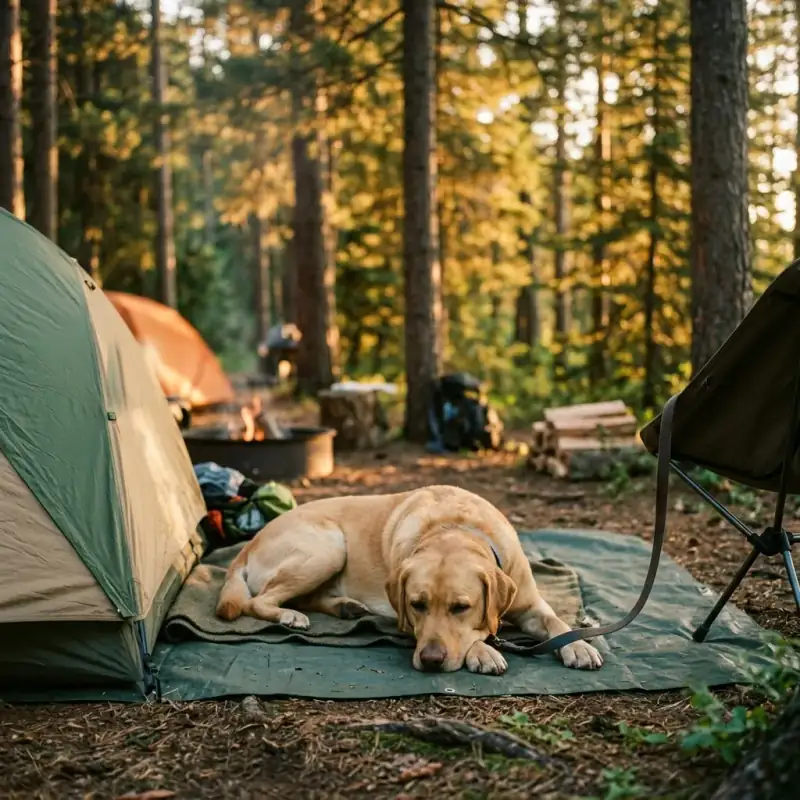
The Lab earns its reputation here on the right axis. High biddability, a genuine off switch indoors, and a tolerance for commotion that makes a busy campground unremarkable rather than threatening. They’re also socially uncomplicated with strangers, which matters when your neighbours are eighteen feet away.
The caution isn’t temperament, it’s appetite. Labs will investigate and eat things at a campsite that other dogs walk past — food waste, foil, cooked bones from the previous occupants’ fire ring. Rubbish discipline is a Labrador-specific chore. Our Labrador guide covers the genetics behind that appetite, which is real and not a training failure.
Golden Retriever — with one honest caveat
Everything good about the Lab, plus a sensitivity to their people that makes them settle beautifully next to a camp chair.
The caveat is heat, and it’s better documented than most owners realise. A study of 905,543 UK dogs found Golden Retrievers carry 2.65 times the odds of heat-related illness compared with Labradors — one of those results that contradicts the breed’s outdoorsy image. Summer camping in a hot climate deserves more caution with a Golden than the marketing suggests. The full picture is in our Golden guide.
Bernese Mountain Dog — built for it, and the AKC says so
The AKC explicitly lists backpacking and camping among the Bernese’s suitable activities, along with carting, and describes their exercise needs as “at least a half-hour of moderate exercise.” That combination — genuinely enjoys the outdoors, genuinely content to lie down afterwards — is close to the ideal camping profile. Our full Bernese Mountain Dog guide covers the trade-off that comes with it: measured median lifespan of around eight years, and the reason is cancer rather than size alone.
Two honest limits. Their lifespan is short for a dog, at 7–10 years, and a heavy double-coated mountain breed is working hard in summer heat. This is a cold-weather camping dog, and an excellent one.
Great Pyrenees — the perfect temperament, the wrong job
Worth including precisely because they look like the answer and often aren’t.
The AKC describes the Pyr as “not a highly active breed” that conserves energy — which sounds exactly like what we said to want. Calm, unbothered, happy to lie down for hours.
But they were bred to guard livestock overnight: patrol a perimeter, announce anything that approaches, and take the job seriously without being asked. On a farm that’s the whole point. On a campground where sites are twenty feet apart and quiet hours start at ten, a dog whose instinct is to vocally challenge every unfamiliar sound after dark is a genuine problem — and one you cannot train away in a weekend, because it isn’t disobedience.
If you have a Pyr and you camp, plan around it. Don’t expect the trait to switch off in an unfamiliar place; unfamiliar places are exactly what it’s for.
Rhodesian Ridgeback — quiet, self-contained, adaptable
An underrated camping dog. The AKC describes their exercise needs as moderate and notes they adapt to a variety of living situations. They’re typically reserved rather than reactive with strangers, and quiet by disposition — a meaningful advantage under a rule that specifically names unreasonable noise.
The trade-off is that a Ridgeback’s recall and prey drive deserve respect in wildlife country. This is a dog for a leash and a long line, not for optimism.
The breeds that need a job before they can rest
These are the dogs most camping lists rank highest, and they can be wonderful campers — after their needs are met, not instead of.
Border Collies, Australian Shepherds and Australian Cattle Dogs are brilliant and hyper-vigilant. The same processing power that makes them trainable makes a campsite a firehose of things to monitor. Camp with one successfully and it’s because you did real physical and mental work first, every day, and gave them somewhere defined to be afterwards. Camp with one on the assumption that fresh air is enough and you get a dog patrolling the site all night.
German Shorthaired Pointers and Vizslas present the opposite problem: they attach so hard to their people that being left — even briefly, even contained — is genuinely distressing. Both breeds carry well-documented separation anxiety tendencies. Given that campgrounds prohibit leaving a dog tied and unattended anyway, that’s less of a conflict than it sounds, but it does mean these are dogs that come with you rather than wait at the site.
Belgian Malinois — if you have one, you already know whether your dog can camp, and you didn’t need a list to tell you.
The breeds with a specific campsite problem
Siberian Huskies and Alaskan Malamutes. Superb outdoor dogs with one disqualifying campsite trait: they roam. The AKC’s guidance on the Husky is unusually direct — it’s “vital to keep the dog on a leash, in harness, or in a fenced yard at all times.” The AKC says much the same about Samoyeds, noting that a loose one “might travel for miles.” A campsite is an open environment with no fence, and the six-foot rule is doing a lot of work. These dogs can absolutely camp; they just never get a moment off-leash while doing it.
Flat-faced breeds — Bulldogs, French Bulldogs, Pugs. The heat data is stark: in that same 905,543-dog study, Bulldogs showed nearly 14 times a Labrador’s odds of heat-related illness and French Bulldogs about 6.5 times, with brachycephalic dogs overall at 2.10 times. Summer camping without reliable shade and climate control is a bad bet for these dogs. Cool-season camping is a different conversation.
Very large dogs generally. The same study found dogs over 50 kg carried 3.42 times the odds of heat-related illness — the highest weight category. Size is its own risk factor in summer, independent of coat and face shape.
What matters more than breed
Given that breed only gets you 9% of the way, here’s where the rest comes from.
Practise the settle at home first. The skill is “lie on this mat and do nothing while life happens.” Build it in your kitchen, then a café, then a park, then a campsite. A dog who has never been asked to settle anywhere is being asked to learn the hardest version of the skill in the hardest possible environment.
Solve containment properly. You can’t tie the dog up and leave. So either the dog is genuinely with you at all times, or you have a crate they already love — which means introducing it weeks in advance at home, not on night one. Our crate sizing guide covers getting the dimensions right, and the common instinct to buy bigger is the wrong one.
Bring a long line, not a retractable. A long line gives a dog room to move around the site while staying under control, and unlike a retractable it doesn’t fail in the way retractables fail. Note that campground leash rules are about the restrained length — six feet is six feet, so the long line is for supervised open space rather than the site itself.
Do the noise work. Given a one-in-three prevalence of noise sensitivity, assume your dog might be in that third until proven otherwise. A first camping trip on a bank holiday weekend at a full site is an unkind experiment.
Start with one night, close to home. Our guide to introducing a dog to camping walks through the sequence, including the 3am problems nobody warns you about, and the camping checklist covers the fourteen things people forget.
The bottom line
Rank camping dogs by settling rather than stamina and the shortlist is: Labrador Retriever as the default, Golden Retriever with a genuine heat caveat, Bernese Mountain Dog for cool-weather camping, and Rhodesian Ridgeback if you want quiet and self-contained. The herding breeds can be excellent and will not do it for free. The northern breeds are wonderful company on a lead they never come off.
And then hold all of that loosely, because the research says breed is about 9% of the answer. The dog that camps well is the dog that has been taught to settle, whatever it says on the pedigree.
If your priority is the walking rather than the sitting, our adventure-breeds hub ranks by what actually limits dogs on trail — which is usually heat rather than stamina — and the runners’ guide does the same for pace. For camping when it’s genuinely cold, our cold-weather breed guide covers which dogs are built for it and where that stops being true.
Sources
- Morrill K. et al. — Ancestry-inclusive dog genomics challenges popular breed stereotypes, Science (2022) — 18,385 dogs; breed explains ~9% of behavioural variation
- Salonen M. et al. — Prevalence, comorbidity, and breed differences in canine anxiety in 13,700 Finnish pet dogs, Scientific Reports (2020) — noise sensitivity 32% prevalence
- Hall EJ, Carter AJ, O’Neill DG — Incidence and risk factors for heat-related illness (heatstroke) in UK dogs, Scientific Reports (2020) — 905,543 dogs; breed odds ratios
- 36 CFR § 2.15 — Pets (National Park Service regulation)
- KOA — Pet Policy
- American Kennel Club breed pages — exercise and temperament guidance for the breeds named above
Frequently asked questions
What makes a good camping dog?
The ability to settle — to do nothing, for hours, in an unfamiliar place with strangers walking past. That's a different trait from trail stamina, which is what most “best camping dog” lists actually measure. A campsite asks a dog to stay on a six-foot leash, never be left tied and unattended, and not bark at every noise. Endurance doesn't help with any of those three.
Are Labradors good camping dogs?
They're the reasonable default, yes. The combination that matters for camping is high biddability — responsiveness to human direction, the most breed-heritable trait in the 2022 Science breed-genetics study — with a temperament that switches off when nothing's happening. The caution isn't temperament but appetite and access: Labs will eat things at a campsite that other dogs walk past, so food and rubbish discipline matters more with them than with most breeds.
Which dogs bark the most at campsites?
Livestock guardian breeds like the Great Pyrenees are the classic case — bred to patrol a perimeter and announce anything that approaches, working overnight by design. That's excellent on a farm and difficult at 2am on a campground with sites twenty feet apart. Beyond breed, the bigger predictor is noise sensitivity, which a study of 13,700 Finnish dogs found in 32% of dogs — the single most common anxiety-related trait measured.
Can I leave my dog tied up at my campsite?
Not in a US National Park, and not at most private campgrounds either. Federal regulation 36 CFR 2.15 specifically prohibits “leaving a pet unattended and tied to an object” except in designated areas. KOA's pet policy independently says dogs “should not be left tethered and unattended.” Two entirely separate rule-makers, same rule — which tells you how the outcome tends to go.
Does breed actually predict how a dog will behave when camping?
Less than you'd think. The largest study of its kind — 18,385 dogs surveyed and 2,155 genotyped, published in Science in 2022 — found breed explains only about 9% of behavioural variation between individual dogs. Notably, “agonistic threshold” (how easily a dog is provoked by frightening or annoying stimuli, which is close to what a campsite tests) was among the traits breed predicted worst. Use breed as a starting probability, not a guarantee.
What is the leash rule for dogs at campgrounds?
Six feet is the standard, and it comes from two independent directions. Federal regulation for National Park Service areas requires you to “restrain on a leash which shall not exceed six feet in length.” KOA, the largest private campground network in North America, applies the same six-foot limit whenever the dog is outside your vehicle or unit. Retractable leashes at full extension do not satisfy this.
What are the best dogs for camping?
The honest answer reorders the usual list, because a campsite does not ask a dog to go — it asks them to stop, for hours, surrounded by strangers and noise. Peer-reviewed work found breed predicts agonistic threshold — how easily a dog is provoked by uncomfortable or annoying things — worst of all the traits studied, which is close to a description of what a campsite tests. So the best dogs for camping are the ones that settle rather than the ones with the most stamina, and the authors' own conclusion is that breed is a poor predictor for an individual dog. Meet the actual animal before you decide.
Comments
Got a question, a tip, or a correction? Leave a comment — no account, no sign-in. Just your name and your thoughts.
Loading comments…